MSE-3022 L1 Intro
Introduction to MSC 3,022: Pharmacology and Drug Development
Key Terminologies in Pharmacology
Pharmacokinetics (PK):
Definition: how the body affects a drug, including absorption, distribution, metabolism, and excretion (ADME).
Pharmacodynamics (PD):
Definition: how a drug affects the body, delving into interactions that induce biological effects.
5 reasons for medications
Treatment
prevention
alleviate symptoms
help deficiencies
disease modyfying agents (target immune system)
5 Pharmacodynamic actions
Action on receptors (agonist & antagonists)
Agonist - fully binds to receptor, turns it on. triggers response from cell
Partial agonist - slightly turns it on.
Antagonist - inhibits or prevents agonists binding to receptor.
Actions on enzymes
Speeds up reactions
Enzyme inhibitors drugs - effects specific enzyme pathway using paticular enzymes (e.g. NSAIDs block cyclo-oxygenase. Ibuprofen - COX 1 & 2, Celecoxib - COX 2)
Action on membrane ionic channels
Interfere with ion movement (charged atoms) across cell membranes (e.g. calcium channel blockers to lower heart rate if its too high, smooth muscle relaxes)
non-specific drug action (physiochemical)
not exactly receptor action
antacids (neutrilise stomach pH
Astringent (rectally to reduce haemorrhoids)
Osmotic laxatives (draw water into bowel from bloodstream)
Emollients (topical), moisturise skin by reducing water loss
Immune therapies (biologics)
New. Probably the future.
Develops monoclonal anitbodies by targeting cytokines and immune system cells
E.G. infliximab → TNF-a (tumor necrosis factor alpha protien secreted as in immune response) causes inflamation to fight infection. overproduction = chronic ongoing inflammation → crohns disease. Biologics bind to TNF-a.
Receptor pathway
Free agonist → receptor binding (changes structure) → signal transduction → secondary messenger → Signal amplification → Biological effect.
Can combine antibiotics with transport inhibitors to make sure the antibiotic stays in the bacteria
Types of receptors (goes in to more detail in other lecures?)
G-protein-coupled receptors (GPCR) (e.g. dopamine & serotonin receptors)
Channel-linked receptors (e.g. nicotinic acetylcholine recepor)
Kinase-linked receptors (e.g. insulin receptors)
DNA-linked receptors (e.g. steroid receptors)
Voltage-sensitive ion channels (e.g. Na+ channels blocked by anaestheticis such as lidocaine)
Enzymes (e.g. Cyclo-oxygenase inhibited by aspirin)
Transporter proteins (e.g. Serotonin reuptake transporter inhibited by fluoxetine).
Drug doses
High potency = lower dosage
Therapeutic window = window over which you can give different concentrations of a drug and they will be effective without causing toxicity (difference bwteen mid point of the drug effect curve and the adverse effect curve).
some drugs given orally over IV because toxic concentration can be hard to control
Pharmacokinetics Concepts Explained
ADME (Absorption, Distribution, Metabolism, Excretion):
Absorption: How drugs enter the bloodstream. (e.g. oral, IV, dermally)
Distribution: Volume of distribution which indicates how the drug spreads across different tissues. (important for different drugs that may prefer fats or water)
Metabolism: Transformation of the drug via enzymes (primarily CYP450 enzymes).
Excretion: Removal of drug metabolites, primarily through the kidneys.
ADME pathway example
medicine taken orally passes into GI system
Leaves GI via blood system, goes into liver via hepatic portal,
then the right side of the heart, then to lungs, back to left side of heart
Distrubuted across body
eventually metabolised by the liver, becoming more polar
Filtered by kidneys (not all drugs e.g. iron tablets not excreted by kidneys)
Excreted
absorption graphs
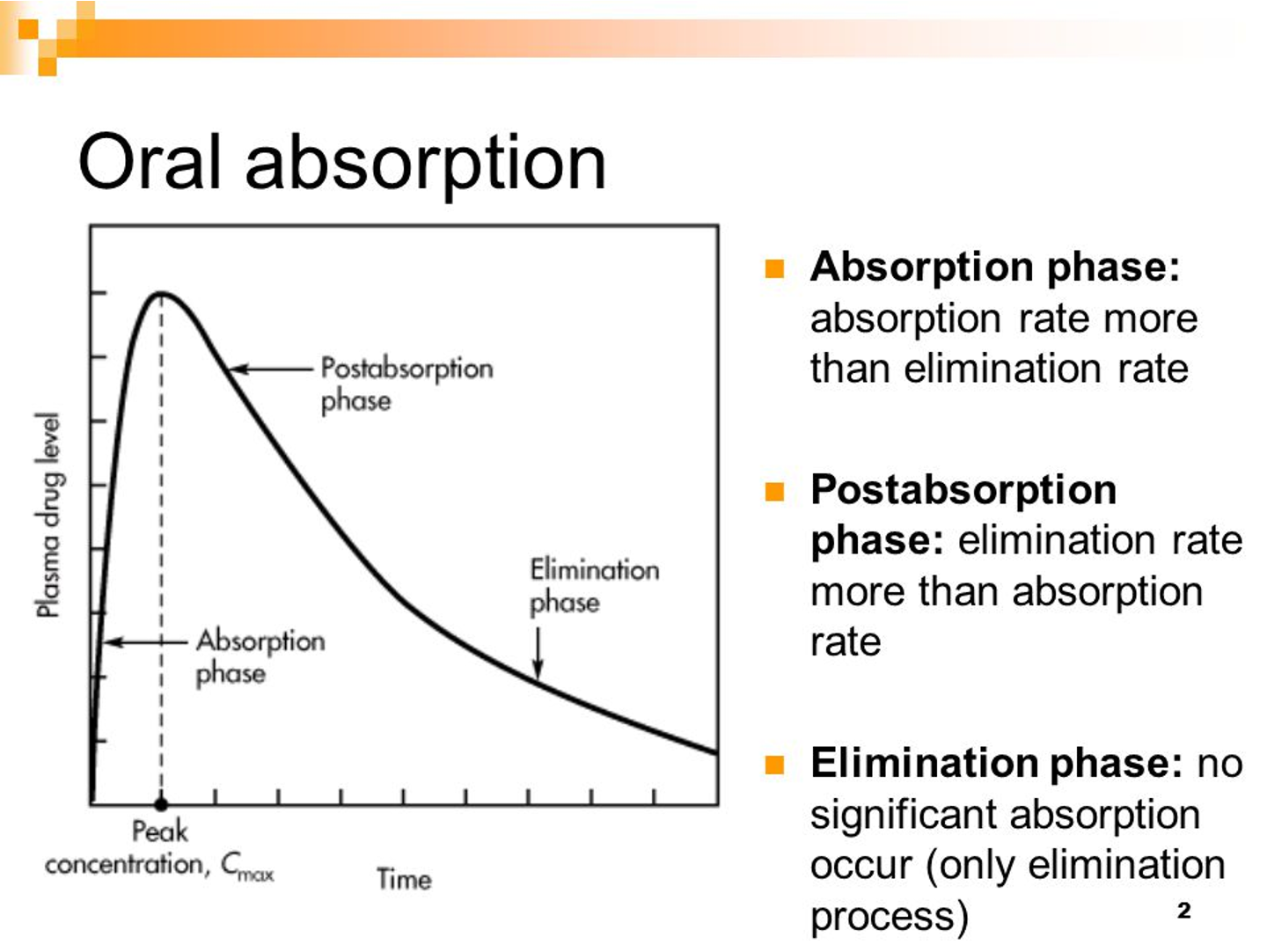
Tmax = time it takes to get to Cmax
Half life of the drug = amount of time it takes for the concentration of the drug to reduce by 50% in the body (starting fro Cmax)
AUC (area under curve) - total exposure to drug that the body recieves
Therapeutic range = between minimum toxic conc. (MTC) and minimum effective conc. (MEC)
We measure absorption via plasma conc.
Bioavailability
how much of the drug is ultimatly abosorbed/ used by the body
some drug lost during absorption process
Bioavailability of IV administered is assumed to be 100%
varies between patients
factors: time in GI tract, formulation of drug (modified release)
Drug distribution
extracellular fluid (fatty tissue)
intracellular fluid
CSF
foetus
synovial fluid
portion will always be bound to protiens (e.g. plasma). albumin is key binding protein
bound = no biological effect
binding depends on chemical properties and patient characteristics (e.g. elderly patients & liver disease = less albumin)
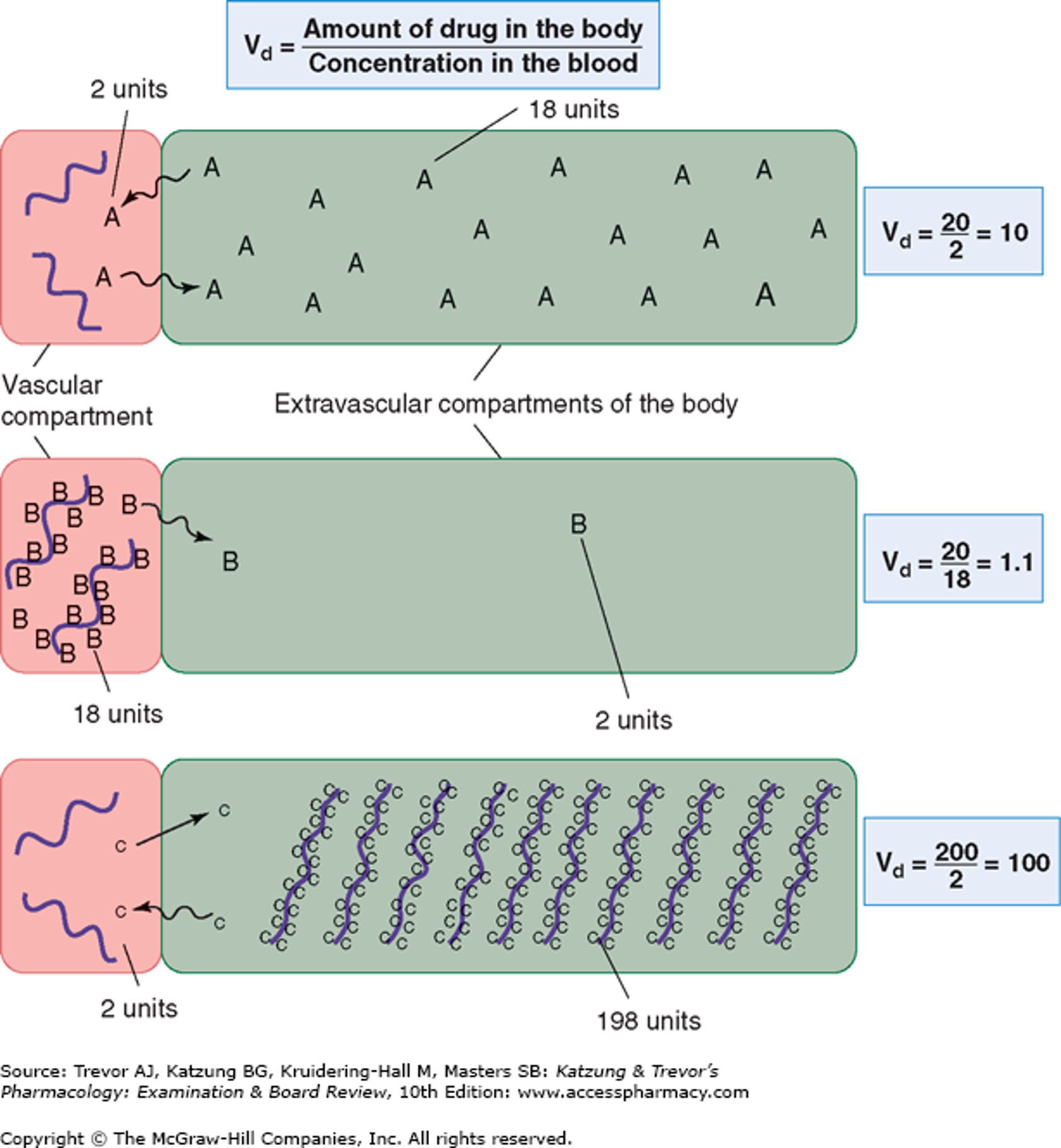
Volume of distribution
Total amount of drug in the body (dose given)/the conc. of drug in the plasma at a given time
higher Vd = more drug moved from plasma into tissues
useful to calculate doses required
Metabolism
drug is chemically altered in the body by liver
family of 300 cytochrome enzymes
made more hydrophilic as pass through liver (better watter affinity = easier for kidneys to filter)
drug converted to metabolite via many rounds in the liver, become less active
some drugs (e.g. aspirin, or codine → morphine) taken in inactive form, become active once metabolised (prodrug)
Metabolism phases
phase 1
oxidation, reduction, hydrolysis, hydroxylation
conversion into more polar inactive compounds
mostly by cytochrome P450 (varies in patients)
Phase 2
Conjugation
enzymes involed with coupling drugs with another molecule (e.g. UDP-GT) to make more water soluble, good for kidney excretion
system can become saturated (Vmax) (e.g. alcohol), so takes long time to metabolise (hangover) - goes from first order of kinetics to zero order (half life becomes inconsistant) - more easy to overdose. only able to metabolise about 10g alcohol/hour
Excretion
eliminated from body without further chemical change
Renal - glomerular filtration, proximal tubule (active secretion) & distal tubule (passive re-absorption)
clearance rates calculated using conc. of drug in plasma, conc. in urine and volume of urine being produced
Conclusion and Final Remarks
steady state - time taken to achieve steady blood of the drug, balance of absorption and elimination is reached (approx 5 half lives)