Fundamentals of Flight & Fixed Wing Operations
Fundamentals of Flight
Terminologies:
Involve the principles governing the behavior of aircraft in flight, including aerodynamics, propulsion, and weight distribution.
Airfoil: The cross-sectional shape of a wing, a propeller blade, or turbine blade.
Aerodynamics: The branch of physics that studies the behavior of air as it interacts with solid objects, particularly the forces acting on a body as it moves through the air.
Chord Line: A straight line connecting the leading and trailing edges of an airfoil.
Relative Wind: The airflow direction with respect to an airfoil.
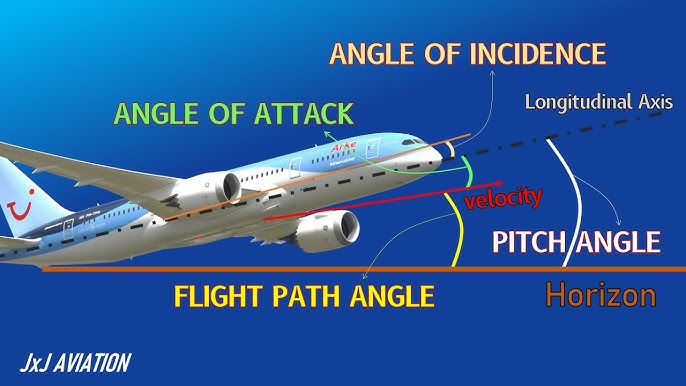
Angle of Attack (AoA): The angle between the relative wind and the chord line of the airfoil, crucial for lift generation.
Angle of Incidence (AoI): The fixed angle between the chord of the airfoil and the aircraft's longitudinal axis; cannot be changed by the pilot.
Bernoulli’s Principle: As air travels over an airfoil, faster airflow over the upper surface results in lower pressure, creating lift due to the pressure difference between the upper and lower surfaces of the wing.
Newton’s Laws of Motion: Describe the relationship between forces acting upon an object and the object's motion:
First Law: An object at rest stays at rest and an object in motion stays in motion unless acted upon by an external force (e.g., an airplane requires a push to start moving).
Second Law: F = MA; the acceleration of an object is directly proportional to the force and inversely proportional to the mass (e.g., increasing thrust increases acceleration).
Third Law: For every action, there is an equal and opposite reaction (e.g., the thrust produced by the engines pushes the airplane forward while the engines push air backwards).
Forces Acting on Aircraft
Thrust: The forward force produced by the aircraft's engines, responsible for propelling the aircraft through the air and overcoming drag.
Direction: In the direction of motion.
Source: Generated by the engine to propel the aircraft forward.
Lift: The upward force that counteracts gravity, allowing the aircraft to rise into the air and maintain altitude during flight.
Direction: Perpendicular to the direction of motion.
Source: Created due to pressure differences on the airfoil; faster airflow on top results in lower pressure than the slower airflow below the wing.
Weight: The downward force acting on an aircraft due to gravity, which must be balanced by lift for stable flight.
Direction: Downwards towards the center of the Earth.
Source: Caused by gravity acting on the mass of the aircraft.
Drag: The aerodynamic resistance experienced by an aircraft as it moves through air, opposing thrust and affecting overall performance.
Direction: Opposite to the direction of motion.
Source: Caused by friction and pressure differences as the aircraft moves through the air.
Basic Aircraft Controls
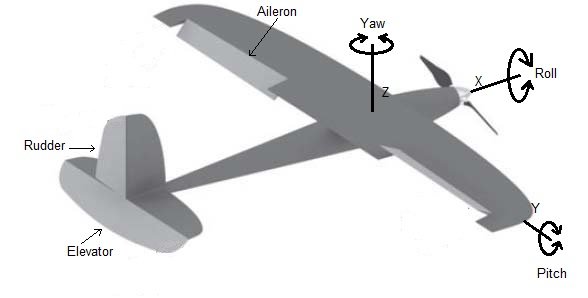
Roll: Rotation around the aircraft's longitudinal axis (controlled by ailerons).
Pitch: Rotation around the aircraft's lateral axis (controlled by elevators).
Throttle: Controls the power output of the engine and thus speed.
Yaw: Rotation around the vertical axis (controlled by the rudder).
Take-off, Flight, and Landing
Take-off/Landing Techniques: The three primary phases of fixed wing operations, each requiring specific adjustments to pitch, throttle, and yaw for optimal performance.
Hand launch
Runway take-off and landing
Catapult launch
Parachute recovery
Belly landing
Net recovery
Fixed Wing Drones Applications
Surveillance: Monitoring areas for security or environmental assessments.
Wildlife Protection: Keeping track of animal populations and poaching activities.
Agriculture: Aiding in crop monitoring, sprouting, and pesticide application.
Mapping: Creating detailed topographical maps for various uses (e.g., urban planning).
Mining: Surveying land and resources from the air to improve productivity.
Construction: Overseeing large construction projects for management efficiency.