Comprehensive Notes on Planetary Science: The Moon
Planetary Science: The Moon
Basic Facts About the Moon
The Moon is Earth's natural satellite.
Distance from Earth: Approximately km.
Diameter: Approximately km, which is about 1/4 of Earth's diameter.
The Moon lacks an atmosphere.
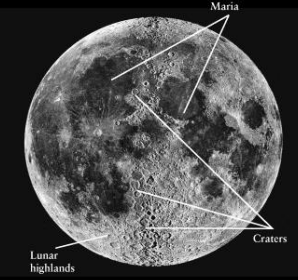
Its surface is characterized by craters and plains (maria).
Structure and Surface
Craters: Formed by impacts from meteoroids.
Lunar Rays: Filamentous, high-albedo deposits radiating from impact craters.
Maria: Basaltic plains on the Moon's surface.
Highlands: Light-colored, elevated regions.
Rilles: Ancient lava channels.
Regolith: A rolling layer of powdery soil mixed with scattered rocks, covering the lunar surface.
Moon Formation Theories
Most Accepted Theory
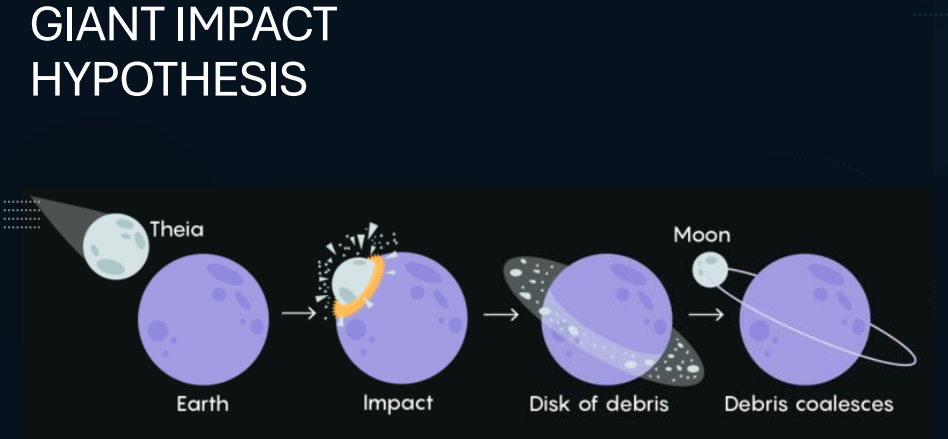
Giant Impact Hypothesis:
The Moon formed from a giant impact between the proto-Earth and another protoplanet, often called "Theia," about the size of Mars.
The impact ejected a mixture of molten rock and hot gas into space.
This debris potentially formed a disk of material known as a "lunar synestia."
Alternative Theories
Co-formation: The Earth and Moon formed simultaneously from the protoplanetary disk.
Fission Theory: The Moon broke away from the Earth.
Capture Theory: The Moon formed elsewhere in the solar system and was captured by Earth’s gravity.
Phases of the Moon
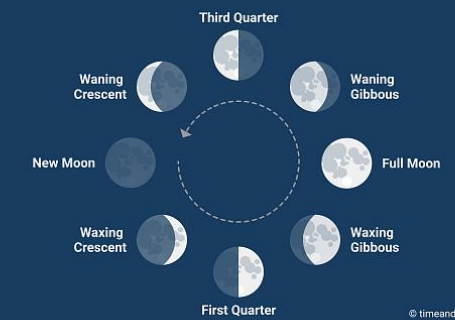
The Moon has eight phases in a lunar month consisting of four primary and four intermediate phases:
New Moon
Waxing Crescent
First Quarter
Waxing Gibbous
Full Moon
Waning Gibbous
Last Quarter
Waning Crescent
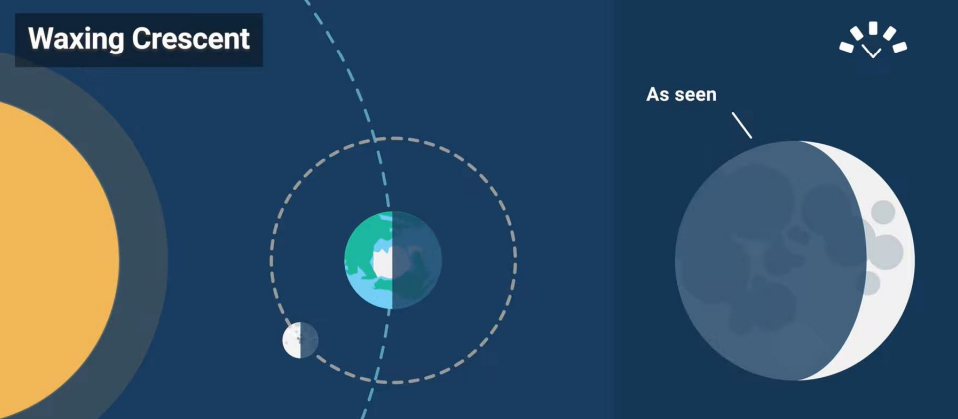
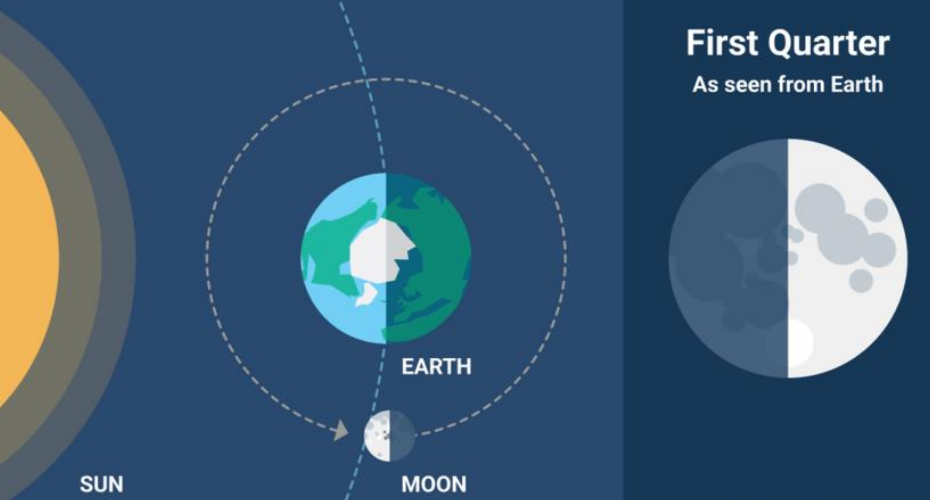
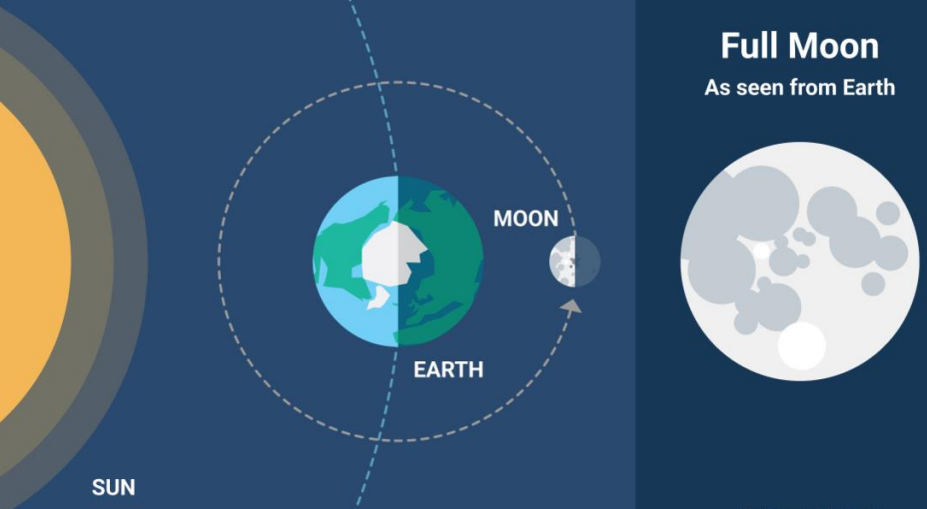
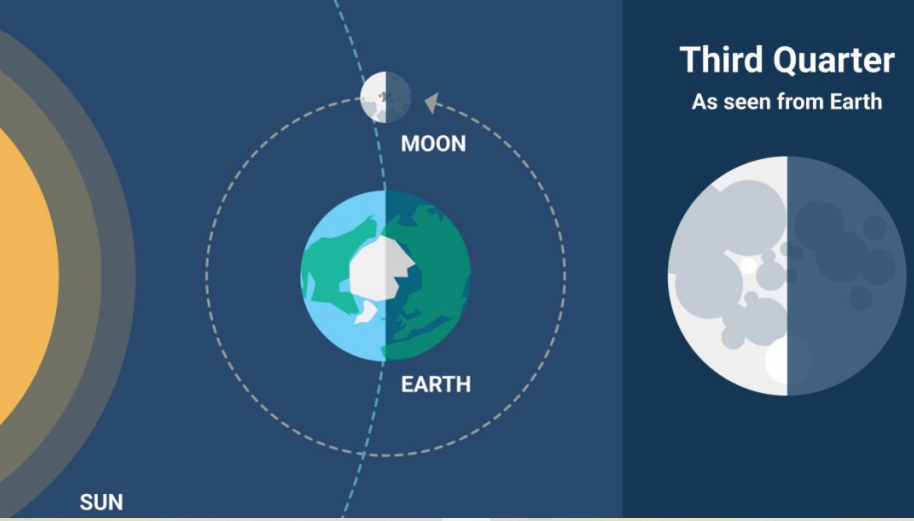
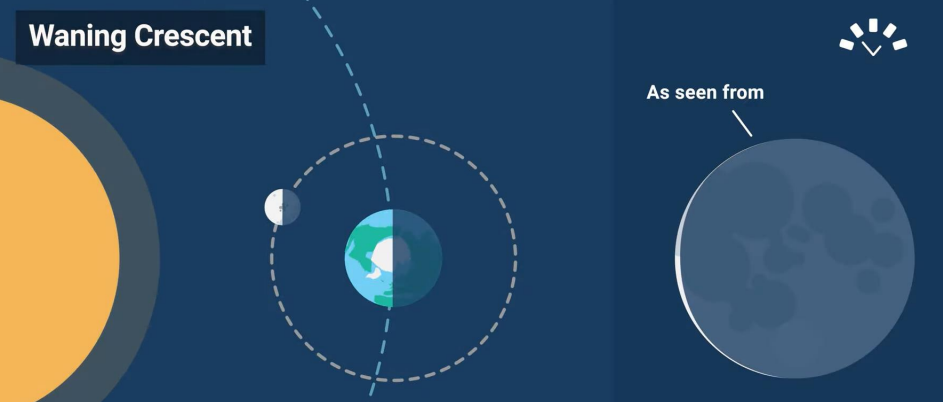
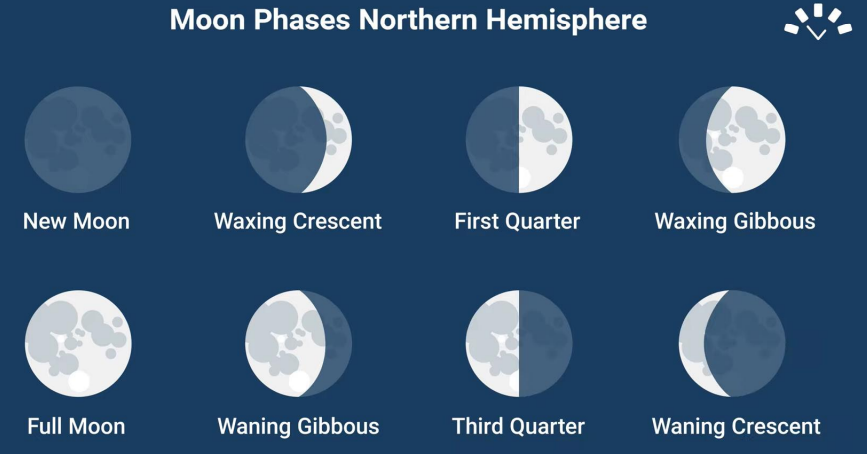
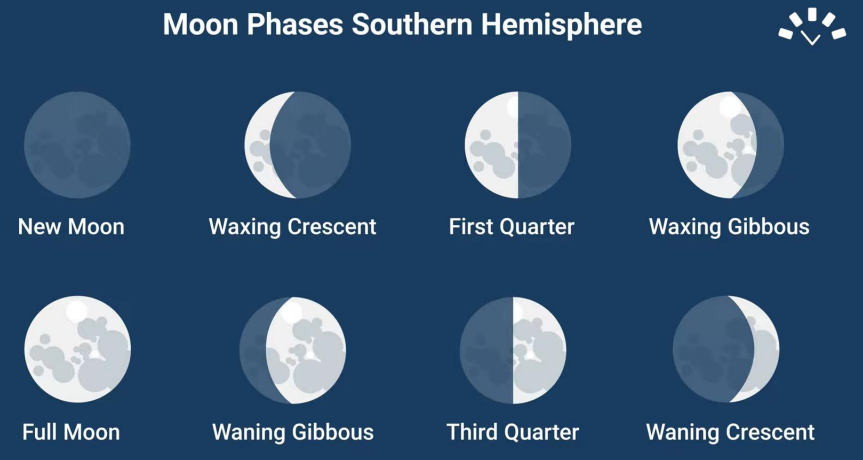
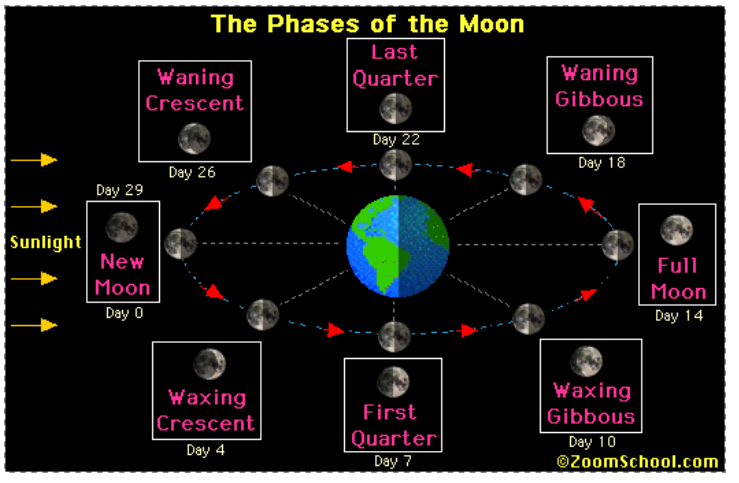
A lunar month, encompassing all eight phases, takes about 29.5 days.
The Moon's orbital period is 27.3 days.
Half of the Moon's surface is always illuminated by sunlight.
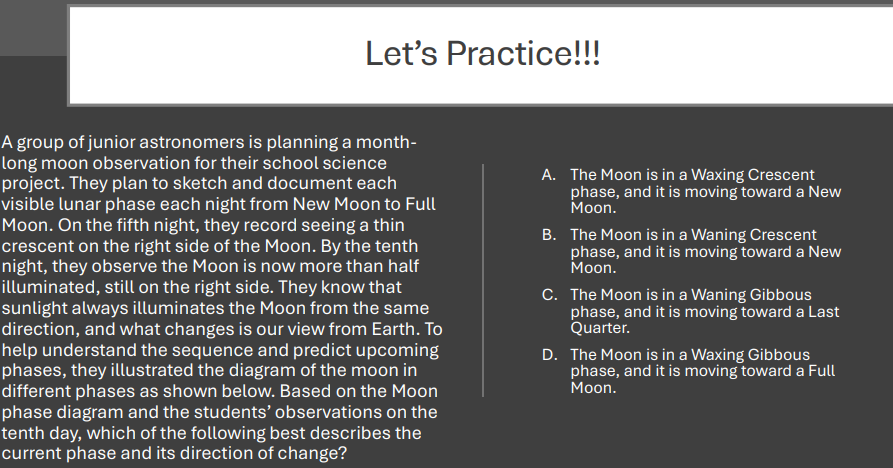
The phases we observe depend on the relative positions of the Earth, Moon, and Sun, which affects how much of the lit-up side we can see.
Eclipses
An eclipse is an astronomical event when one celestial body moves into the shadow of another.
Types of eclipses involving Earth and the Moon:
Solar Eclipse:
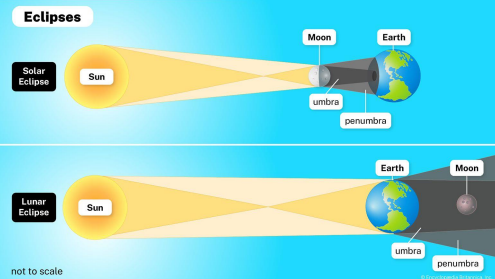
The Moon passes between the Earth and the Sun.
"Moon blocks Sun" (occurs during a New Moon).
Types: Total, Partial, Annular.
Lunar Eclipse:
The Earth passes between the Sun and the Moon.
"Earth blocks sunlight from Moon" (occurs during a Full Moon).
Types: Total, Partial, Penumbral.
Key Terms for Eclipses
Syzygy: The straight-line alignment of the Earth, Moon, and Sun, necessary for an eclipse.
Ecliptic: The plane of Earth's orbit around the Sun.
Node: The points where the Moon’s orbit intersects the ecliptic.
Umbra: The central, darkest part of the shadow, where a total eclipse occurs.
Penumbra: The outer part of the shadow, where a partial eclipse occurs.
Antumbra: The shadow beyond the umbra, where an annular eclipse occurs.
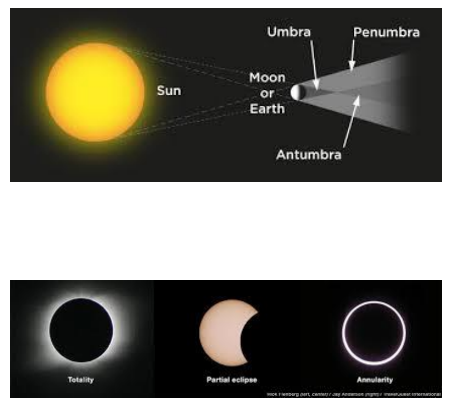
Alignment During Eclipses
Solar Eclipse: Sun → Moon → Earth
Lunar Eclipse: Sun → Earth → Moon
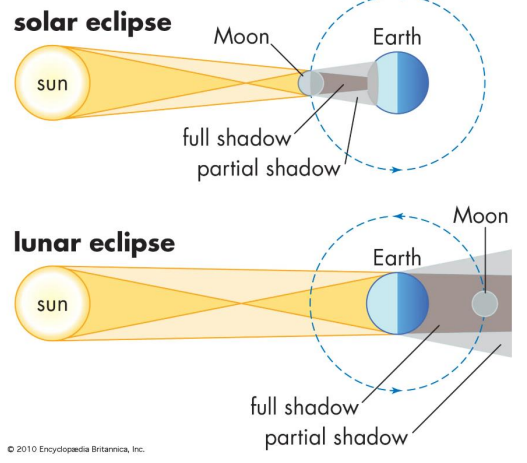
Solar Eclipse Details
A solar eclipse happens when the Moon blocks the Sun’s light, casting a shadow on part of the Earth.
It can only occur during a new moon phase.
Solar Eclipse Types
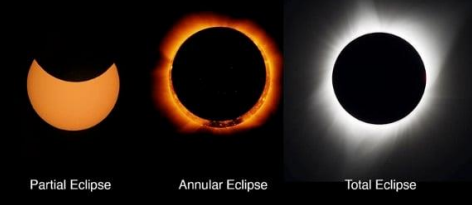
Total Solar Eclipse: The Moon completely covers the Sun as seen from Earth; the observer is in the umbra. This is rare and visible only in a narrow path.
Partial Solar Eclipse: Only part of the Sun is obscured by the Moon; the observer is in the penumbra. This is more common.
Annular Solar Eclipse: The Moon is directly in front of the Sun but appears smaller, leaving a visible ring (the Sun’s outer edge); the observer is in the antumbra. This occurs when the Moon is farther from Earth.
Lunar Eclipse Details
A lunar eclipse happens when the Earth comes between the Sun and the Moon, and Earth's shadow falls on the Moon.
This can only happen during a full moon.
Lunar Eclipse Types
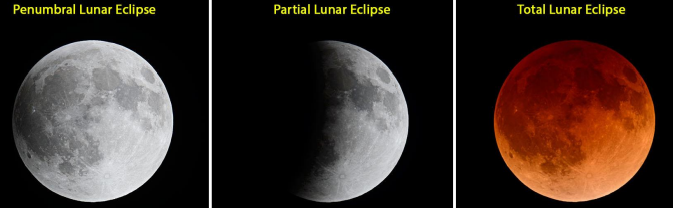
Total Lunar Eclipse: The entire Moon passes through the Earth’s umbra. The Moon may appear reddish due to Rayleigh scattering, and is also called a Blood Moon. It is visible over a large area of Earth.
Partial Lunar Eclipse: Only part of the Moon enters the umbra, making it easier to observe.
Penumbral Lunar Eclipse: The Moon passes through Earth's penumbra, resulting in a very subtle dimming that often goes unnoticed.
Why the Moon Appears Red During a Lunar Eclipse
During a total lunar eclipse, some sunlight still reaches the Moon after passing through Earth's atmosphere.
The atmosphere filters out blue light and bends red light into Earth's shadow, giving the Moon a red-orange appearance.
Tides
Tides are the regular rise and fall of ocean water levels, primarily caused by the gravitational interaction between the Earth and the Moon, and to a lesser extent, the Sun.
They occur in predictable patterns and affect coastal areas worldwide.
Cause of Tides
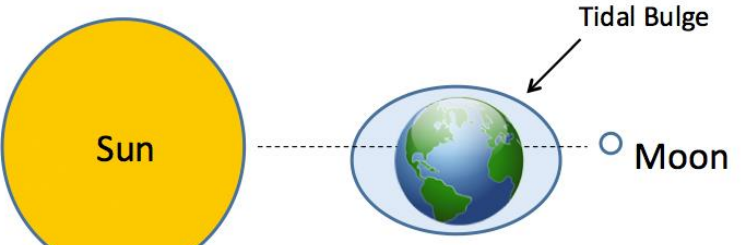
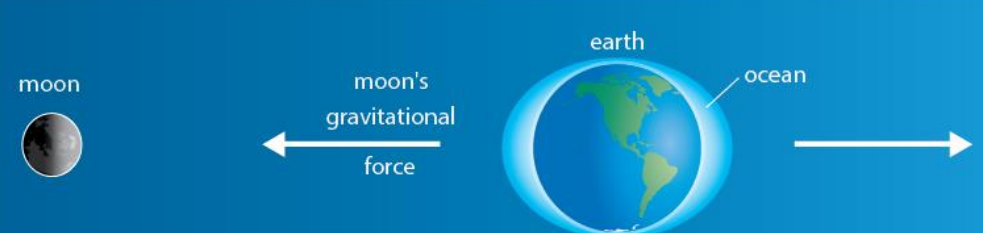
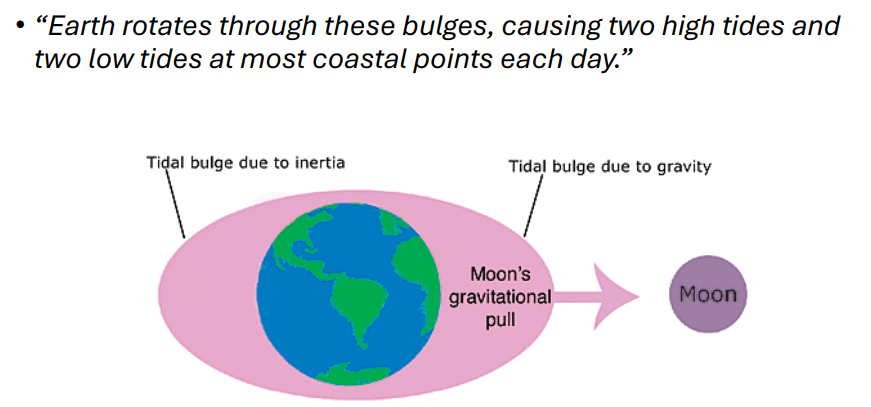
Gravitational Pull: The Moon pulls water towards the side of Earth nearest to it, creating a bulge or high tide.
On the opposite side of the Earth, another high tide forms due to inertia or the centrifugal force from Earth-Moon rotation.
Areas perpendicular to the Moon experience low tides.
The Earth rotates through these bulges, causing two high tides and two low tides at most coastal points each day.
Key Terms for Tides
High Tide: Water level is at its highest point.
Low Tide: Water level is at its lowest point.
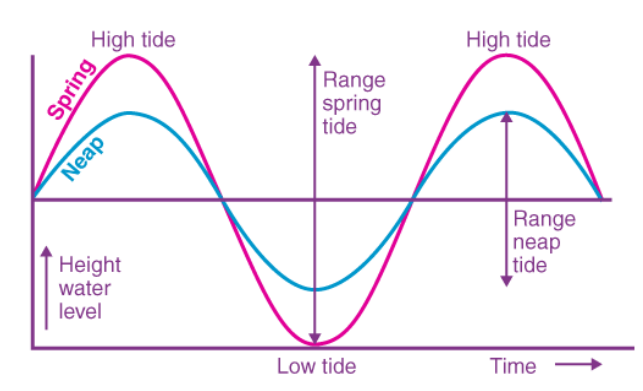
Tidal Range: The difference between high tide and low tide.
Spring Tide: Strongest tides due to aligned Sun and Moon.
Neap Tide: Weakest tides due to opposing Sun and Moon pull.
Syzygy: Alignment of Earth, Moon, and Sun (new/full moon).
Moon and Sun's Gravitational Force on Tides
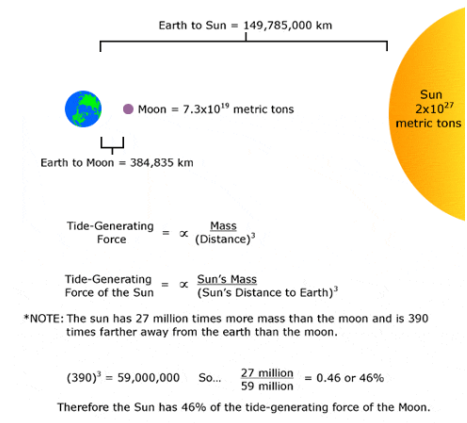
The Moon’s gravity is the dominant tidal force because it is closer to Earth than the Sun, despite being much smaller.
The sun's tide-generating force is about 46% that of the Moon.
The Moon’s orbit influences the timing and strength of tides.
Spring Tides
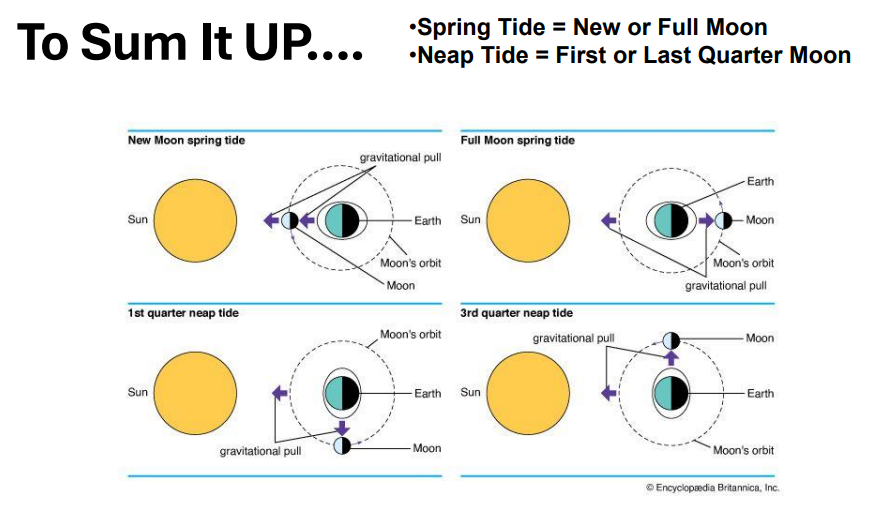
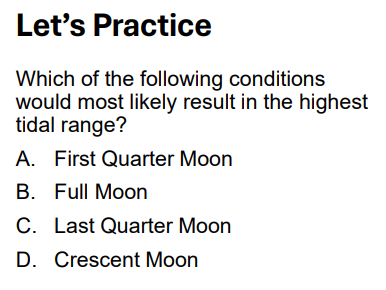
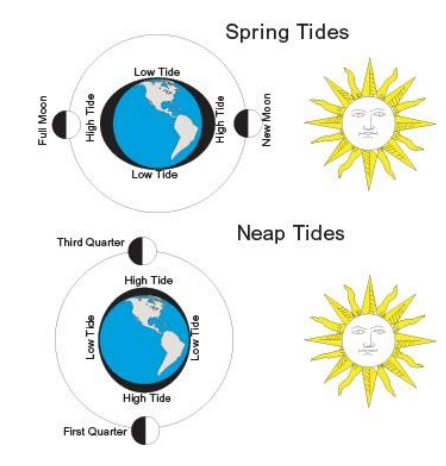
Occur during new moon and full moon phases.
The Sun, Moon, and Earth are aligned (syzygy).
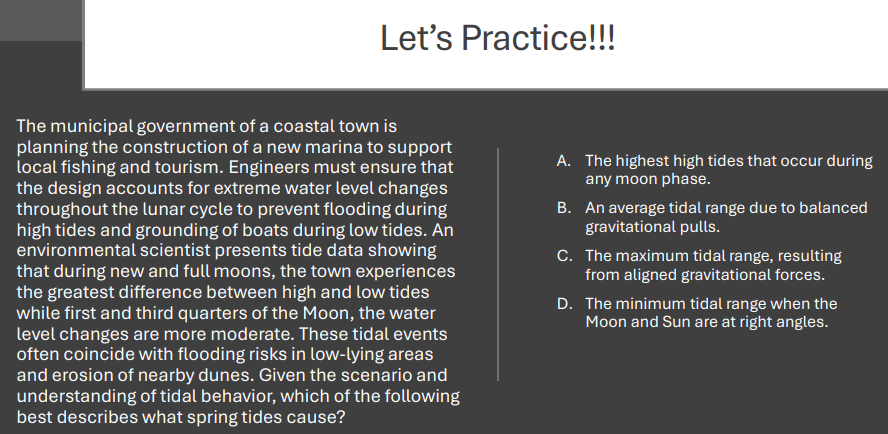
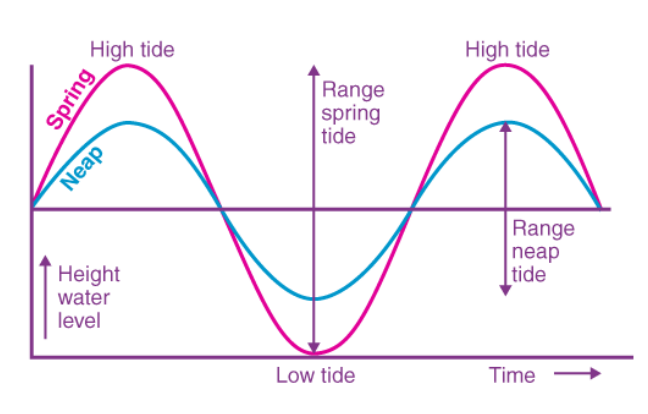
Gravitational forces of the Moon and Sun combine, causing higher high tides and lower low tides.
Result: Greatest tidal range (difference between high and low tide).
Neap Tides
Occur during first quarter and last quarter moon phases.
The Sun and Moon are at right angles to each other relative to Earth.
Gravitational forces partially cancel out, leading to lower high tides and higher low tides.
Result: Smallest tidal range.