cognitive processes exam 3
mon (7.1) CATCH UP
LO: understand how conceptual knowledge is organized into categories
conceptual knowledge - knowledge that enables us to recognize objects/events and make inferences about their properties
concepts - categories of objects, events, ideas
categories - all possible examples of a given concept
categorization - process of assigning something to a category
categories become pointers of knowledge, once you know something about an object or event, you can categorize the info
LO: know the 3 behavioral approaches to forming categories and their limitations
1) definitional approach - determine category membership based on whether item meets definition (contains the features) of the category
AKA featural approach
ex) you know dogs feature furry, four legs, barks, wags tail → so when presented picture of dog, you retrieve knowledge of said features and make sure all boxes are checked
problem:
1 - some categories do not readily lend themselves to feature analysis (definitions can apply to things outside the category)
2 - violation of defining features does not change the category
pollEV: according to definitional approach, members of a category must share _ definign features?
Answer: ALL
2) prototype approach - determine category membership by comparing item to prototype that resembles the category
contrasts definitional, if you had a checklist, you don’t have to check every box, only some
family resemblance: items in category resemble one another in variety of ways (ex. dogs in different costumes are different physically, but still dogs) *THIS IS A STRENGTH OF THIS APPROACH
prototype - typical member of a category that has most of the characteristic features
ex) prototypical bird is a drawing of a bird, but it matches the characteristics of the real thing
prototype of a bird is the set features (flies, sings, lays eggs, small, nests in trees)
highly typical bird - shares more features with prototype (ex. wren)
less typical bird - shares fewer features with prototype (ex. heron)
least typical bird - shares even fewer features with prototype (ex. penguin)
typicality - how closely a category member resembles category prototype
ex) sports
high typicality members:
are named first within the category and rated as being more representative
are rated as more representative of the category
have more overlapping characteristics of the category
sentence verification technique - read statement and judge whether it is true
high typicality members are:
verified more rapidly
are more affected by priming
pollEV: according to prototype approach, members of category share _ features with the typical member category member
ANSWER: SOME
3) exemplar approach - determine category membership by comparing the item to exemplars of the category
exemplar - previously encountered member of a category
exemplar is to having many of, prototype is to having a single average
exemplar is to having experienced before, prototype is to not having experienced before
thus, this approach bases categorization from the many exemplars, and does not use a single prototype
1) retrieve exemplars, 2) check object is similar to exemplar
categorization faster when items more similar to exemplars
problems 1 - unclear how many exemplars are compared or how similarity if computed
what do humans actually do?
combo prototype and exemplar
extent to which item fits in category affects perceived attractiveness
extent to which item fits into category affects stereotyping
LO: understand hierarchical organization of categories and how it is affected by knowledge
hierarchical organization - larger, more general categories
mon (8.1)
LO: define visual imagery and know its role in other cognitive functions
visual imagery - seeing absence of visual stimulus
ex) athletes do this to visualize future action
ex) count kitchen drawers
ex) letter B that becomes a heart “rotate counterclockwise, remove backing, etc”
can involve working and long term memory
ex) exceptional visual imagery in einstein and stephen wiltshire (has autism)
can be used for spatial navigation - to recall landmarks, imagine alternative route
ex) stuck in traffic and imagine different way to school
can plan plan future actions
ex) rearranging your room
can improve memory
by allowing us to access deeper levels of processing
can help with reasoning and problem solving
ex) riddles
ex) which glass to tilt more to rid of water
aphantasia - inability to voluntarily visualize visual images
pollEV: Visual imagery is a __________ process
A. top-down
B. nondeclarative
C. bottom-up
D. physical
E. None of the above
top down is stimulus driven
bottom up is experience driven
LO: Know similarities and differences between visual imagery and perception
imagery v. perception
visual imagery less vivid than perception
visual imagery is effortful and fragile // perception is automatic and stable
ex) bell tower - the imagined version gives you access to more details than perception of it just standing in front of you
the two can be confused
ex) person in lab presented w faint image on screen and asked questions about it - found people’s answers match proper orientation on projector
visual imagery can prime perception
ex) participant told to create mental image of a letter and then presented with that letter (priming), asked to tell if image was shown, did better when image shown matched image primed
spatial representation - different parts in image correspond to specific locations in space
applies to perception, maybe to imagery
mental scanning - we create mental images and then scan them in our mind
ex) imagine boat in mind’s eye, focus on anchor of boat, now focus on motor → found it took longer for participant’s to imagine things further from initial point of focus
mental rotation - takes longer to imagine totating image further away from original image
symbolic distance effect - we detect more details when we are closer to a stimulus
does this car have door handles? - harder to tell when object is further than when object is closer
elephant and rabbit (rabbit smaller) vs fly and rabbit (rabbit bigger) - does rabbit have whiskers? - detect more detail when we imagine a larger rabbit
propositional representation - different parts of image are represented by language or symbols
exclusive to visual imagery, not true of perception
imagery may use spatial and propositional representation
takes longer to imagine finding parts of image further away in space
takes longer to imagine finding parts of image further away in semantic network
ex) imagining map, is Reno or LA further west
visual imagery you imagine LA (LA in CA, CA west of Reno, oh it must be Reno)
actual map is Reno (the part of Nevada Reno is in is further west than LA)
pollev: Both imagery and perception use propositional representations
Response recorded
True
False
LO: Explain ways that visual imagery can improve memory
capacious - something roomy and able to hold a lot
ex) cap spacious
visual imagery - memory better if you form pictures in mind
pegword techinique - you “hang” to-be remembered words tp “pegs” of concrete nouns that you use to create iages
easier when peg words are concrete not abstract (ex. truck not truth)
ex) remember grocery list by imagining a bun with a banana sticking out, shoe full of eggs, tree with milk carton
method of loci - visualize to be remembered items in different locations in a well known mental route
ex) remember grocery list by imagining banana door handle, eggs in entry way (specific locations)
LANGUAGE
LO: define language and know its key features
language - system of communication using sounds or symbols that enable us to express feelings, thoughts, ideas, and experiences
allows us to communicate
involves sequences of signals
creates images (Williams - Red Wheelbarrow)
language is meaningful
language is hierarchical
language follows rules
language is universal
Noam Chomsky
believes children don’t just learn language through imitation and reinforcement, but its inborn ability to master
his support - you can make sentences never said before/there are multiple ways to craft the same meaning
LO: identify structures of language
rules based nature - components can arrange in some ways but not others
semantics - meaning of word, sentence, passage
ex) understanding “alto” means stop despite the literal word being a learned understanding of blobs to form sounds with meanings
syntax - rules determining how words combine into sentence
You know it’s “red is my favorite color” not “color is my favorite red”
language (forming sentences) = semantics (word meaning) + syntax (rules for combining words)
hierarchial nature of language - consists of small components that can combine to make larger units
phonemes - smallest unit of SPEECH
morphemes - smallest meaningful unit of LANGUAGE
words - comprise of 1+ morphemes
sentences - meaningful collection of words
4 aspects of language
acquisition - how we learn language
production - how we produce language
comprehension - how we understand language
representation - how language is represented in the mind
wed (8.2)
LO: understand how word comprehension is affected by word frequency and context
word comprehension
lexical semantics - meaning of words
lexicon - all words we know
semantics - meaning of words, sentences, passages
we comprehend words by finding their meaning in our mental dictionary
ex) let’s take selfie - we know what selfie means to know the prompt is to take a pic
we coMprehend words by choosing the definition that makes sense
ex) going on a date is a romantic hangout with someone, not sitting on the fruit (date)
word frequency - how often words occur
lexical decision task - view stimuli and indicate whether word or nonword
high frequency words: busy, mulvow, history
low frequency words: chard, boovle, waltz
word frequency effect - we respond FASTER to words occurring more frequently
word context
word pronunciation - how we say words is affected by speech speed, accents, slurring
ex) amana, juwana, dijoo
speech segmentation - perceive individual words even though there are often no silences between them
ex) #didyouseethegamelastnight
learned with experience
ex) anna mary can pi (to non english speaker) VS an american pie (to english speaker)
improved by learning which speech sounds occur more often
ex) babies learning segmentation by repeatedly hearing “HI BA-BEE” not “HI-BA BEE”
improved hearing words in context
ex) you learn difference between
have you met my buddy “big EARL” vs “ be a big GIRL”
mondegreens - mishear something/ “slips of the ear”
ex) hearing the wrong lyrics
lexical ambiguity - words with 1+ meanings
ex) rose - flower, color, act of standing up
lexical priming task - read priming sentence followed by probe word as quickly as possible
ex) participant reads sentence followed by probe word as fast as possible, sentence and word either have same, similar, or different meaning
same meaning word produces faster priming affect than others
biased dominance - one meaning occurs more than others
pollEV: It is easier to understand words that ____________.
A) occur more frequently
B) are spoken with a heavy accent
C) appear without their context
D) have more than one meaning
LO: Know how the garden path and constraint-based models of parsing explain sentence comprehension
sentence comprehension
phrasal semantics - meaning of sentences
parsing - mentally grouping words into phrases to create meaning
ex) [after the musician played the piano] [she left the stage]
phrasal semantics = lexical semantics + parsing
garden path sentence - sentences that begin by appearing to mean one thing, but end up meaning another
ex) After the musician played the piano was wheeled off the stage.
garden path model of parsing - listeners use heuristics to group words into phrases
heuristics - educated guesses, intuitive judgements, common sense to problem solve - AKA RULE OF THUMB
late closure - parser assumed each new word part of current phrase
initially rely on late closure to parse new words as part of current phrase
when errored we re-parse correctly (all done really fast)
constraint based model of parsing - listeners use syntax and other info to group words into phrases
easier to sentence parse when word meaning is not ambiguos
ex) the spy saw the man with the binoculars - who has the binoculars, the man or spy? thus, ambiguous
ex) vs the bird saw the man with the binoculars
easier to parse sentence within story context
ex) the horse raced past the barn fell - easier putting it in a story
visual word paradigm - view scene and follow instructions
in a study, eye movements are LESS accurate when parsing ambiguous sentence within scene context, MORE accurate with unambiguous sentence (one apple scene)
eye movements MORE accurate when additional scene info makes (two apple scene) sentence less ambiguous
easier to parse sentence with fewer demands on memory load
ex)
The senator who spotted the reporter shouted.
subjective relative construction - senator is subject of clause
The senator who the reporter spotted shouted
object-relative construction - senator is object of clause
pollEV: Which of the following describes best the difference between the garden path and constraint-based models?
A) the constraint-based model suggests we rely on syntax-based rules; the garden path model suggests we rely on syntax as well as word meaning, context, and memory load to group words into phrases
B) the garden path model suggests we rely on syntax-based rules; the constraint-based model suggests we rely on syntax as well as word meaning, context, and memory load to group words into phrases
C) there is no difference between these models; they both explain how we parse phrases
D) the garden path model does a better job of explaining how we can still derive meaning even when heuristics are violated
LO: Describe principles that make conversations easier to understand
given-new contract - speaker should construct sentences including given info (audience already knows) and new info (hearing for first time)
conversations violating this rule are difficult to understand
common ground - knowledge and beliefs shared among convo participants
convos w friends easy because much shared knowledge
referential communication task - one person must identify something (reference) being described by someone else
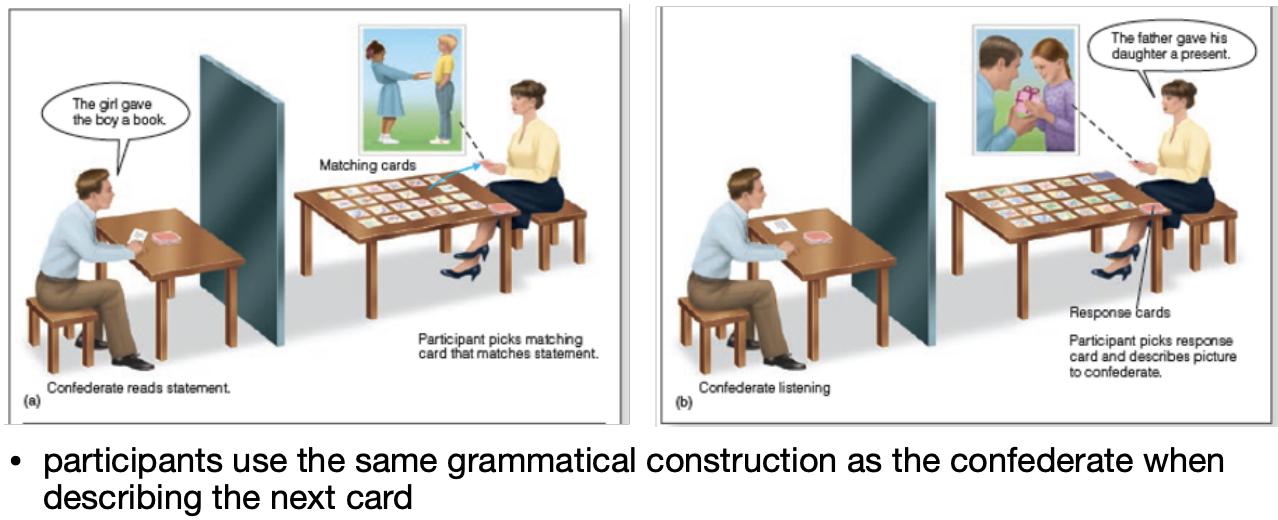
syntactic coordination - convo participants coordinate their grammatical constructs
more likely to respond to statement using same syntax
ex) responding in same order of words or adaptation of segmentation “like…” to break up speech
syntactic priming - hearing grammatical construction increases change that you will use it too
pollEV: The principle of ______________ states that it is easier to understand conversations when the participants already know the back story.
A) syntactic-coordination
B) the given-new contract
C) common ground
D) theory of mind
conversation comprehension
theory of mind - able to understand what other feel, think, believe
nonverbal communication - interpret and react to person’s body language, tone of voice, other meaningful cues
9.2 (wed)
catch up
problem restructuring
1. perceive - x is unknown / 2. represent - same as image (spatial) / 3.
insight - sudden realization of a solution to a problem
enables reorganization, allowing us to see solution not previously obvious
insight problem
ex) move 3 dots to change direction of arrow
ex) move chains to link and unlink
non-insight problem
(1/5)x + 10 =25
janet mac tried to see which problems are easier to solve
functional fixedness - tendency to focus on similar functions or uses of objects
candle problem - mount candle on wall so it burns w/o dripping wax
easier to overcome functional fixedness when tacks presented outside box
two string problem - tie together two strings hanging from ceiling
mental set - preconceived notion about how to approach a problem
water jug problem - measure specific quanitity of water from 3 empty jugs of varying capacities
ex) measure 20 quartz of water - she tells u how, then asks you how u would do it
thus, prior examples establish a mental set that inhibits participants from using simpler solutions later on (i.e. you might copy how it was done in the example shown to you instead of thinking it out for yourself)
pollEV: Insight is the process of changing the way a problem is represented in your mind
ANSWER: FALSE
to make answer true, change “process” to “consequence”
LO: know info processing approach to problem solving via means end analysis
rewatch whole thing
information processing approach - problem solving is a search between posing of a problem and it solution
initial state - conditions at the beginning of a problem
goal state - solution to the problem
intermediate states - conditions after each step is made toward solving a problem
problem space - all possible states that can occur when solving a problem
operators - actions that take problem from one state to another
means end analysis - reduce differences between initial and goal states by creating sub goals
ex) travel operators - 1) shortest travel time when buying flight 2) buy tickets within budget
problems with info processing
mutilated checkerboard problem - if we eliminate 2 corners of checkerboard, can we cover remaining squares with dominos (more difficult than russian but all these problems have same problem solve, there should be no differences in the ease of solving these problems
russian
LO: know analogical approach to problem solving
analogical problem solving - attempting to solve problem using solution to similar problem
ex) Russian marriage solution can be used to solve mutilated checkerboard problem
analogical transfer - experience solving one problem is transferred to another problem
target problem - problem you are trying to solve
source problem - another problem that is similar to and may illustrate a way to solve target problem
pollEV: In the example discussed here, the source problem is _________
difficult to transfer
the radiation problem
what needs to be restructured
the fortress story
LO: understand how expertise affects problem solving
expert - someone skilled/knowledgeable in particular domain
experts solve problems more quickly and more often than beginners, they possess more knowledge about their field