political and social affects on farming, Agricultural Systems and Global Farming Factors
Political Factors in Agriculture
Government Influence Overview: The impact of government on farming practices has seen a steady increase across various nations. Decisions made by individual farmers are heavily constrained and guided by federal policies
United States Federal Farm Policy Components:
Price Support Loans:
These are loans designed to support farmers until their produce is sold.
The government establishes a set price for specific farm products.
if a farmer is unable to sell the product at the market for at least the government-set price, they are entitled to keep the loan, and the government assumes ownership of the crop used as security.
Production Controls:
These regulations establish limits on the quantity of surplus crops a farmer is permitted to produce.
Failure to comply with these limits results in the forfeiture of price-support loans and other federal benefits.
Income Supplements:
These consist of direct cash payments provided to farmers for major crops.
These payments are triggered during years when market prices drop below specific predetermined levels.
State Control in Centrally Planned Economies:
In systems like the former Soviet Union and China, state control over farming has historically been significantly higher than in the West. While reforms have occurred in recent decades (s onwards), the government's influence in these regions remains substantially stronger than in most other parts of the world.
European Union's Common Agricultural Policy (CAP)
Definition: The CAP is a comprehensive framework of rules and regulations that govern all agricultural activities across the $
Historical Context and Rationale: The CAP was introduced in the year . The primary driver for its creation was the necessity for Europe to secure a reliable and adequate food supply following the end of the Second World War.
Economic Cost: The program is expensive to maintain. It is estimated that every individual taxpayer within the contributes approximately annually to fund the CAP.
——————————————————————————————————————————————
Social and Cultural Influences on Farming
Historical Continuity: Current farming practices are significantly influenced by what was produced on the farm and neighboring lands in the past. Farmers often exhibit a tendency to persist with familiar methods and crops.
Generational Tradition: Many farmers feel a profound sense of responsibility to maintain family traditions and land use patterns passed down through generations. The importance of tradition varies regionally but remains a fundamental driver of agricultural decision-making.
Shifting Cultivation:Traditional Rainforest System
Process and Methodology: Shifting cultivation, also commonly referred to as 'slash and burn,' involves clearing a small area of tropical rainforest to create a plot for cultivation. Once the soil nutrients are exhausted, the plot is abandoned, and a new area of forest is cleared.
Circular Pattern: Cultivators frequently move in a circular pattern, eventually returning to previously used plots after the natural soil fertility has been restored through fallowing.
Legal Rights and Land Tenure
Definition of Land Tenure: This refers to the legal and social framework defining how land is owned or managed.
Impact of Inheritance Laws: Historical customs regarding inheritance have dictated farm sizes. In many countries, land was divided equally among all sons upon the father's death (rarely including daughters), leading to a progressive reduction in farm size.
Dowry Customs: The practice of providing land as part of a daughter's dowry upon marriage also contributes to the fragmentation of land holdings.
Economic Consequences of Fragmentation: These processes often reduce farm sizes to such an extent that they can only support subsistence-level farming, preventing commercial viability.
Gender Discrimination and Land Rights
Institutional Gender Bias: Women worldwide face systemic discrimination regarding land and property ownership. Agrarian reforms implemented between the s and the s are described as 'gender blind,' as they assumed all household members would benefit equally from changes, which was not the reality.
Consequences for Women in Low-Income Countries (LICs): Upon the death of a partner, women often lose legal rights to their home, inheritance, possessions, and sometimes even custody of their children.
Socio-Economic and Health Risks: Extreme land insecurity can force women into survival strategies and employment practices that significantly increase the risk of contracting
The UN FAO Position:
The Food and Agriculture Organization states that denying equitable land access creates unanticipated costs, leading to extreme poverty, dependence, rural migration, land abandonment, and social instability.
Economic Correlation: It is widely accepted that societies with well-recognized and protected property rights are more likely to thrive both economically and socially.
The Agricultural System Model
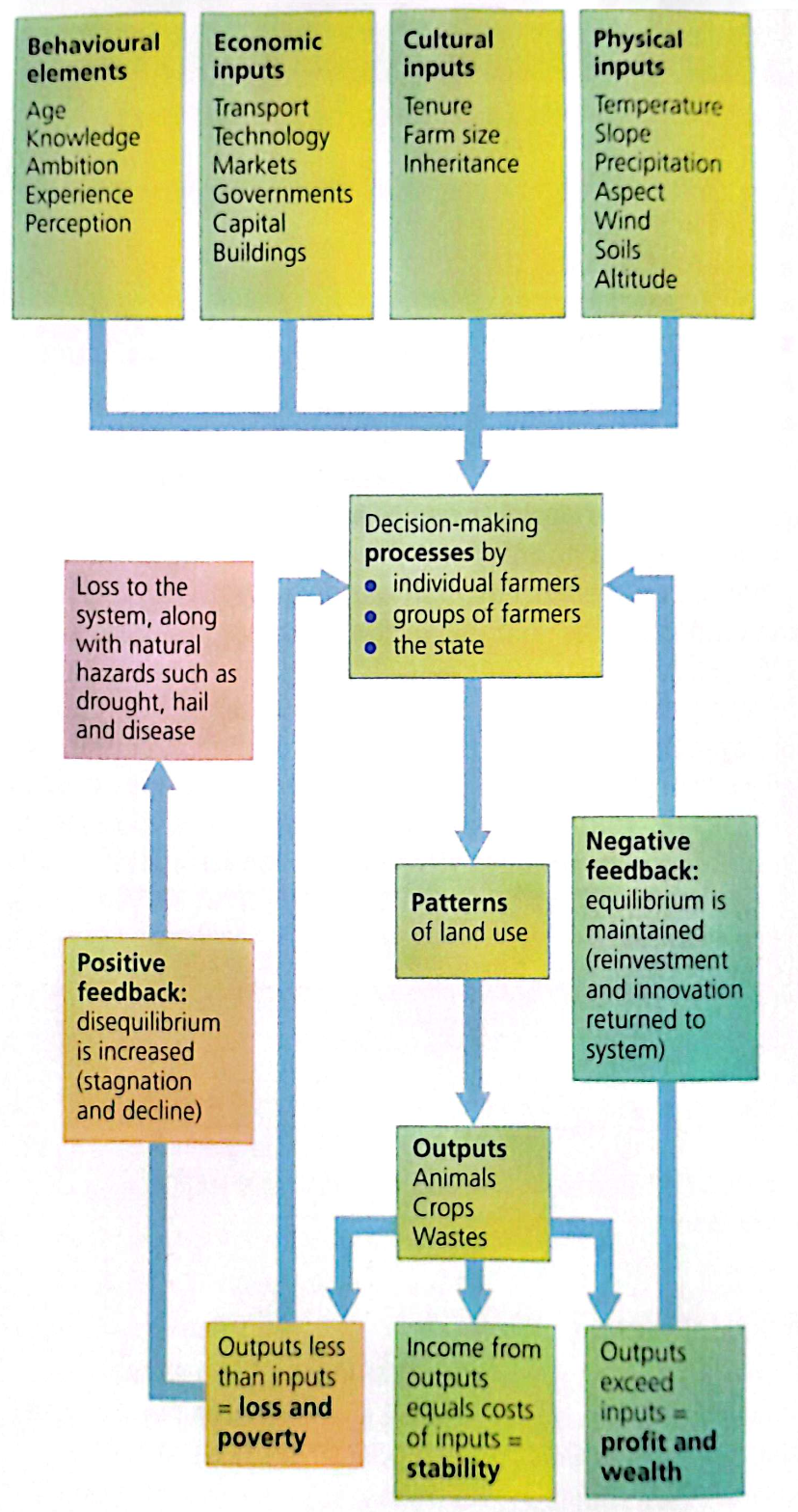
Components of the System: A farm operates as a dynamic system where various factors interact to produce outputs from inputs through specific processes.
Feedback Loops:
Negative Feedback: Equilibrium is maintained within the system through reinvestment and innovation.
Positive Feedback: Disequilibrium increases, leading to stagnation and system decline.
Losses: The system can suffer losses from natural hazards such as drought, hail, and disease.
Classification of Agricultural Systems
Arable, Pastoral, and Mixed Farming:
Arable: Concentration on cultivating crops (e.g., wheat, potatoes). Choice of crop often depends on fluctuating market prices.
Pastoral: Focuses on keeping livestock, including dairy cattle, beef cattle, and sheep.
Mixed: Integration of both crop cultivation and livestock rearing on a single farm.
Subsistence vs. Commercial Farming:
Subsistence: Small-scale and labour-intensive with minimal technology. Produce is consumed by the family with only small surpluses sold. Examples: Shifting cultivation and nomadic pastoralism.
Commercial: The primary objective is to sell all produce to maximize yields and profit. Scale ranges from small to very large.
Extensive vs. Intensive Farming:
Extensive: Characterized by low inputs per unit of land and low yields per hectare. These farms cover large areas. where the primary focus is on maximising production while using minimal labor and capital inputs (e.g. Canadian Prairies wheat farming or sheep farming in Australia).
Intensive: Characterized by high inputs and high yields per hectare. These are often smaller in land area. focuses on maximising production through the use of advanced technologies, high levels of labor, and capital investment. aim is to produce a greater quantity of food or produce within a limited space.(e.g., market gardening, dairy farming, and horticulture).