Unit 4
Plate tectonics
The core…
Inner (being solid)
Outer (liquid)
Above the core is Mantle
Mantle is seperated into layers:
Magma/Asthenosphere/lithosphere/
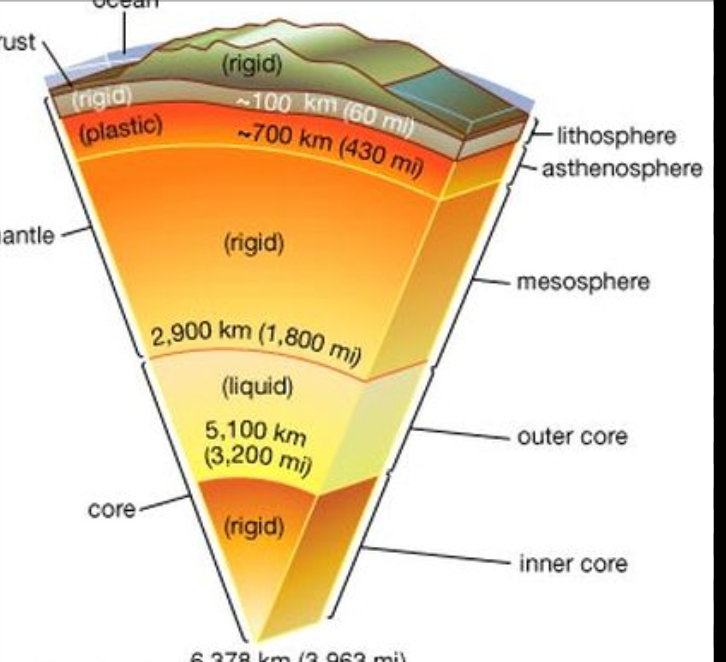
The mantle is divided chemically (by composition) into layers:
Upper mantle: Function: The movement in the asthenosphere drives plate tectonics.
Lower mantle: Function: Transfers heat upward and helps maintain convection currents in the mantle.
But the mechanical (physical) structure of Earth (how materials behave) is divided differently:
Lithosphere – rigid outer layer (crust + uppermost mantle)
Asthenosphere – soft, partially molten part of the upper mantle
Mesosphere – strong, rigid layer below the asthenosphere (includes the lower mantle)
Outer core and inner core
Who created the Theory of Plate Tectonics: Aflred Wegener
Earths lithosphere is divided into plates; in motion
Movements of Boundaries
Divergent
Convergent
Transform
🌋 Divergent Boundary
Definition: Where two tectonic plates move away from each other.
What happens:
Magma rises from the mantle to fill the gap.
New crust forms as the magma cools.
Common features:
Mid-ocean ridges (like the Mid-Atlantic Ridge)
Rift valleys (like the East African Rift)
Earthquakes & volcanoes: Usually mild and shallow earthquakes; volcanic activity common.
Faults: Fractures in the rock caused by transform boundary
Island arches: Chain of volances and islands
Collision zone: boths contential to contential zone in pushing
⛰ Convergent Boundary
Definition: Where two tectonic plates move toward each other.
What happens depends on the plates involved:
Oceanic–Continental: The denser oceanic plate subducts (sinks) beneath the continental plate.
Forms volcanic mountain ranges (e.g., Andes Mountains).
Oceanic–Oceanic: One oceanic plate subducts under the other.
Forms volcanic island arcs (e.g., Mariana Islands).
Continental–Continental: Both plates are too light to subduct.
Forms large mountain ranges (e.g., Himalayas).
Earthquakes & volcanoes: Strong earthquakes and volcanic eruptions common (except when both are continental).
⚡ Transform Boundary
Definition: Where two plates slide past each other horizontally.
What happens:
Crust is neither created nor destroyed.
The plates’ rough edges lock, then suddenly release, causing earthquakes.
Common feature: Fault lines (like the San Andreas Fault in California).
Earthquakes & volcanoes: Strong earthquakes, but no volcanoes.
Soil formation, erosion, composition, and its properties
Types of rocks formed:
Igneous rock:
Formed from: Cooling and solidification of magma or lava.
Types:
Intrusive (formed underground; large crystals, e.g., granite)
Extrusive (formed on surface; small crystals, e.g., basalt)
sedimentary rock
Formed from: Compacted and cemented sediments (like sand, mud, or organic material).
Often formed in: Water environments such as rivers, lakes, or oceans.
Can contain fossils.
Meta(morphis) rock:
Formed from: Existing rocks changed by heat and pressure (but not melted).
Occurs deep underground where temperature and pressure are high.
relating to rock cycle… (slowest of all cycles)
Tectonics
weathering (breaking down)
erosion (movement of weathered rock)
weathering (breaking down): Chemical and physical
Soil formation
Main factors:
Parent material – the rock that breaks down to form mineral particles.
Climate – temperature and precipitation affect weathering and decomposition.
Organisms – plants, bacteria, and decomposers add organic matter.
Topography – slope and drainage affect erosion and accumulation.
Time – soil formation is very slow (can take hundreds to thousands of years).
Summary Table
Horizon | Name | Description |
|---|---|---|
O | Organic | Decomposed plant & animal matter |
A | Topsoil | Mineral + organic mix; most fertile |
E | Eluviation | Leached layer; nutrients move down |
B | Subsoil | Clay & minerals accumulate |
C | Parent Material | Weathered rock pieces |
R | Bedrock | Solid rock base |