Body Structures & Organ Systems
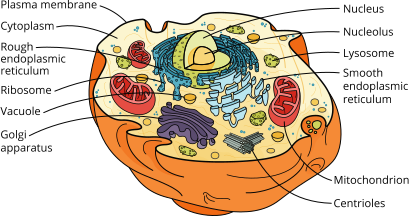
Component | Description | Function |
Plasma membrane | Selectively permeable membrane (allows only certain substances through) made of phospholipids and proteins surrounding the entire cell | Separates the internal components of the cell from the surrounding environment Essential to the life of the cell |
Cytoplasm | Gel-like fluid filling the inside of the cell that is comprised primarily of water, with electrolytes, metabolic waste products, and nutrients dissolved within it | Contains many suspended organelles, or cell structures Medium for chemical reactions |
Nucleus | Large, spherical body near the center of the cell containing genetic material in the form of DNA | Control center of the cell Regulates cell activity Houses genetic material |
Nuclear membrane | Double-layered, porous membrane surrounding the nucleus | Protects the nucleus, allowing in only specific materials |
Nucleolus | Dark, dense body within the nucleus without an enclosing membrane; most cells contain one to four | Forms RNA and ribosomes |
Mitochondria | Elongated, rod-shaped bodies filled with fluid, containing DNA Known as the “power plant” of the cell | Convert nutrients into energy for use by the cell/body; create adenosine triphosphate (ATP) |
Ribosomes | Small granules of RNA found in the nucleolus or cytoplasm | Protein synthesis for both internal and external use |
Endoplasmic reticulum | Complex connection of membranous fluid-filled, flat sacs and tubular channels Connects the cell membrane to the nucleus membrane, as well as some organelles Comprised of the rough endoplasmic reticulum (RER) and smooth endoplasmic reticulum (SER) | Transports materials throughout the cell RER: Supports the synthesis and transport of proteins SER: Supports the synthesis of some lipid molecules, including steroids |
Golgi apparatus
| Four to six flat membranous sacs, connected to the endoplasmic reticulum; typically found near the nucleus | “Packaging and shipping plant” of the cell Packages and releases materials secreted by the cell for external use Forms lysosomes for use within the cell |
Lysosomes | Sacs surrounded by membranes created by the Golgi apparatus | Digest waste materials including damaged materials found in the cell, old cell components, and materials entering the cell |
Cytoskeleton | Comprised of protein microfilaments and microtubules | Maintains the shape and structure of the cell Keeps organelles in place and moves them throughout the cell as needed |
Centrioles | Pair of rod-shaped bodies made of microtubules found near the nucleus | Participate in cell reproduction through the distribution of DNA to new cells |
Cilia | Short, hair-like microtubules projecting from the cell membrane | Aid in the movement of substances along the surface of the cell |
Flagella | Long, hair-like microtubules, projecting from the cell membrane | Move the cell itself, through a whip-like motion |
Planes of the Body
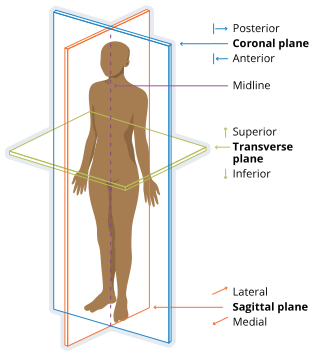
Sagittal plane: Divides the body into left and right sides. Midsagittal refers to an equal division of left and right sides, running along the midline of the body.
Transverse plane: Divides the body into upper and lower sections, not necessarily equally
Frontal plane: Also called coronal plane, divides the body into anterior and posterior sections
Body Cavities
Cranial cavity: Within the skull; houses the meninges (brain)
Spinal cavity: Traveling down the midline of the back and formed by the vertebrae, this contains the spinal cord
Thoracic cavity: Within the chest; houses the lungs, heart, and major vessels
Abdominal cavity: Within the abdomen; houses several major organs such as the stomach, liver, gallbladder, and intestines
Pelvic cavity: Inferior to the abdominal cavity; houses the bladder and reproductive organs
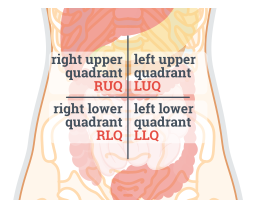
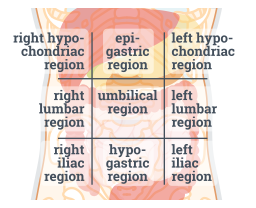
Body Quadrants and Regions
The abdomen can be divided into four quadrants or nine regions, either of which is helpful as reference during physical examination of internal organs. Familiarity with each quadrant assists in correctly documenting a patient’s chief complaint pertaining to issues related to the abdomen.