Thermal Physiology
Thermal strategies
Thermal energy - influence over chemical interactions, affecting macromolecule structure and reactions.
Animals deal with temperature variability in two main ways we identify.
Thermal strategy to ensure body temperature (TB): behavioural, biochemical, and physiological responses.
Ambient temperature (TA): temperature of surroundings (most important environmental influence on thermal strategy).
More than just temperature (energy, metabolic rate) determines energy budget
Salt water can change freezing temperature.
Some animals can only exist between 4 degrees, and some can survive much harsher ranges.
Thermal strategies fall under two categories
Tolerance: body temperature varies with TA. This is mostly invertebrate, worms, insects and fish.
Regulation: body temperature does not vary with TA. Birds and mammals mostly.
Regulation can be costly, but it allows for these animals to live in and undergo different temperatures.
Heat fluxes
We need to understand how heat is exchanged with the environment. There may be lots of sinks depending on situation.
Thermal energy moves down a temperature gradient. We see total thermal energy as being where the energy or heat is concentrated.
Metabolic energy is low in hibernation and higher in working out. Evaporation is heat energy because it takes heat to turn water to gas.
There are different types of heat fluxes
Convection
Thermal energy from object to external medium (moving, light breeze)
Depends on thermal gradient, rate of flow, conductivity of flow (might be good insulator so no conductivity).
Conduction
Transfer of thermal energy from one object or fluid to another.
Heat flux (Q) = rate of heat transfer from hotter to colder.
Unit: watts.
Q = -kA(T/d)
rate of heat flow = -((thermal conductivity)(A))(temperature gradient / distance of flux)
fournier’s law: quantifying thermal conduction
Distance of conductors, as well as the thickness of stuff like air, snow between cold.
Radiation
Heat lamp, basking in sun
Emission of electromagnetic radiation
Darker pigments absorb more energy.
Evaporation
Sweating and respiratory water coming out when you breath.
Water molecules absorb thermal energy.
From solid to liquid to gas (or sublimation)
Heat loss depends on volume of water and heat vaporization. Salt and electrolytes increase amount of heat needed.
Fourier’s Law: Law of heat conduction. bat wings first serves purpose for thermoregulation. This law helps consider distance, insulation due to furs, radiant energy under fur, blubber fat. We see arctic foxes and regular foxes differing in their hair.
Conduction
Certain things have higher or lower thermal conductivity. Pockets of air under fur can add to conductivity. Water has higher conductivity than air. Affected by geometry.
Insulation
Reduce thermal exchange. External and internal insulators. Lots of high altitude species have a thicker fur coat, and hotter areas likely have less coat (or if you hibernate).
Surface area to volume ratio
Influences heat exchange. Big animals exchange heat slower than smaller ones.
Bergmann’s rule: Large animals have lower surface area per mass ratio, and it’s surface is limited, and they will tend to live in colder environments.
Allen’s rule: Animals in colder climates have smaller extremities. Short limbs. In order to lower surface area by being more round.
Behavioural adjustments: this can help limit our surface area (ex. huddling). Body posture can alter exposed surface area.
Thermal strategies
Relative stability of body temperature falls under:
Poikilotherm: variable body temperature
Homeotherm: stable body temperature
Source of thermal energy:
Ectotherm: environment determines body temperature.
Endotherm: animals generate internal heat to maintain body temperature.
You are not always one ot the other, but rather you fall on a scale of a combination of two of them, leaning towards other.
Some animals have no way of maintaining body temperature, but they are a homeotherm because their environment in very stable. They are maintaining their body temperature.
Temporal and Regional Endothermy
Hypometabolic phase, with a decrease in body temperature (hibernation, torpor). We are saving metabolic energy.
Torpor: usually less than a day
Hibernation: longer
Circadian rhythms
Evident in affecting metabolic rate and body temperature.
Reproductive states with infrared technology and ovulation is just after peak of metabolic rate.
VO2 is a measure of metabolic rate.
There are easier ways of testing temperature.
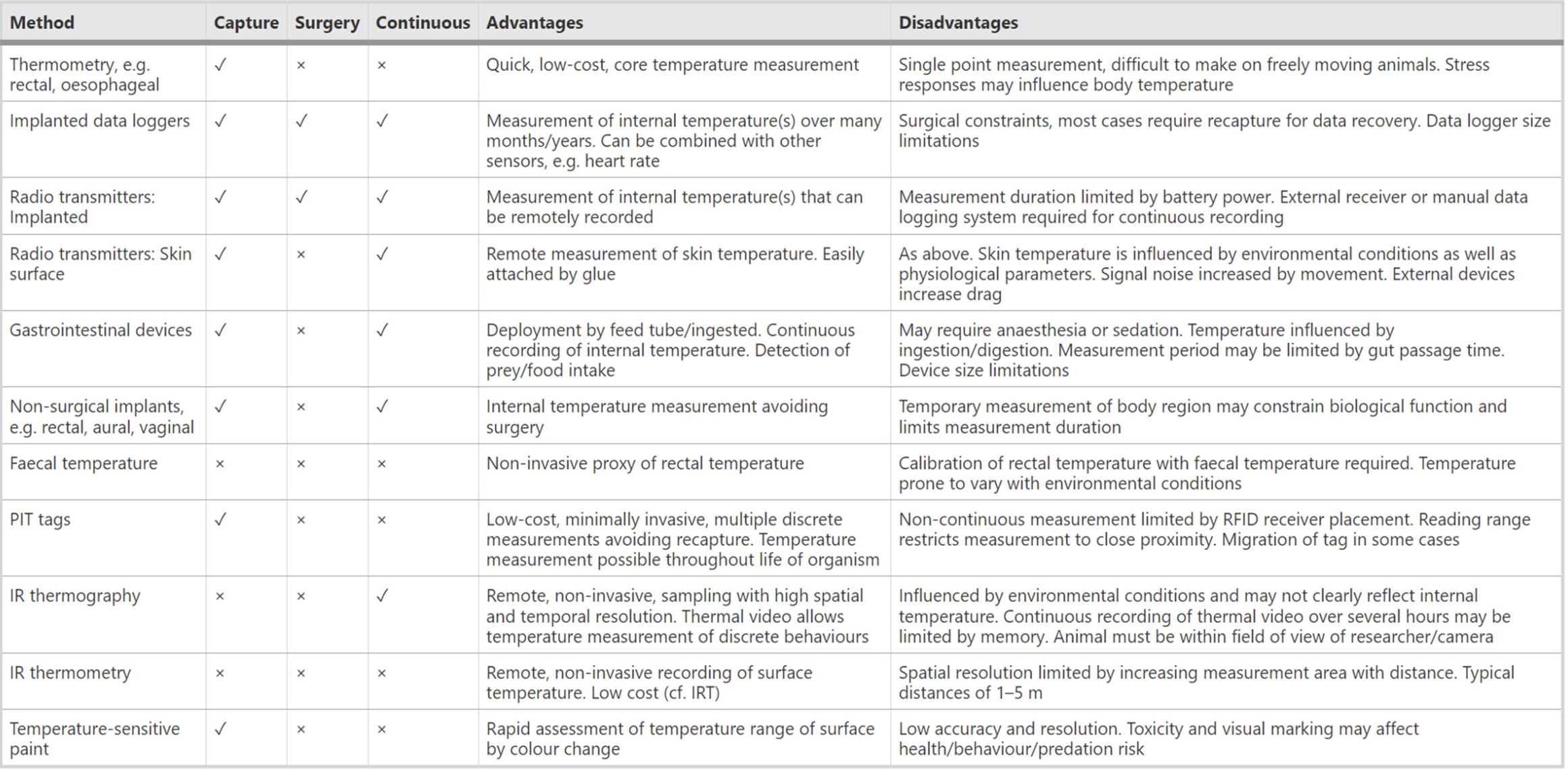
Measuring temperature
Thermometry, implanted data loggers, radio transmitters implanted/skin surface, gastrointestinal device, non-surgical implants, facial temperature, PIT tags, IR thermography, IR thermometry, temp-sensitive paint.
 Homeothermy is relative
There are different TNZ and ranges of TNZ depending on the animal. Body size and daily fluctuations have a general relationship. Temperature range and body mass are negatively correlated, and mean daily body temp and body mass are positively correlated.
Thermal Zones
Thermoneutral zone (TNZ): optimal range for physiological processes; minimal metabolic rate.
Homeotherms
Upper critical temperature (UCT): metabolic rate increases to prevent overheating.
Lower critical temperature (LCT): metabolic rate increases to increase heat production
Animals differ in the width of their TNZ, UCT, and LCT.
Survival zone > tolerance zone > prescriptive zone > TNZ.
Breadth changes in TNZ. As body mass increases, the range may not, but the BMR will increase.
Poikilotherm thermal tolerance
No TNZ, UCT, LCT. There are preferred temperatures. They will move to select a local microclimate they enjoy.
Incipient lethal temperatures: Ambient temperature at which 50% of animals die
Incipient upper lethal temperature (IULT)
Incipient lower lethal temperature (ILLT)
Range of tolerance is between the IULT and ILLT.
Thermal tolerance of animals
Eurytherm: can survive a wide range of ambient temperatures (exist in more thermal niches).
Stenothermal: survives across a narrower range of ambient temperatures (less broad regions).
Regional heterotherms: body temperature varies in regions of the body
Enough thermal inertia to defend temperature, as a poikilotherm in regional heterothermy.
Brain function is better when eyes are warm, so billfish learned to heat up its eyes (by firing lots of ATP).
Fish have white fibres, while tuna stripes are concentrated to the sides. Tuna need to move to respire, so they have red muscle to continue performing well. Countercurrent exchange in vessels of blood (warmed by red muscle) goes back to hear by arterial blood. Is cold from gills and picks up heat.
Some insects shiver their thorax muscles.
Thermogenesis by ion pumping
Ion gradient degrade because of membrane proteins using electrochemical energy to drive transport and biosynthesis, and ions leak across membranes.
Ions must be continuously pumped, producing heat. Plasma membranes of endotherms are leakier than ectotherms, causing increased thermogenesis by ion pumping. ATP being churned through.
Heat production in insects prior to flight
Insects are not shivering (involuntary movement), but rather they are actively trying to warm up.
Futile cycling: 2 opposing enzymes are activated simultaneously.
Carbohydrate metabolism is used in flight muscles, with ATP to ADP to ATP conversion moving between substrate and product.
Antagonistic flight muscles contract simultaneously - energy is expanded and heat is produced without movement, not uncoordinated like shivering.
Warming up is done before coordinating buzzing to flying.
Biochemistry and Physiology
Proteins and lipids are affected with temperature exiting normal range. Hydrogen bonds and van der Walls forces are disrupted by high temperatures. Hydrophobic interactions stabilize.
Membrane fluidity
Membrane fluidity is affected by temperature. Low - lipids solidify. High - increase membrane fluidity.
This affects protein movement in membrane function
We maintain our temperature in upper 30s, as do birds and mammals so anisotropy/fluidity in the the region they best fit.
Homeoviscous adaptation
Maintain membrane fluidity at different temperatures by changing membrane lipids and cholesterol content. Remodelling membranes. Adapting change in fatty acid chain length (more fluidity in shorter chains), and saturation (more fluidity with more double bonds).
Certain phospholipids increase fluidity (phosphatidylethanolamine/PE) and some decrease fluidity (phosphoatidylcholine/PC).
Cholesterol content prevents solidifying when membrane gets cold.
Acclimation
Ectotherms remodel tissues in response to long term changes in temperature.
Quantitative strategy
More metabolic machinery.
Increased number of muscle mitochondria in low temperature.
Qualitative strategy
Alter the type of metabolic machinery
Different myosin isoforms in winter and summer.
Frog: having a specific acclimated temperature gives a specific mid tier fluidity, and acclimatizing to a different range changes when mid tier fluidity occurs.
LDH enzyme in killifish
There are changes in salinity in northern populations, as northern temperatures have 10 degrees less than southern ones. LDH-B subunit has important white muscle.
Two alleles exist, with one over represented, and they are distinct in the different populations. In northern populations. Northern populations are best suited at one temp, with southern at a higher temp. LDH enzyme activity tracks metabolic functions. Recovering NADH is imperative for good ATP function, which is increased by LDH enzyme → differs in which version of the genes you get.
Cold adaptation
Psychotrophs - animals that thrive in low temperatures
Fungi in caves in north america giving bats white nose syndrome.
Posses cold adapted enzymes; fewer weak bonds, enzymes breathe (jiggle) more easily at low temperatures.
Cold adapted enzymes are more vulnerable to temperature-dependent unfolding.
Protein “breathing” - cold vibrates, which key to the function of the enzymes. Changes in 3-D shape during catalytic cycle.
Enzymes do not breathe well at low temperatures because weak bonds are strengthened, decreased enzyme efficiency.
Strategies
Freeze-Tolerance
Animals can allow their tissues to freeze in a controlled, safer way. Ice can pierce cellular membranes when they get too big so animals make it so that they freeze more controlled.
Produce nucleators outside the cell. Control the location and kinetics of ice crystal growth. Extracellular fluid freezes, but intracellular fluid remains liquid. Intracellular solutes counter movement of water.
Freeze-avoidance
Animals use behavioural or physiological mechanisms to prevent ice crystal formation. Add solutes, anti-freeze molecules/proteins. Super-cooled and could be in a chilled coma.
Solutes depress freezing point (osmolarity increases). Antifreeze molecules exist in proteins or glycoproteins and use non colligative actions. Disrupt crystal formation.
More
Supercooling: in the absence of nucleator, water can remain liquid below 0oC.
Ice crystal formation needs a trigger like cluster of water molecules, macromolecules (nucleator).
Deleterious effects. Points and edges pierce membrane, crystal growth removes surrounding water (osmolarity increases).
Maintaining a constant body temperature
Endothermy and high metabolic rate are correlated. More metabolism, more heat production. Higher body temperature, more growth, development, digestion, biosynthesis.
Endotherms and ectotherms produce metabolic heat. Only endotherms have the ability to retain enough heat to elevate body temperature (futile cycles), but ectotherms still have some metabolic heat production.
Endothermy likely evolves from dinosaurs → favourable surface area to body ratio. Our hypothalamus works as our internal thermostat (spine in birds). Hypothalamus sends signals to the body to alter rates of heat production and dissipation.
Birds and mammals shiver to increase heat production. Interferes with normal activity, and can become exhausted from shivering. Muscle glycogen dominates at high intensity. Uncoordinated myofiber contraction that results in no coordinated net muscle work.
Patterns of fuel use during shivering (mirrors patterns of fuel use in muscle with exercise intensity). Muscle glycogen use dominates at high intensities.
Gets into the brown adipose tissue.
Brown Adipose Tissue
Heterothermy or other endotherms (small mammals and newborns in cold environments). Nonshivering themogenesis. In back and should region.
Cells adipocytes, but tissues have more dense blood supply and too much mitochondria. Contracts lots of heat without shivering. Produces UCP1 (uncoupling protein 1).
UCP uncouples ETC and proton pumping from ATP synthesis (futile cycling of protons). Short circuit coupling. We express low levels of UCP constitutively. This increases rate of fatty acid oxidation and energy is released as heat.
All the enzymatic steps of hyping up ETC are producing heat and we’re not getting enough energy into ATP. First part of animals to warm up when waking up from hibernation is the brown adipose tissue.
Activated by sympathetic nervous system. Activates fatty acid beta oxidation, and upregulates UCP translation/transcription. Then UCP activity is activated. UCP lets protons move down gradient, but does not power ATP synthesis. So its just the movement of protons without ATP synthesis.
Torpor
Daily changes in body temperature in various animals. “Deep torpor” we can identify, but “shallow torpor” is hard and there are so many examples. Shallow torpor saves energy by reducing metabolic rate (regulated, moderate temperature, doesn’t strongly lack ambient temp). Torpor duration predicts energy saving more than the torpor depth.
Torpor may occur during migration because of sufficient fat to stay normothermic.