1.3 Early Evolution On Planet Earth
The Hadean Eon- encompasses the earliest period of Earth's history, lasting from the formation of the Earth approximately 4.6 billion years ago until around 4 billion years ago, characterized by a hot, molten surface and the formation of the first solid crust. Led to possibility of protocells.
The Archean Eon-
Snowballs Earth- Valcano’s poked through ice, releasing heat that melted all of the ice.
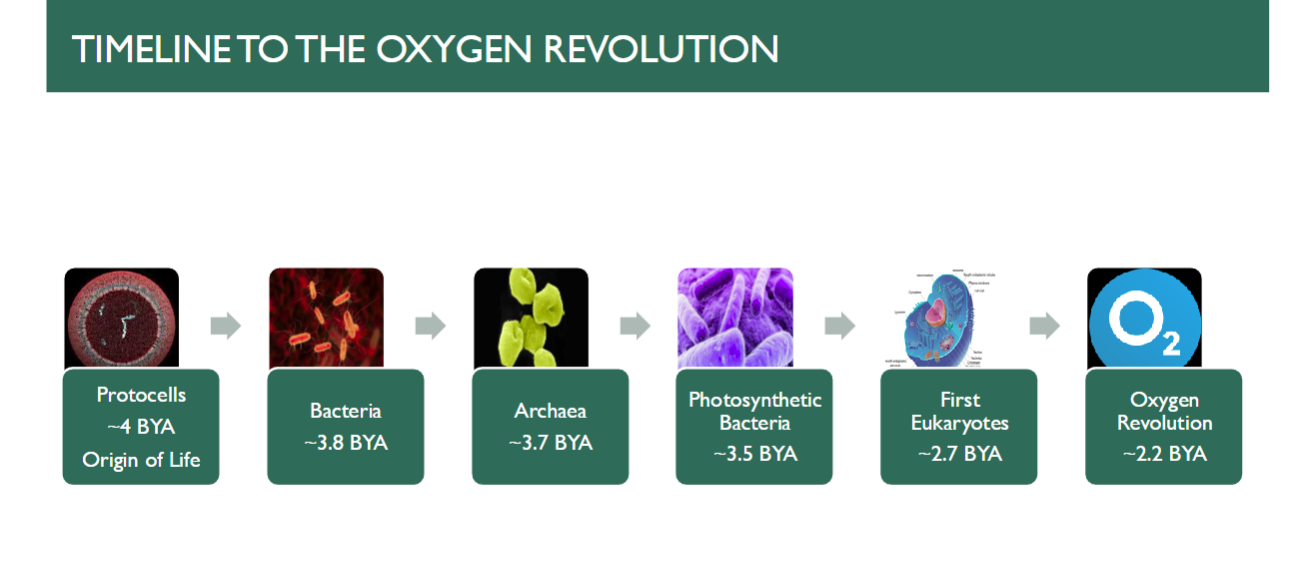
Bacteria (Procaryotic)- 3.8 BYA
Archaea 3.7 BYA- strives in harsh environment
Beginning of anaerobic bacterial photosthesis 3.2
Eukaryotes 2.7 BYA - the emergence of eukaryotic cells, leading to greater complexity in life forms.
-Prokaryotes are simpler, unicellular organisms without a nucleus or membrane-bound organelles, while eukaryotes are more complex, with a true nucleus and organelles, and can be unicellular or multicellular.
Prokaryote VS Eukaryote (memorize)
All extant cells:
-Enclosed by a membrane
-store hereditary information in DNA
-replicate DNA by using the same basic mechanism
-use RNA for transcription of DNA
-translate RNA into protein via tRNA & ribosomes
-use proteins as catalysts
-use ATP (adenosine triphosphate) for free energy
Deep Dive into Photosynthesis
-There was no oxygen (no source). Oxygen highly reactive
-Development of oxygenic or non-cyclic photosynthesis led to the slow process of oxygen being present.
-Oxygen didn’t accumulate until 2.2 BYA (Leads to the first mass instinction.)
-Aerobic respiration became dominant form of metabolism against bacteria.
-6CO₂ + 6H₂O + light energy → C₆H₁₂O₆ + 6O₂. (This happens in the chloroplast)
The Ediacaran fauna: 600-540 MYA
-First most ancient complex organisms on Earth
The Cambrian Explosion:
-Over 100 different phyla compared to 30+ now
-Created predator/prey relationships
The missing link: How did we get from ocean to land?
-Tiktaalik