Unit Six
Deepa Premnath ECON 201
UNIT 6 Long-Run Economic Growth
Part 1
Long-run determinants of the level and growth rate of output (GDP) and real GDP per capita.
The economist Robert Lucas on understanding the determinants of economic growth:
“The consequences for human welfare involved in questions like these are simply staggering. Once one starts to think about them, it is hard to think about anything else”
Introduction:
We spent Unit 5 (GDP) examining how to measure and evaluate real GDP, the most important indicator of our economic well-being as well as several related indicators such as real GDP per capita and the rate of economic growth. In Unit 7 (Unemployment and Inflation) we will learn how to measure and evaluate other key indicators of our standard of living, namely the unemployment rate and the rate of inflation. Taken together, these indicators allow us to measure and evaluate the past and current state of our economy. In Unit 6 (Long Run Economic Growth) we will examine the determinants of our future standard of living.
The Historical Record:
Economic prosperity, as measured by GDP per capita, varies substantially with the average income in the world’s richest countries typically more than ten times that in the world’s poorest countries. The relative positions of countries can change dramatically over time with relatively small variations in the growth rates. Even a one-percentage change in a country’s average economic growth rate can have a significant impact over the generations because of the power of compounding.
The Determinants of Long-Run Economic growth:
The long-run trend rate of growth is the average sustainable rate of economic growth over a long period of time. The higher the long-run economic growth rate the higher our standard of living will be in the future. In order to increase our long-run economic growth rate and our future standard of living we have to improve our ability to produce goods and services.
Labor Productivity and Long-run economic growth
Put simply:
Long-run economic growth is a function of the size of the labor force and labor productivity
Size of the Labor Force: the number of workers participating in the labor force.
Labor Productivity: the value of output produced in one hour of labor time.
If either the number of people in the labor force or labor productivity improves so will long-run economic growth. Economists focus mostly on Labor Productivity as the most critical determinant of long-run economic growth.
Labor Productivity in turn increases when Technology improves and when the following improve/increase:
Physical Capital
Human Capital
Natural Capital
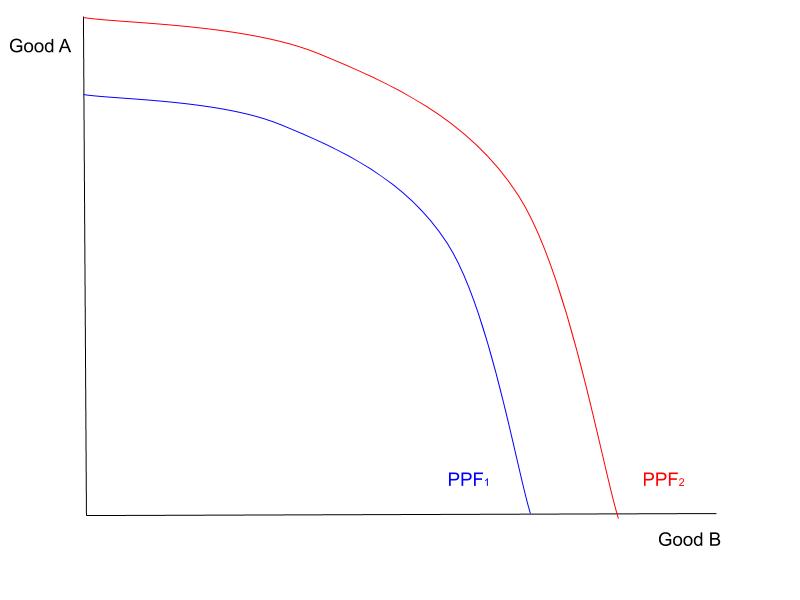
Long-Run Economic Growth: The Expansion of our Productive Capacity (PPF Shifts Out)
The Inclusive Wealth Index:
(Please read the brief one page document on the Inclusive Wealth Index that is available on Blackboard with the lecture notes for Unit 6.)
The IWI is an alternative approach to measuring economic well-being. It was developed by eminent economists such as Sir Partha Dasgupta who believe that GDP is an overly narrow measure. In particular, they argue that since GDP only measures the current income of a nation it overlooks its underlying asset base or the wealth of nations! If for example, countries are enjoying high levels of GDP (income) while depleting their stocks of natural, human and/or physical capital, they are not prioritizing sustainable development and that will leave future generations worse off. The IWI which is now published under the aegis of the United Nations seeks to measure the productive capacity/ production potential of a nation by calculating the value of our:
Physical/Manufactured Capital Stock (e.g. buildings, equipment, roads, bridges, electrical grid)
Human Capital Stock (e.g. the level of education, health, skills, training and experience)
Natural Capital Stock (e.g. energy, agricultural land, freshwater, forests, minerals, the atmosphere, oceans)
“A country’s inclusive wealth is the social value of all its capital assets, including natural capital, human capital and produced capital. We call this the country’s productive base. It is an index of a country’s production potential. If a country’s IWI is either increasing or stable over time, then we can say its (economic) growth is sustainable; its economy is making progress without harming the well-being of future generations.” From UNEP IWI 2018 page 12
UNEP (United Nations Environment Program) Managi, S., Kumar, P. (eds.): Inclusive Wealth Report 2018: Measuring Progress Toward Sustainability. Routledge, New York (2018)
A few insights from the 2012 - 2018 IWI Reports:
For advanced industrialized countries such as the U.S., our most valuable productive asset is our Human Capital.
America’s GDP is around $18 trillion; its inclusive wealth is about ten times higher (and is the highest in the world)
We can with the IWI more easily track growth and deterioration in our productive assets.
Countries have different resource/asset endowments. The index can help policymakers target investments in different productive assets and recognize the trade-offs associated with these resource allocation decisions.
From 1992 to 2010 global GDP increased by 50%; but inclusive wealth rose by just 6%.
In 2018, 44 out of the 140 countries studied have suffered a decline in inclusive wealth even as GDP per capita rose in most of these same countries
Just 13 (out of 140) countries saw their per-person natural capital rise in 2018 implying widespread environmental degradation and an unsustainable use of natural resources. This is especially important when you consider that 47% of the world’s natural capital comprises fossil fuels and minerals that took millennia to form and will not be replaced. They estimate that in high-income countries, a typical person will have 21% less natural capital at their disposal in 2040.
V. Extensive Growth vs. Intensive Growth:
There are two ways of thinking about long-run growth:
EXTENSIVE Growth
This is the result of having more or better Resources (Natural Capital resources, Manufactured Capital resources, Human Capital resources)
Diminishing Returns are a characteristic of extensive growth.
INTENSIVE Growth
The most important determinant of intensive growth is Technological Advancement.
I am using a very broad definition of Technological Advancement by which I mean new and better ways to do things. This definition includes the discovery of new knowledge and the invention of new machines, software and drugs but it also includes better processes such as the assembly line/information sharing as well as new/better Institutions (political systems, laws, regulations etc.).
Intensive growth has been responsible for most of human progress.
Unit 6
Long-Run Economic Growth
Part 2 Public Policy
Now that we understand the determinants of long-run growth, we can consider the role of Public Policy in improving our productive capacity.
Physical/Manufactured Capital Resources
Savings and Investment in Public and Private Manufactured Capital e.g. Infrastructure
Diminishing Returns and the Catch-Up Effect
Foreign Investment
Natural Capital Resources
Sustainable Development
Environmental Protection
Renewable Energy
Human Capital and TECHNOLOGICAL KNOWLEDGE
This is probably the most important area for public policy.
Education
Labor force growth
Training
Health and Nutrition
Free Trade
Research and Development (The primary reason why living standards have improved over time has been due to large increases in technological knowledge and R and D plays an important role here)
POLITICAL INSTITUTIONS (the single most important determinant of long-run economic growth)
More about the type of Political Institutions that foster long-run economic growth:
Property Rights
Rule of Law*
Political Stability
Good Governance (the opposite of good governance would be a Kakistocracy where the government is run by the most unqualified, most corrupt and most unscrupulous people with predictably terrible consequences for our well-being).
Professional Civil Service
Transparent, efficient government regulations
A Government that is resilient and able to handle change and crisis
Liberal Democracy and Representative Government
Definition of Liberal Democracy: A Political order that rests on the republican principle, takes constitutional form, and incorporates the civic egalitarianism and majoritarianism principles of democracy
*Definition of Rule of Law (from https://www.uscourts.gov/educational-resources/educational-activities/overview-rule-law)
“Rule of law is a principle under which all persons, institutions, and entities are accountable to laws that are:
Publicly promulgated
Equally enforced
Independently adjudicated
And consistent with international human rights principles.
The courts play an integral role in maintaining the rule of law, particularly when they hear the grievances voiced by minority groups or by those who may hold minority opinions. Equality before the law is such an essential part of the American system of government that, when a majority, whether acting intentionally or unintentionally, infringes upon the rights of a minority, the Court may see fit to hear both sides of the controversy in court. “