Learning Guide 5
Definition of Stress
- In 1936, an endocrinologist named Hans Selye came up with the idea and the word "stress", after performing several experiments on rats.
- Dr. Selye: "the non-specific response of the body to any demand for change" as he noted how the rats began to develop physiological reactions to the "harsh" conditions they experienced.
\n - This prompted Dr. Hans Selye to come up with a new word called"stressor" in order to differentiate the stimulus from the response. (i.e., the stimulus being the stressors or the cause and the response being the body's reaction to the stressors).
- Stress as a response involves the body where interaction between hormones, glands, and the nervous system.
^^Cortisol^^ - a hormone that ==helps the body manage stress.==
^^Endocrinologist^^ - ==a physician== who is ==trained to diagnose and treat hormonal imbalances== in the body.
Types of stress
==a pleasant sort of stress== that ==improves our performance.== It's ==a beautiful kind of tension== that ==helps us feel good about ourselves==. The Greek term @@(eu)@@ means ^^‘well' or ‘good.'^^
Examples of Eustress are:
- Thrill from a scary movie
- Winning a race
- Completing a task
- Joy on a roller-coaster
- Joy upon a baby's birth
- Joy at getting married
==a harmful kind of stress associated with attention==. It's ==chronic stress that won't go away despite our best efforts==. This type of stress may be persistent and devastating. Anxiety, sadness, and withdrawal are all signs of defeat.
Example of distress:
- An injury that prevents us from exercising
- Not getting into the college of our choosing or losing our job.
\n
Stressors
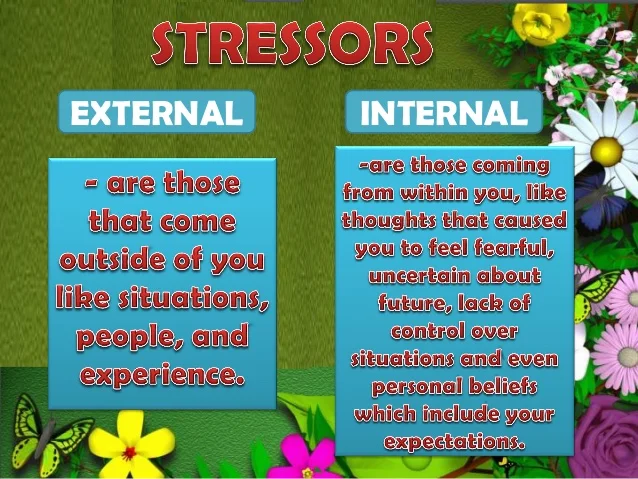
Everyday stressors in the lives of Adolescents
^^Appearance^^- ==Bodily changes characterize adolescence==. Teenagers ==often worry about their height==, weight, physical shape, and skin concerns. Also, wanting to impress others causes tension among them.
^^Pressures at School^^- ==Academic and extracurricular obligations==, including recitation, daily seatwork, quizzes, projects, homework, exams, and graded performance, may stress teenagers. Moreover, the desire to pass topics and courses causes demands and stress (e.g., rigorous review, research, meeting deadlines, sleepless nights).
^^Home/Family^^- ==Family difficulties== can cause stress. ==Divorce or parents' annulment typically results in new living arrangements and other unpleasant situations== ( e.g., having a blended family, lacking privacy, adjusting to a new residence and school, etc.). Stress comes from disagreements with parents, sibling rivalry, and responsibility for younger siblings.
^^Peer/social pressure^^- Stress is ==caused by peer pressure from peers or friends==. For example, forced to attend classes, smoke, or engage in drinking, drug, or sexual activities. Bullying or harassment by peers may also be a factor. These demands may lead to stress overload.
^^Loss^^- The ==loss of a family member,== relative, or acquaintance causes stress. Breaking up with a boyfriend/girlfriend, terminating a friendship, or leaving a beloved job can cause a sense of loss and worry. These might cause a loss of self-esteem and desire to socialize or attend school.
^^Sorrow^^- Missing ==objectives or plans causes stress.== Uncontrollable variables like severe weather or unexpected brownouts cause frustration. These might cause stressful circumstances such as not "Normal life" might generate pressure.
^^Romantic Bonds^^- Adolescence is a time when love connections often bloom. ==Teenagers are stressed out when they don't have a boyfriend/girlfriend.== Those singles sense avoid. Those in a relationship struggle with love quarrels, disagreements, fights, conflicts, the "emotional roller coaster," and other issues.
^^Future^^- Adolescents, especially late adolescents, also consider their future. ==A lack of direction in life may be frustrating==. One knows what one wants but cannot achieve it due to financial limitations or lack of talent or aptitude—for example, taking exams or finishing research assignments.
The Effects of Stress
==Stress raises adrenaline and corticosterone levels in the body==, increasing heart rate, breathing, and blood pressure, and stressing organs. Stroke and hypertension are caused by long-term stress. For example, anxiety produces stomach, head, and body pains (neck, back, and face). In addition, the stress hormone cortisol is responsible for profuse perspiration in, palms and feet.
Stressed people are agitated, impatient, irritable, and moody. ==Too much stress can lead to feelings of helplessness and impotence==. Stressed people often feel awful about themselves and don't want to socialize.
==Worrying is a part of stressed people's thinking== Forgetfulness and disorganization are frequent results. They grow gloomy as negative ideas cloud their minds.
As a ==result of stress, many people procrastinate.== Some may even drink, use drugs, or smoke. Nervous behaviors include pacing and nail-biting. Stress causes behavioral changes. For example, stressed people lose appetite while others binge.
Common Strategies in Coping with Stress
Two Strategies
PROBLEM-FOCUSED APPROACH \n ==This strategy fundamentally involves focusing on the source of stress==. This may include trying to analyze the situation and making an extra effort or working harder to solve the problem. Confronting or communicating with the direct harder to solve the problem. Engaging or communicating with the direct source of stress is also under this strategy.
EMOTION-FOCUSED STRATEGY \n ==This approach encompasses concentrating on one's feelings or emotions brought about by the stress instead of facing the actual source of stress.== A person subscribes to this strategy when he or she accepts the stress but mopes around, keeps complaining, or blames herself/himself or others for the stressful event. This approach may also entail resorting to drinking alcohol, taking drugs, or other forms of escaping the stressful situation. Eventually, this strategy is not advisable.
Other tips on coping with stress
- %%Engaging in physical activities%%
Like exercising, deep breathing, and meditation, some also suggest yoga or taichi. ==Physical activities improve our resistance and immunity== against the brought by stressors.
- %%Doing activities that are relaxing%%
@@Relaxation@@ is ^^a remedy to stress^^. During stressful events, it helps when we learn to stop for a while, give ourselves a break, or engage in activities that bring relaxation. Relaxation brings us back to our senses, produces calmness, and contributes to our wellness.
- %%Acquiring social support%%
In times of stress and crisis, our loved ones, relatives, and friends can provide us helpful and emotional support. The assistance and encouragement they provide can make our stressful events easier to deal with. It is thus advisable to create a support system. ==When we are physically and emotionally alone, we are prone to be vulnerable victims of stress.==
- %%Getting ample rest and sleep%%
Many people understand the importance of relaxation and sleep. However, teenagers frequently stay up late (doing assignments, web browsing, or playing e-games). So they should obtain enough sleep whenever possible. ==Enough sleep and rest help people not only function better but also recover from stress.==
- %%Being realistic%%
They are ==involving acknowledging and accepting our weaknesses and limitations==. Nobody is perfect, and no one is a superhero. However, if we need help with something, we should not be ashamed to ask for help. Some people are better than us, at least in some aspects.
- %%Thinking positively%%
Our outlook and attitudes in life have an impact on the way we see things. ==Thinking with optimism helps us make the best out of stressful situations==. We have to embrace life and its crisis and learn to laugh at ourselves once in a while. Though easier said than done, it will help to be hopeful and have an optimistic mindset even in the middle of adverse events.
As the philosopher, William James once said, "The greatest weapon against stress is our ability to choose one thought over another"(William James).
- %%Learning the art of resilience%%
Some people are quick to recover from stressful events. They have learned the art of being able to bounce back after experiencing crises in life. We should know and practice the art of resiliency to be just 'cool' and 'tough,' despite high stress levels.
\n
\n
How to manage Stress
- Slow down
- Keep calm
- Be positive
- Take it easy
- Unplug
- Enjoy life
- Have fun
- Breathe
- Relax
- Go outside
- Pray
Stress Reduction Methods
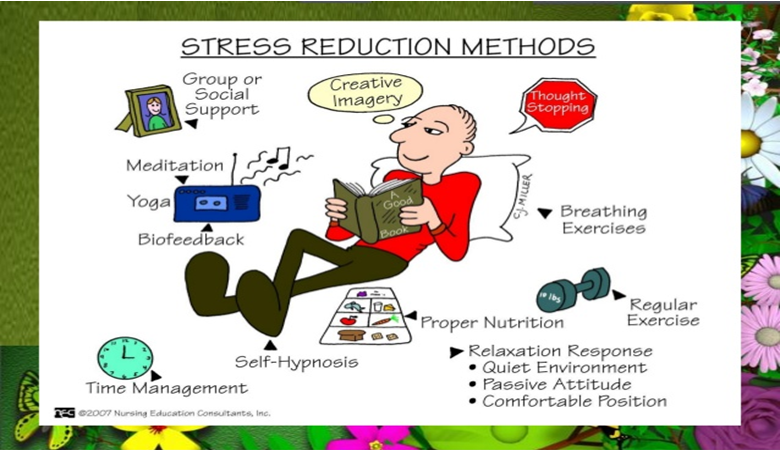
Valuing