Assessment 4: Civics & Citizenship Notes
Key concepts (p356-359)
Democracy
· Any system of government run by the people, for the people.
· Typically, citizens elect representatives which then make laws on behalf of the people that elected them – representative democracies.
· Originated from Greek words ‘demos’ [citizen], ‘kratos’ [rule]
· In Australia, voting is compulsory for everyone over 18.
Democratic Values
The beliefs and ideals that are held by our society as a democracy.
Value | Definition |
Respect | Treating others with consideration and valuing their views, beliefs, and rights |
Equality | Rights and privileges for all without discrimination of any form; all citizens have the right to the same opportunities |
Fairness | All people are treated fairly/without injustice and are given equal opportunity; a ‘fair go’ |
Freedom | Rights, privileges, and responsibilities for all without interference or control from other citizens or the government |
Westminster system
· A form of parliamentary government originating from the UK.
· Has been adopted by several countries (e.g. Canada, New Zealand)
· Base of Australia’s system of government.
· Includes:
o A lower house of parliament that has been elected democratically by the people.
o A head of state/sovereign (e.g. Queen, Governor-General) whose job is mainly ceremonial.
o A head of government (e.g. Prime Minister) who leads the majority of representatives in the lower house.
o an executive/cabinet made up of members of parliament (MPs)
o an independent civil service that serves the government in power
o an independent judiciary (made up of the courts) which upholds the law.
Justice
· Can have multiple definitions depending on societies and cultures.
· Overall, the Australian concept of justice is that people should treat each other in a manner that is fair and balanced.
· Legal system has strong ties with the concept of justice.
· Laws and rights are written and enforced so that we can enjoy a fair and just society.
· Retains the trust of citizens and stops people from breaking the law.
Participation
· Refers to the way citizens contribute to or take part in society.
· In Australia, we can participate by voting in an election/referendum, serving on jury, or paying taxes.
· These help our government deliver services to the community which we, in turn, benefit from
Rights & Responsibilities
· Refers to our entitlements and duties as citizens.
· Rights ensure we are able to have a say in how our country is run.
· Responsibilities ensue we contribute to society in order to keep in running as a strong democracy
Right | Responsibility |
the right to vote | The responsibility to vote |
The right to a trial by jury | Jury service |
The freedom to religion | The responsibility to respect the religious choices of others |
Freedoms (p368-379)
•Freedom of speech
•Our right to express information, opinions and beliefs wihout fear or persecution
•Not limited to speaking - also includes the freedom to express ideas in written form or art
•Allows us to participate in society by expressing our opinions and debating important issues.
•Extends to the media, opposition, political parties, etc who want to express an opinion about the government.
•Freedom of Movement
•A citizen's ability to freely move between states/regions within their own country, or to leave and re-enter our own country without interference from the government
•Migrants who are not citizens may have conditions placed on their visas.
•The government has a responsibility to ensure that freedom of movement is not unresonably restricted.
•Extends to anyone legally entering Australia
•Non-citizens entry is decided by the government.
•Freedom of Association
•The right to peacefully form/join a group, club, or organisation
•Freedom of Assembly
•The right to peacefully gather or meet in public/private places
•Therefore gives us the right to peacefully protest and persuade people who make decisions to consider the needs and wants of citizens
•e.g. rallies, sit-in, marches, and demonstrations
•Freedom of Religion
•The right to believe in or practise your desired religion
•Allows us to live with harmony with one another
•Australia is secular, meaning religion does not have an effect on political decisions. Also known as separation of church and state
Freedom | Bounds of Law |
Speech |
|
Movement |
|
Association | Criminal Workplace relations Anti-discrimination |
Assembly | Criminal Public assembly |
Religion | Criminal |
Criminal:
· Prevents the action or the encouraging of terrorism, violence, harm, or crime.
· Protects the public.
o e.g.: It is illegal to encourage violence, terrorism, or harm to others.
Anti-discrimination:
· Prevents discrimination, intimidation, and harm of a particular group of people.
o e.g.: It can be unlawful to exclude someone based on their disability.
Terrorism:
· Restricts the joining of terrorist organisations and re-entry of a believed terrorist (The Foreign Fighters Act)
Customs & Border Protection:
· Ensures the safety of others.
o e.g.: A person may be detained and quarantined to prevent the spread of disease if they are infected when re-entering Australia.
Citizenship & Passport:
· Ensures the legality of citizenship or permanent residence.
o e.g.: People illegally in Australia may be deported.
Entry Restriction:
· Prevents acts such as trespassing.
o e.g.: People are not allowed to enter private property without permission.
Workplace relations:
· Prevents unfairness shown towards a person or group of people for being part of a union.
o e.g.: An employer is not allowed to fire a worker for being part of a union.
Public Assembly:
· Prevents violence or disturbance during an assembly.
o e.g.: Some states allow police to end a gathering if it is believed it will become violent, riotous, or disturbing.
Information:
· Prevents the sharing of personal or private information without permission.
o e.g.: Journalists are not allowed to publish personal or private information of the people they report of without permission.
Media, broadcasting, and telecommunications:
· Prevents media not being shared as planned.
o e.g.: Classification laws; prevents extreme/obscene content being shown to children without a warning.
Active participation in democracy (p380-381)
Becoming Informed:
· Democracy can only work if the people know about the issues they are voting on.
· This can be difficult as several influential people and/or outlets that want to promote their own political agenda.
· Mainstream media outlets often show a biased representation of political issues.
· To become informed, we must think critically and consider a variety of different sources before we form an opinion.
Voting:
· As informed citizens, we can participate in democracy by voting to elect the people who we feel will best represent us.
· (Nearly) All Australian over the age of 18 are required to vote.
· Anyone on the electoral roll who does not vote has to pay a fine.
· Voting is not only a right, but a responsibility.
· When we vote in an election, we are voting for an electorate representative.
· In Australia, we divide the country into 150 electorates – separate geographical areas of the country, so that the needs of people in other area are able to be represented more equally.
· Every electorate has an elected member of parliament (MP) who represents the interests of the people in their region.
· MPs, as elected representatives, may be responsible for:
o acting as a spokesperson for their electorate
o prioritising government activities and funding for the electorate
o dealing with concerns in the electorate on government matters
Direct Action:
· Also known as non-violent resistance
· A way to raise awareness about political issues.
· Can include protests such as marches, demonstrations, boycotts, and strikes.
· You do not need to be of voting age to participate in direct action.
Lobby Groups:
· Also known as interest groups
· Groups that focus on working on behalf of a particular cause to influence political decisions.
· Lobby groups may attempt to sway decisions through media campaigns or direct communication with federal MPs, state MPs, and ministers.
Contacting an MP:
· A form of actively participating in democracy is contacting our elected representatives.
o e.g. Write a letter to your local MP about an issue you are concerned about, aiming to convince then to fight for the issue in parliament. Strengthen your argument by adding a petition.
Law In Action (p400-411)
Need for rules and laws:
· Laws are needed in order for a community to live together peacefully without violence or crime.
· Society needs rules/laws to guide us.
· There are non-legal rules (not enforceable by government), and legal rules (or laws); enforced by government.
Examples of rules | Examples of laws |
Don’t be late to school. | Don’t go over the speed limit. |
Do chores. | Don’t kill someone. |
Don’t kick the ball in basketball. | Do not participate in piracy. |
Don’t plagiarise. | Do not burgle or steal. |
· Some other reasons for making laws include:
o Laws give us guidelines.
o Laws settle disputes.
o Laws allow us to punish people.
o Laws protect our rights.
Statutory Law
Laws created and passed by both federal and state parliament.
Preparation of a Bill > First Reading > Second Reading debate >Third Reading > The Senate > The Governor General >The New or Modified Law
· A bill is a formal document prepared as a draft Act or Law.
· It is created when people feel the need to change an existing law or establish a new law.
· In the first reading, only the title of the Bill is read, giving members a chance to read the Bill in their own time.
· Member who has introduced the Bill explains why it has been introduced.
· Other members ask questions, suggest changes, and debate the Bill.
· he Bill and changes to it are voted on, and if passed, goes onto the third reading.
· More time is given for details of the Bill and changes to it.
· Members of the HoR (House of Representatives) will vote on the Bill.
· If the vote passes, then Bill moves to the Senate for consideration.
· The Bill goes through the 3 reading stages again.
· It passes to and from the upper & lower houses until both agree to
changes in the Bill or until the Senate rejects it.
· The Governor-General (Monarch’s representative) will review and approve the law
by giving the law royal assent.
· Assenting the law is usually just a formality.
Common Law
· Laws created when a judge has to make a ruling about a case that is not covered by statutory law.
· The role of a judge is to interpret statutory laws and apply them to individual cases.
· In some instances, statutory law is not clear about how a particular case should be dealt with.
· If an issue goes to court, a judge from a superior court must decide how to resolve the issue in a just way, setting a precedent.
· A precedent is a previous case or example that is used as a guide for making decisions when similar circumstances arise.
· In Australia, most of our basic rights are protected by common law.
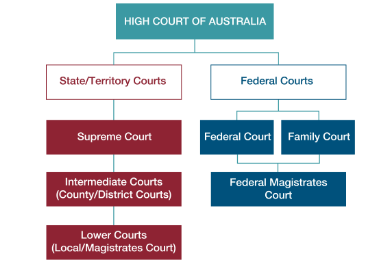 The High Court and the Federal Court are superior courts that can set a precedent.
Criminal Law
· Refers to the group of laws that have been put in place to protect us from harm.
· It is a crime when these laws are broken.
· Criminal law can be divided into indictment offences (serious offences) and simple/summary offences (less serious offences).
· When a person is caught or accused of a crime, the court will consider both a guilty act and a guilty mind; meaning the person intended to break the law.
· In WA, ages 10-17 must go to the Children’s Court of WA; a person under 10 years will not go to court.
When a person goes to court for a crime, it is referred to as a criminal trial or hearing.
In court, the accused is called the defendant; the party appointed by the court to prove the accused is guilty is the prosecution.
At the start of the case, the accused will plead guilty or not guilty.
If the accused pleads not guilty, the prosecution must use evidence to prove the accused to guilty beyond reasonable doubt; if there is any chance the accused is innocent, they cannot be found guilty.
Both the party representing the accused and the prosecution present a case to the court. This is known as the adversarial system.
Serious criminal cases are heard in front of a jury.
A jury is made up of 12-18 random citizens selected to assist in deciding on the outcome of a trial.
After the case is presented from both sides, the jury must then decide whether or not the accused has been proven guilty beyond reasonable doubt.
Punishment | Description |
imprisonment | An offender is sentenced to a set amount of time in prison. |
fine | An offender must pay money to the court or council. |
community-based order | An offender can be ordered to do a certain number of hours of unpaid work for the community. |
suspended sentence | An offender can have their sentence suspended; they don’t have to serve it at all or not fully; on the condition that they do not commit another crime during the suspension. |
good-behaviour bond | An offender can accept no punishment if they promise to behave for the duration of the bond. Usually the sentence given by the Children’s Court. |
Civil Law
Protects individuals.
Typically deals with disputes over actions (or lack of) that results in loss or harm.
If an individual has their right infringed and suffers or is harmed as a result, that individual can sue the other party for damages.
When one party takes action against another, they may not go straight to court. They can negotiate a solution between themselves.
Sometimes, they might need mediation - a method of resolving civil disputes and involves the assistance of an independent third party to moderate the discussion and reach a solution.
If none of these are successful, they go to court.
The person taking the dispute or complaint to court is known as the plaintiff.
The person being sued is the defendant.
The plaintiff is able to choose whether a jury in involved in the case.
If the plaintiff wins the dispute, they are entitled to civil remedy; the method by which the defendant must return to the plaintiff their original position before the dispute.
Civil remedy usually takes the form of money, known as damages.
Civil law cases are judges on the balance of probabilities; the judge will support the claim if it is more likely than not that the defendant caused the plaintiff harm.
Types of Civil Disputes:
Family Law
Contract Law
Tort Law
Defamation
Nuisance
Trespass
Negligence
Aboriginal & Torres Strait Islander Law
· Customary law is the traditional laws of Aboriginal & Torres Strait Islander peoples.
· The Dreaming is a belief system at the centre of all Aboriginal cultures, which has different meanings for different Aboriginal groups; it gives meaning to everything (including creation, spirituality, family, the land, and the law). The Dreaming sets the rules governing relationships between the people, the land and all other things for Aboriginal people.
· An Elder is a key person & keeper of cultural and spiritual knowledge within Aboriginal communities.
· Many of the different groups of Aboriginal peoples didn’t believe in the idea of owning land, rather they saw the land as sacred, to be looked after, not owned.
· Customary Law still has major significance for many of Australia’s Aboriginal & Torres Strait Islander peoples. It has not been officially recognised as Australian law; however, legal developments have been made to recognise it alongside our current legal system.
· e.g.: The 1998 Northern Territory of Galarrway Yunupingu vs. Micheal Mc Rostie.