Chapter 6
Personality is the sum of thoughts and feelings that makes someone unique
Nature vs Nurture: Questions if the inborn qualities or personal experiences shape who we really are
Blank Slate principle: This principle states that every newborn baby is born as if they have a blank slate and they will write their personal experiences
Leaders cannot change human nature, but they can have an affect on that environment.
Birth order theory: This theory states that person’s rank within their family can have an affect on their intelligence and personality.
This theory is an easy way to begin thinking about how the environment one grows up in can change up their personality
Charisma:
Charisma is invisible energy that a person has which attracts other people
Strong charisma can have a negative effect as the followers might be too flattered and will ignore any problems to impress the leader
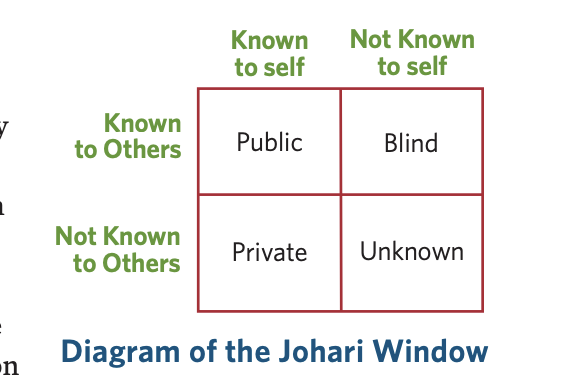
Johari Window: A tool to explore relationships between ourselves and others. Explores self-perception
This is split into 4 arenas:
Public Arena
Blind Arena
Private Arena
Unknown Arena
Myer-Briggs Type Indicator(MBTI) is a self-assessment test in which people reflect on how they work/learn.
According to MBTI, there are 16 types of personalities
The MBTI supports a leader’s development by making the leader understand themselves so that they become effective in working with others
Thinkers are cool, and not swayed by emotion
Feelers have strong sense of empathy toward others
Judgers value structure, order, and predictability
Perceiver keeps their options open
Motivation
Maslow’s Hierarchy of Needs suggested that individuals were motivated by unfulfilled needs.
Self-Actualization Needs
Esteem Needs
Love or Belonging Needs
Safety Needs
Physiological Needs
Maslow says that we are motivated by a need of love or a basic connection with people.
He also says that “What can a man be, he must be”. This describes self-actualization
The hierarchy gives a framework of understanding what motivates people
Hawthorne Studies: This is when leaders pay attention to their people and treat them as partners
Classical Conditioning: The process whereby a living thing learns to connect a stimulus to a reflex.
People found that classical conditioning is a method to motivate people to pursue a goal
The Milgram Experiment: Milgram discovered that the obedience to authority was its powerful motivator
Interpersonal conflict:
In any relationship, there will be conflict
Defense mechanisms:
Defense mechanisms are ways to prevent us from any psychological injury
Defensive behavior is normal, but it can prevent us from seeing different things
Defense behavior can become a habit
Displacement: When someone redirects feelings from about something to another thing less threatening
Projection: Taking someone’s unacknowledged thoughts and falsely attributing them to someone else
Rationalization: When someone devises reassuring or self-serving explanations for their behavior
Intellectualization: This is when a person tries to remove the emotional side of a situation examines their problem in an excessively abstract way.
Denial: When a person fails to acknowledge what has or will happen
Suppression: When a person knows that they have anxiety or problems, they decide to put them aside choosing not to even think about them.
Withdrawal: This is when a person removes themself from people, events, and things around them to bring back painful feelings or thoughts
Conflict:
Conflict is a disagreement through which a person perceives a threat to their needs, interests, or concerns
Leaders are more interested in solving conflicts because it prevents the teams ability to succeed
Conflict creates an uncomfortable feeling which can affect everyone on the team
Leaders focus on changing people’s behavior
Methods of managing conflict:
Zero-sum game: This sees conflicts in only win or losing terms
Mediation: An attempt to resolve conflict by using a third party to help a decision
Leading in a Diverse Society:
Leaders need to have respect in a diverse team
Being prejudiced means to pre-judge someone
The Armed Forces were one of the first institutions to racially segregate.
CAP was founded upon a commitment to diversity.
Harassment: unwelcome conduct
Retaliation: Someone seeking revenge against someone else who objects to harassment or discrimination
5 ways to end hate
Rise up
Pull together
Speak out
Support the victims
Teach tolerance