6.1 Exponential growth and decay
What does “a” and b” do?
a is the starting value
b is the multiplier
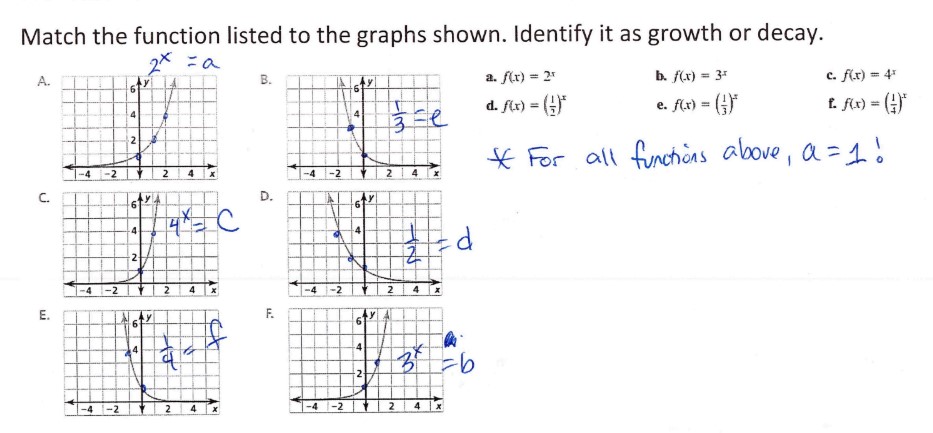
Identify growth vs decay function ***
growth / b is found as y at x = 1
decay / b is y at the x = -1
Uses in real life
Finances, depreciation (house, car etc), population
Compound interest problem ***
A = P(1 + r/n)nt
A = Final amount
P = Starting value / Principal amount
r = Rate as decimal (3% → 0.03)
n = # of compounds (1 → annual, 2 → semi-annual, 4 → quarterly, 12 → monthly)
t = Time in years
For example, if you invest $1,000 at an annual interest rate of 5% compounded annually for 3 years, you would substitute the values into the formula as follows:
A = 1000(1 + 0.05/1)1×3
A = 1000(1 + 0.05)3
A = 1000(1.05)3
A = 1000 * 1.157625
A ≈ 1157.63
Match an exponential function to a graph
Growth Functions: a > 0, b > 1
Increases overtime, J shape
Domain: all real (-infinity, +infinity)
Range: y > 0
Asymptope: y = 0
y-int: (0,a)
Decay Functions: a > 0, 0 < b < 1
Decreases overtime, reverse J
Domain: all real (-infinity, +infinity)
Range: y > 0
Asymptope: y = 0
y-int: (0,a)
For each graph below, determine what the value of “b’” is.
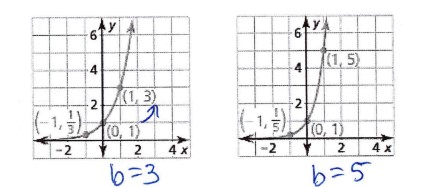
b in this function is the multiplier, meaning the increase is b. seeing.
b is the also the point at x 1
Real life problem ***
The value of a car y (in thousands of dollars) can be approximated by the model y = 25(0.85)t, where t is the number of years since the car was new.
a. Tell whether the model represents exponential growth or exponential decay.
Decay → (1 - r) = (1 - 0.85) = 0.15 or 15%
b. Identify the annual percent increase or decrease in the value ofthe car.
15% decrease
c. Estimate when the value of the car will be $8000.
7 years (no clue why)
You deposit $9000 in an account that pays 1.46% annual interest. Find the balance
after 3 years when the interest is compounded quarterly.
A = 9000(1 + 0.0146/4)4 × 3