Microscopes
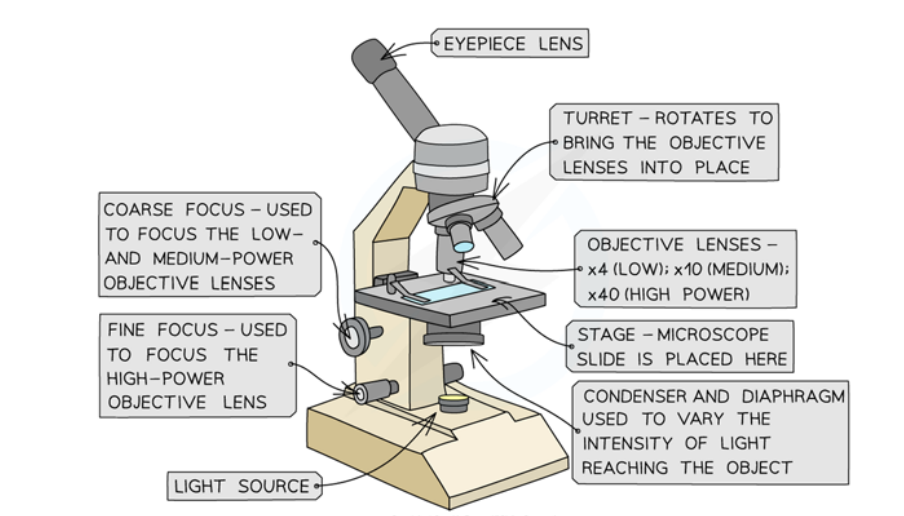
Light microscope‐ uses a beam of light to form larger more detailed images. They can magnify up to x1500 but their resolution is low (0.2μm), therefore even at the highest magnification ribosomes, lysosomes and ER are too small. Light microscopes can be used to view living cells/organisms, but they must be thin and often require staining to distinguish organelles more clearly.
Electron microscopes have much higher magnification and resolution because they use a beam of electrons not light and their wavelength is smaller. There are two types of electron microscope:
Transmission Electron Microscope (TEM)
• It works by shooting a beam of electrons at a thin slice of a sample and detecting those electrons that make it through to the other side.
• Magnification of x500,000
• Resolution of 0.05‐2nm
• The TEM lets us look in very high resolution at a thin section of a sample.
• This makes it particularly good for learning about how components inside a cell, such as organelles, are structured internally.
Scanning Electron Microscope (SEM)
• Uses a focused beam of high‐energy electrons which reflect off the surface of structures
• Gives a 3D image, samples do not have to be thin/cross sections
• Magnification of x100,000
• Has a resolution of 5‐50nm
• Electron microscopes require a vacuum as air particles would interfere with the beam of electrons so the specimens must always be dead.
Light microscopes are the most common microscopes used by biologists. They are relatively cheap, easy to use, and they can magnify living cells or small organisms so their activity and behaviour can be studied.
As light must pass through the specimens to be seen they must be thin. A stain is often used to colour cell structures so that they can be seen more easily as most cells are transparent and don’t contain pigments.
Magnification is making an image larger than the object – when we use a microscope we can increase the magnification by using a higher powered objective lens. This allows us to see in more detail because it increases the size of the image of small details.
The invention of electron microscopes in the 1930’s allowed scientists to see cells in more detail. Electron microscopes helped us to see smaller organelles such as ribosomes; something the light microscope cannot magnify because they are too small. It also shows us the details of the insides of organelles like mitochondria. This helped further our understanding of sub‐cellular structures.
Electron microscopes have a higher magnification and resolution than light microscopes.
Resolution is the ability to distinguish between two objects asseparate points. They use a beam of electrons and can magnify up to 2 000 000 times. Electron microscopes are large, very expensive, and cannot use live specimens.