Lecture G - The World to 1945
Ending of Combat in 1918
Combat officially ended in November 1918, leading to significant challenges for the warring states.
age of anxiety
Immediate and Long-term Consequences:
The transition to peace was complex and mired with problems due to past promises made to populations and stark realities.
The “Spanish Flu” pandemic emerged soon after the war, causing approximately 20 million deaths globally.
German, Austrian, and Russian empires fell
Famine and starvation
Civil War (Russia)
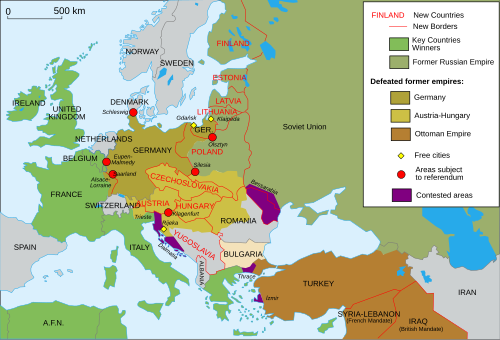
led to new borders and nations being established, resulting in many displaced individuals.
The necessity for official documents, such as passports, arose for displaced individuals needing to prove their national affiliation.
Initial efforts led by future League of Nations members focused on the resettlement of populations affected by these transformations.
Immediate Consequences
Return to a Peacetime Economy:
Governments had exercised full control over economic activities during the war, prompting debates on whether to revert to a free-market economy.
Dislocated Populations:
A significant number of people were dislocated due to fighting and altered borders.
Destruction and Reconstruction Costs:
The level of destruction experienced incurred substantial costs for rebuilding and rehabilitation efforts.
End of Monarchical Empires:
The four major empires (German, Russian, Austrian, Ottoman) ceased to exist.
New Nations and Governments:
Numerous new countries and governments formed amidst the collapsed empires.
Bolshevik Takeover in Russia:
A fundamental transformation in Russian governance following the Bolshevik Communist Revolution.
Threat of Communism and Germany's Military Potential:
Despite restrictions from the Versailles Treaty, Germany's potential for military recovery was perceived as a significant threat, alongside the global fear of communism.
Long-Term Consequences
General Economic Dislocation:
Economic issues emerged, with Europe in debt.
The U.S. became a major manufacturing and financial center in the world economy.
Colonial Issues in Europe:
European colonial powers faced pressures regarding promises and cost of maintaining control.
Effects on Colonial Peoples:
Wilson’s and Lenin’s ideas influenced independence movements among colonial populations.
Disillusionment with War:
Growing skepticism regarding the outcomes of the war, including personal and national sacrifices made.
Total casualties included nearly 10 million soldiers dead and 20 million wounded.
Cultural Disillusionment:
Disbelief in "progress" and the beneficial uses of science and technology mirrored through movements like DADA, Surrealism, and Modernism.
Continued Fear of Soviet Union:
Concerns remained regarding the persistence and survival of Communist states and their influence.
Violence Against Veterans:
Veterans continued a reliance on violence, influenced by their wartime experiences.
Rise of Extreme Nationalism:
Nationalist sentiments grew, influenced by dissatisfaction with peace treaties and socio-economic insecurities.
Establishment of International Organizations:
The League of Nations was intended to manage international disputes through diplomacy rather than military means.
The League lacked enforcement capabilities and primarily relied on economic sanctions against aggressor states.
Despite its ambitions, the League ultimately failed to prevent conflicts due to member states' disregard for its sanctions.
Its notable achievements included aiding in the resettlement of peoples and distributing food.
Article 14 of the League Charter:
Established the Permanent Court of International Justice to resolve international disputes submitted by member states.
The court would offer advisory opinions on questions referred by the assembly or council of the League.
League of Nations and Colonial Oversight
The Mandate Commission monitored territories taken from Germany and the Ottoman Empire under British and French control.
The Commission mandated annual reports from colonial powers about their progress towards independence for these territories.
Wilson’s 14 Points:
Advocated for the end of colonial empires, emphasizing the need for open markets in the U.S.
Colonial powers, primarily Britain and France, initiated paths toward independence by developing education and economic infrastructures, despite underlying assumptions about the capacity of colonized peoples.
Workers' rights were also a focus through international organizations addressing conditions regardless of location.
Interwar Developments and Treaties
Washington Naval Treaty (1922):
Agreement between the U.S., England, France, Japan, and Italy to limit naval capacities, aiming to reduce tensions.
Limited the size and configuration of major navies, producing relatively adherence to the treaty terms.
Kellogg-Briand Pact (1928):
Nations unanimously signed this pact, renouncing war as a national policy.
Soviet Union Formation and Leadership:
Under Lenin and subsequently Stalin, the Soviet Union imposed rapid industrialization and urbanization through oppressive terror tactics.
Emergence of Fascism and Nazism:
In Italy, Mussolini’s fascist regime arose in the early 1920s; Nazism, led by Hitler, emerged in Germany by the early 1930s.
Nazism intertwined racism with extreme nationalism, promoting a belief in racial superiority and utilizing militaristic governance.
Nazi Regime Policies:
The regime systematically targeted and stripped rights from Jews, the disabled, and various minorities leading to mass murders by late 1930s.
Economic Challenges and Path to World War II
The Great Depression:
Began with the stock market crash in 1929 NY, leading to global economic upheaval despite the U.S. practicing isolationism.
NY was the leading center of the world, so when it crashed, it rippled worldwide
Trade between major industrial nations came to a halt
Consumption of raw materials dried up
Contributed significantly to the rise of Nazism in Germany and Imperial Japan’s aggression in Asia, ultimately culminating in the attack on Pearl Harbor in 1941.
WWII
Outbreak of World War II:
Conflict initiated in Europe in 1939; Japan's aggressive actions in Asia (China) began as early as 1936, coinciding with the Allied victory in World War I.
Hitler’s declaration of war against the U.S. after the Pearl Harbor attack escalated existing hostilities.
Nature of World War II
Targeting of Civilians:
The war marked a distinct shift in targeting civilian populations based on race, religion, gender, class, and political alignment, particularly seen in the Holocaust, which resulted in the murder of approximately 6 million Jews.
The war's brutality was underscored by systematic extermination practices, distinguishing it from previous conflicts.
Mass Production in Warfare:
Superior production capabilities, technological and scientific innovations significantly influenced war outcomes, with the U.S. contributing to 60% of war material.
There was an introduction of computers, jet planes, long-range missiles, and nuclear/chemical weapons.
Inhalation of mustard gas would eat away at your lungs months to years after the fact, slowly leading to death
Global Nature of Conflict:
Warfare spanned worldwide, excluding only the Americas and Antarctica. Even within the Americas, active participation was predicated on war declarations.
War on all Oceans
Colonial Contributions to the War Effort:
Colonies were mobilized to support their colonial governments, with promises founded on potential independence.
i.e. India
Collaboration between Capitalist and Communist States:
Temporary alliances were formed to combat shared adversaries, laying the groundwork for future tensions and Cold War dynamics.
The enemy of my enemy is my friend, typa dynamic.
Post-war, these fundamental differences re-emerged, giving rise to the Cold War.
Post-War Realities
Following the Allied victories in 1945, the global landscape transformed drastically.
An estimated 60 million people lost their lives, predominantly civilians, with significant military casualties.
The mass murder and genocide that occurred, for instance, affected approximately 25 million Chinese civilians during the Japanese invasion, necessitating a deep moral reckoning and critical questions regarding global responses to such atrocities.
Physical destruction across continents required restorative strategies and comprehensive justice frameworks.