S1 Fall Exam
UNIT 1 - ATOMIC STRUCTURE & PROPERTIES
isotope - same protons and electrons but diff. neutrons » diff. mass
photoelectric effect: high enough energy » ejection
* max e- in main energy levels is 2n²
energy lvl » sublvl » orbital
aufbau exceptions: d & f “borrow”
isoelectronic - same e- configuration
binding E: hν - KE
F α q1q2/r²
IE ^>; +E is endothermic
EN ^> F***; no noble gases
EA ^>; -E is exothermic
AR v<
IR: least protons is the largest when they are isoelectronic
D-block: 2 valence e-
FORMULAS
avg. atomic mass = ∑(% each)(mass each)/100
percent mass = (mass element)/(molar mass) *100
UNIT 2 - MOLECULAR & IONIC COMPOUNDS
covalent bonds based on EN (so noble gases excluded)
nonpolar covalent: two of same OR C&H
polar covalent: dipoles w/ partial charges
ionic: M + NM
as atoms approach, potential E decreases; but too close leads to repulsion between nuclei
happy medium: min. potential E
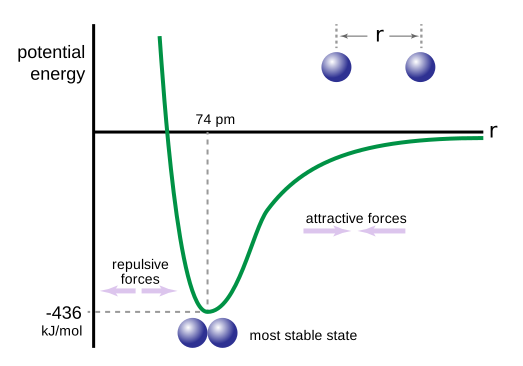
inverse rls between bond length and E
larger AR » long, weak bond; smaller AR » short, strong bond
(ionic): charges, distance - coulomb’s law
ionic lattice structure - high MP&BP, low volatility&VP, brittle, conduct when aq.
*presence of H2O implied in dissolving equation
covalent IMFs - low MP&BP
interstitial alloy: smaller atoms fill spaces
substitutional alloy: replacement with other atoms (EX: sterling silver, rose gold)
(N - A)/2 = S
*H & F are never central atoms (least EN)
expanded octets start from 3d orbital
incomplete octets are usually Be or B
isomers: same molecular formula, diff. arrangment (EX: pentane, isopentane, neopentane as C5H12)
overall dipole moments go to most EN
sum of formal charges is total charge of polyatomic ion
lowest formal charges & (-) charges on most EN
cis isomers: same sides of double bond
trans isomers: diff. sides of double bond
*diff. conformations are not isomers
FORMULAS
formal charge = (neutral atom # of e-) - (central atom # of valence e-)
UNIT 3 PART 1 - IMFs & PROPERTIES
LD » DiD » DD» HB » ID » IB
LD: instantaneous dipole = induced/polarized dipole (“atomic peer pressure”)
polarizability - **e-, *SA
(EX: I2, high sublimation point)
ID: **charge, *AR
HB: N,O,F lone pair to H+
**↑BP, ↓VP
covalent network solids - diamond & graphite (allotropes), silicon dioxide, silicon carbide/quartz
diamond- tetrahedral; high MP&BP
graphite - trigonal planar 2D plane; high MP; single-plane conduction
molecular solids - low MP, nonconductive (EX: I2)
solUTE dissolves in solVENT
chromatography - stationary and mobile phases
eluent - fluid entering
eluate - fluid exiting
elution - process of moving compund using solvent
FORMULAS
Rf = (mixture component distance traveled)/(solvent distance traveled)
UNIT 3 PART 2 - GASES & SOLUTIONS
↑P↑T; ↑V↑T; ↑P↓V
(STP): 1 mol (g) = 22.4 L
effusion - gas escaping through small opening
diffusion - homogenous mixture formed through mixing of two diff. gases
urms = sqrt[3RT/MM]
KMT: gas particles (1) are spherical, (2) move in straight lines, (3) have no volume, (4) have no IMFs, (5) undergo perfectly elastic collisions, KE conserved
avg. KE dependent on K temp. ONLY
KE = ½MMv²

distribution graphs should consist of same areas
deviation: high P, low T
endothermic - breaking bonds
exothermic - forming bonds
enthalpy - heat of solution (△H)
UV & visible - short λ, high E
IR - intermediate λ, E
microwave - long λ, low E
low absorption = higher reflection
FORMULAS
PV = nRT (atm L mol⁻¹ K⁻¹)
Pa = Ptotal*Xa
Xa = (mol A)(total mol gas)
(rate effusion A)/(rate effusion B) = sqrt[(MM B)/(MM A)]
A = εbc
(absorbance) = (molar absorptivity)(path length)(concentration)
UNIT 4 - CHEMICAL REACTIONS
separating physical components - chromatography, filtration, distillation
combustion: hydrocarbon + O2 → CO2 +H2O
**subscript H/2: even is coeff. 1, odd is coeff. 2
strong solubility: SNAP, So I CLearly BRought NO CLean CLothes, G1&2 metal hydroxides
titrant - from burette, known M & V
titrand/analyte - into flask, known V, unknown M
acids lose H+; bases gain H+
amphoteric - both acid and base
LEO, GER
(oxidation #s)
pure element: 0
monatomic ion: charge
F: -1
O: -2
O w/ F: +1, +2
O w/ perioxide: -1
H: +1, -1
G1: +1, G2: +2
Al: +3
FORMULAS
percent yield = (actual)/(theoretical)
UNIT 5 - KINETICS
collision theory criteria:
reactant particles must collide
Ea met
correct molecular orientation
increasing reaction rate: increasing concentration, SA, temp. or adding catalyst
△H does not affect reaction rate
unimolecular (fastest) » bimolecular » termolecular (slowest)
rate-determining step - slowest, highest-reaching potential energy
intermediate: ○»●——●»○
catalyst: ●»○——○»●
**neither present in overall reactions
rate law determined from reaction mechanism and/or experimental data
**no intermediates in final rate law
zero order: linear, constant rate
first order: constant half-life
second order: exponential
FORMULAS
rate = △M/△s
rate = k[A][B][C]
zero order lin: [A]t - [A]₀ = -kt
first order lin: ln[A]t - ln[A]₀ = -kt
second order lin: 1/[A]t - 1/[A]₀ = kt
t½ = ln2/k