Patrycja Kaminski - Earthquake Study Guide - 14775400
Earthquakes Study Guide
Three Types of Faults
- An Earthquake is the shaking and trembling of Earth’s crust as a result of the movement of rocks beneath the Earth’s surface.
- Earthquakes occur because of tectonic forces that assert stress on the crust.
- What is the footwall and hanging wall? The footwall lies below the fault, you can walk on the footwall. The hanging wall lies above the fault and you can hang your canaries on it.
- Write the type of plate boundary associated with each.
- Write the type of stress force associated with each.
- Write movement of hanging wall for each earthquake.
This answers 4-6:
Normal fault: Hanging wall falls, stress force is tension, divergent plate boundary
Reverse fault: Hanging wall rises, stress force is compression, convergent plate boundary
Strike-slip fault: Hanging wall moves sideways, stress force is shear, transform plate boundary
Earthquake safety
1. Write the three words to remember if you experience an earthquake. Drop, cover, hold.
2. How does base-isolation technology protect buildings during earthquakes? Shock absorbing rubber pads and springs allow buildings to sway without cracking.
3. What is the # 1 cause of injury and death during earthquakes? Falling debris.
4. How well can scientists predict when and how powerful quakes will hit? Even with the use of advanced technology, scientists still can not predict the date and magnitude of a future earthquake.
Measuring Earthquakes
1. What is the difference between epicenter and focus of an earthquake? Epicenter is on the surface. The focus is in the crust where the fault moved.
2. Write the term of how energy gets transported through the earth. Seismic waves.
3. Write the three types of waves. “P”,“S” and surface waves.
4. Identify the term used to measure the energy of a quake. Magnitude.
5. Identify the magnitude where earthquakes are: a) first felt (about 2.5) b) are first considered dangerous (around 5) & c) at high end of destructiveness (6.5 and above)
6. Identify three scales used to measure earthquake’s power
Richter scale: Measures seismic waves on a seismograph
Moment Magnitude scale: Most modern method of measuring total energy released by a quake
Mercalli Scale: Uses Roman Numerals to rank the level of destruction for a given region.
7. How much more energy is released from a 4 magnitude quake compared to a 3? 32 times more energy is released when comparing a magnitude increase by 1.
8. How much more energy is released from a 5 magnitude quake compared to a magnitude 3? 32 x 32 = 1024 more energy. 322 for comparing quakes with increases by a magnitude of 2, 323 for comparing quakes with increases by a magnitude of 3, etc.
Earthquake Hazards:
1. Term for violent shaking of surface waves due to loose, soft, saturated soil (Think Loose Dirt + Water). liquefaction.
2. Term for second or third or more, smaller earthquakes following the main quake. After shock.
3. Term for a giant ocean wave caused by quakes occurring at the bottom of the ocean. Tsunami
Risks in USA
1. Use this map to determine earthquake risks for each state, including Pennsylvania. (Choose: high, moderate, low)
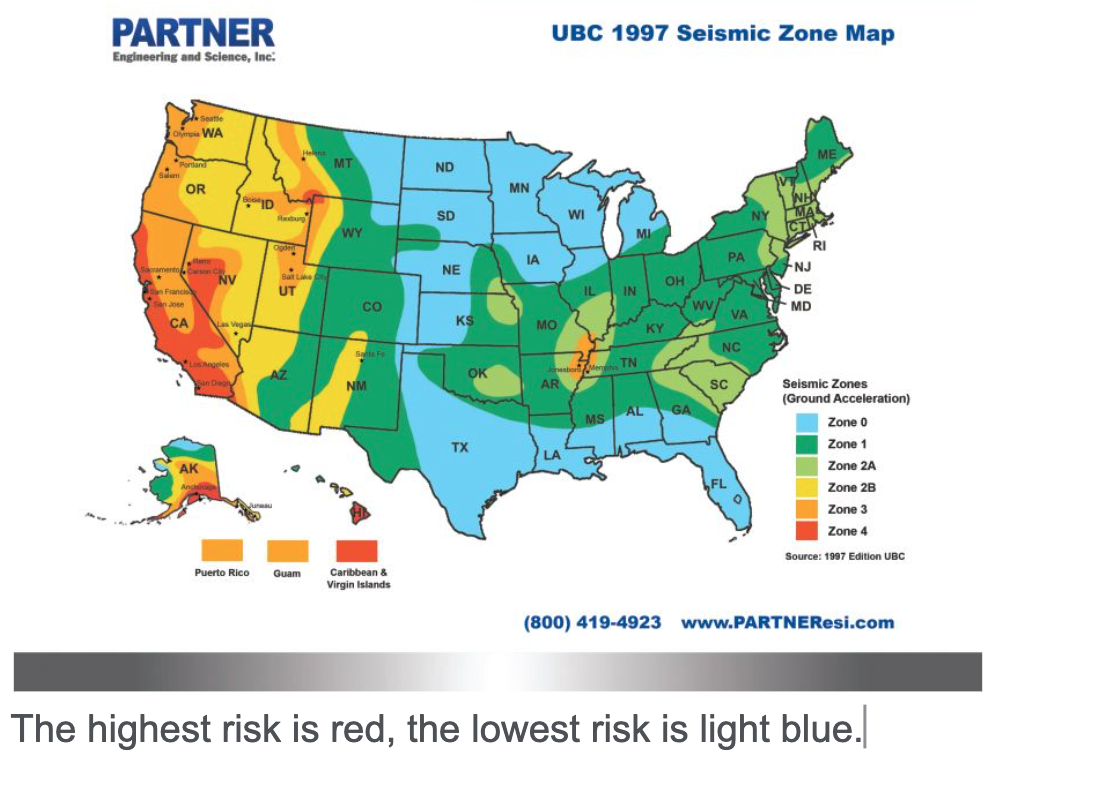
2. What three factors do geologists take into account when they determine earthquake risk for a region?
The proximity to plate boundaries, location of active faults and history of past earthquakes
Historic Earthquakes: Be able to identify the location, year, characteristics and tectonic cause for each of these earthquakes. You may use your chart for this portion of the test.
1. Most powerful of ever recorded 2. 1964 Most powerful in USA, tallest tsunami
3. Nearly destroyed entire city in 1906 4. Highest death toll of all in world history
5. Killed over 200,000 with tsunami 2004
6. Killed over 200,000 in 2010
8. Hit California in 1989. Disrupted the World Series.
Earthquakes and Plate tectonics:
- How many earthquakes occur per year and where are they most frequent.
Over 1,000,000. Most occur on plate boundaries
2. What is subduction? Occurs when one plate descends under another.
3. How does subduction lead to earthquakes and Mountain building, such as the Andes Mountains in South America? Earthquakes follow the depth of the subducting ocean plate and cause the continental plate to be uplifted during countless earthquakes resulting in mountains.
4. How are quakes constructive in terms of geology? Quakes cause uplift of land resulting in the formation of islands and mountains.