Lesson 1: Angles & Polygons
LO: Identify, calculate, and use angle properties to solve problems involvgin triangles, quadrilaterals, and polygons
1. Types of Angles ( Basics, Parts & Properties )
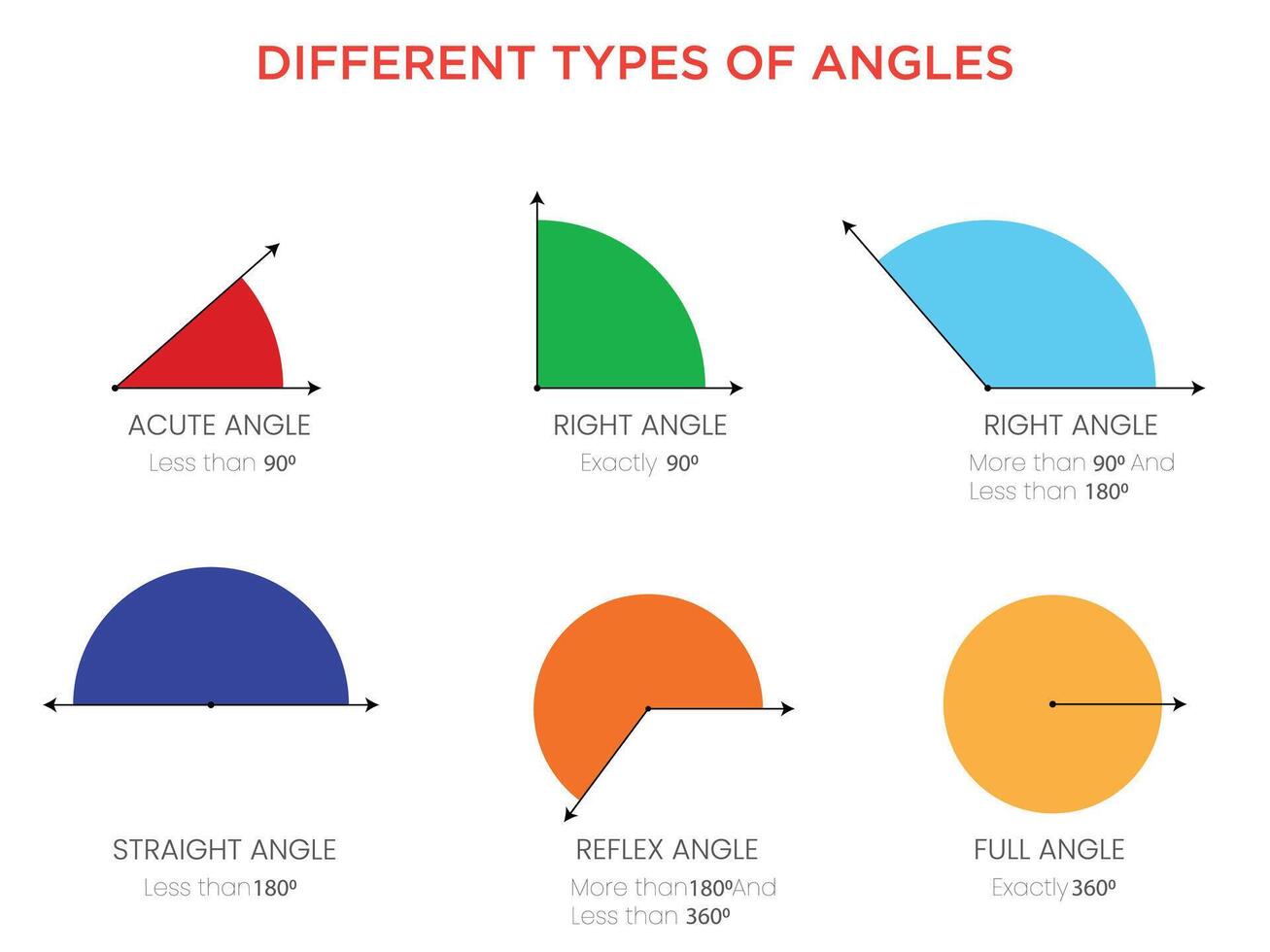
An angle measures a turn using degrees.
It is made up of two rays ( straight lines) that meet at the vertex.
Acute angle | Measures less than 90 degrees |
Right angle | Measures exactly 90 degrees |
Obtuse angle | Measures greater than 90 degrees but below 180 degrees |
Straight angle | Measures exactly 180 degrees |
Reflex angle | Measures greater than 180 degrees but below 360 degrees |
Full turn | Measures exactly 360 degrees |
Angles on a straight line | Always sum up to 180 degrees |
Angles around a point | Always sum up to 360 degrees |
Finding Missing Angles
Subtract the known angle or the sum of known angles from 180 degrees if on a straight line, or 360 degrees if around a point.
E.g. Calculation for missing angles on a straight line
A straight line is split into two angles
One is 57 degrees
The other angle is missing, labelled as “a”
degrees
degrees
E.g. Calculation for missing angles around a point
Imagine 4 angles meeting at a point
Three of the known angles are known: 115 degrees, 78 degrees, and 34 degrees
The fourth angle is missing, labelled as “x”
degrees
degrees
degrees
2. Vertically Opposite Angles
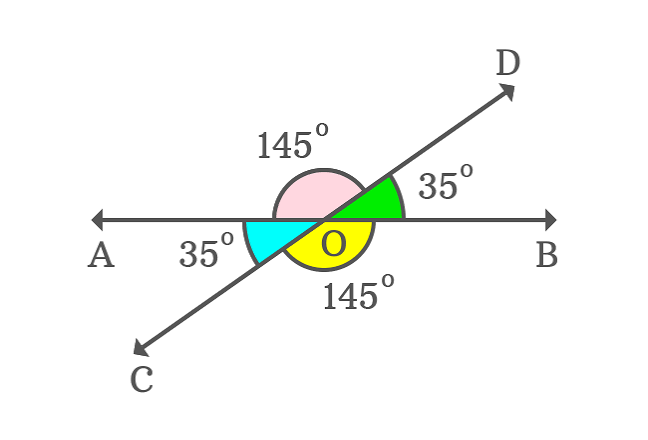
Vertically opposite angles are identified when two straight lines cross forming two pairs of angles, vertically opposite of each other and equal in measure.
Finding Vertically Opposite Angles
NOTE: ALL ANGLES MUST SUM UP TO 360 DEGREES
First Method
If you know one angle, the angle vertically opposite of it, is identical
Subtract the given angle from 180 degrees because it is on a straight line
The angle opposite of it will be identical
E.g. Calculation for finding vertically opposite angles ( 1st method )
Vertically opposite angles make an “x'“ shape
The top angle is 64 degrees
The bottom angle is unknown and labelled as “a”
The left angle is unknown and labelled as “b”
The right angle is unknown and labelled as “c”
Angle “a” is vertically opposite of the top angle, meaning they are both equal, therefore, degrees
Subtract 64 degrees from 180, .Therfore angle “b” is 116 degrees
And angle “c” is vertically opposite of angle “b”, therefore angle “c” is 116 degrees
Second Method
If you known one angle, the angle vertically opposite of it, is identical
Add both of them together
Subtract the sum from 360 degrees
Divide the answer by two because you are finding what two angles of the same measure are
E.g. Calculation for finding vertically opposite angles ( 2nd method )
Angle “a” is vertically opposite of the top angle, meaning they are both equal, therefore, degrees
Double 64,
Subtract 64 from 360 degrees.
Divide 296 by 2, . Angle “b’ and “c” are both 148 degrees each as they are vertically opposite of each other
3. Types & Properties of Triangles and Quadrilaterals
Triangles
A triangle is a 3-sided polygon whose interior angles sum up to 180 degrees.
Equilateral triangle | 3 equal sides and interior angles are each 60 degrees |
Isosceles triangle | 2 equal sides and two equal interior angles |
Scalene triangle | No equal sides and equal interior angles |
Acute triangle | All interior angles are below 90 degrees |
Right triangle | Has one right interior angle |
Obtuse triangle | Has one interior angle greater than 90 degrees |

Finding Missing Angles in Triangles
NOTE: ALL ANGLES MUST SUM UP TO 180 DEGREES, NO MATTER WHAT TYPE IT IS
Equilateral Triangle
Divide 180 by 3, because all 3 sides & angles are equal.
Isosceles Triangle
First Method ( If top angle is known )
Subtract the known angle from 180 degrees
Divide the result by 2 to know what the two base angles are individually
E.g. Calculation for finding missing angles in triangles ( 1st method )
Top angle is 52 degrees
Because the top angle is 52 degrees, subtract 52 from 180 degrees,
Divide 128 by 2, to find the two base angles which are both equal, . The two base angles are each 64 degrees
Second Method ( If one base angle is known )
Double the known base angle ( since they are equivalent )
Subtract the answer from 180 degrees to find the top angle
E.g. Calculation for finding missing angles in triangles ( 2nd method )
The base angle is 23 degrees
Because the two base angles are the same, double it,
Subtract 46 from 180 degrees, to find the top angle, . The top angle is 134 degrees
Scalene Triangle
Method
Add the two known angles together
Subtract the sum of the two known angles from 180, to get the missing angle
E.g. Calculation for finding missing angles in triangles
The two known angles are 45 & 89 degrees
Add 45 and 89 degrees together,
Subtract 134 from 180 degrees to find the missing angle, . The missing angle is 46 degrees
Right Triangle
NOTE: ONE ANGLE IS A RIGHT ANGLE, HENCE WHY IT IS CALLED A RIGHT TRIANGLE
Method
Add the right angle with the other known angle
Subtract the sum from 180 degrees
E.g. Calculation for finding missing angles in triangles
The other known angle is 67 degrees
Add 90 and 67 degrees together,
Subtract 157 from 180 degrees to find the missing angle, . The missing angle is 23 degrees
Acute Triangle
Method
NOTE: ALL THREE ANGLES ARE ACUTE ANGLES
Method
Add the two known angles together
Subtract the sum from 180 degrees
E.g. Calculation for finding missing angles in triangles
The two known acute angles are 89 & 45 degrees
Add 89 and 45 degrees together,
Subtract 134 from 180 degrees to find the missing angle, . The missing angle is 43 degrees
NOTE: ONE ANGLE IS OBTUSE, THE OtHER TWO ARE ACUTE
Method
Add the two known angles together
Subtract the sum from 180 degrees
E.g. Calculation for finding missing angles in triangles
The two known angles are 123 and 23 degrees
Add 123 and 23 degrees together,
Subtract 146 from 180 degrees to find the missing angle, . The missing angle is 34 degrees
Quadrilaterals
A quadrilateral is a four-sided polygon whose interior angles sum up to 360 degrees.
Square | 4 equal sides, interior angles are 90 degrees each |
Rectangle | 2 pairs of equal opposite sides, 4 interior angles are 90 degrees each, and two pairs of parallel sides |
Parallelogram | 2 pairs of parallel and equal sides, with equal opposite angles |
Rhombus | 4 equals ides and equal opposite angles |
Trapezium | 1 pair of parallel sides |
Kite | Two pairs of equal-length sides that are adjacent, one pair of angles is equal |

Calculating Missing Angles in Quadrilaterals
Missing Angle = 360 degrees - Sum of three known angles
5. Types & Properties of Polygons
A polygon is a 2D shape made of straight lines.
Sum of Interior Angles of Polygons
Sum of Angles = ( n - 2 ) x 180 degrees. n is the number of sides
Finding Individual Angle of a Polygon
Interior Angle = Sum divided by n