Gene Expression and Regulation LO's
Gene Expression and Regulation LOs
DNA and RNA Structure:
Learning Objective:
1) Describe the structures involved in passing hereditary information from one generation to the next. (IST-1.K)
- DNA & in some cases RNA is the primary source of hereditary information.
- DNA is a double-stranded antiparallel helix that stores hereditary information within its sequence and uses the base pairs guanine, cytosine, adenine, and thymine
- RNA is a single-stranded helix that uses the base pairs guanine, cytosine, adenine, and uracil
- Prokaryotes have circular chromosomes while eukaryotic organisms have linear chromosomes
2) Describe the characteristics of DNA that allow it to be used as the hereditary material (IST-1.L).
- DNA and sometimes RNA use the nucleotide base pairings adenine pairs with thymine or uracil, and guanine pairs with cytosine
3) Describe the mechanisms by which genetic information is copied for transmission between generations. (IST-1.M)
- DNA is synthesized in the 5’ to 3’ direction
- Replication is a semi-conservative process where each strand is used as a template to make complementary DNA during the S-phase
- This process starts with helicase →unzips the DNA to make it ready for replication
- Single-stranded binding protein or SSB → keeps strands separated and topoisomerase → keeps the DNA from overwinding (relaxes the DNA strands)
- Primase comes in, to build RNA primers to let the DNA polymerase to know where to start (in the middle of replication bubbles/origins)
- DNA polymerase follows the primers and moves in a 5’ to 3’ direction
- The leading strand is in one piece & the lagging strand has okazaki fragments → small DNA fragments which are glued together by ligase
MAKES TWO SEMI-CONSERVATIVE DNA STRANDS WOOOOO!!!
P.S!
- The Leading strand is the new strand which is complimentary to the original strand that moves from 3’ to 5’ (it is made faster since DNA polymerase moves from 5’ to 3’)
- The Lagging strand is the new strand which is complimentary to the original strand that moves from 5’ to 3’ (it is made slower since DNA polymerase moves from 5’ to 3’)
Transcription & RNA Processing, and Translation:
Learning Objectives:
4) Describe the mechanisms by which genetic information flows from DNA to RNA to protein. (IST-1.N)
Transcription (DNA → mRNA)
- mRNA carries the genetic information from the nucleus to the ribosome to make the protein
- Transcription: In the nucleus, RNA polymerase will attach to a gene to unwind the DNA, specifically the TATA box/promoter region
- Transcription Factors will read the base pairs from a 5’ to 3’ direction to replicate a complementary RNA strand by picking out complementary base pairs.
- As the transcription factors keep on adding base pairs, RNA processing will start by adding on a 5’ methyl cap (helps move the mRNA out of the nuclear pore).
- RNA process (still): After the pre-mRNA moves out of the RNA polymerase, a poly-A tail will be added to prevent the exonucleases from removing coding DNA from the mRNA.
- RNA processing (still): Alternative splicing will occur which removes the introns (non-coding DNA)
- YAY, YOU HAVE mRNA NOW!!! (DIAGRAM BELOW)
5) Describe how the phenotype of an organism is determined by its genotype. (IST-1.O)
Translation (Eukaryotes) (mRNA →Protein)
Initiation:
- The mRNA strand leaves the nucleus and enters the cytosol to find a ribosome to synthesize proteins
- b) the tRNA molecules →instructed to bring amino acids to the P - site
Elongation:
- The rest of the tRNA attach their amino acids in the A site moving from A to P to E.
- When reaching the E site, they let go of the amino acid and leave the ribosome
Termination:
- After all the amino acids are attached to make the protein, a stop codon will be read which tells the tRNA to initiate the release factor which releases the amino acid
- Prokaryotes: transcription occurs during translation since both processes happen at the ribosome
Additional Vocab:
reverse transcriptase: a DNA polymerase enzyme that transcribes single-stranded RNA into cDNA for virus
Antisense: the non-coding DNA strand that is complementary to mRNA
Gene Expression and Cell Specialization:
Learning Objectives:
6) Describe the types of interactions that regulate gene expression (IST-2.A).
Regulatory Proteins:
- There are positive and negative regulatory proteins that increase and decrease the rate of mRNA being produced known as transcription
Epigenetics:
- Methylation does not allow transcription from occurring
- De-methylation: removes the methyl groups and allows for transcription to occur
- Histone methylation causes DNA around the histones to stop transcribing
- Histone Acetylation: causes the DNA wound up around the histones to relax and become loose
- Histone De-acetylation: causes for the DNA wound up around the histones to become tighter and more compact
→the tightness limits transcription factors and regulatory proteins to access the DNA
Cell Specialization:
- Transcription Factors control which genes are transcribed, depending on which genes are turned on → allowing the cell to have a specific structure and function
7) Explain how the location of regulatory sequences relates to their function (IST-2.B)
In eukaryotic cells, groups of genes → influenced by transcription factors to regulate expression
In prokaryotes, operons are popular ways to regulate gene expression!!
Order of the Operon - Lac Operon Example:
- RNA polymerase binds to the promoter to make mRNA, unless it is blocked by the repressor which is attached to the operator
- When an inducer molecule shows up, or in this case lactose, it binds to the repressor, and the repressor is no longer blocking the RNA polymerase, and mRNA is created
→ This process tends to happen when there needs to be digesting enzymes
8) Explain how the binding of transcription factors to promoter regions affects gene expression and/or the phenotype of the organism (define differences in Prokaryotes & Eukaryotes. (IST-2.C)
- In transcription for PROKARYOTES, Promoters control the binding of RNA polymerase to the DNA,
- In transcription for EUKARYOTES, transcription factors bind to the promoters that control the binding of RNA polymerase to the DNA
- Negative regulatory molecules inhibit gene expression by binding to DNA and blocking transcription
9) Explain the connection between the regulation of gene expression and phenotypic differences in cells and organisms. (IST-2.D)
- Gene regulation controls which genes are turned on and off for each cell
- Based on which genes are turned on, transcription and translation will happen and pro\duce proteins showing phenotypic differences in cells and organisms.
Mutations:
Learning Objective:
10) Describe the various types of mutation. (IST-2.E)
DNA, RNA, and even viruses can experience mutations. There are different degrees about how harmful or beneficial a mutation can be. Mutations are also random; however, mutations are more likely to happen due to factors such as external and internal factors
Types of mutations:
External examples:
- Temperature, radiation, and sunlight
Internal:
- Mistakes in events that cause problems →interphase, cell duplication
Neutral/Silent:
- Many types of substitution mutations are neutral
Harmful:
- Insertion in the exon DNA creates a frameshift which changes all of the amino acids commanded → all amino acid commands are changed after the frameshift mutation
- Deletion at the beginning of the gene will result as no protein
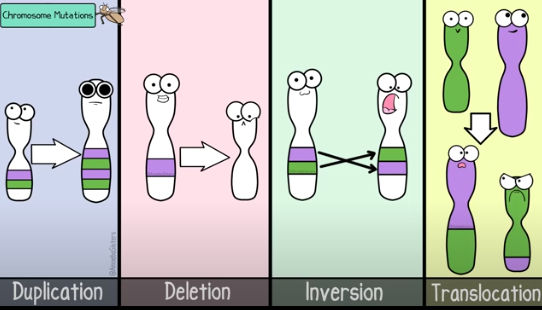
Chromosomal Mutations:
- Duplication: the genes selected are doubled
- Deletion: the genes selected are deleted and the gene is not transcribed & translated
- Inversion: switches the order of specific genes selected
- Translocation: all of the chromosome parts are switched around
11) Explain how changes in genotype may result in changes in phenotype. (IST-4.A)
- Disruptions in the genotype of the gene will result in different amino acids commanded →leading to another protein created → different phenotypes/physical characteristics such as different shapes and sizes
- Mutations also increase genetic variation AND are the primary source of genetic variation!!!
Errors in mitosis/meiosis will result in changes in chromosome numbers
Examples:
Triploidy: when the chromosome number in a human is 69 instead of 46
Trisomy: when an extra chromosome is present
Turner Syndrome: only occurs in females →when there is only one normal x chromosome instead of 2
- These disorders are due to changes in chromosome numbers
Horizontal gene transfer: HAPPENS IN PROKARYOTES
Conjugation: cell-to-cell transfer
Transformation: When outside genetic material is absorbed by the cell
Transduction: when a virus spreads its genetic material to other bacteria
Transposition: DNA segments within DNA molecules
- These forms of horizontal gene transfer increase genetic diversity and variation
12) Explain how alterations in DNA sequences contribute to variation that can be subject to natural selection. (IST-4.B)
- Alterations in DNA sequences lead to changes in the genotype → different proteins made and different physical characteristics which contribute to genetic variation.
Biotechnology:
Learning Objective:
13) Explain the use of genetic engineering techniques in analyzing or manipulating DNA (IST-1.P)
- What are some common techniques used to analyze or manipulate DNA & RNA?
Techniques are…
- Gel Electrophoresis
→ can separate molecules according to their size and shape
→DNA molecules are negatively charged
→DNA samples containing fragments are loaded into wells
→current applied to gel creates a positive/negative charge
→the DNA moves towards the positive side because it is negative and opposites attract
→ smaller particles can penetrate the gel faster since they are more permeable to
- Polymerase Chain Reaction (PCR)
→ allows for small fragments of DNA patterns to be analyzed by making it bigger
→ Technique involves DNA to be denatured, primers are added and DNA is replicated.
- =DNA Sequencing
→determines the order of sequencing of nucleotides in DNA molecule
- How can genetic engineering techniques be used to manipulate DNA & RNA?