The Minor Planets (Part 6)
Classification of Solar System Bodies
Astronomers classify bodies on several overlapping criteria.
Definition of a Planet
Orbital Criterion: A planet is a celestial body that is in orbit around the Sun.
Shape Criterion: It has sufficient mass for its self-gravity to pull itself into a nearly spherical shape.
Due to rotation, planets are often wider at the equator than at the poles.
Clearing Criterion: It possesses enough mass for its gravitational force to clear its orbital neighborhood of debris.
Definition of a Dwarf Planet
A dwarf planet satisfies criteria (1) and (2) but does not meet criterion (3) for clearing its orbital neighborhood.
Small Solar System Bodies (SSSBs)
All other objects in the solar system that are not classified as planets, dwarf planets, or moons.
Examples of Dwarf Planets
Pluto
Ceres (named after a Roman goddess)
Eris (named after a Greek goddess)
Makemake (named after a god from Rapa Nui)
Haumea (named after a Hawaiian goddess)
Haumea has an unusual egg-shaped appearance attributed to its rapid rotation, similar to an egg spinning on a table.
Current Developments
As astronomers gather more data on solar system objects, definitions for dwarf planets and SSSBs may evolve.
Discovery of Pluto
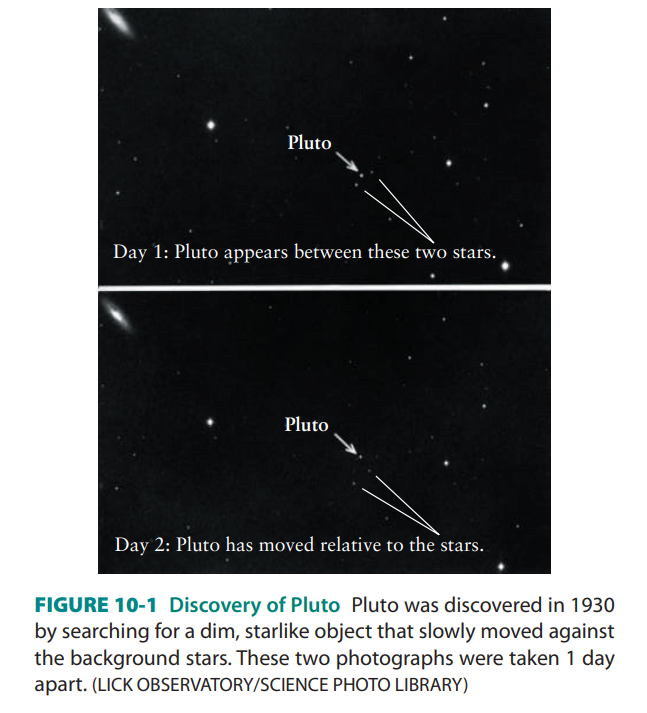
Discovered in 1930 by Clyde Tombaugh through photographic evidence of its movement against background stars.
Detailed Study of Pluto
Pluto and its moon Charon share similar sizes:
Pluto: Diameter = 2370 km
Charon: Diameter = 1208 km
Pluto's observed mass is .
Charon's orbit around Pluto helped determine Pluto's mass from eclipses observed from Earth between 1985 and 1990, marking them as a binary system debate.
Geological Features of Pluto
Over a thousand craters have been cataloged on Pluto. Most are worn down or partially destroyed by erosion.
Eroded craters and the heart-shaped region named Sputnik Planitia shows an absence of craters - indicating a younger surface.
The left side of the white heart-shaped region is nearly free of craters.
Proposed geological processes suggest ancient fractures and possible mountains from icy interiors.
To the left of this region are features consistent with the surface having fractured in the past.
Astronomers propose that when Pluto was young, the left half of the heart-shaped region had mountains build up on it atop an icy interior.
The weight of that surface rock eventually crushed the ices below it, which caused the mountains to sink.
The formation of the right half of the heart is still being studied.
Presence of cryovolcanoes emitting substances such as water, nitrogen, methane, or ammonia is also noted.
The surface of Pluto has 12 distinct regions—more large-scale features than any object in the solar system other than Earth.
These features include:
Regions dominated by rock
Regions dominated by ice
Major impact regions
Mountain ranges
One mountain range extends as high as 3.5 km (11,500 ft) and is believed to be no more than 100 million years old due to the lack of nearby cratering.
Studies of Pluto’s surface show that different regions vary in temperature from one another by up to 25 K.
Its surface features are changing in color and brightness, possibly as a result of seasonal effects.
Specifically, getting redder and its northern hemisphere getting brighter.
Pluto’s spectrum shows that its surface contains frozen nitrogen, methane, and carbon monoxide.
The orange tinge may be due to the presence of carbon-rich methane being chemically altered by the Sun’s ultraviolet radiation.
The brightest regions are believed to be covered with frozen carbon monoxide, while the darker regions probably contain rocky debris.
Other Moons
In 2005, the Hubble Space Telescope detected Nix (named after the goddess of the night and mother of Charon) and Hydra (named after the nine-headed serpent living at the gates of Hades); both are much smaller than Charon.
The fourth and fifth known moons, Styx and Kerberos, were discovered in 2011 and 2012, respectively.
Nix, Hydra, and Styx are very bright, suggesting they are covered with layers of ice. Kerberos is as dark as charcoal.
Styx and Kerberos are tumbling chaotically under the changing gravitational attraction of Pluto and Charon.
Charon's Features
Argo Chasma: A canyon on Charon, approximately 700 km (430 mi) long and believed to be five times deeper than the Grand Canyon on Earth. The average distance between Charon and Pluto is less than one-twentieth the distance between Earth and our Moon.
Both Pluto and Charon exhibit synchronous rotation, where they always show the same side to each other. As seen from the satellite-facing side of Pluto, Charon neither rises nor sets, but instead hovers in the sky, perpetually suspended in the same place above the horizon.
The image of Charon reveals a complex surface, with cratered regions, a relatively smooth marialike region, and multiple cliffs and canyons. The smooth region is rust-colored, created when gases containing methane and organic molecules from Pluto are deposited on Charon and transformed by ultraviolet light from the Sun.
The exceptional similarities between Pluto and Charon suggest this binary system may have formed when Pluto collided with a body of similar size, or Pluto's gravity captured Charon during a close encounter. These scenarios suggest many Pluto-sized objects must have existed in the outer regions of the young solar system for such an event to be feasible.
Orbital Characteristics of Pluto
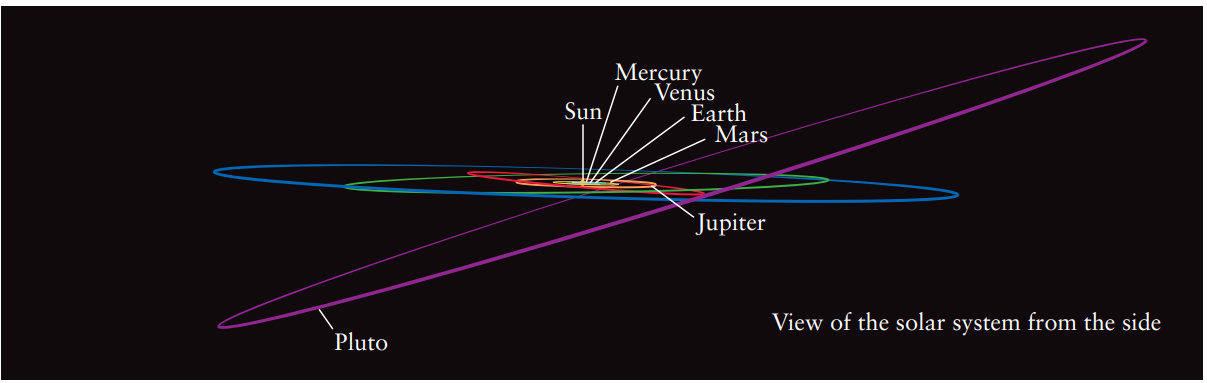
Orbital eccentricity: , sometimes placing it closer to the Sun than Neptune.
Its orbital inclination: just over , far greater than that of any planet.
Lunar Discovery of Charon
Discovery of Charon in 1978 was prompted by detection of Pluto's varying image shape.
Considered a binary system due to similar size and behavior.
Influence of Astronomy on Pluto
Observations of eclipses helped refine measurements of Pluto's mass and offered new insights into its characteristics.
Future Missions
New Horizons spacecraft, the only spacecraft to visit Pluto, passed by Pluto on July 14, 2015, providing unprecedented images and data about Pluto and its moons. The images revealed worlds very different from others discussed so far.
Since leaving the vicinity of Pluto, New Horizons has been en route to a more distant Kuiper belt body called 2014 MU69, which it intercepted in early January 2019.
Pluto's Atmosphere
Pluto has a very thin, hazy atmosphere of nitrogen, methane, and carbon monoxide.
The low gravity on Pluto causes hundreds of tons of this atmosphere to drift into space every hour.
Much of this gas is pushed away from the Sun by the solar wind (particles flowing out of the Sun), thereby creating a tail for Pluto.
The atmosphere is believed to be replenished as a result of heating of the planet, leading to cryovolcanism and other outgassing mechanisms.
Intriguingly, this atmosphere has about 20 distinct layers of haze.
In contrast, Charon’s surface appears to be covered predominantly with water ice, and no atmosphere has been detected around it.
Other Dwarf Planets
Ceres
Discovery: First identified on New Year's Day 1801 by Giuseppe Piazzi, who noticed a dim 'star' shifting its position.
Size and Classification: Initially cataloged as a planet, further observations revealed it was much smaller than other planets. It is spherical, with a diameter of 940 km (585 mi), one-quarter the diameter of Earth's Moon. In 2006, Ceres was classified as a dwarf planet.
Composition and Surface: Visited by the Dawn spacecraft from 2015-2018. It is differentiated, containing a rocky core clad in an icy outer layer. Salts, water ice, clays rich in ammonia, and organic (carbon-based) compounds have been detected on its surface.
Atmosphere: Has a very thin atmosphere of water that waxes and wanes with solar activity, dissipating within a week of normal solar conditions.
Eris
Discovery and Location: First observed in 2003, before current definitions were established. It is presently located 98 AU from the Sun, three times farther out than Pluto.
Characteristics: Has a diameter of about 2400 km (Pluto is 2300 km). It is very bright with an albedo of about 0.86. Observations suggest one-quarter of this world is water ice.
Orbit: Its 558-year orbit is highly eccentric, meaning for part of that time, Eris is closer to the Sun than Pluto.
Moon: A moon named Dysnomia (about 300 km across) was discovered orbiting Eris in 2005.
Haumea
Discovery and Rotation: Discovered in 2005, it rotates once every 3 hours and 55 minutes, likely due to a collision with another body.
Shape and Mass: Its rapid rotation has distorted its shape to look like a watermelon. It is classified as a dwarf planet despite its non-spherical shape due to rotation. Its mass is about one-third that of Pluto.
Moons: Has two known moons, Hi’iaka (310 km across) and Namaka (170 km across), named after its mythological daughters. Their surfaces are almost pure water ice. Hi'iaka has an exceptionally short rotation period of 9.8 hours.
Ring: Possesses a ring located 2287 km (1421 mi) from its center; the composition of the ring debris is under investigation.
Makemake
Discovery and Rotation: Discovered in 2005, it rotates once every 7 hours and 45 minutes.
Size and Orbit: About three-quarters the size of Pluto, it orbits the Sun once every 310 years.
Moons: Unlike other Kuiper belt dwarf planets, Makemake has no known moons.
Small Solar System Bodies (SSSBs)
Definition: Includes the rest of the asteroids, all comets, hybrid objects called Centaurs, and the smallest rubble orbiting the Sun (meteoroids).
Formation and Origins:
The solar system formed from a rotating disk of gas and dust.
Matter with too much angular momentum coalesced into planetesimals.
Many planetesimals collided, forming planets, dwarf planets, and larger moons.
Other chunks of rock, metal, and ice were captured as small, irregularly shaped moons (e.g., Phobos and Deimos).
Many planetesimals still orbit the Sun today in isolation, classified as asteroids or minor planets.
Trans-Neptunian Objects (TNOs): All bodies orbiting the Sun beyond Neptune are called TNOs. Pluto, Eris, Makemake, and Haumea are examples of both dwarf planets and TNOs.
Asteroids
Formation and Origins
The Nice model of solar system formation predicts all debris initially orbited counter-clockwise.
About 0.01 percent of asteroids have retrograde (clockwise) orbits, possibly captured from other star systems.
Jupiter's migration (inward then outward) sent most of the debris into the current asteroid belt region.
Discovery and Location
Most asteroids orbit the Sun between Mars and Jupiter (the asteroid belt).
Pallas was discovered in 1802 by Heinrich Olbers, orbiting between Mars and Jupiter.
Only a few asteroids (Ceres, Pallas, Juno, Vesta) were initially found until improved telescopes in the mid-1800s.
The region between Mars and Jupiter (2 to 3.5 AU) is called the asteroid belt.
Asteroids whose orbits lie entirely within this region are called belt asteroids.
Notable Asteroids
Pallas:
Discovered by Heinrich Olbers in 1802.
Smaller and dimmer than Ceres, with a diameter of 600 km (375 mi).
Vesta:
Explored by the Dawn spacecraft in 2012.
Heavily cratered northern hemisphere is over a billion years older than the smoother southern hemisphere.
Features a 20 km (12.4 mi) high mountain at its south pole, taller than Earth's Mauna Kea.
Differentiated, with heavier elements (iron) settled to the core and lighter rock floating upward.
Detection Methods
Early asteroids were found by scrutinizing faint, uncharted