EDUCATION
DURKHEIMS VIEWS OF EDUCATION (functionalist)
functions of education
promoting social solidarity
teaching specialist skills
Social solidarity
definition: the ties that bind people together in society
the forms of social solidarity
pre industrial era - mechanical solidarity
modern era - organic solidarity
education ensures that solidarity isnt lost
how does education achieve this
passes on shaped heritage —> history, literature, music —> students understand aspects of culture
communal gatherings —> assemblies, prize giving —> promote values of community
social cohesion —> enrichment, sports, houses —> sense of unity
contemporary applications
Michael grove reforms curriculum beginning with history
compulsory teaching of brutish values
democracy
rule of law
individual liberty
mutual respects for those with different faiths and beliefs and for those without faith
critisisms
marxists: whose values and heritige are being passed on
ethnocentric curriculum focused on ‘little englandism’ (ball)
british values - marginilises some groups in society
teaching specialist skills
industrial revolution
changes in skills required for the ‘complex division of modern labour’
creation of state education systems to prepare next generation for employment
how does education achive this
core knowledge - national curriculum
specialist knowledge - alevel subjects
vocational skills - btech
creation of universities - red brick
contemporary applications
additional funding for maths students at level 3
teaching bursaries for shortage subjects
standardised assesments
reforms to the curriculum - global skills
critisisms
marxists
overqualified workforce
fragmentation
lower wages
reserve army of labour
high levels of youth unemployment
skills shortage in areas in the uk
girls are discoraged from certain subjects.
PARSONS VIEWS OF EDUCATION (functionalist)
parsons - secondary socialisation
bridge between home and society - need for value consensus
particularistic to universal values
ascribed status to achieved status
collectivism to individualism
how does education achieve this
hidden or informal curriculum
norms and values of school
assessments
competition between students
contemporary applications
school uniform policies
disciplinarity policies of schools
Ofsted - cultural capital
social, moral, spiritual and cultural education
criticisms
marxists - hidden curriculum prepares students for exploitation - transmits values of capitalism
most modernists - fragmented nature of society means socialisation by various agents
clash of working-class and middle-class values in education leads to underachivement
DAVIS AND MOORE VIEWS OF EDUCATION (functionalist)
Davis and Moore role allocation
society requires skilled workforce tat is fully qualified
certain roles require certain aptitudes
education prepares students for their roles based on their ability
how does education achive this
‘sifts and sorts’ students based on ability
promotes ideas of social mobility and meritocracy
most able pupils end up in higher positions in society
lower ability end up in low-skilled positions
contemporary applications
streaming and setting
university entrance
subject choice - vocational and academic routes
wage inequalities
criticisms
marxists - meritocracy is a myth making machine
seminists - gender pay gap - feminine professions paid less
‘old school tie’ netwoek
privately educated student are more advantaged
THE NEW RIGHT VIEWS OF EDUCATION
the new right
developed functionalist ideas of social solidarity and the teaching of specialists
additionally, parents should be given choice in their child’s education
LEAs are inefficient - prefer free market approach (Chubb and Moe)
how does education achieve this
competition between schools for results
increased choice for parents - open enrolment
increased involvement of private enterprise in education
the 1988 education reform act
introduced
national curriculum
formula funding
standardised testing
parental choice and open enrolment
further developments
introduction of OFSTED
league tables
application to contemporary education
standardised testing throughout school life
development of education markets extending from early years to higher education
increased privatisation of education
wider range of schools
evaluations
marketisation has been dominant approach to education for over 30 years
introduced selection policies that disadvantage certain social groups
Gewirtz et al - middle class advantaged as they play the system
ALTHUSSERS VIEWS OF EDUCATION (marxist)
Althusser - state apparatuses
the ruling class looks to control masses through different apparatuses
repressive state apparatus - physical control, coercion - police, military, courts
ideological state apparatus - control over thoughts, beliefs and ideas - education, religion and media
the ideological state apparatus
teaching students the necessary skills for employment
reproduces the dominant ideology of the ruling class
reproduces and legitimises inequality
how do schools achieve this
fragmented curriculum
basic skills - literacy, numeracy
curriculum based on ruling class values - history, literature, music
myth of meritocracy
contemporary applications
national curriculum split into distinct subjects
students to study for a passing grade in english and maths until the age of 18
changes to curriculum under coalition government
growth mindset
criticisms
functionalists views - agree with marxist ideas, but suggest that they are beneficial for society
limited empirical evidence for althusser’s ideas
postmodernists would suggest education is one way of expressing ability in contemporary society
deterministic
- more children from manual labour backgrounds going into HE that even before - still only 9%
BOWLES AND GINTIS VIEWS OF EDUCATION (marxist)
bowles and gintis
the long shadow of work
reproduction of the workforce
hidden curriculum
how do schools do this
the correspondence principle - schools mirrors the world of work
punctuality
rewards/sanctions
extrinsic motivations
division of students
hirearchies and power
privilage for conformity/status
education legitimises inequality
opportunity and meritocracy are myths
education confirms working-class pupils will end up in working class jobs
system gives advantages to those of middle-class backgrounds
contemporary applications
uniform policies
conservatives ‘teacher given power’
role of academies - closer links with work
apprenticeships and vocational education
criticisms
functionalists agree with skills for employment but suggest this is for benefit of society
do all students become passive and unthinking puppets
are the workers being produced equipped with necessary skills for employment.
BOURDIEUS VIEWS OF EDUCATION
Bourdieu
cultural reproduction model
habitus - tastes, attributes of individual
field - cultural framework of specific context
cultural capital - value a persons cultural knowledge has within a field
education as cultural reproduction
middle-class habitus has given symbolic capital - teachers and heads are middle class - those who write the curriculum and policies are middle class
working class pupils are disadvantaged and subject to symbolic violence
contemporary applications
Ofsted - cultural capital
school policies on uniform
curriculum based on middle -class knowledge
teacher judgements
support for Bourdieu
archer - Nike identities
Reay - psycho-social approach - cleft habitus
sullivan - students with higher cultural capital achieve higher
criticisms
functionalists suggest that education is meritocratic
socialised into value consensus - skills are needed to achieve
students acquire cultural capital throughout their education
WILLIS VIEWS OF EDUCATION
learning to labour (‘lads experiment’)
mixed methods approach - observations, interviews
studied the ‘lads’ - a group of working-class boys who were disruptive, misbehaved and had a negative view on education
anti-school subculture - praise earned from behaviour against the school ethos
conclusions
education was ineffective as an agent of socialisation
the ‘lads’ were not socialised into work, rather into wanting to leave education
contradicts the work of functionalists and other marxists
contemporary applications
anti-school subculture within contemporary education
crisis over the achievement of working class males
does being a working class male carry a label of underachievement
evaluations
close bonds with boys could have caused the Hawthorne effect
‘choose to fail’ - is this by design of free will
end results - working class boys ended up working in working-class jobs - does this prove that education reproduces inequality?
FEMMINISTS VIEWS OF EDUCATION
what does the feminist perspective cover
achievement by gender
experience of different genders in education
gender socialisation
formation of gendered identities
gendered subject images
achievement by gender
historically, girls underachieved in comparison to boys - lowered expectation - gendered subject choices - career paths - socialisation into expressive roles
since 1980’s girls started to achieve higher than boys - rise of feminism - career aspirations - feminisation of education - educated female role models
experience of different genders in education
sexual harassment of girls in schools - ‘male gaze’
higher expectations on girls for behaviour
rigid controls on girls for behaviour
gender socialisation
girls more controlled by parents and teachers
girls have less freedom
canalisation of educational toys
books and imagery - lobban
formation of gender identities
schools reinforce traditional feminine identities
uniform regulations
sexual behaviours
sports
gender subject images
traditional make and female gender domains - STEM subjects are male dominated - humanities are female dominated
change in gendered images represent girls more positively
initiatives such as GIST and WISE
evaluations
despite progress many issues still remain - gender pay gap, glass ceiling
jackson (2010) - focus is on boys underachievement in education, rather than inequality beyond education
education increasingly female dominated - 80% of graduates in education are female
KEY TRENDS IN EDUCATIONAL ACHIVEMENT
educational trends
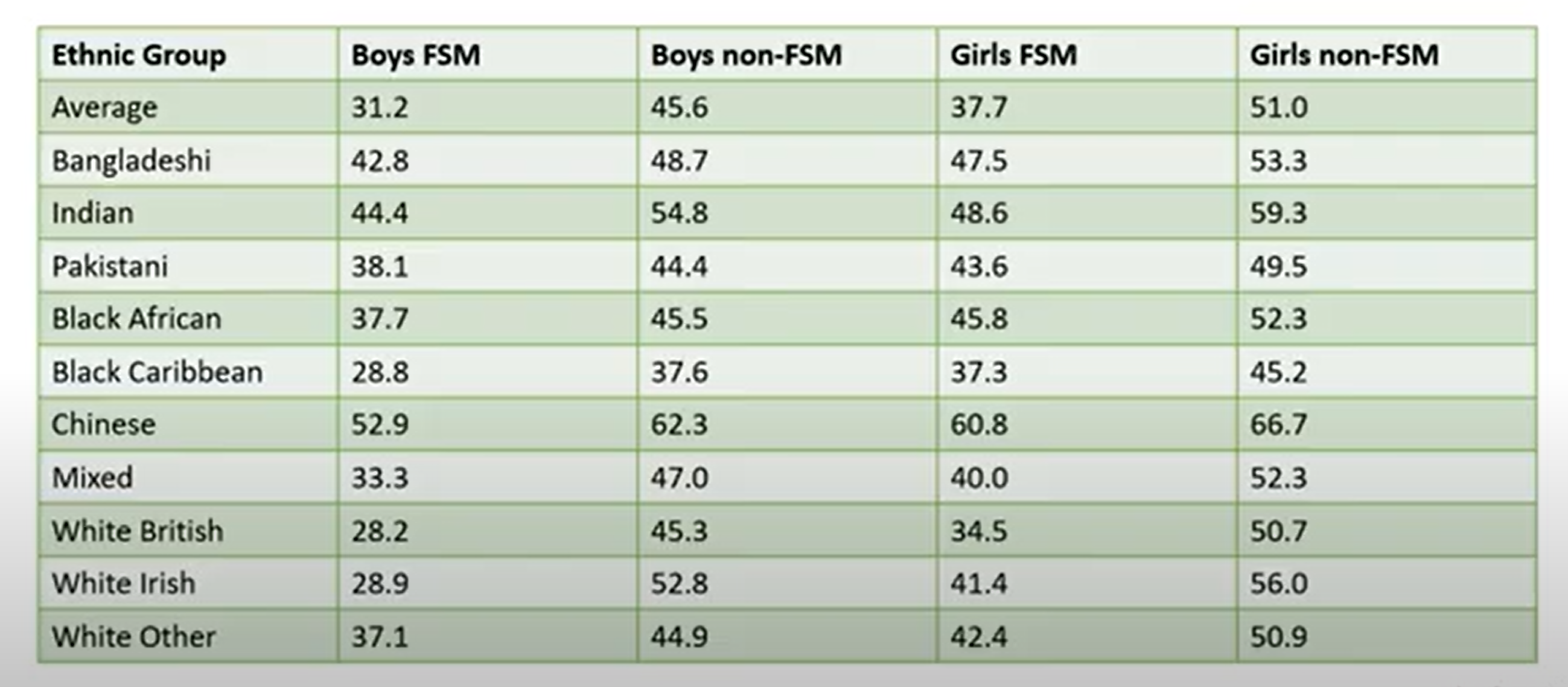
GCSE performance by social class, gender and ethnicity
attainment 8 - progress made over 8 key subjects
university enterence
attainment 8 data 2017/18
INTERNAL AND EXTERNAL FACTORS EFFECTING ACHIEVEMENT
external factors
material factors
cultural background
linguistic differences
parental attitudes and socialisation
racism in wider society
subcultural attitudes
internal factors
teacher-pupil interactions
pro and anti-school subcultures
setting and streaming
institutional racism
organisation of teaching, learning and assessment
curriculum content
interactions between internal and external
linguistic differences - language learned at home - language of education based upon middle-class values
labelling - labels applied based on family background, appearance, language and attitudes - influenced by external factors
habitus comes from home life
clashes with habitus of school, school imposes its tastes and attitudes onto students
curriculum content
parental knowledge of curriculum comes from social class that can be passed down to their children
racism in wider society influences stereotypical views that some teachers hold
lack of educational role models in society leads to underperformance in school
anti-school subcultures - collectivist nature of working-class replicated in subcultures
gender socialisation at home reinforced by gendered teachers in subjects
teacher expectations of girls and boys differ because of internal influences
feminisation of education led to fewer males choosing to go into teaching
MATERIAL DEPRIVATION (external)
what is material deprivation
inability to afford basic resources that impacts on a child’s educational achievement
douglas (1964) ‘home and the school’ - material deprivation has a cumulative effect on achievement
who suffers from material deprivation
measurement for material deprivation is usually receipt of free school meals
4.6 million children (34%) live in poverty but only 13.6% claim FSM
45%of children in minority ethnic families live in poverty
white and mixed ethnicity students on FSM make less progress in secondary school than their non FSM peers
how does it impact education
lack of availability to afford resources and hidden costs
overcrowded accommodation
part-time jobs
diet and nutrition
caring responsibilities
how does it impact education
90% of schools rated requires improvement or lower in deprived areas
schools such as detritus - student self-esteem
instability in educational provision
what has the government done
new labour - sure start, EMA, excellence in cities, city centre academies
coalition - universal free school meals to year 2, pupil premium
evaluations of material deprivation
2017 - 28.6% of FSM pupils achieved 5 GCSEs compared to 60.8% of those not on FSM
validity of measurements - many in poverty not in receipt of FSM
Chinese students on FSM - 77% achieved 5 GCSEs, Chinese not on FSM - 78% achieved 5 GCSEs
most minority ethnic groups have small gap in progress 8 scores between those on FSM and those not on FSM
impact of material deprivation on in-school behaviours.