Unit 5 - Lawmaking Process
Vocabulary
Bill: A proposed law, the first phase in making legislation; a “baby law”
Constituents: The people who are represented by members of Congress
Legislation: the process of making laws or the laws themselves
Legislator: A member of Congress, someone who makes laws
Sponsor: the legislator who writes and introduces a bill
Committee: a group of legislators who research, debate, and report on legislation
Veto: the power of the president to refuse to sign a bill into law
The Basics
- Legislators can get ideas for laws from their constituents
- Trying to improve the lives of the people they represent
- President CAN NOT propose legislation
- Only a member of congress can propose a bill
- The President CAN influence policymaking though
- Once a law is proposed/introduced by a legislator (the sponsor) it is then reviewed by a committee
- A committee is formed to review the proposal
- The people on the committee are knowledgeable on the subject
- Multiple committees can overlook one bill/proposal
- Markup: in committees, bills can be revised, then a final draft is written
- Bills are then discussed and debated on the floor of the chamber
- Chamber: one of the houses of Congresses
- Floor: the place where legislators meet
- Floor of the Chamber: everyone is invited to this discussion
- Quorum: The minimum number of people required for debate and votes to happen
- After debate & discussion of the bill, there is a vote in that chamber to approve it
- If approved, it goes to the other chamber of congress
- When bills are voted on in the second chamber, it must be identical to the bill approved in the first
- Sometimes one chamber wants to make changes to the bill, there is a committee made of members of both chambers that will work out a compromise
- After both chambers have approved the bill it goes to the President
- The president can:
- Sign the bill
- Pocket Veto the bill (if it isn’t signed within ten days)
- Veto the bill
- Voice Vote
- Instead of voting with machines or slips of paper, members of Congress just shout out if they are a YEA or NAY vote
- Less complicated, faster, and cheaper
- Only done when many people are leaning a certain way
- The leader of the Chamber should be relatively certain what the outcome of the vote will be before calling the voice vote
- The whips gather information on what way their party is leaning and can report back to the leader
- In a voice vote, the names and numbers of the members voting are not recorded
Powers of Congress
- Article I, Section 8 of the Constitution describes the specific powers that Congress has
- Expressed or Enumerated Powers: what the Constitution clearly and specifically says that Congress can and must do
- Implied powers: Congressional powers that aren’t specifically stated in the Constitution but can be understood or inferred
- The Necessary and Proper Clause gives Congress implied powers because the writers of the Constitution couldn’t know what needs the government would have in the future
- This clause gives Congress the power to do what they think is necessary even if it is not specifically listed in the Constitution
- Airplanes weren’t around in 1789, but congress CAN regulate trade/commerce/business so airplanes fall under that jurisdiction
Enumerated Powers
- The power to tax and spend
- Implied: Tax dollars are spent building roads & bridges
- Coin money
- Implied: A new design for the $20 bill
- Making rules for immigration and citizenship
- Implied: Convicted terrorists cannot become citizens
- Regulate foreign and interstate trade
- Implied: Congress bans Russian oil after the invasion of Ukraine
- Approve presidential appointments
- Implied: Congress approves Deb Haaland as Secretary of the interior
- Impeach public officials
- Implied: President Bill Clinton is impeached for lying under oath
- Ratify treaties with Foreign Countries
- Implied: US joins the Paris Climate Accord in 2016
- Create & Arm a military
- Implied: Congress created the Coast Guard in 1915
- Declare War
- Implied: President Wilson asked Congress to declare war on Germany in 1917
Leadership and Other Roles in Congress
- One of the first things that happens after congressional elections is four different groups in the legislative branch choose their leaders
- Republicans and Democrats in both the House and Senate
- The major party in each chamber holds important leadership positions
- Majority Party: the party that holds more seats/positions in the two chambers of Congress
- Republicans are the majority party in the House of Representatives
- Democrats are the majority party in the Senate
- The majority party gets more seats (people) on committees
The House of Representatives
- Speaker of the House: the leader of this chamber of Congress
- Kevin McCarthy, R, California
- The Speaker has immense powers:
- Controls the calendar for the House
- Sets the agenda for the House
- Assigns bills to Committees
- For two years, McCarthy is almost in complete control over what laws do or do not get passed
- If both the President and VP die, the Speaker of the House would become President
- Majority and Minority leaders are the next most powerful members of the House, after the Speaker
- These two people get to be the first to speak during the debate over a bill
- Whip: Someone who is in charge of both discipline and organization in their party
- The whip is an enforcer and makes sure members of the party are following their party platform and voting in line with party votes
- Committee Chair: Holds a lot of power since they can decide to “kill” a bill before the House can vote on it
Senate
- The leader of the Senate is called the President of the Senate but is also at the same time the Vice President (of the country)
- But this position is mostly “ceremonial”
- The leader of the Senate can break ties
Gerrymandering:
- To draw congressional districts (for the HOR) so that the political party in power stays in power; boundaries for districts are drawn in such a way as to create a district where a single party has a majority
- Partisan Gerrymandering
- Redistricting happens every ten years (after the Census is taken) but not all districts are gerrymandered
- The census tells us which districts or states increased/decreased in population
- State legislatures are the ones who draw these districts
- State legislators are representatives and senators
- Racial gerrymandering: drawing districts on the basis of race
- Each district MUST have the same number of people
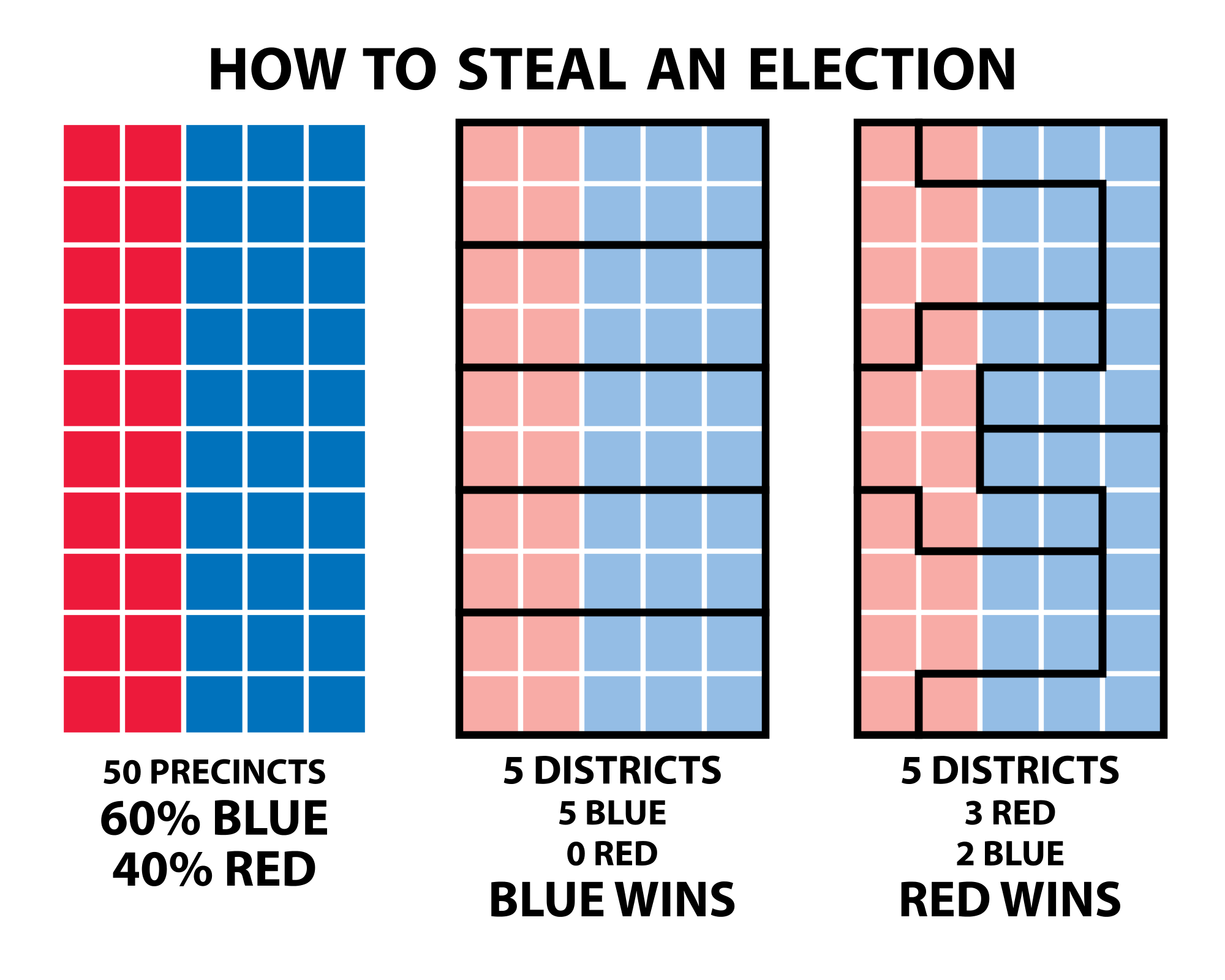
SCOTUS Court Cases about Gerrymandering
Baker vs. Carr, 1962: a case in Tennessee, where new districts had not been drawn in decades, despite some big changes in population
- Rural districts had much smaller populations than urban districts
- Because congressional districts must have an equal population (as close as possible), some people did not feel they were being adequately counted
- Charles Baker argued he (and his neighbors) were being denied “equal protection,” which is guaranteed under the 14th Amendment
- Equal protection clause: no person or group can be denied the same rights and protections under the law that are given to other people or groups
- The government must be impartial & not treat people differently
- in a single sentence: Courts can hear cases about redistricting and the Constitution guarantees the one person-one vote principle which results in districts with equal populations.
- \
Shaw vs. Reno, 1993: As a result of the 1990 census, North Carolina gained a seat in the HoR (the state population had increased since 1980)
- NC had a history of racial discrimination in voting before the 1965 Voting Rights Act
- Because of this, the US Attorney General (top lawyer) had to supervise the drawing of the new district to make sure that there were no racially discriminatory things going on with the new district
- Two new districts were drawn that were “majority-minority”: a racial minority (Black people in this case) made up more than half the district
- Five white voters sued Janet Reno, the Attorney General (AG), saying these “Black” districts violated the “equal protection” clause
- in a single sentence: Race cannot be the only factor in drawing district boundaries.
Creating a Budget
- Some of the laws that Congress passes are about the money that the federal government takes in and gives out
- The Power of the Purse: the ability of one branch of government to check another branch by using its authority over money and how it is spent
- Congress and the President are constantly negotiating but Congress has more power
- Revenue: Income, money coming into an organization
- The federal government’s source of revenue comes through taxes
- Types of Taxes:
- Taxes on payroll, income tax, property tax, sales tax
- Last year, the federal government took in $4.05 trillion dollars in taxes
Where does money go?
Vocab
Outlay: another word for money being spent
Mandatory Spending: Spending required by law to be used for certain programs
- Social security, Medicare, unemployment, other funds for people in temporary need
- More than 60% of the federal budget
Entitlements: Government programs that guarantee payments to people who meet certain criteria
- Elderly, poor, people with disabilities, veterans
Discretionary Spending: Other funds to be spent how Congress sees fit
- Pays for everything else
- About 38% of the federal budget
Judicial Branch Basics
- Article III of the constitution describes a court system with one supreme court and inferior courts set up by congress
- These a federal courts, not state or local ones
- Supreme Court is the only one specifically mentioned by Constitution
- Federal judges and SCOTUS justices: appointed/nominated by the President, confirmed by majority vote in Senate
- Federal judges have their jobs for life and can only die, retire, or be impeached and convicted by congress
- Attorney General: head of Department of Justice - enforces Federal law
- Courts in federal: settle disputes between parties, individuals, businesses, government organizations, etcc
- Criminal law: crimes against a community, breaking a law
- Civil law: not crimes, laws mostly dealing with personal and property issues
Marbury V Madison
- SCOTUS case from 1803 establishes Judicial Review
- Judicial Review: SCOTUS’s power to review whether acts of the legislative branch, the executive branch, and state governments are constitutional, and strike down acts it finds unconstitutional
- Case has to do with a dispute over a judge (Marbury) not being appointed to a position given to him by an outgoing president (J. Adams) ]
- New president - James Madison - sued by Marbury directly in the SCOTUS
- Big outcome of the case has nothing to do whether Marbury should get his new job
- Constitutional question was: can someone bring a case like this to the SCOTUS? Does SCOTUS have the authority to decide a dispute like this?
- Actual importance of the case: SCOTUS struck down part of a law passed by Congress and used by Marbury
Supreme Court Basics
- SCOTUS’s main job: interpret existing laws, deciding if they align with the Constitution; this happens when they review a case already decided by another court
- Doesn’t really carry out trials
- Jurisdiction: the power, right, authority to interpret the law
- Appeal: when someone who loses a case in a trial court asks a higher court to review the trial court’s decision
- SCOTUS is the highest court, therefore “last chance” for appeal
- All cases heard by SCOTUS: come from appeals court
- Many cases heard by SCOTUS deal with a question about the Constitutionality of the law
- About 7,000 cases are sent to SCOTUS but they hear and write opinions on fewer than 100
- Rule of Four: how justices decide which cases to hear if 4/9 say yes
- Most cases are one of national importance, usually civil liberties/personal freedoms
- Appellate Jurisdiction: when a case involves federal officials, international issues, or when a US state is part of the conflict
- Bush v Gore (2000 election)
- Miranda v Arizona (Miranda Rights)
TAKING A CASE TO THE SCOTUS!!
- Do you have standing?
- Standing: Do you have any sort of stake in the case? Does the outcome actually affect you?
- Is it a constitutional question?
- Does the case deal with an interpretation of the Constitution? SCOTUS won’t hear your case if it’s just a state law
- Did the SCOTUS grant cert?
- Writ of certiorari: an order to the lower court to send them all the case records
- Have you written a brief?
- This is a summary of the case & legal review, statements from attorneys
- Did you have friends write a brief for you?
- Amicus curiae/amicus brief: briefs written by “friends” who might not have standing in the case, but who have expertise on the issue
\n