Gluconeogenesis
: synthesis of ^^glucose and/ or glycogen^^ from ==non-carbohydrate precursors==
Main function: supply blood glucose in case of carbohydrate deficiency (fasting, starvation and low carbohydrate diet).
Site: mainly ==liver cells==, and to a lesser extent kidneys (due to presence of glucose-6-phosphatase and fructose-1,6-bisphosphatase).
- All gluconeogenic enzymes are present in the cytosol, except ==mitochondrial pyruvate carboxylase==
I. Conversion of Pyruvate to 2-PEP (dicarboxylic acid shuttle)
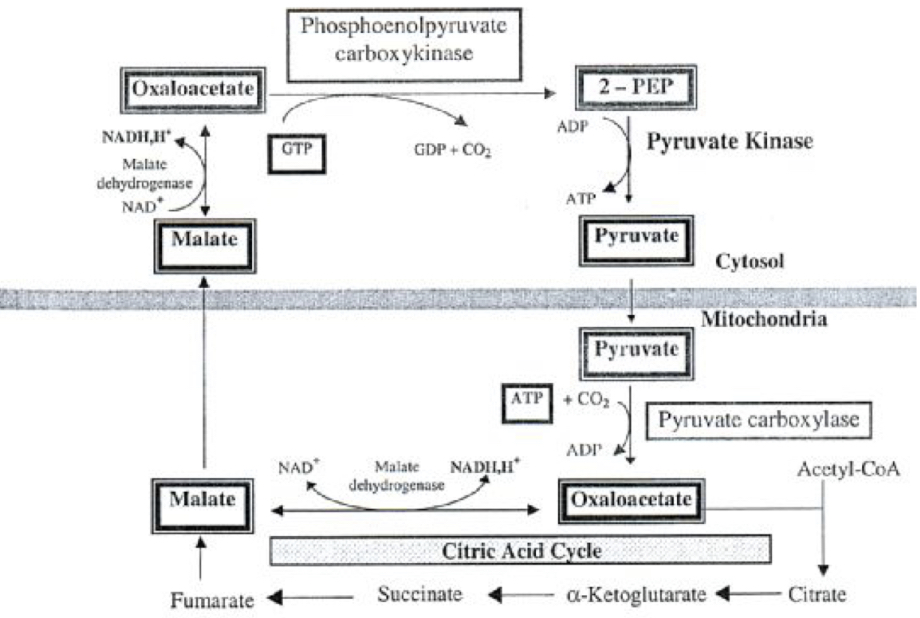
- Pyruvate is transported to the %%mitochondria%% where it is converted by pyruvate carboxylase to %%oxaloacetate%%.
- The mitochondrial membrane is impermeable to oxaloacetate, so it is converted to %%malate%% by malate dehydrogenase.
- Malate is transported to the %%cytosol%%, then by reversal of malate dehydrogenase, it is converted to %%oxaloacetate and NADH%%.
- Oxaloacetate is converted by PEP-carboxykinase to %%PEP%%
II. Conversion of PEP to Glucose (or glycogen)
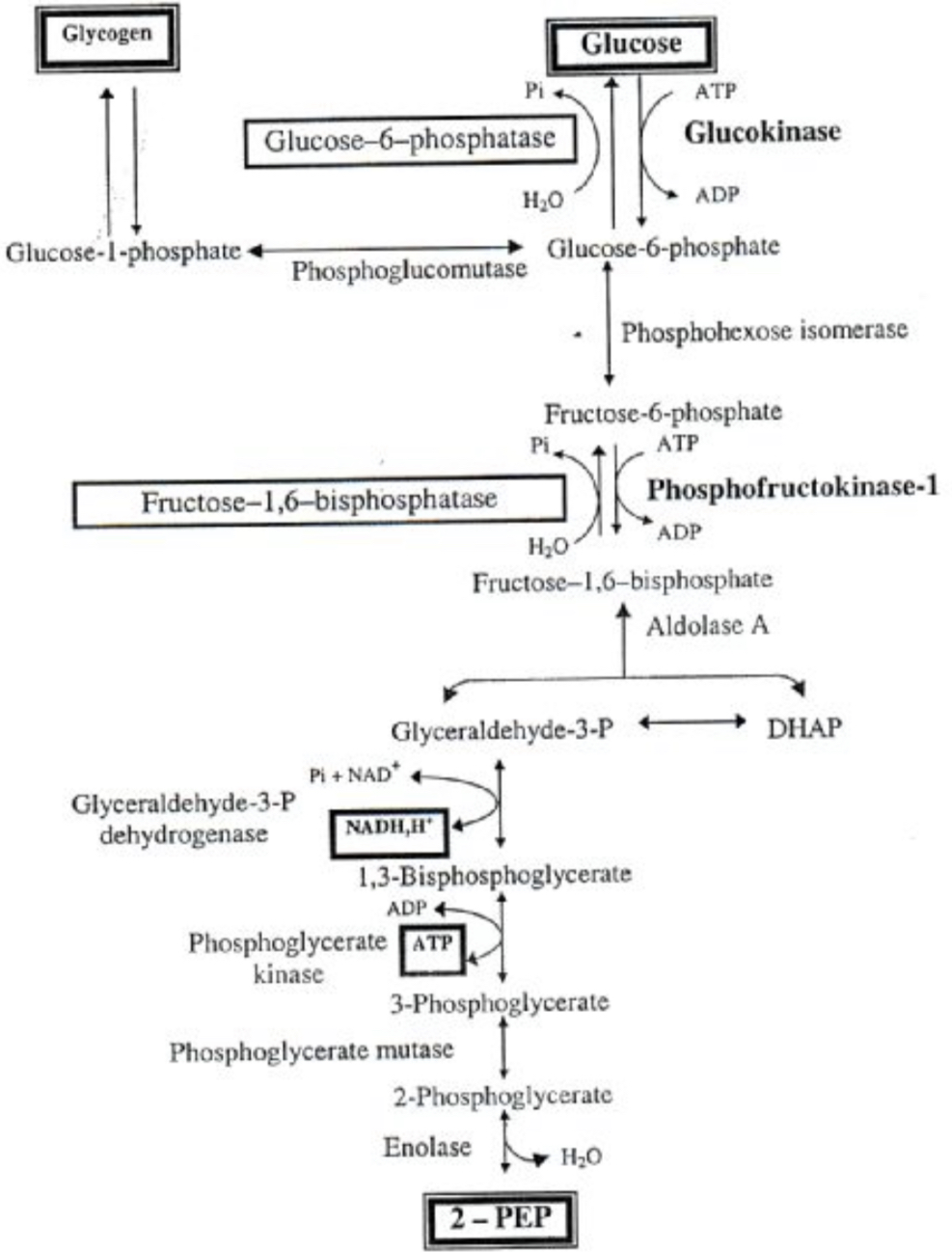
Two molecules of 2-PEP are utilized by @@reversal of glycolysis to@@ form %%fructose-1,6-bisphosphate%% then ^^glucose or glycogen.^^