Chapter 4: Sensation and Perception
Psychophysics:
Sensation is the stimulation of sense organs
Perception is the selection, organization, and interpretation of sensory input
Thresholds:
Sensory receptors are tuned to a particular form of energy
Auditory receptors in the ear code for sound pressure changes, not for light
Sensory systems require a minimum amount of energy for activation (absolute threshold)
Just - noticeable difference (JND): The minimum difference in stimulation that is just noticeable
Weber noted that the JND is a fraction of the original stimulus intensity: the fraction is different for different senses
The Visual System:
the eye detects electromagnetic radiation (light)
vision is functional
Allows for detection of movement )predator or prey)
Allows for detection of color (ripe or spoiled)
Light detection is useful because:
light travels rapidly (no delay, unlike hearing)
light travels in straight lines (no distortion)
light interacts with the same surfaces of objects in the environment (is reflected or absorbed)
Transduction of Light:
Light travels through the retina to impinge on photoreceptors at the back of the eye
light bleaches a pigment contained within the photoreceptors:
bleaching leads to a graded receptor potential that eventually produces an action potential in the ganglion cell
Two types of photoreceptors:
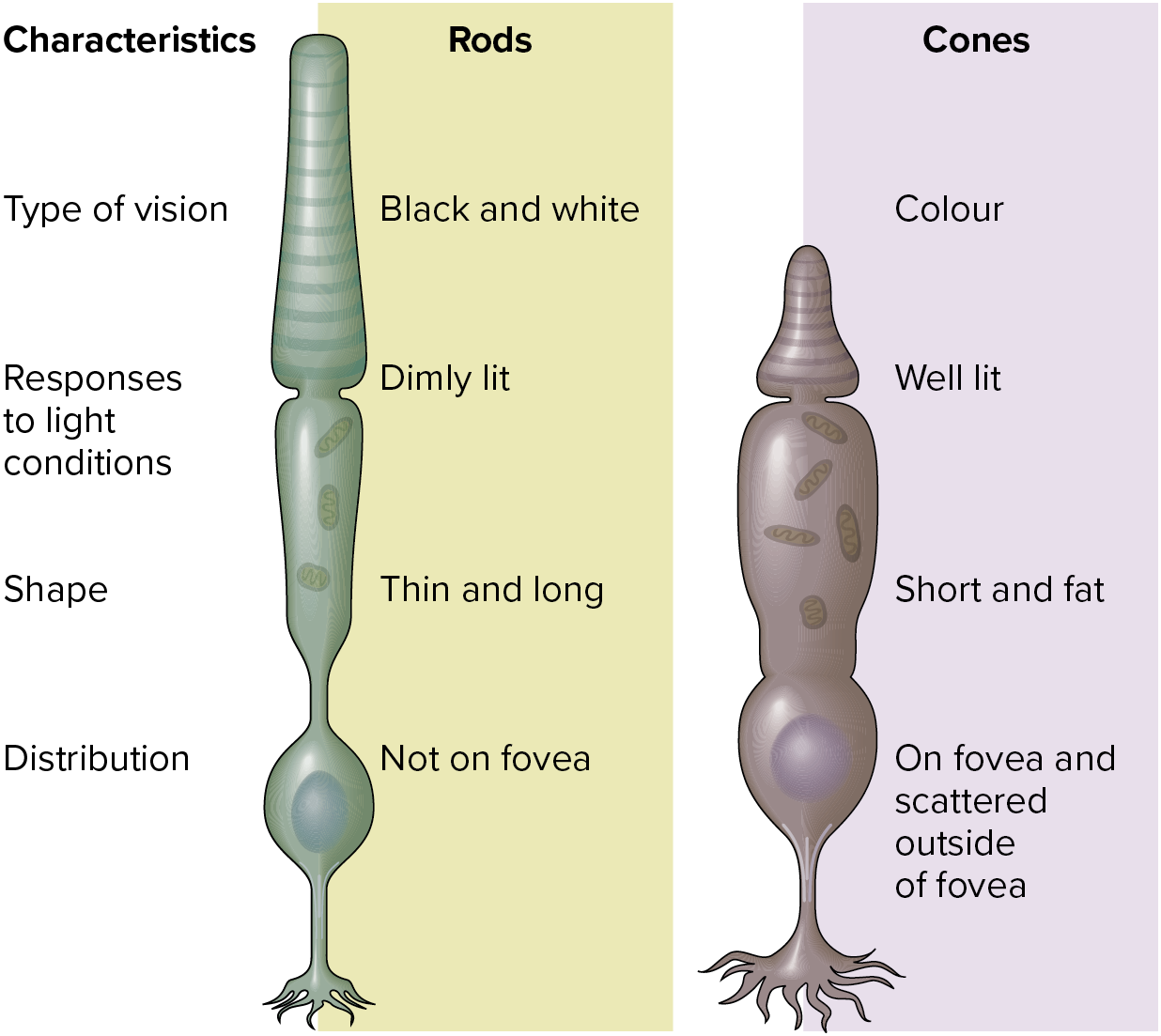
Cones: found in center of retina (fovea) and are sensitive to fine detail and color
Rods: found in periphery of retina and are sensitive to movement but not fine detail
Perception of Color:
color is a psychological perception
Three dimensions of color:
Hue is the apparent color of an object (blue)
Brightness is the intensity of a color
Saturation is the purity of the color
three different types of cones are found in the eye
Each is sensitive to different wavelengths of light
S - Cones: Blue
M - Cones: Green
L - Cones: Red
Color Vision Theories:
Young - Helmholtz:
Color is explained by different activation of 3 color elements in eye
Could not account for negative color afterimages
Hering: Opponent - Process Theory
Colors are derived from activity of 3 antagonistic systems
Black - White
Red - Green
Blue - Yellow
Sound:
Sound waves are vibrations of molecules that travel through air
amplitude - decibels
Wavelength - Frequency (cps or hertz)
Purity - timbre
The Auditory System:
External ear - pinna, eardrum
Middle ear - ossicles (hammer, anvil, stirrup)
Inner Ear - Cochlea
Basilar membrane - hair cells
Taste: the Gustatory System
Taste Buds
Primary tastes: sweet, sour, bitter, salty
perception of flavor
papillae: circumvallate, foliate and fungiform
Smell: the olfactory system:
Smell: chemical substances dissolved in mucus
olfactory cilia
olfactory nerves
olfactory bulb
Skin Senses:
receptors are localized within the skin to detect physical stimuli in the outside world
three classes of skin receptors:
Touch: physical contact of objects with the skin
Temperature of objects
Pain: destruction of skin tissue
Pain:
pain is a source of information that relates to tissue destruction
Force
Heat
Chemical
Pain is a adaptive to a degree (motivates behaviors to terminate the source of the pain)
pain is influenced by
cultural beliefs
emotional states
exogenous drugs (opiates)
internal transmitters (endorphins)
How do we sense and perceive the World?
consists of ophthalmology, audiology, neurology / neuroscience
requires comprehending the physical properties of the objects of our perception like light, sound and texture
The psychological approach to these processes involved understanding the physical structures and functions of the sense organs as well as the brain’s conversion of information from these organs into experience
What are the processes and purposes of Sensation and Perception?
Sensation and perception are the processes trough which we detect and understand these various stimuli
Sensation: Process of receiving energy from stimuli in our internal or external environment and transforming energy into action potentials
Transduction: The process by which a specialized receptor cell converts energy from an external stimulus to an internal electrical signal
Three common things in all sensory systems:
Multiple subsystems
transduction
specialized receptor cells
Each of the sensory organs have a specialized receptor cells register a stimulus and transduction takes place
the Energy is then converted to an action potential that relays information about the stimulus through the nervous system to the brain
When it reaches the brain, the information travels to the appropriate areas of the cerebral cortex
Each sensory system is comprised of multiple subsystems
Brian gives meaning to the sensation through perception
Perception: The process of organizing and interpreting sensory information so that it makes sense
Receptor cells in our eyes record
Sensation is the raw materials of experience when Perception is the experience itself
What are Bottom - Up and Top - Down Processing?
Bottom - Up Processing: The operation in sensation and perception in which sensory receptors register information about the external environment and send it up to the brain for interpretation
Bottom - Up Processing means taking in information and trying to make sense of it
Top - Down Processing: The operation in sensation and perception, launched by cognitive processing at the brain’s higher levels, that allows the organism to sense what is happening and to apply that framework to information from the world
To understand this, we use listening to a song as an example:
When you hear a song for the first time, you listen to it carefully to get a feel for the song which is Bottom - Up processing
After hearing it many times, you listen to it in a different way as you know what comes next which is Top - Down processing
Our ears provide only incoming information about sound in the environment
only when we consider both what the ears hear and what the brain interprets makes us understand sound perception completely
What good is perception:
An organism must be able to sense and respond quickly and accurately to events in the immediate environment such as the approach of a predator, the presence of prey, or the appearance of a potential mate
A close comparison of sensory systems in animals reveals that each species is exquisitely adapted to the habitat in which it evolved
Animals that are generally predators generally have their eyes at the front of their face so that they can perceive their prey accurately
Preys have their eyes on their sides of their head allowing them to have a wide view of their surroundings at all times
How are sensory receptors and the brain connected?
Sensory Receptors: Specialized cells that detect stimulus information and transmit it to sensory nerves and the brain
Afferent nerves bring information from the world to the brain
Sensory Receptors are the openings through which the brain and nervous systems experience the world
Sensory Receptors take in information from the environment and convert it to electrical impulses in the form of action potentials
the receptors trigger action potentials in sensory neurons, which carry the sensory information to the central nervous system
The intensity of the stimulus cannot be communicated to the brain by changing the strength of the action potential
Sensory Neurons follow the all or nothing principle
the receptor varies the frequency of action potentials sent to the brain
if a stimulus is very intense like the sun, the neuron will fire more times per second to let the brain know that the light is very bright
Sensory receptors are very selective and have different neural pathways
They are specialized to absorb a particular type of energy and convert it into an action potential and transmit this electrical energy to specific brain regions
the intensity of a stimulus is conveyed in the frequency of neuronal firing
Three main categories of receptors:
Photoreception: Detection of light (sight)
Mechanoreception: detection of pressure, vibration and movement
Chemoreception: detection of chemical stimuli
nearly all sensory signals go through the thalamus where the signals are routed to the sensory areas of the cerebral cortex where they are modified and spread throughout a vast network of neurons
Visual Information is processed mainly in the occipital lobes
hearing in the temporal lobe
pain, touch, and temperature in the parietal lobes
interactions and pathways of sensory information are complex, ad the brain often must coordinate extensive information and interpret it
Extrasensory perception: a person who can detect information from the world without receiving concrete sensory input
WHAT ARE THE THRESHOLDS FOR DETECTING STIMULI?
What is the Absolute Threshold:
Absolute Threshold: The minimum amount of stimulus energy that a person can detect
When the energy of a stimulus falls below this absolute threshold, we cannot detect its presence and when the energy of the stimulus rises above the absolute threshold, we can detect the stimulus
Noise: Irrelevant and competing stimuli - not only sounds but also any distracting stimuli for the senses
What is the difference Threshold:
Difference Threshold: The degree of difference that must exist between two stimuli before the difference is detected
Difference Thresholds increase as a stimulus becomes stronger which means that at very high levels, small changes are less noticeable
Weber’s Law: The principle that two stimuli must differ by a constant minimum percentage (rather than a constant amount) to be perceived as different
Is Subliminal Perception possible?
Subliminal Perception: The detection of information below the level of conscious awareness
Study of Thirstiness:
the participants came to the study thirsty because they were not allows to drink anything for at least three hours prior
the participants were shown either words related to being thirsty or words of the same length but not related to thirst flashed on a computer screen for 16 milliseconds while they performed an unrelated task
after the subliminal exposure to thirst or non-thirst words, participants were allowed to drink a beverage
when given a chance to drink afterward, those who has seen thirst - related words drank more
What is Signal Detection Theory:
Single Detection Theory: An approach to perception that focuses on decision making about stimuli under conditions of uncertainty
It depends on the detection of sensory stimuli depends on many factors besides the physical intensity of the stimulus and the sensory abilities of the observer
Example scenario to see how signal detection theory works:
A family member is getting married and you need a date
In your library, you see someone who seems like a potential candidate.. The question here is “Should you ask them out?”
There are four outcomes:
Hit: Answer is yes
Miss: answer could’ve been yes but you don’t ask them
False Alarm: politely declined
Correct Rejection: you do not ask them out and they would’ve responded with a No
Decision making has two main components: Information acquisition and criterion
Information Acquisition: Gathering of relevant indicators
Criterion: standards used to make a decision
The criterion is the decision maker’s assessment of the stakes involved in each possible outcome
Signal detection theory provides a way to examine the processes that underlie our judgements about whether we perceive a stimulus or not
Signal detection theory allows us to consider the mistakes a perceiver might make and the reasons behind those errors
What factors influence our perception:
Perception of stimuli is influenced by more than the properties of the stimuli themselves
Important factors in perceiving sensory stimuli are attention and perceptual set
How does attention influence perception:
Attention: The process of focusing awareness on a narrow aspect of the environment
Selective Attention: The act of focusing on a specific aspect of experience while ignoring others
Selective Attention example: Ability to concentrate on one voice among many in a crowded classroom or a noisy restaurant which is called a Cocktail party effect
Stroop Effect: Refers to the way that automatically reading the name of a color can make it difficult to name the color of ink that the word is printed in
Novel Stimuli: refers toa new or unfamiliar element introduced in an experiment or situation which is designed to assess how individuals react, perceive or adapt to something they have not encountered before
Emotional Stimuli: triggers that evoke emotional responses in individuals though images, sounds, situations or other sensory inputs that lead to the experience of various emotions and are used o study emotional processes and their impact on behavior and cognition
Emotion - induced blindness: refers to the fact that when we encounter an emotionally charged stimulus which we often fail to recognize a stimulus that is presented immediately after it
Inattentional Blindness: refers to the failure to detect unexpected events when our attention is engaged by a task
Inattentional blindness is more likely to occur when a task is difficult and occupying and when the potentially distracting stimulus is very different from stimuli that are relevant to the task at hand
How does perceptual set influence perception:
Expectations influence perceptions
Perceptual Set: A predisposition or readiness to perceive something in a particular way
it reflects top - down influences on perception and act as psychological filters in processing information about the environment
When the cards were given to the children, they are more likely to be more accurate than the adults with results as they have less experience with cards and therefore have not developed the perceptual set that the ace of spades is black
What is sensory adaptation?
Sensory Adaptation: A change in the responsiveness of the sensory system to the average level of stimulation
WHAT IS THE VISUAL SYSTEM:
How and what does the visual system see:
our ability to detect visual stimuli depends on the sensitivity of our eyes to differences in light
What is Light?
Light is a form of electromagnetic energy that can be described in terms of wavelengths
it travels through space in waves
the wavelength of light is the distance from the peak of one wave to the peak of the next
Wavelengths of the visible light range about 400 to 700 nanometers
the wavelength of light that is reflected from a stimulus determines its hue or color
the waves of light can differ in their height or amplitude which determines the brightness of the stimulus
the purity of the wavelengths determine the perceived saturation, richness of a visual stimulus
colors that are very pure have no white light in them
they are located on the outside of the color tree
deep colors at the edge fade into pastel colors towards the center
What is the structure of the eye:
The eye is constructed to provide you with a highly accurate picture of the world
an accurate picture is in focus and has good contrast between the dark and light parts
three parts of the eye that is visible when looked at closely: Sclera, iris, and pupil
Sclera: the white, outer part of the eye that helps to maintain the shape of the eye and to protect it from injury
Iris: the colored part of the eye, which might be light blue in one individual and a dark brown in another
Pupil: appears black, is the opening in the center of iris which contains muscles that control the size of the pupil and hence, the amount of light that gets into the eye
the two structures that bring an image into focus is the cornea and lens
Cornea: A clear membrane just in front of the eye
Lens: A transparent and somewhat flexible, disk-like structure filled with a gelatinous material
the function of both of these structures is to bend the light falling on the surface of the eye just enough to focus it at the back
the curved surface of the cornea does most of this bending, while the lens fine-tunes things
lens have a relatively flat shape because the light reaching the eye from faraway objects is parallel and the bending power of the cornea is sufficient to keep things in focus
the light reaching the eye from objects that are close needs to be bent more to achieve focus
Muscles can contract and change the shape of the lens so that it is more round (less flat)
as we get older, the lens loses its ability to change shape
as we age, our body makes more cells and eventually the lens can no longer change from its normal flattened shape to the rounder shape needed to bring close objects into focus
this is the reason why almost everyone with normal vision throughout their young adult lives requires reading glasses as they age
The eyes take in the light energy and focus it onto the structure that actually transforms that light energy into something we see at the back of the eye is the multilayered retina
Retina: The multilayered, light sensitive surface in the eye that records electromagnetic energy and converts it to neural impulses for processing in the brain
it is complex and is elegantly designed
the primary mechanism of sight
has around 126 receptor cells
change electromagnetic energy of light into action potentials that the nervous system can process
2 types of visual receptor cells: rods and cones
Rods: The receptor cells in the retina that are sensitive to light but not very useful for color vision
function well under low illumination
they are hard at work at night
humans have around 120 million rods
Light sensitive
require more light to respond than the rods do
operate best in daylight or under high illumination
humans have around 6 million cones
Cones: The receptor cells in the retina that allow for color perception
they are different in the way how they respond to light and in their distribution on the surface of the retina
Fovea: A tiny area in the center of the retina which allows us to see the finest detail
contains only cones and is vital to many visual tasks
the cones in the fovea allow you to see the greatest detail but requires more light
rods are almost found everywhere except fovea
rods gives the ability to detect fainter spots of light on the peripheral retina than at the fovea
rods do not allow us to see color well
when the light activates the rods and cones, an action potential is transmitted to the bipolar cells and then relayed to another layer of specialized cells called ganglion cells
Optic Nerve: The structure at the back of the eye, made up of axons of the ganglion cells that carries visual information to the brain for further processing
How does the Brain process visual information:
The optic nerve leaves the eye carrying the information about light towards the brain
light travels in a straight line
the stimuli in the left visual field stimulate rods and cones in the right half of the retina in both eyes
optic chiasm: the part of the brain where the optic nerves cross and is therefore of primary importance to the visual pathway
the optic nerve fibers separate and approximately half of the nerve fibers cross over the midline of the brain
the visual information originating in the right halves of the two retinas is transmitted to the right side of the occipital lobe in the cerebral cortex
the visual information coming from the left halves of the retinas is transmitted to the left side of the occipital love
These crossings mean that what we see in the left side of our visual field is registered int he left side of the brain
This information is processed and combined into a recognizable object or scene in the visual cortex
What does the Visual Cortex Do:
Feature Detectors: Neurons in the brain’s visual system that respond to particular features of a stimulus.
most of the visual information travels to the primary visual where it is processed before moving to other visual areas for further analysis
these neurons might respond to the edges of an object or stimulus or only to its movement
David Hubel and Torsten Wiesel (1963):
David Hubel and Torsten Wiesel won a Nobel prize in 1963 for research on feature detectors.
They recorded single neuron activity in cats while varying patterns in size, shape, color, and movement.
Their research revealed neurons in the visual cortex sensitive to specific features like lines, angles, and movement direction.
Feature detectors respond to particular aspects of stimuli.
Deprivation of visual stimulation during early development can lead to loss of certain perceptual abilities.
This suggests a critical period in visual development where stimulation is needed for skill acquisition.
Brain development and perception are influenced by early experiences.
How is visual information processed so fast:
Sensory information processes quickly due to parallel processing in the brain
parallel processing involves disturbing information across different neutral pathways simultaneously
if sensory qualities were processed together, allowing us to perceive various characteristics at once
this is known as parallel processing
it enables simultaneous perception of “what” and “where”
There is evidence of parallel processing in other sensory systems too