CSI Exam 2 Study Guide
FIVS 422 – Exam 2 Study Guide (Spring 2025)
Lecture | Important points | notes |
Fingerprints | patent, plastic, and latent prints | Patent: typically, visible to the naked eye due to fingers being contaminated with foreign materials
Plastic: occurs when a finger touches or presses against soft material and creates a negative impression of the friction ridge pattern (clay, playdough, paint, wax, adhesive tape, etc)
Latent: results from small amounts of grease, sweat, and dirt deposited into a surface (need to be developed in a manner that makes them visible to the naked eye and to properly examine, can be found on porous and non-porous materials, which determines the way the prints need to be developed) |
| Composition of prints | Epidermis of planar surfaces of hands present intricate patterns formed by fine ridges separated by furrows
Each ridge bears sweat pores
When finger covered with perspiration touches surface, impression of ridges may be left on surface
Perspiration mostly moisture but solids (salt, urea, albumin, etc) left behind (98% H2O & 2% combination of grease, oils, salts and amino acids)
Most common form of evidence providing individual characteristics |
| Pattern types and how to identify them | Arches: ridges enter on one side and leave on the other, forming a wavelike structure (5%)
Loops: have a sufficient recurve of one or more ridge, must have one delta, must have ridge count across looping ridge, loop pattern slanted to right or left (70%)
Whorls: ridges are usually circular, all must have 2 sets of type lines, a minimum of 2 deltas. (25%)
|
| Pattern subtypes (radial/ulnar loop, plain whorl, etc.) and how to identify them | Ulnar loops: loops that enter and exit towards the pinky finger Radial loops: loops that enter and exit toward the thumb
Plain whorl: one or more ridges which makes a complete circle with 2 deltas (line drawn between deltas touch/cut one side of the inner pattern)
Central pocket loop whorl: one or more ridges make a complete circle with 2 deltas (line drawn between deltas does not touch/cut any ridge of inner pattern)
Double loop whorl: 2 separate and distinct loop formations and 2 deltas
Accidental whorl: combination of 2 different (except plain arch) with 2 or more deltas OR possesses some of the requirements for 2 or more patterns OR conforms to none of the definitions
Plain arch: ridges enter from one side of print and exit on opposite side, rising at the center of the pattern forming wavelike structure
Tented Arch: similar to plain arch but sharp up-thrust or spike of ridges
|
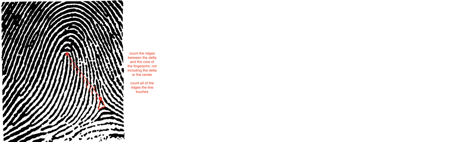
| Ridge counting | the number of ridges between the delta and the core along a drawn line connecting the two points (not counting the delta or core)
|
| Techniques for locating latent prints | 1. Visual examination 2. Oblique lighting 3. White light-crime scene search mode 4. Alternate light source 5. Special development methods |
| Developing with powder – when to use powder; types of powders and how to choose; how to dust and lift prints | Hard, non-absorbent surfaces (non-porous)
Powder dusting: method of physical enhancement relying on fingerprint powders (lightly applied to a hard, non-absorbent surface) mechanically adhering to the perspiration (moisture) and oily components of skin ridge deposits left on the surface
Variety of powders available, choice of color depends on background and visibility of developed latent print in photograph
Regular powders: used on relatively smooth, non-tacky and dry surfaces
Grey, white, silver: dark surfaces
Black: light surfaces
Dual-use: (combination of black & silver/grey powder) light/dark surfaces
Magnetic powder: effective on rough, grained or porous surfaces (composed of metal shavings, magnetic brush applicator holds powder particles in long rows which are pulled across surface being processed, adheres to latent print overcoming magnetic attraction to brush)
Fluorescent powders: effective on multicolored surfaces when ridge lines run across multiple of colors (powder used in standard fashion but fluoresces under UV light, can be magnetic or non-magnetic)
Techniques: 1. Safety (use mask), 2. Choose powder color that provides contrast to surface, 3. Select brush (fiberglass, camel hair, feather, large chunk of cotton), 4. Powder brush (avoid inserting brush directly into powder container), 5. Remove excess powder on brush, 6. Brush surface using light, short circular strokes, 7. Once partial latent print appears concentrate on area in question using lighter strokes & reducing circular motion, 8. Discard any unused powder, 9. Discard any unused powder
Lifting: 1. When possible, lift powder prints after photographing, 2. Types of lifters (transparent lifting tape, rubber/gelatin lifting tape, hinged lifters)
Procedure: 1. Expose adhesive, 2. Apply lifter to surface (cover entire latent), 3. Gently force lifter over surface with smooth, steady motion, 4. Remove lifter from surface, 5. Once lifter is removed (lifting tape is applied to appropriate backing OR adhesive section of hinged lifter is pressed against attached backer OR mylar is placed over rubber/gelatin lifter) |
| Chemical development – when to use chemical; Ninhydrin, physical developer, super glue fuming, amido black, leucocrystal violet | Soft, porous surfaces
Ninhydrin: reacts with amino acids in sweat to produce a purple print (Ruhemann’s purple), ninhydrin mixed w/ solvent such as acetone or ethyl alcohol then applied, applied using a spray or dipping method followed by heat acceleration
Ninhydrin considerations: check evenly periodically (slow developing method), detail dissipates over time, prints under extreme magnification look fuzzy, Ninhydrin may cause ink to run (addition of 3M Novec to ninhydrin prevent running of ink – latents will appear more black)
Physical developer: used on wet or previously wet porous surfaces, consists of silver nitrate-based solutions that develop prints in a dark grey color
Physical developer considerations: used as post DFO and ninhydrin process, can’t be used with silver nitrate, avoid skin contact
Superglue fuming: cyanoacrylate vapors adhere to fingerprint residues on non-porous surfaces, requires a controlled chamber and fume application (used on plastic, glass, glossy/waxed paper, metal, leather, lacquered wood, human skin, various non-porous surfaces), processed print appears white (can be enhanced by dusting, staining w/ fluorescent dyes, etc)
Superglue fuming considerations: over fuming, process works best on recent prints, processing can be conducted indoors or outside, once fumed latent image can be transported w/out fear of destroying image, avoid vapors, avoid skin contact with glue, always used approved mask and eye cover
Amido black: sensitive to blood proteins, stains blue-black color, enhances print only on non-porous surface, submersion or wash solution over surface, processing on vertical & horizontal surfaces, corrosive (causes damage to metal surfaces)
Leucocrystal violet: sensitive to blood hemoglobin, stains purple, enhances prints on porous surfaces, used to process large areas, spray with fine mister, photograph soon after development when in direct sunlight |
| What gives prints evidentiary power? | 1. Possess individual characteristics 2. Remain unchanged during lifetime 3. Possess general characteristics permitting systematic classification (1924: act of congress established identification division of FBI to create database; 1999: FBI integrated automated fingerprint identification system (IAFIS) developed) |
| IAFIS | Automated database for fingerprint comparisons maintained by the FBI |
Ethics and Crime Scene Management | Best practices for maintaining integrity in an investigation | 1. Conduct objective and impartial investigations 2. Document and collect evidence as found 3. Truthfully and objectively report information and evidence |
| What is physical evidence? | Any object that: 1. Can establish that a crime has been committed OR 2. Can provide a link between a crime and its victim OR 3. Can provide a link between a crime and perpetrator |
| 5 steps of crime scene processing | 1. Secure scene / establish evidence integrity and contamination control 2. Assess crime scene 3. Document crime scene 4. Process scene for evidence 5. Debrief and release crime scene |
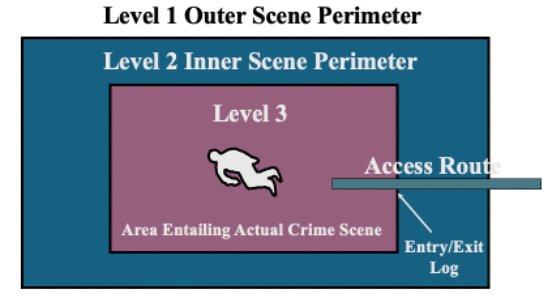
| Multi-level approach of crime scene barriers |
|
| Preliminary walk throughs | 1. Mentally begin preliminary reconstruction of the events 2. Evaluate type of scene 3. Determine personnel & equipment needs 4. Identify types of evidence present 5. Determine search patterns to be employed 6. Protect, preserve, collect physical evidence if needed 7. Note entry/exit points, paths between them, target area of scene, types of damage 8. May be advantageous to interview victim and/or witnesses |
| Approach plans | Area approach: single group of investigators responsible for all processing for a given area in the scene
Functional approach: crime scene teams handle specific functions within the entire scene |
| Safety considerations- selecting the appropriate PPE | Eye protection, disposable coveralls, face mask, disposable gloves, shoe covers |
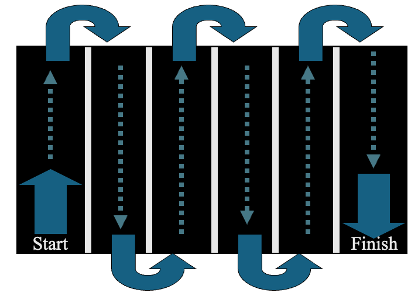
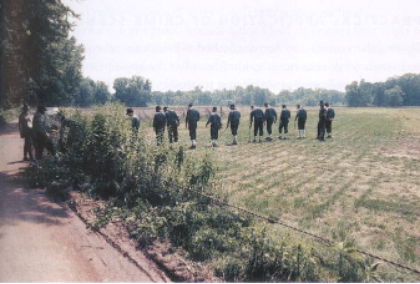
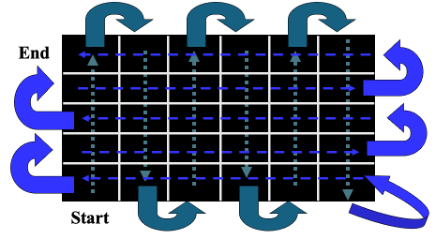
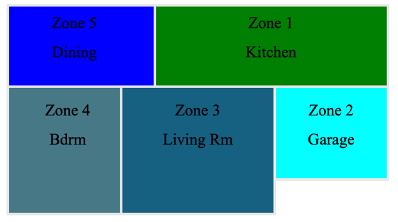
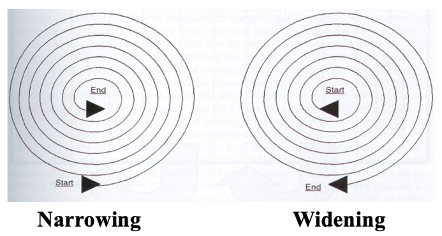
| Search patterns | Determine search swatch size: consider the mature of ground being searched, lighting conditions, on-scene environmental conditions, size of item being searched for
Strip search method:
Lane (line) search method:
Grid search method:
Zone search method:
Spiral search method:
|
| Preventing contamination | 1. Limit access to scene(s) 2. Designate area(s) for trash/equipment/evidence 3. Use PPE 4. Utilize single-use equipment/tools or clean between evidence collections and/or scenes |
| Releasing the scene – important considerations | 1. Release only after final survey conducted 2. Document releasing of scene (time/date, to whom/by whom) 3. Once formally released, re-entry may require warrant |
Legal issues | 4th, 6th, and 14th amendments to the Constitution | 4th amendment: protection from unreasonable search and seizure, based on probable cause, supported by a warrant
6th Amendment: Guarantees the rights of criminal defendants, including the right to a public trial, an impartial jury, the right to know the charges against oneself, the right to confront witnesses, and the right to have legal counsel.
14th amendment: Provides equal protection under the law and due process for all citizens, prohibiting states from denying any person life, liberty, or property without due process of law; it also addresses citizenship rights and the rights of former slaves. |
| Weeks v. United States | · Landmark supreme court case · Weeks convicted of illegal gambling (home searched without a warrant) · Ruling: warrantless search & seizure violated 4th amendment · Outcome: exclusionary rule at the federal level (mapp v. ohio 1961: rule extended to state courts) |
| Exclusionary rule – purpose, know the exceptions, be able to recognize when an exception has been met | · Disallows the use of illegally obtained evidence in criminal trials · Prevents a prosecutor from introducing evidence seized from an illegal search · Prior to adoption, evidence seized in violation of the 4th amendment was admissible · If evidence was shown to be pertinent to the issue, court did not take notice how evidence was obtained · Deters improper police conduct (creates incentive to search within the limits of the 4th amendment, unlawfully obtained evidence will be useless: fruit of the poisonous tree)
Exceptions: 1. Intervening circumstances (people v. Martinez: unlawful car stop —> arrested for gun possession —> questioning for homicide) 2. A significant intervening event served to break the chain of the exclusionary rule 3. Inevitable discovery doctrine: if the prosecution can prove that the evidence would have been found through lawful means, then it can be admitted despite the initial unlawful police action |
| Primary vs. secondary evidence | Primary evidence: evidence obtained as a direct result of illegal conduct, subject to the exclusionary rule
Secondary evidence: evidence that is obtained indirectly as a result of leads or information gained from that primary evidence, only secondary evidence is admissible under the inevitable discovery doctrine |
| Warrant requirement of 4th amendment- know what is and is not an exception, be able to recognize when an exception has been met; special considerations for fire scenes | Exceptions: 1. Consent: voluntary decision by a citizen not to assert a 4th amendment right (voluntariness determined by totality of circumstances) 2. Plain view doctrine: warrantless seizure of contraband, evidence, or instrumentalities of a crime, where these items are in open view and the officer sees from a lawful vantage point 3. Inventory search: vehicle is lawfully impounded, search must be conducted according to department guidelines, not designed as crime scene search, can search any closed container within vehicle as long as it is allowed in department policy 4. Abandonment: person loses all expectation of privacy, must be given up voluntarily, may not be coerced or precipitated by unlawful police activity 5. Hot pursuit: suspect may not defeat an arrest by fleeing to a private place, officer may enter premise without a warrant to search for suspect who has fled after committing a crime under the following circumstances: probable cause crime has occurred & person being pursued committed it, evident person entered building when he/she is still in view
Mincey v. Arizona: homicide scenes are NOT exceptions to the 4th amendment
Fire Scene: entry to fight a fire requires no warrant, officials may investigate cause for reasonable time, evidence discovered can be seized under the plain view doctrine, if fire official leaves premises, a security person should remain to ensure integrity of a scene, once scene is relinquished, need warrant or consent to return |
| Brady vs. Maryland | · Brady & Boblit convicted of 1st degree murder & sentenced to death · Prosecutors withheld a statement by Boblit stating he alone committed the murder · Brady argued he would have gotten a lesser sentence if statement wasn’t withheld · Ruled in Brady’s favor |
| Brady Rule | Prosecutors to disclose material, exculpatory evidence to the defense
Withholding exculpatory evidence violates due process under the 14th amendment (right to a fair trial) |
| Types of evidence favorable to the accused | Exculpatory evidence: evidence that tends to exonerate the defendant (testifies to justice, excuse, or clear the defendant from alleged fault or guilt)
Mitigating evidence: evidence that tends to reduce the defendant’s moral blameworthiness
Impeachment evidence: evidence or information used to assess the credibility or reliability of the government witnesses |
| Crawford v. Washington | · Attempted murder of a man Crawford said tried to rape his wife · Wife provided recorded testimony that contradicted Micheals claim · Wife didn’t testify in court (spousal privilege) · Prosecution played recording and Crawford convicted
Outcome: · Testimonial evidence can’t be used unless the witness is available for cross-examination · Reinforced the defendant’s right to confront accusers in court · Changed how courts handle hearsay evidence, making trials fairer |
| How hearsay was handled before Crawford | Ohio v. Roberts: hearsay allowable if it falls into a firmly rooted hearsay exception or judge deemed it trustworthy |
Evidence handling | Locard’s principle | Every contact leaves a trace |
| Naloxone | Used for opioid overdose and should be nearby in case of exposure |
| Separation of evidence | · Store “questioned evidence” in separate container · Store “questioned evidence” from the victim and/or the crime scene in separate containers from evidence collected from the suspect · Change gloves (DO NOT wear the same gloves when handling questioned evidence from different sources or reference samples) |
| Rules for handling wet evidence | Items that may mold should be packaged in paper (anything wet i.e. clothes, paper, plant material, etc) |
| How to package with a proper seal | · Don’t package items from multiple cases in the same container · All items must have proper seal w/ non-cellophane tape & initials (include date of seal too) · No staples
A proper seal: · Tamper-resistant tape (for security, to prevent loss of evidence & to prevent contamination from external sources) · w/out the tape: keep in mind the purpose of the seal, clear box tape works well (not gift wrapping tape) |
| Considerations for evidence storage facilities | · access (controlled, limited, a list of authorized personnel should be maintained, tracked electronically or written) · environment (facility should be climate controlled to prevent deleterious change to the environment, maintain low humidity & room temperature, protect from water damage, direct sunlight & excessive heat, protect from rodent & insect activity) |
| DNA evidence- How to collect; when to refrigerate vs. freeze; special considerations for contamination | Collection: 1. document & photograph the removal of stains 2. for absorptive surfaces: cut out questioned stains 3. for non-absorptive surfaces: damped a sterile swab with sterile water to collect dry stains 4. IMPORTANT: air dry any wet items or swabs before packaging and sealing
Considerations: · Thoroughly dry the wet or moist items before packaging · Do not use plastic packaging for biological evidence · Store the packaged items in a cool, dry area (avoid sunlight, heat and excessive humidity) · Label & seal all packaging properly · IMPORTANT: mark all packages with biological hazard stickers
Fridge vs. Freeze: · Refrigerate liquid biological samples & sexual assault kits if they contain liquid samples (i.e. blood) if uncertain, the kits should be refrigerated NOT FROZEN · Freeze tissue samples, DNA extracts, swabbing’s, & cuttings |
| Trace evidence – types of trace evidence; assessing probative value; paper folds; picking, taping, vacuuming; fracture matching; collecting controls; fragility of evidence | · Types: Picking (collecting individual hairs/fibers using gloved hands & clean tweezers/forceps or place individual hair/fiber within folded paper), taping, vacuuming · Probative value: may be limited due to the facts of a particular case or the type of material collected · Paper folds: should be placed into paper envelopes with sealed corners (hold single hairs/fibers or small amounts of hairs/fibers) · Fiber controls: collect entire item of possible, otherwise collect each color & kind or fiber from control (should be collected from all possible suspects) · Hair controls: adequate number of control hairs (30 pubic hairs, 50 head hairs), representative sample (head hairs should be obtained from all areas of the scalp) · Fracture matching: realignment of 2+ fragments to prove they were once joined from a single object |
| Questioned Documents – written instruments and types of QD evidence; types of forgery; types of comparisons; non-request and request exemplars; | Written Instruments: not only writing on a page but also credit cards, automobile VIN, and writing on walls
Types of QD Evidence: written instruments, forgery, completed (fills in or signs a genuine document), altered (changes portions of a document)
Forgery: means a written instrument which if falsely made, completed or altered i.e. drivers licenses
Comparisons: handwriting/hand printing, ink, paper examinations, mechanical impressions, indented writing, alterations/obliterations, print process identification, counterfeit documents, charred documents
Non-request: set of authentic standard prepared in the normal course of social, occupational or business activities & examples obtained from multiple sources
Request: set of standard prepared on demand, most often needs a court order, you can tell someone what to write but not how to write it, strongly recommend contact QD examiner prior to conducting handwriting session because you have only one chance to obtain exemplars |
| Firearms – types; components of a cartridge; things to record when collecting firearm/ammunition evidence; proper packaging; GSR and what to collect for GSR analysis; collecting residue from hands; preserving evidence for ballistics analysis (no metal) | · Types: handguns & long guns · Cartridge components: single, complete round of ammunition composed of a bullet (projectile), gunpowder (propellant), primer, and metallic cartridge case · Things to record when collecting evidence: record location of weapon/ammunition using measurements, sketches, and photographs, record physical appearance of firearm (caliber, make, model, serial number, position of slide, bolt or cylinder, position of exposed hammer, firing pin & safety, trace evidence found on weapon) · Proper packaging: place firearm in box & pack to prevent shifting, do not package loose ammunition with firearms · GSR: when firearm is discharged, gases from detonation of primer & burning of gunpowder escape, depositing residue · What to collect for GSR analysis: outermost garment from victim with bullet hole, suspect weapon, suspect ammunition · Collecting residue from hands: collect within 4 hours of deposition, preserve by covering persons hands, sample deceased body before moving, 2 techniques (swab & disc lift) |
| Toxicology – types of specimens; special considerations; proper packaging of seized drugs and paraphernalia | · Types of specimens: blood, vitreous fluid, liver, gastric content, others (nails, hair, etc), urine, muscle & other tissues, spleen, saliva · Special considerations: timing between sample collections & testing, specimen selection & postmortem cases specimen quality is quite broad, proper storage temperature, drug stability
Proper packaging: · Dry evidence: package in plastic zippered or heat-sealed bags · Wet evidence: dry out if possible, if not then package in leak proof containers · Plants & botanicals: package in paper to allow for drying while in storage & minimize potential for mold growth |
| Clandestine labs – recognizing them and precautions | Definition: unlawful, covert operation consisting of a combination of commercial and/or improvised lab apparatus and chemicals used to illegally manufacture controlled substances or designer drugs
Indications: · Large amounts of household items in unusual locations · Commercial and/or improvised lab glassware & equipment · Exposure symptoms of individuals nearby
Precautions: · Hazardous & toxic · Do not breathe vapors & avoid any contact/exposure · Possibly “booby-trapped” · Dumping of toxic waste/by-products in areas around labs |
| Digital evidence - Proper documentation of scene; proper packaging and storage | Documentation: · Label & document all connections · Record locations of computer components · Record status of computer & components, brand, model, serial numbers, all actions taken and changes observed · Diagram complex scenes to assist in reassembly · Photograph entire scene: image on screen, peripherals, cables
Packaging & storage: · Do not use packaging materials that produce static electricity · Package to prevent damage · Avoid folding, bending, or scratching of media · Keep multimedia digital evidence away from magnetic sources · Avoid storage in extreme conditions |