Functional Theories of Translation Notes
Functional Theories of Translation
Introduction
Functional theories emphasise the purpose and communicative action of translation, influenced by the socio-cultural context of the target text (TT).
This contrasts with purely linguistic theories by highlighting the function of the translation and its role in the target socio-cultural context.
Key Points:
Focus on the intended purpose of the translation, which shapes its form and content.
Consideration of the receptor's expectations and cultural norms is essential.
Evaluation of translations based on their effectiveness in achieving the intended communicative purpose of the TT.
Key Figures
Katharina Reiss.
Mary Snell-Hornby.
Justa Holz-Mänttär.
Hans J. Vermeer.
Christiane Nord.
Timeline and Location
Late 20th century (1970s-80s) in Germany.
Core Concept: Functionalism
Focuses on the function of texts and translation.
Shifts emphasis from linguistic typologies to culture.
Linguistic equivalence - Functional appropriateness.
Katharina Reiss: Text Type
Emphasises that communication is achieved and equivalence should be sought at the text level rather than at the word or sentence level.
This approach allows for a more nuanced understanding of meaning, taking into account the cultural context and intended purpose of the translation.
Language functions include informative, expressive, and appellative dimensions, influencing language dimensions, text types and communicative situations.
Functional Characteristics of Text Types
Reiss identifies three main text types:
Informative:
Plain communication and representation of objects and facts.
Language function - Informative.
Language dimension - Logical.
Text focus - Content.
Expressive:
Creative composition, expressing sender’s attitude.
This function emphasises the emotional and aesthetic qualities of the message, allowing the sender to convey personal feelings and subjective experiences.
Language function - Expressive.
Language dimension - Aesthetic.
Text focus - Form.
Operative:
Inducing behavioural responses, making an appeal to the text receiver.
Language function - Appellative.
Language dimension - Dialogic.
Text focus - Appellative.
Audio-Medial Texts
Films and advertisements are examples of multimodal texts supporting functional characteristics of text types.
Hybrid types
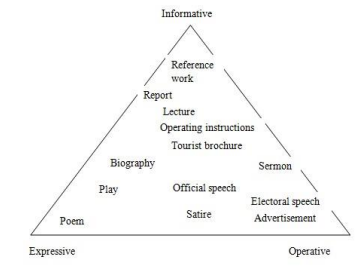
Despite the existence of such hybrid types, Reiss (1989: 109) states that ‘the transmission of the predominant function of the ST is the determining factor by which the TT is judged.
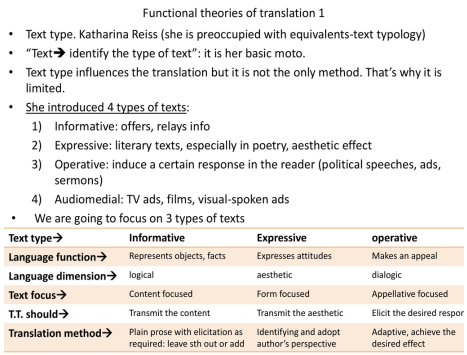
Informative:
TT should transmit referential content.
Translation method - ‘Plain prose’, explicitation as required.
Expressive:
TT should transmit aesthetic form.
Translation method - ‘Identifying’ method, adopt perspective of ST author.
Operative:
TT should elicit desired response.
Translation method - ‘Adaptive’, equivalent effect.
Intralinguistic and Extralinguistic Instruction Criteria to Assess the Adequacy of a TT
Linguistic components:
Semantic equivalence.
Lexical equivalence.
Grammatical and stylistic features.
Non-linguistic determinants:
Situation.
Subject field or domain.
Time.
Place (characteristics of country and culture).
Receiver.
Sender.
Affective implications (humour, irony, emotion, etc.).
Importance of Criteria
The importance of these criteria varies based on text type and function.
Encyclopaedia entry: emphasises semantic equivalence (E.g. Tyrannosaurus rex).
Popular science book: considers the individual style of the ST author.
Scientific paper: follows specialised conventions of academic articles.
Metaphors?
Example: Gulliver's Travels
Originally a satirical novel attacking the British government of the day (i.e., a mainly operative text), it is nowadays normally read and translated as ‘ordinary entertaining fiction’ (i.e., an expressive text).
Swift's experience with the Tories and their conflicts with the Whigs caused him to write books that mock religious beliefs, government, or people with views differing from his own. In one of these books, Gulliver's Travels, Swift criticises the corruption of the English government, society, science, religion, and humanity in general.
Significance of Reiss's Theory
Moves translation theory beyond a consideration of lower linguistic levels, the mere words on the page, beyond the effect they create, towards a consideration of the communicative function of translation.
Recognises that the TT function may differ from the ST function, crucial in challenging the prevailing view of equivalence that saw the translator’s goal as achieving equivalent effect.
Criticism of Reiss's Theory
Why only three language functions?
What about informative texts containing a large number of simple and complex metaphors?
Can all text types and genres be differentiated on the basis of the primary function?
What about the coexistence of functions within the same ST?
How does the translator's role and purpose affect the translation?
What about sociocultural pressures?
The credit crunch bites and shows its teeth!
Families ration their fun as the credit crunch bites by cutting back on beer and eating out. After all five levels are attended, you will have the tools necessary to professionally traverse a bull and bear market.
Mary Snell-Hornby: Integrated Approach
Advocates a broad interdisciplinary approach including cultural history, literary studies, sociocultural studies, area studies, legal, economic, and medical concepts, etc.
Uses prototypes for text type categorisation and proposes a stratification model from the most general to the most particular.
Stratification Model
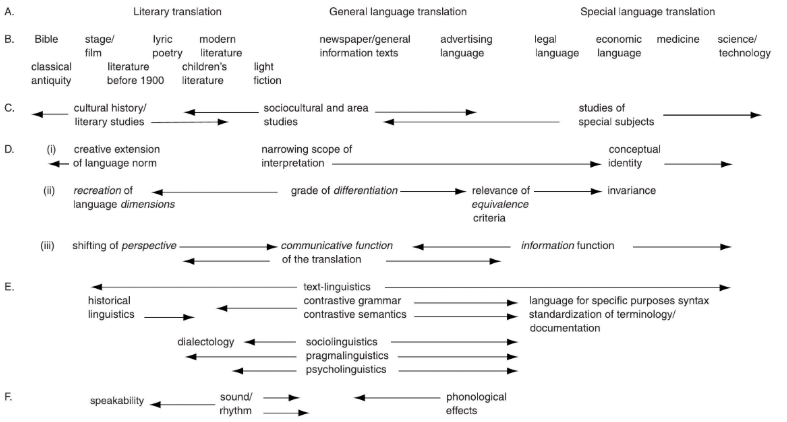
Level A: Single continuum instead of isolated categories according to different areas of translation.
Level B: Prototypical basic text types.
Level C: Non-linguistic disciplines intertwined with translation.
Level D: Translation process.
Understanding ST function.
TT focus.
Communicative function of TT.
Level E: Areas of linguistics relevant to translation.
Level F: Phonological aspects like alliteration, rhythm and speakability of stage translation and film dubbing.
Inconsistencies in Snell-Hornby’s Model
Should all newspaper texts be grouped as 'general language translation'? What about technical, scientific, financial texts?
Should film translation be treated as literary translation?
Why is 'advertising' placed further from literary texts than 'general' texts?
It may well have far in common with the creative language of lyric poetry.
Is 'cultural history' less relevant to medical text translation than literary translation?
Is background research (‘studies of special subjects’) inappropriate for translating literary texts?
Why is 'speakability' restricted to literary works? What about news interviews designed to be as a voice-over?
The model aims to remove rigid divisions between text types and languages.
X - Translator training: commercial vs. literary translators.
Web Localisation and Digital Genres
Involves domain specialisation and new genres and text types requiring instant translation.
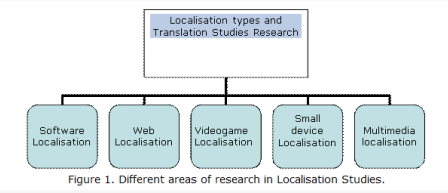
Jiménez Crespo’s Classification (2013: 97-99)
Text type (or supra-genres): informational, advertising, instrumental, communication-interaction, entertainment.
Functions: Vary according to purpose of the text.
Participants: Determined by roles of sender and receiver.
Web genres: personal homepage, corporate website, etc.
Subgenres: Personal, professional, etc.
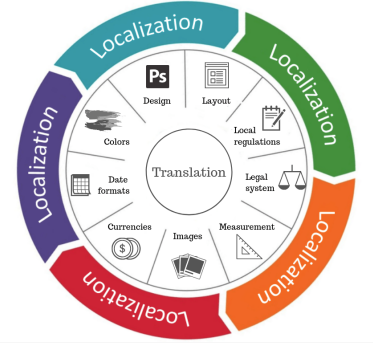
Multilingual version involves localisation.
Justa Holz-Mänttäri: Translatorial Action Model
Focuses on guiding cooperation across cultural barriers to enable functionally oriented communication. It’s not just about translating words, sentences or texts.
Aim: To provide a model and produce guidelines applicable to different professional translation situations.
Translation is purpose-driven and outcome-oriented, viewed as a communicative process involving various roles and players, each with their own goals.
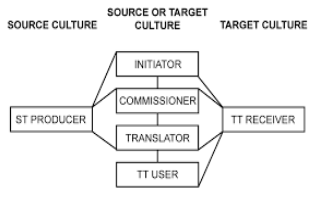
The Process of Translation
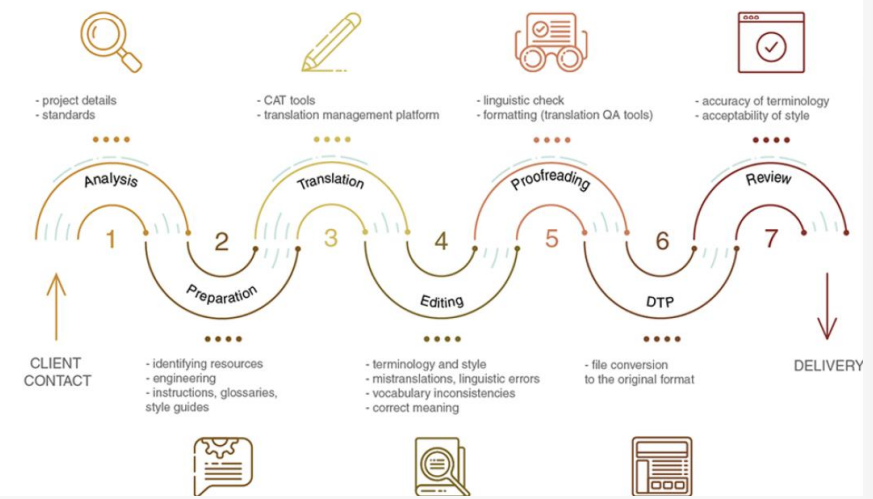
Roles and Players
The Initiator:
The company or individual who needs the translation.
The Commissioner:
The individual or agency contacting the translator.
The ST Producer:
The individual(s) within the company who write(s) the ST, and who is/are not necessarily involved in the TT production.
The TT Producer:
The translator(s) and the translation agency or department.
The TT User:
The person who uses the TT (e.g., teacher using a translated textbook).
The TT Receiver:
The final recipient of the TT (e.g., students using the textbook in the teacher’s class)
Translatorial Action Model
Translatorial action focuses on producing a TT that is functionally communicative for the receiver.
The form and genre of the TT must be guided by what is functionally suitable in the TT culture, rather than copying the ST profile.
ST is examined for its construction and function profile, with relevant features described according to content and form.
Content is divided into factual information and overall communicative strategy.
Form is divided into terminology and cohesive elements.
The Needs of the Receiver Are Determining Factors for the TT
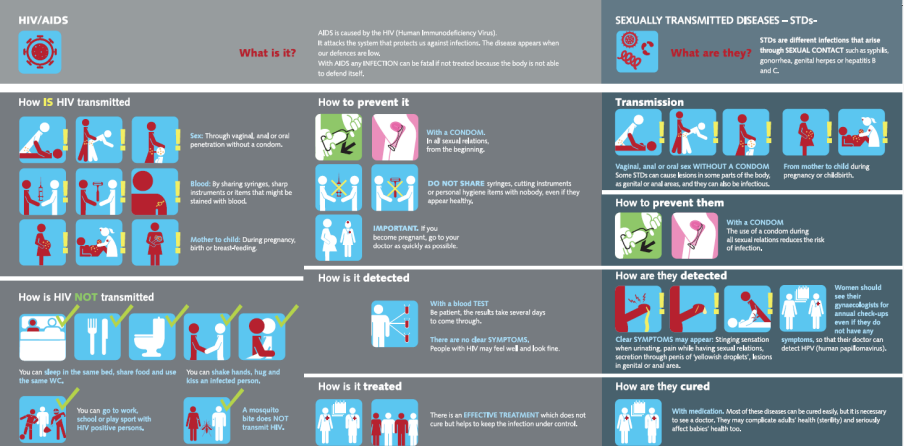
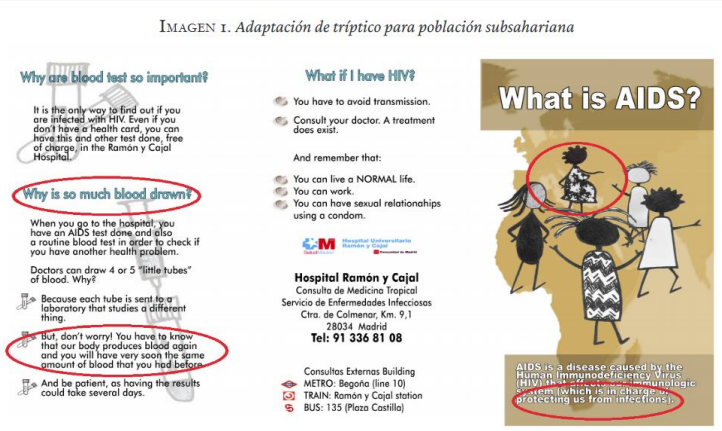
Final Reflection on Mänttäri's Model
Places translation within its sociocultural context.
Addresses real-world commercial translation constraints.
Includes the translator-initiator interplay, as well as other roles/players.
Flexible enough to incorporate new translation roles and practices (e.g. workflow, project management systems, translation agencies, and even usergenerated content, such as fan subs).
Criticism
Complex jargon (e.g., translatorial text operations).
Fails to consider cultural difference in more detail, although it aims to provide guidelines for intercultural transfer.
Skopos Theory
Skopos means 'aim' or 'purpose'.
Developed by Hans J. Vermeer (1970s).
Core Principles
The purpose of a translation is the main factor guiding the translation process.
Every action, including translating, has a purpose (a skopos).
The skopos of a translation depends on its addressees/audience.
The skopos is the most important factor determining the translator's decisions and the final form of the TT (translatum / outcome of translational action).
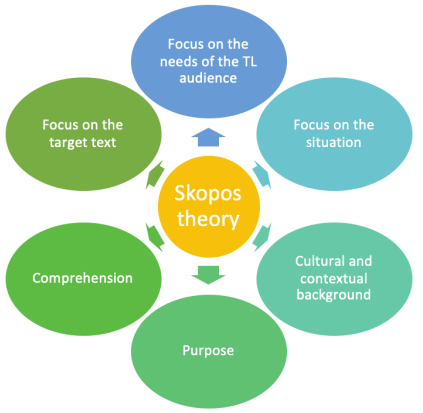
As translators, we must know why the ST needs to be translated and what the function of the TT will be.
Basic Rules
A translational action (TT) is determined by its skopos.
A translational action is an offer of information in a target culture and TL concerning an offer of information in a source culture and SL.
A TT does not initiate an offer of information in a clearly reversible way.
A TT must be internally coherent.
A TT must be coherent with the ST.
FUNCTIONAL ADEQUACY
Coherence and Fidelity Rules
Coherence rule: internal textual coherence
The TT must be sufficiently coherent to allow the intended users to comprehend it, considering their assumed background knowledge, needs, and situational circumstances. Otherwise, the TT is NOT ADEQUATE for its purpose (rule 4).
Fidelity rule: intertextual coherence
Some relationship must remain between TT and ST once the paramount principle of skopos has been met (rule 5).
Functionality and Loyalty Principle
Christiane Nord (2005: 31-32) emphasises:
While functionality is the most important criterion for translations, translators do not have absolute license (carte blanche) and there must be a relationship between ST & TT, which is established by the purpose/skopos.
Loyalty commits the translator to both the source and target sides. It must not be mixed up with fidelity or faithfulness, concepts that usually refer to a relationship holding between source and target texts. Nord (1997: 125) defines loyalty as an interpersonal category referring to a social relationship between people.
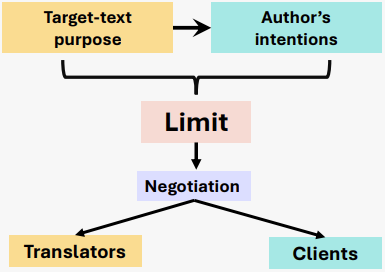
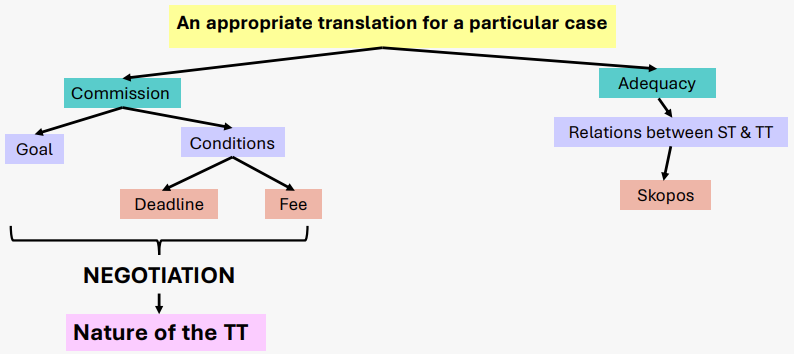
Commission and Skopos
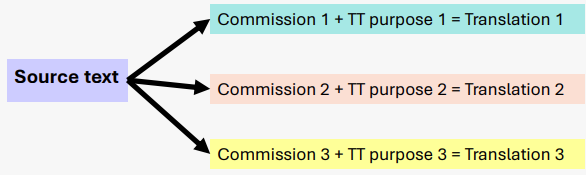
The translation purpose (skopos) justifies the translation procedures.
Criticism
(1) What purports to be a 'general' theory is in fact only valid for non-literary texts. Literary texts are considered either to have no specific purpose and/or to be far more complex stylistically. Vermeer (1989/2012: 232-3) answers this by stressing that goals, purposes, functions and intentions are 'attributed to' actions. Thus, for a poet or his/her translator the goal may be to publish the resultant Translatum (poem) and to keep copyright over it so as to make money from its reproduction. He/she may also have the intention of creating something that exists for itself ('art for art's sake').
(2) Reiss's text type approach and Vermeer's skopos theory consider different phenomena and cannot be lumped together. The point at issue is the extent to which ST type determines translation method and the nature of the link between ST type and translation skopos.
(3) Jargon such as Translatum does little to further translation theory where workable terms (e.g. target text) already exist. However, as we have seen, in Nord's English translation the focus is firmly on the theory as 'translational action'.
(4) Skopos theory does not pay sufficient attention to the linguistic nature of the ST nor to the reproduction of micro-level features in the TT. Even if the skopos is adequately fulfilled, it may be inadequate at the stylistic or semantic levels of individual segments. This fourth criticism in particular is tackled by Christiane Nord with her model of translation-oriented text analysis, to which we shall now turn.
Translation-Oriented Text Analysis
Developed by Christiane Nord (1980s).
Her model is based on the function and intention of the target text in the target culture, but she pays more attention to the features of STs, deeply analysing their extra- and intratextual features.
Aim: Understanding the ST and selecting translation strategies adequate to the intended translation purpose.
Provides students with a model of ST analysis applicable to all text types and situations.
Documentary vs. Instrumental Translation
Documentary translation:
Openly a translation of something else.
You know it’s a translation.
Culture-specific lexical items are MAINTAINED.
Instrumental translation:
It’s not an open translation.
The text functions as an independent communication INSTRUMENT in its own right.
* Function-preserving translations: ST and TT have the same function (e.g., IKEA assembly instructions) - This is not always the case.
Key Aspects
The importance of the translation commission/brief.
The role of ST analysis.
The functional hierarchy of translation problems.
The Importance of the Translation Brief: ST—TT Comparison
The (intended) text function(s).
The target text addressee(s).
The (prospective) time and place of text reception.
The medium over which the text will be transmitted.
The motive for the production or reception of the text.
The Role of ST Analysis
Feasibility of translation.
ST items to address to achieve functional translation.
Translation strategy to fulfill the translation brief.
* Intratextual factors
Subject matter, content, presuppositions, text composition, non-verbal elements, lexis, sentence structure, suprasegmental features.
North and South, Elizabeth Gaskell

Functional Hierarchy of Translation Problems
Determine the functions of the ST & TT and the type of functional translation needed (documentary vs. instrumental).
Consider what’s stated in the translation commission. (1: text functions, addressees, medium, time and place of reception…).
Decide on the translation style (preserve/adapt certain elements). The translation type helps to decide the translation style.
Identify problems of the text at a lower linguistic level. (2: non-verbal elements, lexis, content, presuppositions…).
Final Thoughts
An approach combining the strengths of other functional and action theories:
Holz-Mänttäri’s roles and players relating to the translation commission.
Reiss and Vermeer’s skopos relating to intended text functions, but without total dominance.
Reiss’s work relating to communicative function + ST genre features.
Discourse and Register Analysis Approaches
Growth of Discourse Analysis in Translation Studies
From the 1970s onward, discourse analysis gained prominence in applied linguistics, largely influenced by Halliday’s systemic functional grammar (SFG). This framework views language as a system for meaning-making entrenched in social relationships and power dynamics. Translation analysis began to adopt discourse analysis to better understand how meaning and social context interplay in communication.
Key scholars expanded this approach:
House developed a model for assessing translation quality that builds on Halliday’s register analysis.
Baker introduced discourse and pragmatic analysis as practical tools for translators.
Hatim and Mason incorporated pragmatic and discourse perspectives into the analysis of register, emphasising multi-layered meaning in translation.
Halliday’s Model of Language and Discourse
Halliday’s model of discourse analysis, based on what he terms systemic functional
linguistics (SFL), focuses on studying language as a tool for communication. It
emphasises that a writer’s linguistic choices carry meaning and, through a detailed
grammatical framework, connects these choices to the text’s purpose within a
broader sociocultural context. The model highlights the deep interconnection between language, communicative goals, and society.
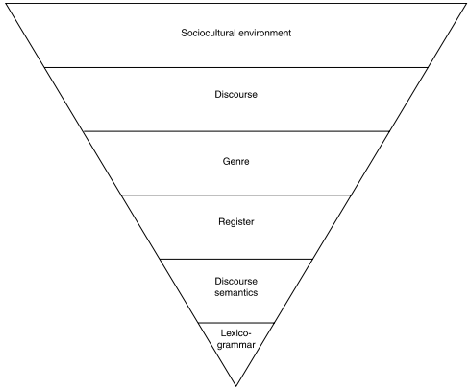
Sociocultural Environment: The highest hierarchical level influencing a text. This includes the conventions of the time and place in which the text is produced. Along with social and cultural factors, it also reflects political, historical, and legal conditions.
The Cuban Revolution of 1959
The wave of Latin American fiction translation in the U.S. from the 1960s onward was influenced by the political climate following the Cuban Revolution of 1959. Amid rising tensions, various cultural, political, and philanthropic organisations in
the U.S. sought to strengthen ties with Latin America, sometimes for ideological or diplomatic reasons. This interest in Latin American literature led to the translation and international recognition of several authors. Ultimately, this translation boom was not just a literary movement but also a
reflection of broader political and cultural dynamics.
Fact Sheets on the European Union
In an EU based on the motto ‘United in diversity’, languages are the most
direct expression of our culture. Linguistic diversity is a reality, observance of which is a fundamental value of the EU.
= Legal requirement
Genre: Defined in SFL as a conventional type of text realised for specific communicative functions, e.g., an invoice issued by a company’s accounts department to a customer. The sociocultural environment partly shapes the genre, while genre itself helps to determine other elements in the systemic framework.
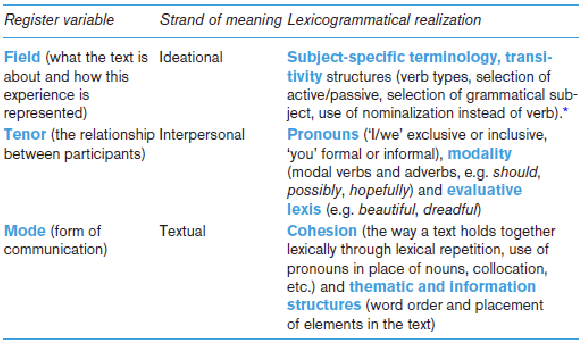
Register: It should not be confused with the more common use of "register" as formal or informal language. In SFL, it is a technical term that is more nuanced and complex. It connects the variables of social context to language choice. It consists of three essential variables:
Field: What is being written about (e.g., the price for a delivery of goods).
Tenor: Who is communicating and to whom (e.g., a sales representative to a customer).
Mode: The form of communication (written/spoken, formal/informal).
Each variable corresponds to a strand of meaning, or Discourse Semantics, in the text. The three strands, called “metafunctions”, are:
Ideational: Represents events or the world.
Interpersonal: Enacts social relationships.
Textual: Ensures coherence and cohesion.
These metafunctions are realised through lexis, grammar, and syntax, or “lexicogrammar,” chosen by the text producer (author, speaker, translator. . .).
Register Variables and their Typical Realisations
Contextual Example: The Cuban Revolution and Translation
The political climate post-1959 Cuban Revolution influenced the translation boom of Latin American fiction in the U.S. This boom reflected not just literary trends but geopolitical interests aiming to strengthen ties and promote cultural exchange shaped by ideological motivations.
In 2000, Gabriel García Márquez wrote an essay about the case of Elián González, a young Cuban boy found floating on a raft after a tragic journey in which his mother drowned. The incident sparked a heated political dispute between the U.S. and Cuba, with Elián's relatives in Miami wanting him to stay in the U.S., while his father in Cuba insisted he return. The case became a symbol of the broader geopolitical tensions between the two countries.
The essay exemplifies translation challenges embedded within political discourse. The textual choices in translation can obscure or reveal agency—for instance, shifting blame for Elián’s behavioural changes from U.S. caretakers to the child himself as indicated in the Spanish source and its English translation. Understanding these nuances is crucial to preserve meaning in cultural and communicative contexts.
Same Meaning?
ST: las abuelas volvieron a Cuba escandalizadas de cuánto lo habían cambiado (lit. the grandmothers returned to Cuba outraged at how much they had changed him).
TT: the grandmothers returned to Cuba outraged at how much he had changed.
Absolutely Not!
The effect of the TT is to obscure the reality that it is the boy's U.S. relatives who are depicted as responsible for altering his behaviour. This type of analysis can be highly valuable for translators, as it helps them identify key elements in the ST and understand how these elements contribute to meaning within a particular cultural and communicative context.
The Hallidayan Model
While Halliday’s model is appealing for applied linguistic research, including translation studies, due to its functional focus, it is also highly complex and, in some cases, difficult to manage.
As a result, other translation scholars have chosen specific elements that are relevant to their work and, when needed, simplified them.
House’s Model of Translation Quality Assessment
House critiques Skopos theory and other target-audience-centered approaches for being “fundamentally misguided” as they overlook the source text’s integrity. She develops a model based on a comparative analysis of the source text and target text to evaluate translation quality, emphasising discrepancies or mismatches between them.
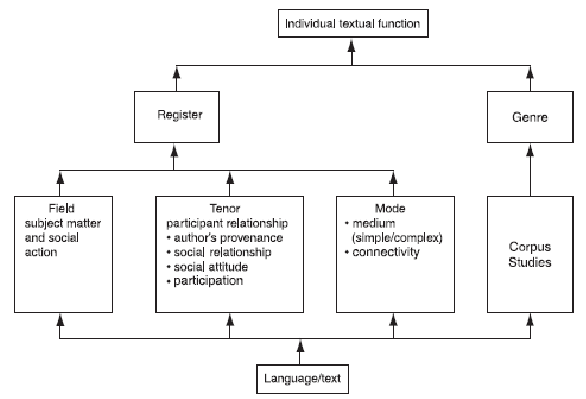
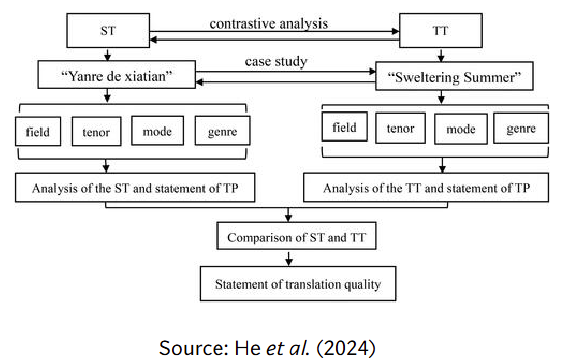
This model systematically compares the textual profile of the source text and target text. While it incorporates various, sometimes complex, taxonomies, its core focus is on Register analysis in both texts. It examines the lexical, syntactic and textual features that construct Register.
House’s concept of Register expands on Halliday’s framework and includes:
Field: The subject matter and social action, including the specificity of lexical choices.
Tenor: The addresser’s temporal, geographical, and social background, as well as their intellectual, emotional, or affective stance.
Mode: The communication channel (spoken, written, etc.) and the level of interaction between the addresser and addressee (monologue, dialogue, etc.).
How Is the Model Applied?
Source Text (ST) Register: A profile is produced of the ST Register (field, tenor, mode), analysing field, tenor, and mode. Then, a description of the ST genre is added. Together, this allows a ‘statement of function’ to be made for the ST, including the ideational and interpersonal component of that function (in other words, what information is being conveyed and what the relationship is between sender and receiver).
Target Text (TT) Register: It undergoes the same process. Then, the TT profile is compared to the ST profile and a statement of “mismatches” or errors is produced. These are categorised according to the situational dimensions of Register and genre. Such dimensional errors are referred to as:
Covertly erroneous errors: Mismatches in situational dimensions of register and genre, subtle and not obvious.
Overtly erroneous errors: Denotative mismatches (which give an incorrect meaning compared to the ST) and target system errors (which do not conform to the formal grammatical or lexical requirements of the TL).
A “statement of quality” is then made of the translation.
The final evaluation includes the quality judgement and classification of the translation type:
Overt Translation: The target text (TT) audience is not directly addressed in the same way as the original audience. In other words, the TT does not attempt to appear as an original text nor is it tailored specifically for the new audience. A clear example is the translation of a historical speech, such as Winston Churchill’s addresses from World War II. The original speech was deeply rooted in its source culture, historical moment, and context, all of which differ for the TT audience. Similarly, literary translations also fall into this category, as they remain closely tied to the culture of the source text.
House argues that in overt translations equivalence cannot be achieved at the level of text function due to differences in the discourse worlds of the source and target texts. Instead, she proposes a “second-level functional equivalence” based on language, Register and genre. In this model, the TT allows readers to access the ST’s function without replicating it fully. For
instance, a Korean translation of Churchill’s speech provides insight into the original but does not serve the same communicative function.
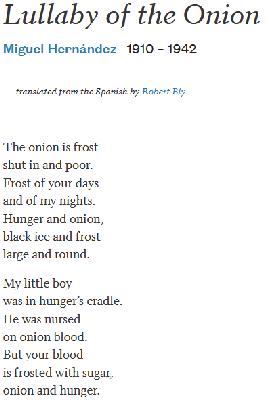

Covert Translation: A covert translation is one that functions as an original text in the target culture, without being explicitly linked to the source culture or audience. Both the ST and TT directly address their respective readers, making the translation appear as naturally written in the target language. The key aim of a covert translation is to reproduce the original’s function in the target culture without immersing the reader in the discourse world of the ST.
To achieve this, the translator must apply what House calls a cultural filter, adapting cultural elements to make the target text feel like an original. This process may involve modifications in language and Register to align with the expectations of the target audience (tú/usted).
House explores the concept of the cultural filter in German-English comparative pragmatics, highlighting differences in communication styles. For example, German business communication at the time tended to be more direct and content-focused, whereas English business communication was typically more interpersonal. In a covert translation, these differences must be reflected—such as making a company chairman’s letter sound more relational and engaging in English.
House emphasises that the overt-covert translation distinction is a spectrum, not a strict binary. A translation can be more or less overt/covert depending on the context. Additionally, if functional equivalence is the goal but the ST genre does not exist in the target culture, the translator should aim for a version rather than a direct translation.
Practical Application and Examples
For example, board game instructions written for a child in one language may need to be adapted if the target culture expects a more formal tone. A phrase like “The castle moves sideways or up/down. Try moving it as far as you want!” might be rendered as “The rook moves horizontally or vertically with no limit” to match genre conventions in the target language.
Baker’s Text and Pragmatic Level Analysis
II Congreso Internacional. Traducción y Sostenibilidad Cultural: Retos y Nuevos Escenarios
“La traducción tiene el potencial de jugar un papel transformador en la reconfiguración de relaciones sociales y políticas, articulando nuevas formas de conocimiento a través de la confrontación responsable de
epistemologías y experiencias culturales diversas. El trabajo de grupos activistas como Guerrilla Translators y Respond Crisis Translation demuestran el poder de la
traducción en este sentido. Al mismo tiempo los encuentros traductológicos, incluso cuando son bienintencionados, pueden ser fuente de explotación, manipulación y pueden reforzar más que desafiar las estructuras de poder. Esto es evidente en la labor de un número creciente de grupos “activistas” que alegan ofrecer traducciones hechas por voluntarios para difundir ideas progresistas y apoyar a comunidades marginadas. Algunos de estos grupos adoptan discursos de la
globalización, desarrollo, derechos humanos, diversidad y comprensión mutua que enmascaran procesos agresivos de homogeneización, exclusión y apropiación” (…)
“Translation has the potential to play a transformative role in the reconfiguration of social and political relations, articulating new kinds of knowledge through the responsible confrontation of epistemologies and diverse cultural experiences. The work done by activist groups like Guerrilla Translators and Respond Crisis Translation show the power of translation in that sense. At the same time, traductologist encounters, even when good-hearted, can be a source of exploitation, manipulation and can reinforce more that challenge the power structures. This is evident in the labour of a growing number of “activist” groups that alledge offering translations done by volunteers to spread progressive ideas and to help marginalised communities. Some of these groups adopt discourses of globalisation, development, human rights, diversity and mutual comprehension that mask aggressive proceses of homogeneisation, exclusion and appropriation” (…)
Baker examines equivalence across multiple levels, including the word level, above-word level, grammatical structures, thematic structure, cohesion, and pragmatics.
Of particular relevance is her application of the systemic approach to thematic structure and cohesion, as well as her integration of the pragmatic dimension, which focuses on language in use.
Thematic and Information Structures
Baker places special emphasis on thematic structures (i.e. order of elements), comparing nominalisation and verbal forms in theme position in a scientific report in Brazilian Portuguese and English.

E.g. Analisou-se as relações da dopamina cerebral com as funções motoras.
[Analysed-one the relations of dopamine with the motor functions.]
The relations between dopamine and motor functions were analysed.
An analysis is carried out of the relations between dopamine and motor functions.
Baker proposes a different order of elements (i.e., a different thematic structure) to comply with the genre conventions of English abstracts.
Different Languages, Different Patterns
A fundamental issue, as demonstrated by this example, is that thematic structure is realised differently across languages. Baker provides several examples from languages such as Portuguese, Spanish, and Arabic—verb-inflected languages that may position the verb at the beginning or in the 'theme' position, as seen in the previous example. Consequently, this results in distinct thematic patterns between the source text (ST) and the target text (TT).
Relative Markedness
The key consideration in thematic analysis of the source text (ST) is the translator’s awareness of the relative markedness of thematic and information structures. As Baker (2018: 144) observes, such awareness "can help to heighten our awareness of meaningful choices made by speakers and writers in the course of communication" and, consequently, inform decisions on whether a marked form should be used in translation. However, what constitutes markedness varies across languages.
If You Know, You Know
What makes La Isla de las Tentaciones so captivating is its ability to exploit human emotions for entertainment. What viewers expect to see is not just love and commitment, but also betrayal, temptation, and emotional breakdowns. What this reality show does is create a setting where relationships are tested under extreme conditions, exposing both the strength and fragility of human connections. What the format of the show relies on is a carefully constructed environment where desire is heightened and loyalty is questioned. What many contestants fail to realise is that their every move is orchestrated to generate the most dramatic reactions possible. What producers aim to achieve is not a genuine exploration of relationships, but a spectacle designed to keep audiences engaged.
Cohesion
Cohesion is created through the grammatical and lexical links that help a text stay unified. Within the text, it is closely connected to the coherence of the argument.
ST: She told them not to help each other.
TT: Elle leur dit de ne pas s’aider et de travailler tout seul.
In this case, the target text clarifies what is only an implicit ellipsis in the source text.
Cohesive Ties
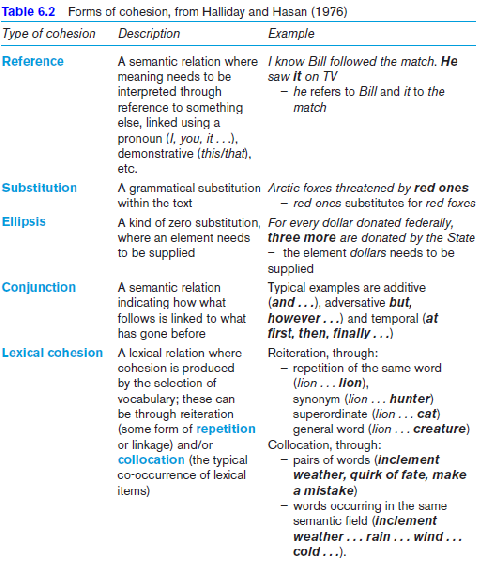
When translating, changes in cohesion can lead to functional shifts in texts.
Ugly or beautiful?
Dumb or clever?
Young or old?
Loud or quiet?
The density and progression of cohesive ties are crucial, similar to thematic structure. These relationships may differ between the ST and TT, as lexical cohesion networks are not identical across languages. Additionally, a TT should be coherent, meaning it should logically hold together for the receiver. This relates to pragmatics, as discussed in another chapter by Baker.
Pragmatics and Translation
Pragmatics is the study of language in use. It is the study of meaning, not as generated by the linguistic system but as conveyed and manipulated by participants in a communicative situation (Baker, 2018: 235).
E.g.
I’ll start my project right away.
I’d love to read that book.
It’s cold in here.
Great weather, isn’t it?
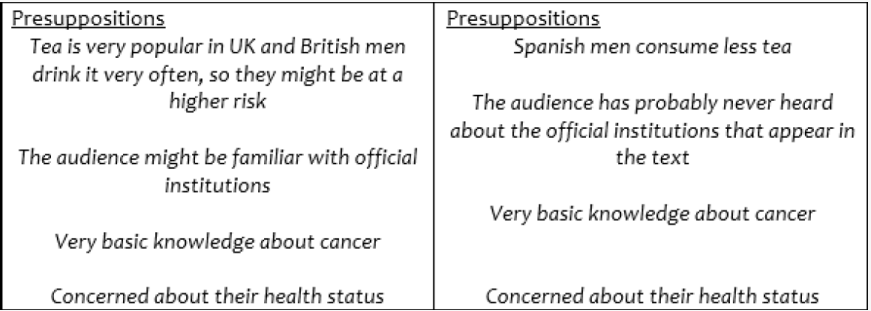
Coherence. The coherence of a text, which is related to cohesion, “depends on the hearer’s or receiver’s expectations and experience of the world” (Baker, 2018: 237.) Evidently, these expectations and experiences may differ between the source text (ST) and target text (TT) readers. E.g. The flagship Harrods = the splendid Knightsbridge store.
Presupposition. Coherence relates closely to the area of presupposition, which Baker (ibid.: 259) defines as "pragmatic inference." Presupposition refers to the linguistic and extralinguistic knowledge that the sender assumes the receiver possesses or needs to understand the message.
Let me now turn to bananas. The Commission decided last week – with the consent of the Council of Ministers – not to appeal on either the substance of the issue or the so-called systemic question, but we do intend to pursue the latter issue (…) I believe that everybody has agreed that our objective has to be conformity with the WTO. But this will not be easy (…) I discussed this issue in Washington two weeks ago with the US agriculture secretary among others.
Implicature. Baker places greater emphasis on implicature, a specific form of pragmatic inference, which she defines as “what the speaker means or implies rather than what they explicitly state” (Baker, 2011: 223). The concept of implicature was introduced by Paul Grice, a philosopher of language who formulated a set of "maxims" that govern cooperative communication (Grice, 1975).
Maxims
Quantity: Provide the necessary amount of information, neither too much nor too little.
Quality: Only say what you know to be true or what you can substantiate.
Relevance: Ensure that your contribution is relevant to the conversation.
Manner: Express yourself in a clear, appropriate and comprehensible way.
Politeness: Maintain politeness in communication (see Brown & Levinson 1987).
In conversations, participants assume that others follow communicative maxims, leading them to interpret and express utterances cooperatively to ensure mutual understanding. However, these maxims may be deliberately flouted!
Translators face challenges when the target language culture follows different maxims, such as manner and politeness or quality and relevance.
E.g.
Bacon; pork chops → meat.
A large brandy → a glass of water.
Sherry → some drinks.
I’ll handle it as well as I can
Hatim and Mason: the Levels of Context and Discourse
Rather than focusing solely on the textual function, these authors place special emphasis on the realisation of ideational and interpersonal functions in translation and incorporate the discourse level into their model.
L'Étranger by Albert Camus is a novel that explores themes of existentialism and the absurd. The story follows Meursault, a detached and emotionally indifferent French Algerian man. The novel begins with Meursault’s reaction to his mother’s death, which he attends with little emotion or concern. He soon becomes involved in a series of events that lead him to commit an unprovoked murder of an Arab man. Throughout the novel, Meursault’s lack of emotional response and his indifference to societal norms highlight his existential isolation.
Alterations in the transitivity structure in the English translation are observed to result in a shift in the text’s ideational function. Hatim and Mason conclude that these shifts in the target text have made the character more passive. They propose that the cause of these shifts could lie in the translator’s overall interpretation of the novel, where Meursault's passivity is a central aspect of his character.
Hatim and Mason also examine shifts in modality, specifically the interpersonal function, through an example (1977: 73-76) involving trainee interpreters’ challenges with recognising and translating a French conditional in a European Parliament debate.
E.g.
Un plan de restructuration qui aurait été préparé par les administrateurs judiciaires
Was probably prepared / which it is rumoured was prepared vs had been prepared
Hatim and Mason’s Foundations of a Model for Analysing Texts
Language and texts are viewed as embodiments of sociocultural messages and power dynamics. Consequently, these authors conceptualise discourse in its broader sense, defined as:
modes of speaking and writing which involve social groups in adopting a particular attitude towards areas of sociocultural activity (e.g. racist discourse, bureaucratese, etc.).
Hatim and Mason, 1997: 216
One example they provide of the translator's discourse influence is the English target text of a Spanish source text discussing the history of indigenous American peoples prior to the arrival of the Spaniards in Mexico. Hatim and Mason demonstrate how lexical choices, such as pre-Colombian and Indian in the target text, impose a Eurocentric perspective on a source text originally written from an indigenous point of view. In this case, the European translator is imposing a pro-Western ideology and discourse on the recounting of the history of the Americas.
The semiotic function is also carried out by idiolect and dialect.
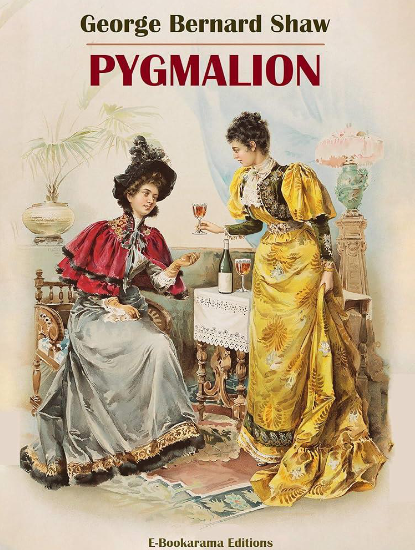
This play that explores themes such as social class, language and personal transformation. The story follows Eliza Doolittle, a poor flower girl in London with a strong Cockney accent. One day, she encounters Henry Higgins, a professor of phonetics from the upper class, who wagers with his friend Colonel Pickering that he can teach Eliza to speak like a lady in just six months. Throughout the play, Eliza undergoes a transformation in both her speech and behaviour, which leads her to question her identity and place in society.
E.g.
I ain't done nothing wrong by speaking to the gentleman. I've a right to sell flowers if I keep off the kerb. I'm a respectable girl: so help me, I never spoke to him except to ask him to buy a flower off me.
Yo no he hecho naa malo. Tengo derecho a vender flores, que pa eso pago mi licencia. Yo soy una chica honraa, y a ese cabayero sólo le dije que me comprase unos ramilletes.
I can give you change for a tanner, kind lady.
Puedo darle cambio d'un biyete de dieh chelineh, bondadosa dama.
Hatim and Mason propose foundational elements for a model of text analysis, but they address a wide range of concepts, making it unclear whether their approach truly constitutes a model that can be traditionally “applied.”
Instead, their suggestions can be seen as a set of factors to consider when analysing translation. Specifically, they focus on distinguishing between dynamic and stable elements within a text. These elements are positioned on a continuum and associated with translation strategies. More stable source texts might require a more literal translation approach, while dynamic STs present greater challenges for the translator, making literal translation less viable.
Specific elements that are not easily translatable may also be the site for dynamic and very sensitive translation decisions that may reveal the translator’s subjective interpretation.
E.g. our patchwork heritage is a strength… not a weakness. We are a nation of Christian
and Muslims… Jews and Hindus… and non-believers.
Diverse heritage (generalise)
Multiethnic heritage (explicate)
We: does it include the audience?
Criticism of Discourse and Register Analysis Approaches to Translation
Rigid categorisation: Despite their widespread use, discourse analysis models have been criticised for their inflexible classifications and complexity.
Language bias: these models are often English-language oriented, making it difficult to apply them to languages with more flexible word order or different grammatical structures.
House’s Model
Can Register analysis reliably recover authorial intention and ST function?
Mismatches between ST and TT do not always indicate errors—some result from explicitation or compensation.
How does the model account for these strategies?
Grice’s Maxims
Cultural bias: They reflect values specific to English-speaking cultures, such as sincerity, relevance and brevity.
Are they universally applicable in translation?
System Theories
System theories are a group of theories created as a reaction to static, prescriptive models in the 1970s.
Even-Zohar’s polysystem theory.
Toury and descriptive translation studies (DTS).
Chesterman’s translation norms.
Lambert and van Gorp and the Manipulation School.
Even-Zohar’s Polysystem Theory
New Words for New Realities

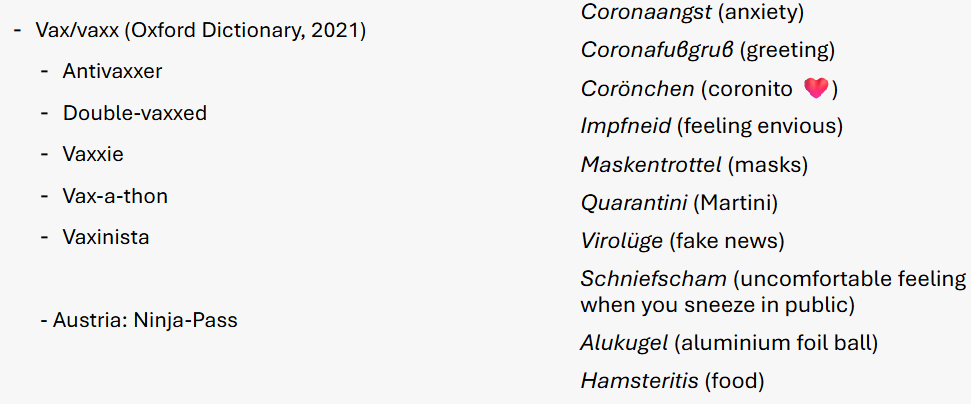
Very influential.
1970s, Itamar Even-Zohar.
Specific application to the study of translated literature.
Arising from Russian and Czech literary theorists: a literary work is never studied in isolation, but as part of a fluctuating system.
Within this dynamic, multilayered system, he focuses on genres that other academics had labeled as unimportant: children’s literature, thrillers, and the whole system of translated literature.
‘High’ (well-recognised, respected) vs ‘low’ (peripheral) literature.
Even-Zohar: translated literature operates as a system in itself.
Why?
TL culture selects works for translation.
Translation norms, behaviour, and policies are influenced by other co-systems.
He focuses on the relations between these systems in an overarching concept named polysystem.
Even-Zohar’s definition of polysystem:
A multiple system, a system of various systems which intersect with each other and partly overlap, using concurrently different options, yet functioning as one structured whole, whose members are interdependent (2005: 3).
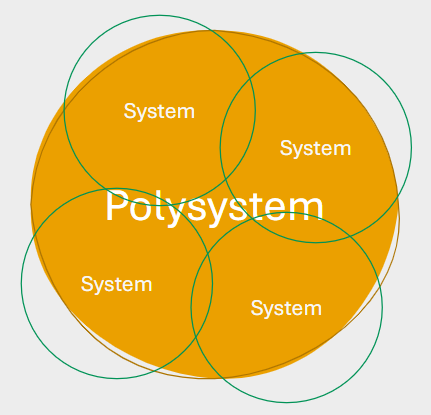
The polysystem is not static! The hierarchical positioning of the systems change according to the historical moment of the different strata of the polysystem.
Conservative and innovative systems are constantly “competing for the top position.”
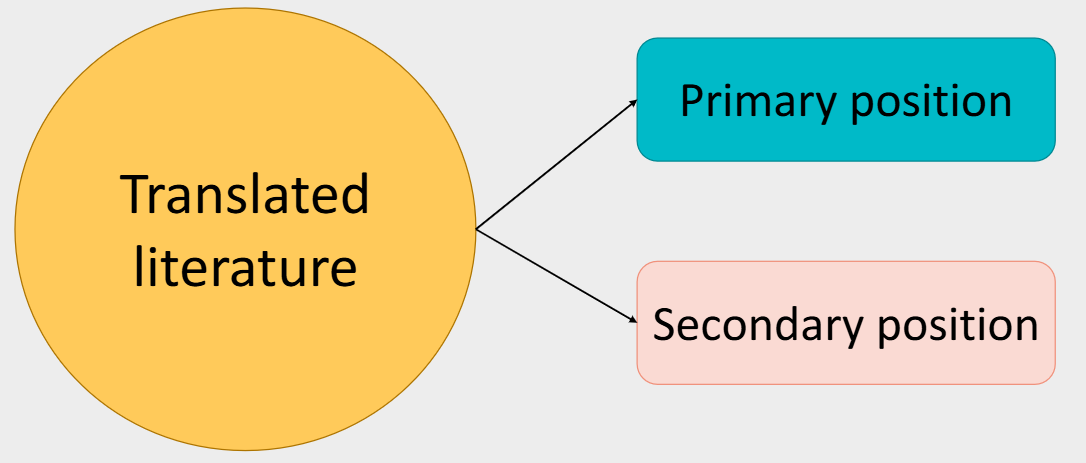
As primary, translated literature…
Shapes the centre of the polysystem actively.
Innovatory and linked to major events of literary history.
Leading writers produce the most important translations.
Translations are key elements in creating new models for the target culture, poetics, or techniques.
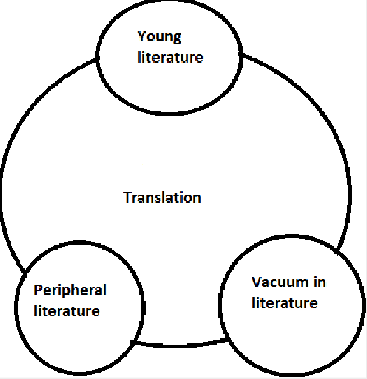
When does translated literature occupy a primary position?
A literature is too young or in the process of being established
A literature is peripheral, weak, or both
A literature going through turning points, changes, crises, or there exists a literary vacuum
As secondary, translated literature…
‘Normal’ position for translated literature (although stratifications may exist!).
Represents a peripherical system within the polysystem.
Becomes a conservative element, preserving conventional norms and conforming to the literary norms of the target system.
Is it THAT important whether translated literature assumes a primary or secondary position in the polysystem? —- YES!!!!
Even-Zohar suggests that the position of translated literature in the polysystem conditions the translation strategy.
Primary position: translators are more prepared to break conventions and do not feel constrained to follow target literature models. The influence of the foreign language model may lead to the creation of new models in the target language.
Secondary position: translators use target-culture models and produce translations following the norms of the target culture and language.
Strengths
Literature is studied together with social, historical and cultural forces.
Individual texts are not studied in isolation, but together with the cultural and literary systems in which they occur.
‘Equivalence’ and ‘adequacy’ are not fixed concepts and allow for variation according to extratextual conditions, such as the historical, social, and cultural situation of the text.
E.g.:
Llévame pal Máh Alláh.
No eh tu hora todavía. Con isah cosa no seh puée jubar. Sierra loh ohoh. Vamoh, vieha.
Criticism
The tendency to focus on the abstract model rather than the “real-life” constraints placed on texts and translators.
Even-Zohar restricts the application of the theory to literature. An interesting question is how far it would be applicable to other text types (e.g., scientific texts)
Toury and Descriptive Translation Studies (DTS)
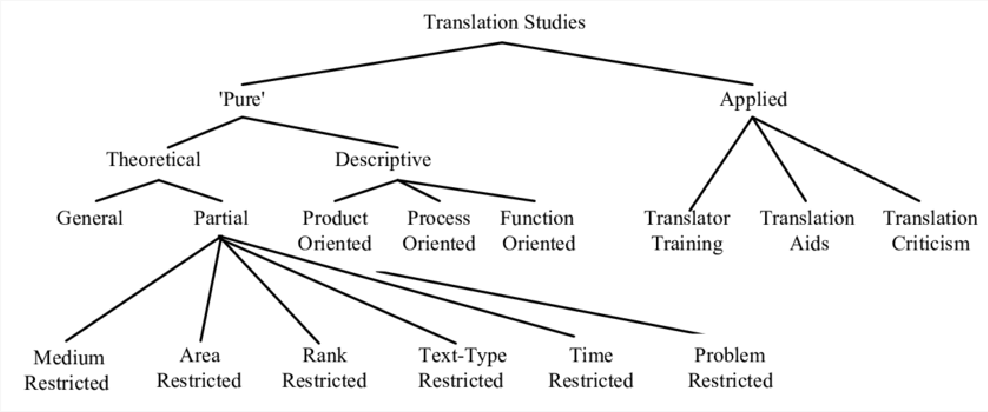
Gideon Toury’s influential Descriptive Translation Studies — and Beyond (case studies).
Early work on the polysystem theory (sociocultural conditions determining the translation of foreign literature into Hebrew).
Translation is examined through a target-oriented approach, focusing especially on its role in cultural history.
Toury emphasises the need to promote descriptive studies:
“No empirical science can make a claim for completeness and (relative) autonomy unless it has a proper descriptive branch (…) What is missing (…) is a systematic branch proceeding from assumptions and armed with a methodology and research techniques made as explicit as possible and justified within translation studies itself” (Toury 1995: 1, 3).
In a Nutshell:
He considered that translations occupy a position in the social and literary systems of the target culture. This position determines the translation strategies.
Three-phase Methodology for Systematic DTS
Situate the text within the target culture system looking at its significance or acceptability.
Undertake a textual analysis of the ST and the TT to identify relationships between corresponding segments in the two texts (‘coupled pairs’), which leads to the identification of (non)-obligatory translation shifts → ad hoc coupled pairs.
Attempt generalisations about the patterns identified in both texts, which helps to reconstruct the process of translation for this ST-TT pair.
An Additional Step!
Repeat the three previous phases for other pairs of similar texts. This replicability allows the corpus to be extended and a descriptive profile of translations to be built up according to genre, period, author, etc. In this way, we can identify the norms pertaining to each kind of translation.
If several descriptive studies are performed, we can infer norms and laws of behaviour for translation in general.
Case Studies
In Toury’s work, the objective of the case studies was to identify trends in translation behaviour, formulate generalisations about the translator’s decision-making process, and subsequently "reconstruct" the norms governing the translation process. These reconstructed norms serve as the basis for hypotheses that can be tested through future descriptive studies.
The Concept of Norms of Translation Behaviour
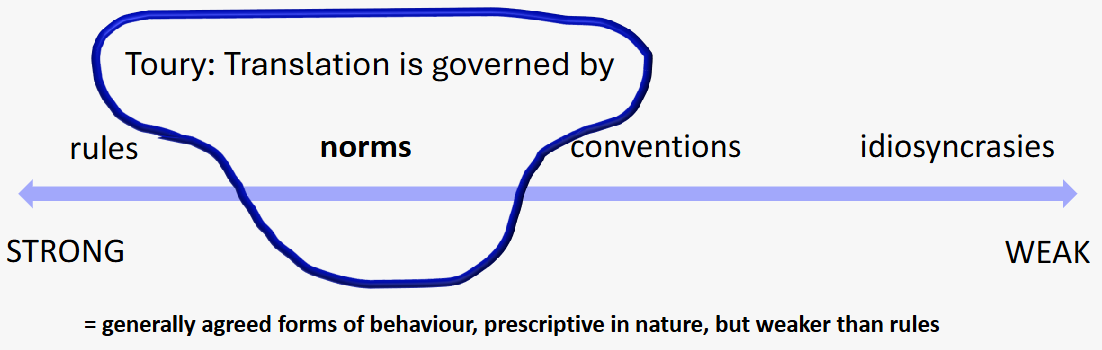
Toury defines norms as:
The translation of general values or ideas shared by a community –as to what is right or wrong, adequate or inadequate– into performance instructions appropriate for and applicable to particular situations (2012: 63).
These norms are sociocultural constraints specific to a culture, society and time.
Norms
They define the type and extent of equivalence reflected in actual translations.
They are choices that translators within a specific socio-cultural context consistently make.
They exert pressure and perform some kind of prescriptive function.
How Do We Reconstruct the Norms that Prevailed in the Translation of a Particular Text?
We can examine the texts to identify the trends of relationships and correspondences between the ST-TT segments, which will point to the processes adopted by the translator and the norms that were in operation (i.e., finding regularities of behaviour).
We can examine the explicit statements made about norms by translators, publishers, reviewers… These “explicit” statements may be incomplete or biased and are therefore best avoided.
Different Kinds of Norms Operate at Different Stages of the Translation Process
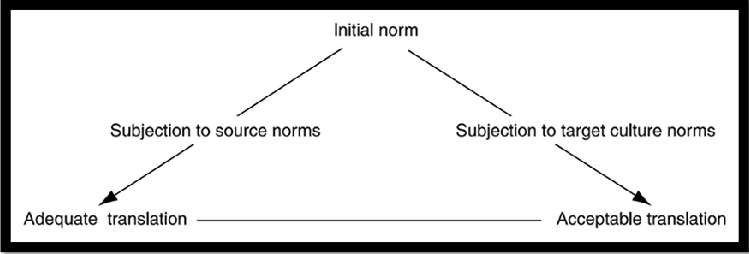
Lower-order Norms and Their Relation to the Initial Norm
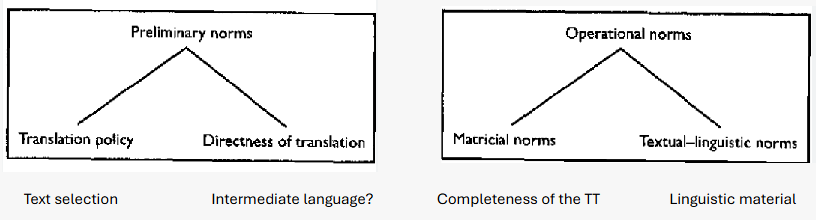
Examining ST and TT will reveal shifts that have occurred between the two during translation. Here, Toury introduces his own interpretation of ‘translation equivalence’. This concept is functional-relational (i.e., it assumes ST-TT equivalence). He focuses on how the assumed equivalence has been realised and serves a tool for uncovering ‘the underlying concept of translation (…) [the] derived notions of decision-making and the factors that have constrained it’ (Toury, 2012: 86).
It seeks to reconstruct the norms governing the translation process. Toury (2012) emphasised that norms exist on a continuum, as translators' behaviour is not entirely systematic and varies due to multiple factors. Furthermore, these norms differ in intensity, ranging from obligatory practices to common but non-mandatory tendencies, and behaviours that are merely tolerated.
Cumulative identification of norms in descriptive studies will enable the formulation of ‘laws’ and thence of ‘universals of translation.’
Toury’s Model in Action
Case studies: conjoint phrases or binomials in Hebrew literature (able and talented, law and order, terms and conditions).
A possible generalisation to be tested in future studies across languages and cultures: “frequent use of conjoint phrases, particularly in place of single lexical items in the ST, may represent a universal of translation into systems which are young, or otherwise weak.”
According to Gentzler (1993/2001), the key aspects of Toury’s work include:
The influence of the target culture system in the translation process.
The destabilisation of the concept of a fixed original message.
The integration of both the original and translated texts within a semiotic-cultural framework.
Criticism
Objectivity and replicability: His model is not fully objective.
Ambiguous terminology: Hermans (1999) questions the unclear nature of "equivalence" and the evaluative connotations of "adequate" vs. "acceptable."
Exclusive focus on the TT: Toury’s early model risks overlooking ideological and political factors, such as the promotion of translation of the source literature and the reciprocal influence of translation on the source culture.
Criticism: Translation Laws and Their Validity
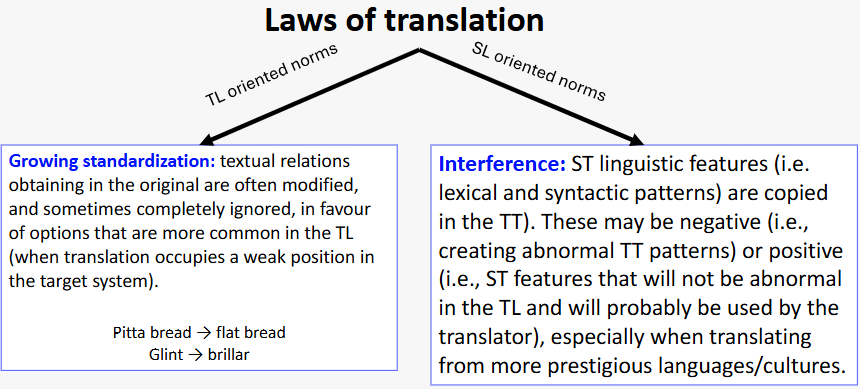
Toury proposes probabilistic laws like "growing standardisation" (TL-oriented) and "interference" (ST-oriented), although these can be contradictory.
Critics argue that DTS tends to overgeneralise from case studies, making it difficult to establish universal laws for translation.
These laws do not necessarily consider factors like the translator's decision-making process under time pressure.
Toury defends his laws as probabilistic explanations, not universals, and suggests that exceptions can be explained by other laws operating at different linguistic levels. So called “universals” of translation should be understood to be common tendencies and cannot cover every act of translation.
‘Universals’ of Translation (Chesterman, 2004)
‘S-universals’: universal differences between translations and their source texts (a ST-TT comparison).
TTs tend to be longer than STs.
Dialect tends to be normalised.
Explicitation is common.
Repetition is perhaps reduced.
Retranslation may lead to a TT that is closer to the ST.
‘T- universals’: features characterising translated language as compared to naturally occurring language, irrespective of the source language (TTs versus non-translated TL texts). They are identified by examining TTs without reference to their STs.
Lexical simplification and conventionalisation.
A contrary move to non-typical patterns (e.g. unusual collocations, such as do a mistake).
Under-representation of lexical items that are specific to the TL (e.g. reduced use of culture-specific items).
Chesterman’s Translation Norms
THEORIES OF NORMS in translation studies:
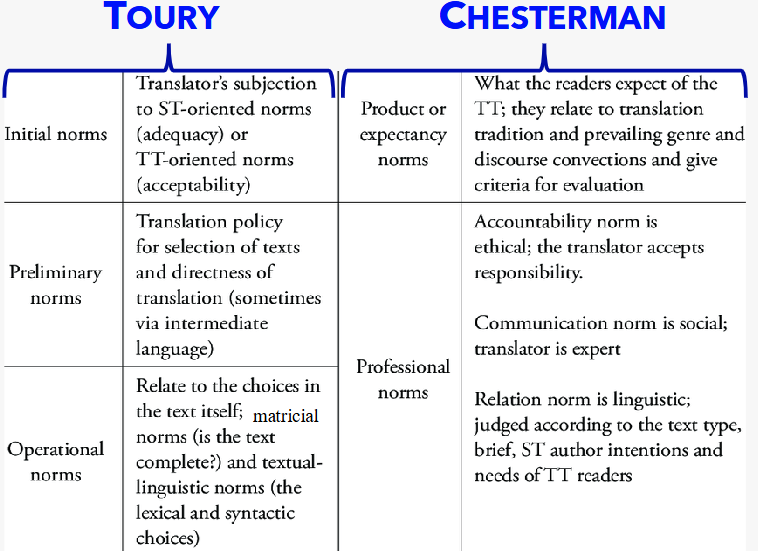
Toury's (1995) model of norms: focused mainly on their function as a descriptive category to identify translation patterns, attracting dis(approval) within society. Norms are central to the act of translation.
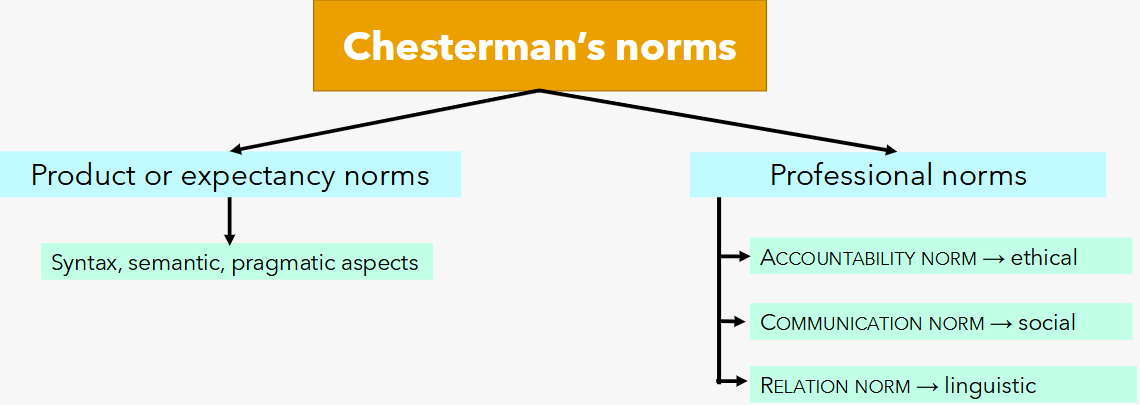
Chesterman's (1997) norms of translation: all norms ‘exert a prescriptive pressure’. He proposes his own set of norms, considering that certain translation norms prevail within a specific society at a particular time/period.
Product or expectancy norms: expectancy of readers of a translation about what a translation must look like.
Professional norms: concern the process of translation.
Product or Expectancy Norms
Readers of a translation of a given type expect translations to meet their expectations.
Predominant translation tradition in the TC.
Discourse conventions of a similar TL genre (e.g. grammaticality, style, form, discourse).
Economic & ideological considerations.
Allow evaluative judgements. As readers, we have notions about what is an ‘appropriate’ translation of a specific genre and will approve of a translator who meets these expectations.
I’VE GOT FAIR EYELASHES AND MY EYES LOOK AWFUL WITHOUT MASCARA.
- Translation 1: Tengo las pestañas claras y mis ojos se ven horribles sin máscara.
- Translation 2: Tengo las pestañas rubias y sin rímel mis ojos tienen mal aspecto.
- Translation 3: No tengo las pestañas oscuras y me veo los ojos muy raros si no me echo rímel.
Validated by a norm-authority, that confirms the prevalent norm by encouraging translations that conform with that norm. Criticising translations may damage the reception of a book.
Examples: teachers, literary critics, publishers.
Professional Norms
Governed by the accepted methods and strategies of the translation process. They are subordinate to and determined by expectancy norms. They are validated by norm authorities (e.g., professional bodies and other professionals) and by their very existence. They can be subdivided into:
The accountability norm.
The communication norm.
The relation norm.
An example: Professional Norms in Healthcare Interpreting
The National Code of Ethics for Interpreters in Health Care sets the ethical environment for the practice of health care interpreters in the United States. By formalizing a set of principles for appropriate behavior into a code, an emerging profession begins to move away from the confusion of personal preferences and opinions about what is acceptable and what is not, to statements of preference that are shared and that, as a result, become “demands” on each other. These “demands” form a cohesive network of rules or ‘norms’ that serve to sustain the integrity of the profession and its purpose.
A NATIONAL CODE OF ETHICS FOR INTERPRETERS IN HEALTH CARE (2004, p. 7)
The accountability norm: this is an ethical norm, dealing with professional standards of integrity and thoroughness. The translator will accept responsibility for the work produced for the commissioner and the reader.
The communication norm: this is a social norm, establishing that the translation, as a communication expert, works to ensure maximum communication between the parties.
The relation norm: this is a linguistic norm, covering the relation between ST and TT. Chesterman rejects narrow equivalence relations and sees the appropriate relation to be judged by the translator ‘according to text-type, the wishes of the commissioner, the intentions of the original writer, and the assumed needs of the prospective readers’ (p. 69-70).
Other Models of Description Translation Studies: Lambert and van Gorp and the Manipulation School
Even-Zohar and Toury’s early work on the polysystem theory became influential.
Toury presented “The Nature and Role of Norms in Literary Translation” in 1976 at the Leuven conference on “Literature and Translation.”
Even-Zohar presented “The Relations between Primary and Secondary Systems in the Literary Polysystem” in 1973 at the VII Congress of the International Comparative Literature Association, Montreal-Ottawa.
A key publication was a collection of essays edited by Theo Hermans in 1985, which was entitled The Manipulation of Literature: Studies in Literary Translation. This word-play gave rise to the name of our group of scholars: the Manipulation School or the Manipulation Group.
Book Description
First published in 1985, the essays in this edited collection offer a representative sample of the descriptive and systematic approach to the study of literary translation. The book is a reflection of the theoretical thinking and practical research carried out by an international group of scholars who share a common standpoint. They argue the need for a rigorous scientific approach the phenomena of translation –one of the most significant branches of Comparative Literature– and regard it as essential to link the study of particular translated texts with a broader methodological position.
Table of Contents
Translation Studies and a New Paradigm, Theo Hermans.
A Rationale for Descriptive Translation Studies, Gideon Toury.
On Describing Translations, José Lambert and Hendrik van Gorp.
Second Thoughts on Translation Criticism: A Model of its Analytic Function, Raymond van den Broeck.
How Distinct are Formal and Dynamic Equivalence? Maria Tymoczko.
Ways Through the Labyrinth: Strategies and Methods for Translating Theatre Texts, Susan Bassnett-McGuire.
Images of Translation: Metaphor and Imagery in the Renaissance Discourse on Translation, Theo Hermans.
Translation and Literary Genre: The European Picaresque Novel in the 17th and
18th Centuries, Hendrik van Gorp.
Translated Literature in France, 1800-1850, José Lambert, Lieven D’hulst and Katrin van Bragt.
The Survival of Myth: Mandel ‘schtam’s "Word" and Translation, Leon Burnett.
The Response to Translated Literature: A Sad Example, Ria Vanderauwera.
Why Waste our Time on Rewrites? The Trouble with Interpretation and the Role of Rewriting in an Alternative Paradigm, André Lefevere.
The Manipulation School represents an approach to translation as manipulation or more precisely as rewriting of texts for a specific target audience in conformity with target language norms and under various constraints. The scholars associated with this school are mainly concerned with literary texts, their translations and culture-related aspects of translation (Dukāte 2009, p. 44).
What Did They Have in Common?
This group of scholars view “literature as a complex and dynamic system; a conviction that there should be a continual interplay between theoretical models and practical case studies; an approach to literary translation which is descriptive, target-organised, functional and systemic; and an interest in the norms and constraints that govern the production and reception of translations, in the relation between translation and other types of text processing, and in the place and role of translations both within a given literature and the interaction between literatures“ (Hermans 1985b, p. 10-11).
On Describing Translations, José Lambert and Hendrik van Gorp
Methodology for case studies.
Even-Zohar & Toury’s early work → a scheme for the comparison of ST and TT literary systems and the description of relations within them.
Each system comprises a description of author, text, and reader.

Lambert and van Gorp divide the scheme into four sections:
Preliminary data: title and title page, metatexts (preface, etc.) and the general strategy (whether translation is partial or complete). Preliminary data allows generating hypothesis to investigate on macro- and micro-levels.
Macro-level: the division of the text, titles and presentation of the chapters, internal narrative structure (dialogue, description, etc.) and any overt authorial comment. This should generate hypothesis about the micro-level.
Micro-level: the identification of shifts on different linguistic levels, including the lexical level, the grammatical patterns and the narrative point of view. The results should interact with the macro-level and lead to their ‘consideration in terms of the broader systemic context.’
Systemic context: here, micro- and macro-levels, text and theory are compared and norms identified; intertextual relations (relations with other texts including translations) and intersystemic relations (relations with other genres) are also described.
Lambert and van Gorp accept that it is not possible to summarise all relationships involved in the act of translation, but suggest a systematic scheme to highlight the link between an individual case study and the wider theoretical framework, since translations and translators have positive or negative connections with other translations and translators (1985, p. 41, 45)
Having said this, ideology and patronage also influence the system of translated literature. We should not overlook the fact that we also need to consider other intellectual and social movements, including gender studies, cultural studies, or the new interdisciplinarity of human sciences
Cultural and Ideological Turns
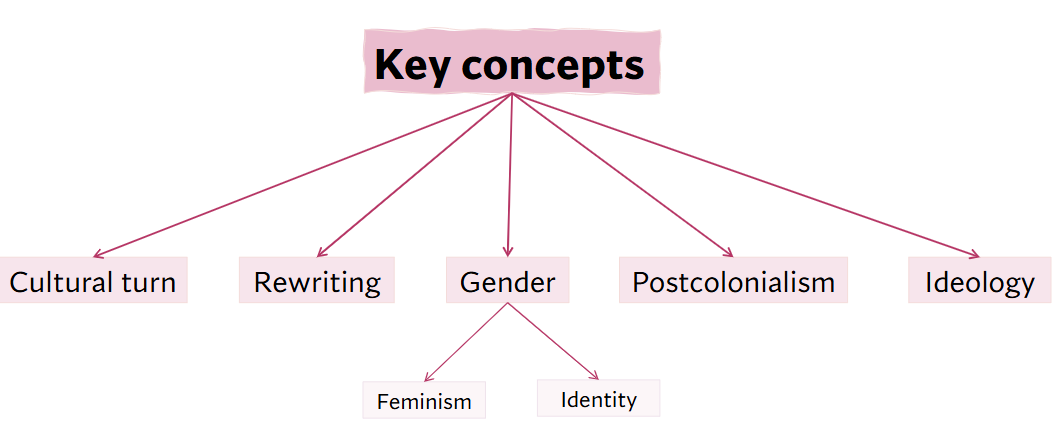
Bassnett & Lefevere criticise:
Traditional linguistic approaches to translation for remaining limited to the textual level without considering broader cultural contexts.
Meticulous comparisons between source texts and translations that overlook cultural
influences.
To emphasise the interplay between translation and culture, exploring how cultural factors shape and constrain translation, as well as larger issues of history, context, institutions and convention.
Snell-Hornby (1990) highlights the shift from viewing translation as a mere textual activity to understanding it as a cultural practice.
= cultural turn
This implies considering translation as text to translation as culture.
Leonardo Bruni
Translator and historian.
The Italian War against the Goths: “not a translation, but a compilation made by me” [aka: verbatim translation of Procopius’ Books V-VIII of Procopius’ History of the Wars].
Humanist Flavio Biondo observed this with the help of an unknown translator. He shared his discovery, to which Bruni responded. He acknowledged using only one source—Procopius—but argued that his role as an author should not be confused with that of a translator. He maintained that he had not simply translated the text; rather, he had reorganised, reordered and rephrased Procopius' rudimentary prose.
Translation as Rewriting
In the concept of translation as rewriting, the focus shifts from questions like "Are they translations or original writings?" and "Who are their authors?" to deeper inquiries such as:
Why did one author choose to rewrite another’s work?
How was this done?
How did readers respond?
How did the rewrite fit into a new cultural or historical context?
Lefevere
“Translation is the most obviously recognizable type of rewriting, and (…) it is potentially the most influential because it is able to project the image of an author and/or those works beyond the boundaries of their culture or origin” (Lefevere 1992/2017:9).
Lefevere specifically focuses on examining the "very concrete factors" that systematically influence the reception, acceptance or rejection of literary texts. These factors include issues such as power, ideology, institutions and manipulation.
Lefevere argues that those in positions of power are the ones responsible for "rewriting" literature and controlling its consumption by the public. The motivation for such rewriting can be either ideological, aligning with or opposing the dominant ideology, or poetological, conforming to or resisting the prevailing poetics.
Edward Fitzgerald
Edward Fitzgerald considered Persians to be inferior and felt justified in taking liberties with the
translation to improve the original. He adapted the text to align with the Western literary conventions of his time, resulting in a translation that was a phenomenal commercial success.
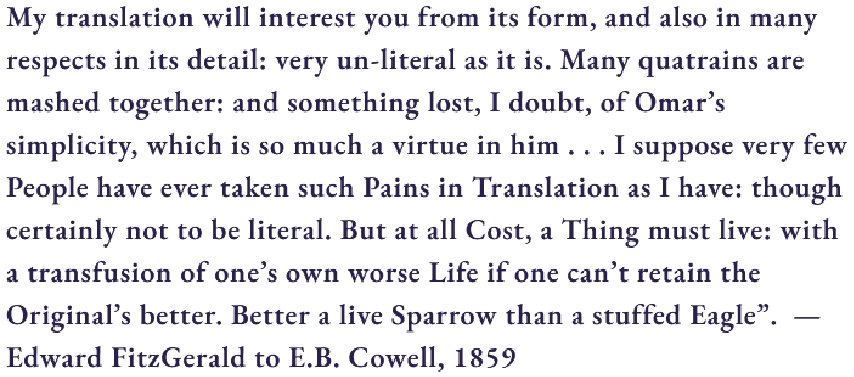
Should We Adapt the Original Text to Meet the Audience's Expectations or Should We Preserve Its Original Form and Integrity?
For Lefevere, the literary system in which translation operates is governed by two main factors:
Professionals within the literary system, who play a role in shaping and influencing the dominant poetics.
Patronage outside the literary system, which influences the ideological and economic conditions under which literature is produced, disseminated, and received.
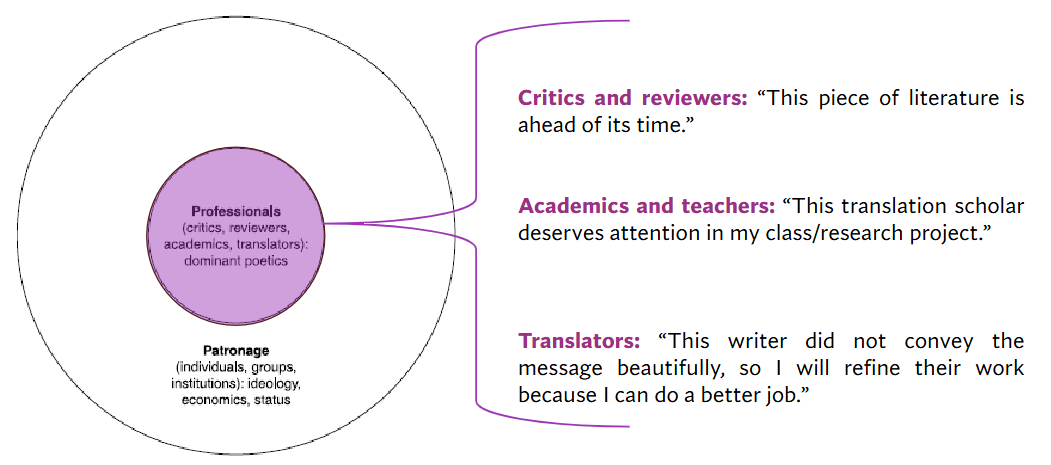
Patronage
These are the powerful forces—both individuals and institutions—that can either promote or obstruct the reading, writing and rewriting of literature. Patrons may be:
Influential and powerful individuals in a given historical era (e.g. Hitler in the 1930s Germany).
Groups of people (e.g. the media, a political party).
Institutions regulating the distribution of literature and literary ideas (e.g. the educational system)
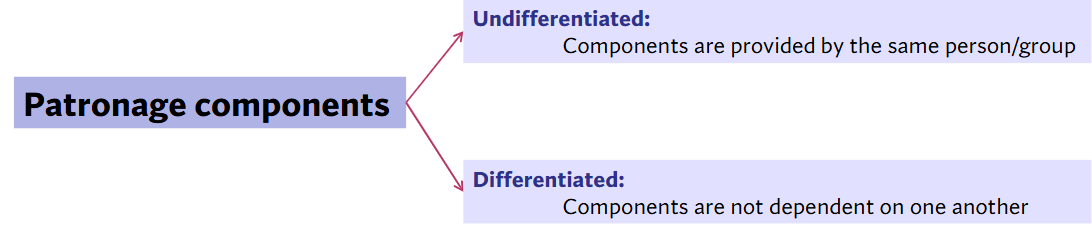
Lefevere identifies three key elements of patronage:
Ideological component. The ideological component shapes both the choice of subject matter and its presentation. Lefevere adopts a broad definition of ideology, not limited to politics but encompassing the structures of form, convention and belief that influence our actions and creative expression.
Economic component. The economic component relates to financial support for writers and rewriters. Historically, this took the form of patronage through pensions or stipends from benefactors. In modern contexts, it includes translator fees, royalties and funding for critics and educators, often provided by publishers, universities or state institutions.
Status component. The status component manifests in various ways. Economic support often comes with an expectation of alignment with the patron’s values or preferences. Additionally, belonging to a literary or cultural group requires adherence to its norms. Lefevere cites the example of the Beat poets, who gathered at the City Lights bookstore in San Francisco in the 1950s, reinforcing their collective identity.
Apart from ideological motivations, translators may rewrite a text either in alignment with or in opposition to the dominant poetics. In this regard, Lefevere analyses two key components:
Literary devices: these encompass genres, symbols, leitmotifs, narrative structures and character development, which may eventually become formalised within a literary tradition.
The concept of the role of literature: this is shaped by institutions that enforce, or at least attempt to enforce, the dominant poetics. Such institutions influence the literary canon by elevating certain contemporary works to the status of "classics" while marginalising others.
Ultimately, however, the dominant poetics is largely shaped by ideology.
“On every level of the translation process, it can be shown that, if linguistic considerations enter into conflict with considerations of an ideological and/or poetological nature, the latter tend to win out” (Lefevere, 1992: 39).
For Lefevere, the most important consideration is ideological. In this context, it refers to either the translator’s own ideology or the ideology imposed upon the translator by patronage. The poetological aspect pertains to the dominant poetics within the target language culture. Together, ideology and poetics shape the translation strategy and determine how specific translation challenges are addressed.
Euphemistic translations often reflect the prevailing ideology of a particular time and society, and they essentially "become the play" for the target-text audience, who are unable to read the source-text.
Lefevere discusses how the 1947 Dutch edition of Anne Frank's diary, prepared in collaboration with (and rewritten by) her father Otto, alters the portrayal of Anne. For instance, it omits paragraphs related to her sexuality. Unflattering descriptions of friends and family are also removed, along with sentences mentioning individuals who collaborated with the Germans, with these omissions made at the request of the people involved.
Lefevere then analyses the 1950 German translation of Anne Frank's diary, produced by Anneliese Schutz, a friend of Otto Frank. This translation contains both comprehension errors and deliberate modifications to the portrayal of Germans and Germany. Lefevere highlights numerous discrepancies, including the omission or softening of derogatory remarks about Germans and alterations to references concerning the treatment of Jews.
Dutch ST: er bestaat geen groter vijandschap op de wereld dan tussen Duitsers en Joden
[lit. there is no greater enmity in the world than between Germans and Jews]
German TT: eine grössere Feindschaft als zwischen diesen Deutschen und den Juden gibt es nicht auf der Welt
[lit. there is no greater enmity in the world than between these Germans and the Jews]
Gender and Translation
Sherry Simon
She critiques translation studies for frequently employing the term culture as though it denoted an evident and unproblematic reality. Lefevere, for instance, had characterised it merely as ‘the environment of a literary system’ (1985).
Dominance, fidelity, faithfulness, betrayal.
After Babel (George Steiner): translation as penetration.
Les belles infidèles: “They remind me of a woman I once loved dearly (…); she was beautiful but unfaithful.”
Simon examines translation through the lens of gender studies, identifying a language of sexism within the field, reflected in metaphors of dominance, fidelity, faithfulness and betrayal. Feminist theorists also draw a parallel between the marginalised status of translation—often regarded as derivative and inferior to original writing—and that of women, who have frequently been suppressed in both society and literature. This forms the foundation of feminist translation theory, which aims to identify and critique the network of concepts that consign both women and translation to the lowest ranks of the social and literary hierarchy.
“For feminist translation, fidelity is to be directed toward neither the author not the reader, but toward the writing project—a project in which both writer and translator participate” (Simon, 1996: 2).
“The feminist translator, affirming her critical difference, her delight in interminable rereading and re-rewriting, flaunts the signs on her manipulation of the text” (Barbara Godard, 1990: 91).
“My translation practice is a political activity aimed at making language speak for women. So my signature on a translation means: this translation has used every translation strategy to make the feminine visible in language” (Susanne de Lotbinière-Harwood, 1989).
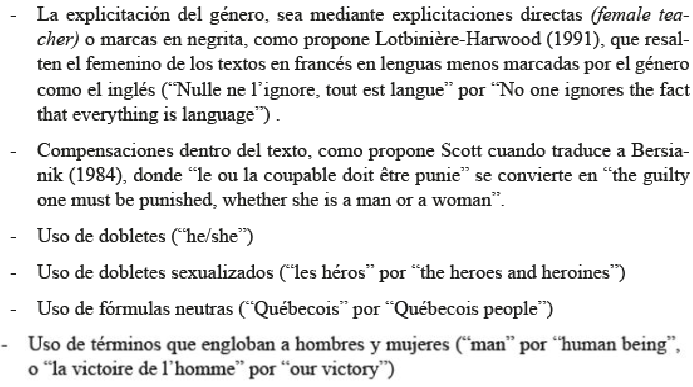
One such strategy explored by Simon is the handling of linguistic markers of gender. Examples cited from de Lotbinière Harwood’s translations include the use of a bold e in the word one to highlight the feminine, the capitalisation of M in HuMan Rights to expose implicit sexism, the neologism auther (in contrast to author) to render the French neologism auteure, and the feminisation of nouns such as aube (dawn) by employing the English pronoun she.
Other chapters in Simon’s book reassess the contributions of women translators throughout history, examine the distortions present in the translation of French feminist theory and explore feminist reinterpretations of the Bible.
Martínez Carrasco & Peñarrocha
(2021)

Translated by feminist Suzanne Jill Levine.
Levine (1991: xi): “I wouldn’t be accused of profaning a sacred script, because the author himself would be the first traditore.”
30 pages longer than the original!
Among the case studies are summaries of the significant literary translation work undertaken by women in the first half of the twentieth century. Simon highlights that the great classics of Russian literature were initially made available in English primarily through the translations of one woman, Constance Garnett. Her sixty volumes of translation encompass almost the entire works of Turgenev, Tolstoy, Dostoevsky, Chekhov and Gogol. Likewise, key works of German literature were translated by women translators, including Jean Starr Untermeyer, Helen Lowe Porter and Willa Muir (in conjunction with her husband Edwin).
Language and Identity
Other research on translation and gender has critically examined the relationship between language and identity. This integrates linguistic analysis of literary texts with a cultural theory perspective. This approach allows for an exploration of the social and ideological context that shapes linguistic exchange.
“Camp talk is a form of expression constructed through speech, and this represents the identity of a community, as is the case of the identity of the LGTB+ community. (…) At that decade, Spanish equivalents for the vocabulary used by the LGTB+ community were just being constructed through the first translations of mass consumer products such as movies or series. The translation of camp talk is considered a problem [because] to maintain the identity of the LGTB+ community, the target text must fulfill the communicative function of the source text and consider the equivalents of the vocabulary used by the LGTB+ community.”
Harvey (Translating Camp Talk: Gay Identities and Cultural Transfer) explores the homosexual discourse of camp in English and French texts, as well as in their translations. He investigates how ‘gay men and lesbians work within appropriate prevailing straight (and homophobic) discourses’ (ibid.: 346), frequently adopting linguistic patterns from various communities.
Camp talk in English:
Girl talk and Southern belle accents: Oh, my! Adorable!
French expressions: Ma bébé, comme ça
Formal + informal register.
Camp talk in French uses English words and phrases in a similar language ‘game’.
Harvey identifies that in several books translated into French, camp expressions in English are often rendered into pejorative or neutralised terms. Hyperbolic gay camp collocations, such as perfect weakness and screaming pansies, are either omitted in translation or replaced with negative equivalents. He argues that markers of gay identity tend to disappear or become pejorative in the target text.
Harvey connects these findings to broader cultural issues within the target culture. He discusses how the suppression of the label gay in translation ‘reflects a more general reluctance in France to recognise the usefulness of identity categories as the springboard for political action’ (ibid.: 358) and highlights the ‘relative absence of radical gay (male) theorising in contemporary France’ (ibid.: 359).
He examines the American English translation of a novel originally written in French. In this case, he demonstrates how the translator’s lexical choices and additions have amplified and made certain camp elements more visible. Harvey suggests that this translation strategy may have been influenced by commercial pressures from the US publishers, who were actively supporting gay writing, as well as by the broader (sub)cultural context in the United States, which ensured a more favourable reception for the book compared to its reception in France.
According to Sherry Simon:
‘Contemporary feminist translation has made gender the site of a consciously transformative project, one which reframes conditions of textual authority’ (p. 167).
‘Cultural studies brings to translation an understanding of the complexities in gender and culture. It allows us to situate linguistic transfer with the multiple ‘post’ realities of today: poststructuralism, postcolonialism and postmodernism’ (p. 136).
Postcolonialism
Although its precise scope is sometimes undefined, postcolonialism is generally understood to encompass the study of the history of the former colonies, the examination of powerful European empires, resistance to colonial powers, and, more broadly, the analysis of the effects of power imbalances between the colonised and the coloniser.
What distinguishes postcolonial approaches to translation is that they examine intercultural encounters in contexts marked by unequal power relations. Their major contribution has been to illuminate the role of power in the production and reception of translation (Shamma, 2009, p. 183).
Gayatri Chakravorty Spivak
Spivak addresses these issues in her essay "The Politics of Translation" (1993/2012), which integrates feminist, postcolonial and poststructuralist perspectives. She highlights the tensions among these approaches, particularly criticising Western feminists who expect feminist writings from outside Europe to be translated into the dominant language—English. In Spivak’s view, such translation often results in "translatese" (also referred to as "translationese"), a form of translation that erases the identity of individuals and cultures with less political power, ultimately leading to the standardisation of distinct voices.
“In the act of wholesale translation into English there can be a betrayal of the democratic ideal into the law of the strongest. This happens when all the literature of the Third World gets translated into a sort of with it translatese, so that the literature by a woman in Palestine begins to resemble, in the feel of its prose, something by a man in Taiwan”
(Spivak, 1993/2012: 314-316)
Feminists from hegemonic countries should demonstrate genuine solidarity with women in postcolonial contexts by learning the languages in which they speak and write.
The politics of translation currently prioritises English and other hegemonic languages of former colonisers.
Despite good intentions, translators often over-assimilate less powerful languages to make them more accessible to Western readers, thereby diminishing linguistic and cultural specificity.
Translation has actively contributed to the process of colonisation, serving as a vehicle for the dissemination of an ideologically driven portrayal of colonised peoples.
The colony itself can be seen as an imitative and inferior translational copy, its suppressed identity overwritten by the coloniser.
= Shameful history of translation (Bassnett & Trivedi, 1999, p. 5)
Tejaswini Niranjana
Niranjana’s focus is on how translation into English has been used by colonial powers to construct a rewritten image of the ‘East,’ which has subsequently been accepted as the truth. She provides further examples of the coloniser’s imposition of ideological values, ranging from missionaries who ran schools for the colonised and also acted as linguists and translators, to ethnographers who recorded grammars of native languages. Niranjana views all of these groups as participating in the vast project of collection and codification that formed the foundation of colonial power. She specifically critiques translation’s role within this power structure.
Shamma (2009, p. 185)
The translation of the cultural products of the colonised provided colonial administrators with the essential knowledge to govern local populations. This is why colonial enterprises were often accompanied by large-scale translation efforts, aimed at transcribing local cultures for the benefit of the new rulers.
Translating the culture of the colonisers into the language of the colonised also played a crucial role in assimilating the colonised people into the linguistic and cultural norms of the dominant nation.
“Translation as a practice shapes, and takes shape within, the asymmetrical relations of power that operate under colonialism” (Niranjana, 1992, p. 2).
Furthermore, Niranjana criticises translation studies itself for its predominantly Western orientation and identifies three main failings she attributes to this perspective:
Translation studies, until recently, has largely neglected the issue of power imbalances between different languages.
The concepts underlying much of Western translation theory are flawed, as they are based on an unproblematic, naively representational theory of language that assumes an unquestioned relationship between text, author and meaning.
The ‘humanistic enterprise’ of translation itself needs to be questioned, as translation within the colonial context reinforces a conceptual image of colonial domination, embedding this ideology within the discourse of Western philosophy.
Niranjana’s recommendations for action:
In general, the postcolonial translator must critically examine every aspect of colonialism and liberal nationalism: identify how the West represses the non-West and marginalises its own otherness.
An ‘interventionist’ approach from the translator.
The Ideologies of the Theorists
These new cultural approaches have broadened the scope of translation studies, introducing a wealth of new insights. However, they have also given rise to significant conflict and competition between differing perspectives.
Although these new angles have expanded the horizons of translation studies, enriching the field with valuable insights, they have also introduced considerable conflict and competition among several perspectives.
Such differences in perspective are inevitable and should even be welcomed, as both translation and translation studies continue to expand their influence.
Simon’s Perspective (Gender Studies): Simon argues that the translation of Cixous’s work leads to a distorted representation, as many critics only have access to the parts available in English. This suggests that translation can shape and potentially limit the reception of feminist discourse in different linguistic and cultural contexts.
Arrojo’s Perspective (Postcolonial Approach): Arrojo critiques Cixous’s own appropriation of the Brazilian writer Clarice Lispector. She describes this as an example of an “aggressively masculine” approach to difference, implying that, despite her feminist stance, Cixous engages in a form of intellectual dominance over a writer from the Global South.
All the strategies are part of Lefevere’s concept of the rewriting process. Even when undertaken from the perspective of ‘minority’ cultures, translation remains a political act, involving a deliberate manipulation of texts for specific political or economic advantage.
Translation, Ideology and Power in Other Contexts
The issue of power in postcolonial translation studies, along with Lefevere’s work on the ideological dimension of rewriting, has prompted the exploration of power and ideology in other contexts where translation plays a role.
The concept of ideology has undergone significant variation in meaning, from its initial neutral usage to describe a new science of ideas, to its negative (Marxist) interpretation as false consciousness, denoting misguided thinking or even manipulation. Much research from an ideological perspective seeks to uncover instances of manipulation in the target text, which may reflect the translator’s conscious ideological stance or be shaped by external ideological forces within the translation environment—such as pressure from a commissioner, editor, or institutional or governmental bodies.
The harsh, macro-contextual constraints of censorship in authoritarian regimes are perhaps the most obvious example of ideological manipulation.
Research has focused on the power imbalance between languages, particularly the rise of English as a global lingua franca and the implications of this asymmetry in translation, especially in non-literary genres. Karen Bennett discusses the phenomenon of epistemicide, which refers to the systematic destruction of an ethnic group’s system of knowledge, often to force assimilation into a European worldview.
Language imbalance (and the economic and political power behind it ) has been a constant backdrop to translation through the ages.
Recent research has increasingly focused on the fact that much translation occurs informally between coexisting linguistic communities in multilingual cities, rather than between participants living in separate countries and speaking distinct national languages. In Cities in Translation (2012), Sherry Simon examines the cases of linguistically divided “dual cities”, where two historically rooted language communities “feel a sense of entitlement to the same territory.”
Such complex, ‘superdiverse’ societies are home to dynamic, multilingual forms of communication, including the phenomenon of ‘translanguaging’ (Garcia and Li Wei 2014), which values language diversity.
The Role of the Translator
Venuti: the ‘invisibility’ of the translator and the ethical consequences.
‘Foreignising’ versus ‘domesticating’ translation.
Berman: the ‘negative analytic’ and deformation of translation.
The sociology of translation focuses on the role of the translator and the social nature of translation.
The power network of the translation industry.
The reception of translation: paratexts, reception theory and translation reviewing.
The role and degree of involvement of the translator and other stakeholders in the translation process and how this is manifested in the methods and strategies employed in their translation practice.
Venuti and the “Invisibility” of the Translator
Translation historian and theorist, but also a translator himself. When examining translation studies, Venuti (2018) argues that we need to consider the value-driven nature of the sociocultural framework.
Invisibility: the translator’s situation and activity in contemporary American and British cultures.
Translators often aim to produce an idiomatic and fluent target text, thereby creating an illusion of transparency.
A translation is typically considered acceptable by publishers, reviewers, and readers when it reads smoothly and gives the impression of being the original text.
According to Venuti (1998), the key factor contributing to the translator’s invisibility is “the prevailing conception of authorship” (p. 31). Translation is often regarded as derivative and of lesser value than original writing. As a result, there is a tendency to conceal the act of translation to preserve the illusion of an original text.
Domestication and Foreignisation
"Either the translator leaves the author in peace, as much as possible, and moves the reader towards him; or he leaves the reader in peace, as much as possible, and moves the author towards him" (Schleiermacher, 1813, p. 74).
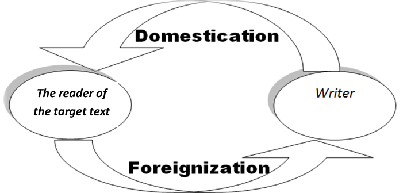
These are practices (or strategies!) which are related both to the choice of text to translate and the translation method.
Domestication
Domestication dominates translation practices in the UK and the US.
It involves translating in a fluent, transparent style that renders the translator invisible and minimises the perceived foreignness of the target text: ethnocentric reduction of the foreign text.
It reflects domestic literary canons by favouring texts that are amenable to this strategy.
Under domestication, the push for fluency and transparency erases signs of the translator’s presence in the text. The translator’s voice, decisions and agency are effaced, reinforcing the perception of translation as a neutral, mechanical process. This undermines recognition of translation as a form of authorship and of the translator as an active cultural mediator.
Foreignisation
It involves a non-fluent, estranging or heterogeneous translation style aimed at foregrounding the translator’s presence and preserving the foreignness of the source text.
It seeks to make the target culture more aware of the linguistic and cultural otherness embedded in the original.
It functions as a resistance to the dominant, domesticating tendencies of the English-language translation market, by selecting and presenting texts that challenge prevailing norms and values in the target language.
Advocated by both Schleiermacher and Venuti.
In The Scandals of Translation (1998), Venuti associates foreignisation with “minoritising” translation. He exemplifies this through his own translation of works by the Italian novelist Iginio Ugo Tarchetti. Tarchetti, a relatively marginal figure in 19th-century Italian literature, employed the standard Tuscan dialect to challenge the literary establishment. His experimental and Gothic narratives subverted the dominant moral and political ideologies of his time. By translating Tarchetti in a foreignising style, Venuti seeks to reproduce this subversive effect in English and expose target-language readers to alternative literary and cultural values.
Venuti introduced foreignising elements (e.g., modern American slang plus archaisms, British spellings). This deliberate stylistic choice aimed to make the translator a visible agent in the text. By disrupting the illusion of transparency, he encouraged readers to recognise that they were engaging with a translation of a work rooted in a foreign culture.
“You can bring the author back home” or just “send the reader abroad.” Generally speaking, foreignization is based on retaining the culture specific items of the original like personal names, national cuisine, historical figures, streets or local institutions, whereas domestication focuses on minimizing the strangeness of the foreign text for the target readers by introducing the common words used in the target language instead of providing readers with foreign terms.
Terminology Coordination European Parliament DG TRAD (2017)
Domestication and foreignisation
They should not be viewed as binary opposites. Rather, they exist along a continuum and reflect ethical decisions made by the translator with the aim of broadening the cultural repertoire of the target audience.
The terms ‘domestication’ and ‘foreignisation’ indicate fundamentally ethical attitudes towards a foreign text and culture, ethical effects produced by the choice of a text for translation and by the strategy devised to translate it, whereas the terms like ‘fluency’ and ‘resistancy’ indicate fundamentally discursive features of translation strategies in relation to the reader’s cognitive processing (Venuti, 2008, p. 19, my emphasis).
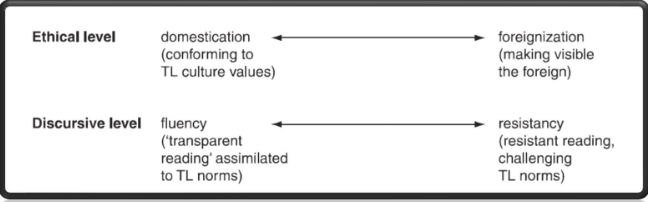
Venuti defends foreignising translation while recognising its inherent contradictions, as all translation entails some level of domestication.
Foreignisation only becomes visible when it clashes with the dominant values of the target culture.
According to Venuti, both strategies are historically and culturally contingent, and their significance shifts depending on wider sociocultural contexts.
How Can We Analyse Venuti’s Approach to Translation Ethics, (In)Visibility and Power Dynamics in Publishing?
Compare source and target texts to identify foreignising or domesticating strategies.
Analyse translators’ statements, interviews, drafts and correspondence with authors to trace decision-making processes (sometimes unreliable).
Interview publishers, editors and agents about selection criteria, translation instructions, and market aims.
Examine translation contracts and the visibility of the translator in paratexts (e.g. cover, copyright, prefaces).
Track translation flows: which texts are translated, into which languages, and evolving trends over time.
Investigate how translations are received in reviews: focus on whether and how translators are mentioned and evaluated.
Antoine Berman: the ‘Negative Analytic’ of Translation
French theorist whose work significantly influenced Venuti’s thinking.
Raises a key question: To what extent is the foreign text assimilated in translation, and to what extent is its difference preserved?
In L’épreuve de l’étranger (1985), Berman conceives translation as a double trial (épreuve):
A trial for the target culture, which must confront the foreignness of the text and language.
A trial for the source text, which undergoes displacement from its original linguistic and cultural context.
“The properly ethical aim of the translating act is receiving the Foreign as Foreign” (Berman, 1985, p. 241).
Rejects what he calls naturalisation, which domesticates the foreign text.
However, translations are often shaped by a “system of textual deformation” that suppresses foreignness.
Berman calls the study of these distortions a “negative analytic”, which identifies how target texts systematically alter or neutralise the source text.
Every translator faces various ethnocentric forces that influence the shape and form of the target text.
By raising awareness of these forces, translators can mitigate their effects on the translation process.
A key challenge when translating fiction is maintaining the novel’s complex, multifaceted nature while avoiding oversimplification or homogenisation of its content.
When translating fiction, there is a tendency to reduce the variation present in the original text. He identifies twelve “deforming strategies.”
Rationalisation: modifying syntactic structures (e.g., punctuation, sentence structure and order, removing repetitions, simplifying complex sentence structures…).
Clarification: rendering clear what is not intended to be clear in the ST.
Expansion: TTs tend to be longer than STs due to overtranslation, flattening, empty explicitation…
Ennoblement: improving the original text by rewriting it in a more elegant style. The opposite (using colloquialisms) is also destructive.
Qualitative impoverishment: replacing words or expressions with TT equivalents lacking the sonorous richness or ‘iconic’ features (e.g., butterfingers).
Quantitative impoverishment: loss of lexical variation in translation (e.g., face).
The destruction of rhythms: more common in poetry, involving deformation of word order and punctuation.
The destruction of underlying networks of signification: some networks of words add an underlying uniformity and sense to the text (e.g., jaulón, cabezón, portón, montón, barrigón, bodegón).
The destruction of linguistic patternings: the ST may be systematic in its sentence constructions and patternings, as well as linguistic patterns, which are standardised in the TT.
The destruction of vernacular networks or their exoticisation: local speech, language patterns, cultural items playing an important role in the setting of a novel (e.g., Yorkshire English terms or grammar → We should put us name here). Italics? TL vernacular or slang equivalent?
The destruction of expressions and idioms: replacing an idiom or proverb by its TL equivalent is an ethnocentrism because we are producing a new network of TC references (e.g., Bedlam).
The effacement of the superimposition of languages: translation tends to erase traces of different forms of language that co-exist in the ST (e.g., mix of American English and varieties of American Spanish in the word of new Latinx writers).
Berman defends a ‘positive analytic’ approach to preserve the foreignness of the source text in the target text, which he refers to as ‘literal translation.’ Here, ‘literal’ means closely adhering to the letter (of works). This approach helps limit the deformation caused by negative tendencies in translation. However, how exactly this is applied depends on the translator’s creativity and innovation.
The Position and Positionality of the Translator
Positionality refers to how one’s social background—such as class, race, gender, nationality, and ideological affiliations—shapes perspective (Mullings, 1999).
In translation, the translator’s positionality is always present, as they operate within a specific cultural and temporal context, often engaging with prevailing socio-political discourses (Von Flotow, 2000).
This perspective informs their professional choices and sense of responsibility. While translators were once seen as ‘invisible’, more are now sharing their reflections through blogs and interviews, making their practices increasingly visible.
Translators often describe their practice as intuitive, guided by an internal ‘ear’ attuned to language (Rabassa, 1984).
Margaret Sayers Peden, known for translating Latin American writers like Allende and Esquivel, emphasises attentiveness to the source text’s ‘voice’—that is, the unique mode of expression shaping tone, vocabulary and syntax.
Similarly, Felstiner, in translating Neruda’s The Heights of Machu Picchu, sought to capture the poet’s rhythm and emphasis by listening to his readings, visiting the site itself, and engaging deeply with its cultural context. He highlights that much of the translator’s effort—personal, contextual and compositional—often becomes ‘invisible’ in the finished work.
The translator’s positionality has become increasingly central in translation studies, as it is now widely acknowledged that translations can be shaped by both the ideological frameworks of their sociocultural context and the stances of translators themselves.
Scholars such as Tymoczko (2003) argue that translators are not neutral intermediaries, but rather active agents whose work reflects their own perspectives, values, and the dominant discourses of their environment.
This explains the call for translators to act as ethical agents of social change.
The Sociology and Historiography of Translation
Both disciplines highlight translation as a social practice.
A significant body of research on the sociological dimensions of translation draws on the work of Pierre Bourdieu (1977, 1991), a French sociologist and ethnographer. Key concepts from his theory help to frame translation within broader power dynamics.
Field of social activity: A structured social space in which agents (e.g. authors, translators, publishers, editors, readers) interact and contend for influence.
Habitus: The translator’s ingrained dispositions, shaped by personal history, education, social class and cultural background—factors that explain divergent behaviours.
Capital: Various forms of power within the field—economic (financial resources), social (networks), cultural (knowledge and education) and symbolic (prestige or recognition).
Illusio: The emotional investment individuals make in the field’s goals and rewards (Threadgold, 2019).
Heteronomy vs. Autonomy: Refers to a field’s dependence on external influences (e.g. market-driven translation of best-sellers) versus internal values (e.g. translating marginalised literature).
Doxa: The prevailing norms and ideologies of the target culture, which shape translation choices. These may shift over time—for example, how translators navigate religious sensitivities, such as the treatment of humour or bodily references in Dante’s Divine Comedy.
Naming: The act of defining a field.
The Power Network of the Translation Industry
Translators often lack full autonomy in choosing their strategies due to political and economic constraints.
Venuti (1992) notes that literary translators typically operate under contract, frequently on modest flat fees, with publishers initiating most projects and aiming to reduce costs. He highlights the industry’s reluctance to offer translators copyright or a share of royalties, framing this as a form of systemic repression in which translators occupy a marginalised position.
Fawcett (1995) similarly characterises the publishing sphere as a ‘power play’, where editors and copy-editors exert considerable influence, often steering the translation towards domestication. Translation, therefore, emerges as a collaborative but hierarchically structured process involving various agents—commissioners, literary agents, revisers, editors, and translators—who function as what Bourdieu would term ‘gate-keepers’, shaping which texts are translated and how they are presented.
The Reception and Reviewing of Translations
The influence of the publishing industry on the reception of translations is significant. Reviews play a key role in shaping readers’ expectations and responses. Drawing on reception theory, Brown (1994) explores how texts either align with, challenge, or subvert the reader’s ‘horizon of expectation’ in terms of genre, style, form, or content.
Reviews offer insight into the reception of a translation, functioning as a collective response to the author, the translated text and prevailing cultural attitudes towards translation. While reviewers often favour translations that ‘read well’, they may not always have access to or engage with the source text, limiting their ability to evaluate translational choices in depth.
There is no single model for analysing reviews in translation. Reviews can be examined synchronically (analysing responses to a single work at a particular moment) or diachronically (tracing the reception of an author’s works or a publication’s review trends over time).
Gérard Genette (1997) distinguishes between two types of paratexts (i.e., elements that surround and shape a reader’s engagement with a text).
Peritexts are internal to the published work and typically provided by the author or publisher; these include titles, subtitles, prefaces, dedications, epilogues and visual elements such as the cover or blurb.
Epitexts are external to the text yet remain closely linked to it, circulating in the broader cultural sphere. Examples include promotional materials, reviews, and academic or critical discourse on the text and author.
Philosophical Approaches to Translation
Key Authors
Hermeneutics (the theory of interpretation of meaning), linked to the German Romantics.
Steiner’s hermeneutic motion, the four moves of translation.
Pound: the energy of language.
Benjamin: the ‘pure’ language of interlinear translation.
Derrida: deconstruction.
Lewis’s ‘abusive fidelity.’
Introduction
Although the philosophical tradition has a long history of engaging with language and meaning, its sustained exploration within the context of translation has only emerged relatively recently. There are, however, notable earlier exceptions such as Schleiermacher and Nietzsche.
It was not until the twentieth century that translation began to occupy a more central position in the work of several prominent philosophers, including Wittgenstein, Benjamin, Davidson, Butler, Spivak, Wang and Abdurrahman.
Nevertheless, their reflections on translation did not exert a significant influence on the development of translation studies as a discipline, which has been predominantly shaped by linguistic frameworks.
Anthony Pym (2007)
Philosophers have frequently employed translation as a case study or metaphor to explore broader conceptual and epistemological questions.
Translation theorists and practitioners have drawn upon philosophical discourses to lend theoretical support and authority to their own conceptual frameworks and methodologies.
Philosophers, scholars and translators alike have engaged critically with the challenges and implications of translating philosophical texts and discourses.
Steiner’s (Fourfold) Hermeneutic Motion
Hermeneutics is a theoretical framework focused on the interpretation of meaning. The term derives from the name Hermes, the messenger of the Greek gods, which gave rise to the Greek verb hermeneuein, meaning ‘to interpret’, and hermeneutike, referring to the ‘art of interpretation’.
The hermeneutic movement traces its origins to the German Romantics of the eighteenth and nineteenth centuries.
In the field of translation studies, George Steiner’s After Babel: Aspects of Language and Translation represents a seminal contribution. Widely regarded as a classic published in multiple editions—it presents itself as “the first systematic investigation of the theory and processes of translation since the eighteenth century (1975, p. 249).
Steiner (1975/1998, p. 249) defines the hermeneutic approach as “the investigation of what it means to ‘understand’ a piece of oral or written speech, and the attempt to diagnose this process in terms of a general model of meaning.” In line with this perspective, the hermeneutics of translation is described as “the act of elicitation and appropriate transfer of meaning” (1975/1998, p. 312).
Steiner’s hermeneutically oriented and ‘totalising’ model presents communication, understanding and translation as virtually interchangeable concepts. This is grounded in the premise that communication relies on understanding and understanding itself necessarily involves processes of translation across temporal, spatial and cultural boundaries.
The term ‘totalising’ refers to Steiner’s argument that all acts of expressive articulation and interpretative reception are fundamentally translational in nature, whether they occur within a single language (intralingually) or between different languages (interlingually) (Steiner, 1998, pp. 293-294).
The hermeneutic motion which forms the core of Steiner’s description consists of four moves:
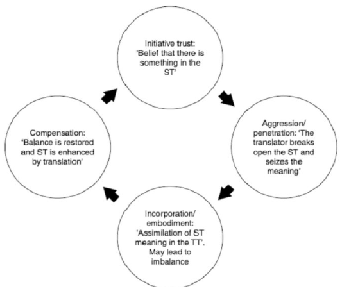
Initiative trust: This refers to the initial presumption that there is something meaningful to translate, even if the source text appears, at first glance, to lack clear or coherent content. As translators, our primary gesture is an investment of belief in the existence of an underlying coherence or significance within the source text that can be rendered into another language. This entails two risks:
The ‘something’ may turn out to be ‘everything’ (Bible).
It may be ‘nothing’ (non-sense content).
Aggression (or penetration): This phase refers to the translator’s active engagement with the source text. It involves an incursive and extractive process through which the translator (and, by extension, the target culture) appropriates the knowledge, meaning and cultural capital embedded in the source text. The act is framed as one of textual conquest: the source is metaphorically ‘looted’, leaving behind what Steiner (1975/1998) describes as an “empty scar” in the original landscape.
Incorporation: This stage involves the embodiment or integration of meaning from the source text into the target language. Following the extractive act of the previous phase, incorporation signifies the reconfiguration of the ST’s content within the linguistic and cultural framework of the TL, which already possesses its own semantic and stylistic conventions. Two different types of assimilation may occur.
Complete domestication: The translated text is fully absorbed into the TL system, becoming part of its literary or discursive canon.
Permanent strangeness and marginality: Often associated with literal translation, this approach preserves the foreignness of the original.
Importing the meaning of foreign texts, Steiner notes, “can potentially dislocate or relocate the whole of the native structure” (1998:315). This process may take the form of sacramental intake, whereby the target culture assimilates the foreign text and is enriched by it. Conversely, it may result in infection, where the source text disrupts the target culture to such an extent that it is ultimately rejected.
Just as a culture may be unbalanced by the importation of certain translated works, so too can a translator’s energy be either invigorated or depleted by the act of translation.
Translating into another language gives rise to new words… and potentially new emotions? Is that possible?
Such imbalance can only be restored by the act of compensation, the last movement.
Compensation: The aggressive appropriation and incorporation of the ST’s meaning creates a state of imbalance, as the energy is drawn out of the ST and transferred into the TT. This transfer necessitates a compensatory act to restore equilibrium. We must consider that the ST is ‘enhanced’ by the act of translation because it is deemed ‘worthy’ of translation, and the subsequent transfer to another culture broadens the original. The ST enters different relationships with its resultant TTs, which enrich the ST.
Steiner’s Elective Affinity and Resistant Difference
Steiner believes that genuine understanding and translation take place where languages merge into one another: ‘this insinuation of self into otherness is the final secret of the translator’s craft’ (1998, p. 378).
Steiner argues that translators with limited knowledge of the languages involved in the translation process may, in fact, be at an advantage, as distance from the source text and culture enables them to work without preconceptions or the complications arising from direct contact (e.g., Pound’s translations from Chinese and Japanese).
Resistant Difference
The translator experiences the foreign language in a way that differs fundamentally from their native tongue.
Each source–target language pairing is unique and imposes its distinctive character on both the translator and the receiving culture.
This process influences the translator’s identity, as the linguistic and cultural force of resistant difference may hinder full immersion in the original text. This obstacle is overcome through elective affinity, which arises when the translator feels drawn to the source text as to a kindred spirit, recognising themselves within it.
When resistant difference and elective affinity coexist, the translator is both rejected and attracted by the text. This dynamic translates into a creative tension that finds expression in successful translation. The process parallels the interplay between Venuti’s domesticating and foreignising strategies.
Steiner (1998, p. 413) contends that ‘good translation can be defined as that in which the dialectic of (…) intractable alienness and felt “at-homeness” remains unresolved, but expressive.’ In his view, the greater the proximity between two languages and cultures, the greater the potential for unresolved tension and, thus, for great translation. Conversely, translation between distant languages and cultures is considered trivial, since this tension is diminished.
Put simply, translators must navigate a balance between elective affinity and resistant difference. This means being so familiar with the source culture that they feel ‘at home’ in its expressive forms, while still retaining enough distance to perceive its otherness and understand what may challenge or intrigue the target audience (Steiner 1975/1998, p. 399, as cited in Goodwin 2022).
Steiner believes that the more similar the languages and cultures of the source and target texts are, the stronger the tension between the familiar and the unfamiliar. It is precisely this tension that can give rise to a great translation. By contrast, when the languages and cultures are very different, that tension is diminished, which is why Steiner considers translations between distant cultures to be less profound, or even “trivial”.
Ezra Pound and the Energy of Language
He was an American modernist poet (1885-1972).
Poetry-Philosophy: He made a significant contribution to the development of theories concerning the relationships between languages, both through his practice of translation and his critical writings on the subject.
His translation theory was shaped by a German intellectual tradition marked by literary experimentalism.
Pound’s experimentalism and his challenge to the dominant poetic doctrines of his time continue to inspire many subsequent translators and theorists, despite the fact that these same qualities contributed to his marginalisation.
He was consistently experimental and deeply concerned with the expressive potential of language, aiming to revitalise it through clarity, rhythm, sound and form, rather than through literal sense.
His entire body of work was shaped by his engagement with past literatures, including Greek, Latin and Anglo-Saxon texts.
In an effort to break away from the rigid norms of the Victorian and Edwardian English literary tradition, he adopted an archaicising style—often obscure—by imitating original metrical patterns and calquing source text vocabulary (This approach closely resembles the strategy of foreignisation.)
In nearly all of his translations, Pound employed some form of archaism when rendering older poetry.
The Task of the Translator: Walter Benjamin
A German-Jewish philosopher, cultural critic and essayist (1892–1940).
The Task of the Translator (or The Translator’s Task) originally served as an introduction to Benjamin’s own German translation of Baudelaire’s Tableaux Parisiens. It has since become one of the most influential philosophical texts on literary translation.
Language and the philosophy of language were central to Benjamin’s critical thought. He regarded language as a magical medium, whose ultimate purpose was to reveal spiritual content.
Benjamin argues that the purpose of a translated text is not to convey the ‘meaning’ or informational content of the original to its readers. Rather, the translation exists as an independent yet related entity. It follows the original, emerging from its ‘afterlife’, while also granting the original text a form of ‘continued life’. This act of recreation ensures the survival of the original work across time and linguistic boundaries.
The purpose of translation is to express the most intimate relationships between languages, relationships that would otherwise remain concealed without the act of translation.
Translation does not aim to replicate or mirror the original, but rather to bring two distinct languages into a productive and meaningful relationship.
Its ultimate goal is the pursuit of a pure or higher language, which is released by the co-existence and complementation of the translation with the original.
Word-for-word rendering enables this pure language to shine through, an approach that closely aligns with the notion of foreignisation. Thus, the translator’s task is to liberate the pure language embedded in the foreign text by rewriting it in their own language.
According to Benjamin:
The literalness of syntax and the freedom of pure language converge in interlinear translation, that is, a word-for-word gloss in the target language inserted above the words of the original.
The ‘prototype’ or ‘ideal’ form of translation is the interlinear version of the Bible, through which the divine Word is allowed to appear.
Derrida: Deconstruction
As a movement, it originated in France in the 1960s and is closely associated with postmodern and poststructuralist thought.
Its leading figure was the French philosopher Jacques Derrida (1930–2004).
He deconstructs long-established assumptions about translation, including the stability of the linguistic sign and the very notion of equivalence.
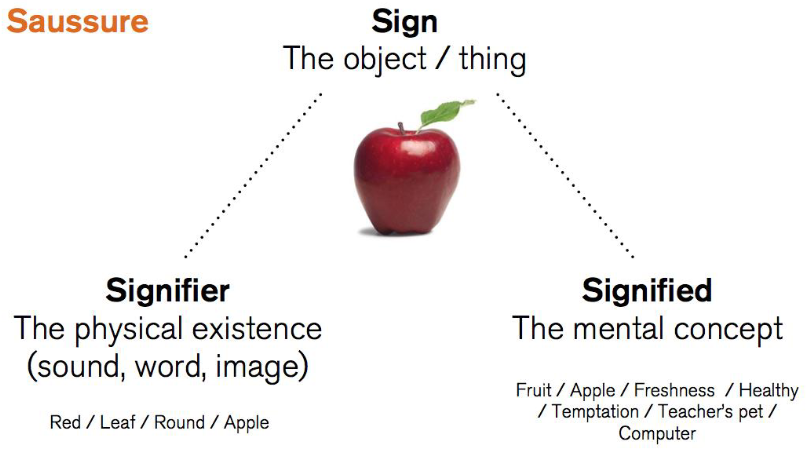
Deconstruction has sought to dismantle some of the foundational premises of linguistics. It rejects the primacy of meaning as something fixed or contained within the word itself. Deconstruction does not claim that there is no meaning to translate, but emphasises that meaning is inherently unstable and fluid. As a result, it challenges the possibility of defining, capturing or stabilising meaning, an idea with significant implications for the practice and theory of translation.
Derrida’s terminology is complex and often difficult to grasp.
For our purposes, we will concentrate on the term différance. This concept plays on the dual meaning of the French verb différer—to defer and to differ—and refers to the disruption of any notion of stable meaning.
Put simply, meaning is always shaped by context and by its difference from other meanings.
Lewis’s Abusive Fidelity
Abusive fidelity is a translation strategy proposed by Philip Lewis in his essay on translating Derrida and it has since influenced several translators and scholars.
This approach challenges the traditional valorisation of transparency and fluency in translation, instead advocating for a deliberately “abusive” manipulation of the target language to preserve the foreignness of the source (Meiyuan, 2020). In this view, translation must resist domesticating tendencies.
Lewis values translations that avoid conforming to the norms of the target culture and instead maintain such strict fidelity to the source text that the translation may appear strange or alien to the target-language reader (Pym, 2008).
He observes that translators have historically adhered to fluent and natural-sounding patterns in the target language and calls instead for a strategy of abusive fidelity, one that embraces risk, strangeness and linguistic experimentation.
Lewis’s ideas have influenced other areas within translation studies.
Nornes (1999/2004) draws on Lewis’s concept to advocate for an abusive approach to subtitling: one that embraces linguistic and visual experimentation on screen.
He illustrates this with the case of fansubbing in Japanese anime films. Amateur subtitlers often experiment with font colour and size to reflect aspects of voice and dialect, incorporate foreign word borrowings and fill the screen with explanatory notes or unconventionally placed titles. Such practices defy the norms and conventions of mainstream subtitling.
These abusive subtitlers deliberately maximise their visibility, challenging the ideal of invisibility traditionally associated with subtitling practice.
New Directions from Audiovisual Translation and Digital Technology
In Brief
The rise and widespread use of multimodal texts and digital technologies have expanded the scope of translation, introducing new genres, distribution platforms and reception contexts. Alongside advances in translation tools [and AI] these developments have reshaped translation practice and compelled theoretical frameworks to reassess established concepts while incorporating new perspectives.
Audiovisual translation and multimodal texts: revisiting and embracing new concepts.
Digital production: different means of production, reception and the concept of audience.
Localisation and globalisation: alternative options of equivalence and power.
New technologies: interactions between machine and translation.
Game localisation: new genres and approaches.
Transcreation: the creative side of translation.
From Practice to Theory
Constrained translation.
Film and TV translation.
Screen translation.
Film translation.
(Multi)media translation.
Audiovisual translation (AVT).
Audiovisual Translation (AVT, TAV)
A natural challenger for core concepts in translation studies.
Historically neglected within the discipline, particularly due to its nature as an audio-medial text type and its incompatibility with medium-restricted theoretical frameworks.
AVT has drawn attention to the constraints imposed by non-verbal elements and technical limitations. For instance, the need to synchronise text with image, character restrictions and reading speed in subtitling.
These limitations have led to the conceptualisation of AVT as a form of constrained translation (Titford, 1982; Mayoral et al., 1988).
The coexistence of sound, image and language introduces unique challenges that go beyond purely linguistic or verbal dimensions.
Audiovisual translation (AVT) can be understood as involving the translation of programmes in which the verbal dimension is only one of the many shaping the communicative process (Díaz Cintas, 2010). This definition underscores the multisemiotic nature of audiovisual texts, distinguishing AVT as the mode of translation that engages with source materials in which visual, oral and auditory elements jointly contribute to meaning-making.
AVT functions as an umbrella term encompassing various modalities such as subtitling, dubbing, voice-over, surtitling, subtitling for the deaf and hard of hearing (SDH) and audio description.
Alternative formats (e.g., videogames and crowdsourced translations) pose new and evolving challenges to traditional AVT frameworks.
Dirk Delabastita
Dirk Delabastita (1989) characterises audiovisual translation (AVT) as a distinct type of translation due to the fact that “film establishes a multi-channel and multi-code type of communication” (p. 196). This multi-layered communicative structure involves several intersecting semiotic systems, including:
The verbal code, which encompasses stylistic variation, dialectal features and linguistic register.
The literary and theatrical code, which informs elements such as plot, dialogue structure and conventions appropriate to the genre.
The proxemic and kinetic code, which refers to non-verbal behaviours such as gesture, facial expression and spatial relationships.
The cinematic code, which includes camera movement, editing techniques, visual composition and genre-specific conventions.
Simplistic distinctions between the verbal and non-verbal must be avoided, as Delabastita (1989) points out: the visual channel can convey verbal signs (e.g. written text on screen) while the acoustic channel may transmit non-verbal signs (e.g. music, intonation, ambient sounds, background noise). Thus, meaning is not confined to a single mode but emerges from the interaction between multiple semiotic resources.
Audiovisual translation (AVT) has played a key role in challenging the primacy of the written word within Translation Studies. By foregrounding the interaction of various semiotic resources, AVT has contributed to a broader, more inclusive understanding of what constitutes a “text”.
Zabalbeascoa (1992) explicitly called for an expansion of Translation Studies beyond its traditional focus on written texts.
Gottlieb (1994) introduced the term polysemiotic text to describe communicative acts that operate across two or more channels.
Snell-Hornby (1993) proposed the category of multimedial text to refer specifically to texts characterised by the integration of multiple modes of communication.
The Multimodal Source Text
Focusing mainly on dubbing, Chaume (2004) identified ten codes as part of a proposal for an integrated model to analyse the signifying codes of cinematographic language. This was in response to calls for the development of an analytical framework specific to audiovisual texts and AVT. Some of these codes relate to the acoustic channel, while others pertain to the visual channel.
Acoustic Channel
The linguistic code (e.g., wordplay, the presence of multiple languages and culture specific elements) is shared with other forms of translation. However, in AVT, these features are typically scripted and “written to be spoken as if not written”, which places particular demands on the translator.
The paralinguistic code also plays a key role: dubbing scripts often include symbols to indicate laughter or pauses, while in subtitling, graphical markers are used to signal voice level, tone and pauses.
The musical and special effects code involves the representation and adaptation of song lyrics, as well as consideration of their function within the narrative.
The sound arrangement code takes into account whether a speaker is on- or off-screen, which affects whether or not lip synchronisation is required.
Visual Channel
The iconographic code involves visual symbols that may not be easily recognised by the target audience and may therefore require verbal clarification. This also includes ensuring coherence between verbal references and on-screen items, especially when wordplay is involved.
The photographic code refers to visual elements such as lighting; for example, shifts in lighting may necessitate changes in subtitle colour to ensure cultural and visual appropriateness.
The planning code is particularly relevant in dubbing, as close-ups demand accurate lip synchronisation. It also involves translating visually salient written content, such as text on posters, which may not be verbally expressed.
The mobility code considers character movement within a dubbed scene and the need to synchronise bodily gestures with speech (e.g., head shaking).
The graphic code relates to any written text that appears on screen, including titles, labels and embedded subtitles.
The syntactic code refers to editing conventions and the need to verify the alignment between verbal elements and corresponding images or other semiotic resources.
Multimodality
Early contributions, such as Chaume’s work and that of other scholars, marked a significant turning point by highlighting the role of non-linguistic resources. This represented a major shift from the traditional focus in translation studies, which predominantly centred on verbal language. However, some questions remain:
How are these codes manifested on screen?
What are the processes through which meaning is constructed?
Why are visual and aural resources often regarded merely as context?
The term multimodality (or multimodal studies) refers both to a field of research and to a communicative phenomenon that combines various modes, such as images, speech, writing and gestures. Theoretical approaches to multimodality are based on four key assumptions:
All communication is multimodal.
Modes work together, each playing a specific role, and meaning emerges from the relationships established between them.
Each mode has unique affordances, which arise from its materiality as well as its historical and social uses. These factors, in turn, shape how the mode is employed to address specific communicative needs.
A language-focused analysis can only partially explore the complex meaning-making processes in which multiple modes are involved.
Multimodal Social Semiotics (MSS) has had a significant influence on audiovisual translation (e.g., Kress and van Leeuwen (2006), Baldry and Thibault (2006)).
Their work emphasises that the relationship between form and meaning is not entirely arbitrary. Rather, it is shaped by how each mode has been historically used by different users, with different purposes and in different contexts.
This perspective is particularly relevant to AVT, where audiovisual texts are typically crafted with clear communicative intentions in mind.
Scholars such as Klaus Kaindl (2012) have reconceptualised translation not merely as a process of language transfer, but more broadly as the design of texts across cultural boundaries.
The translator is now seen as a text designer, whose aim is ‘not to understand the text himself/herself, but to produce texts for the needs of somebody else’ (Kaindl, 2012, p. 258).
Given that monomodal communication is now the exception rather than the norm, scholars in audiovisual translation are increasingly examining how sound, image and verbal language co-occur and interact to create meaning, rather than treating them merely as contextual elements for verbal expression (Dicerto, 2018).
This has led some authors to ask: Is translation practice confined to the mediation of written or spoken language alone? What becomes of modes beyond verbal resources? (For instance, colour in illustrated children’s books).
Non-verbal modes may also pose challenges for foreign audiences and may require translation in their own right.
Multimodal Text Analysis and Corpora
There is a need for analytical tools specific to audiovisual translation to address the challenge of how to document and analyse multimodal products in written form. Taylor (2003) puts forward a model for the multimodal transcription of audiovisual texts.
His approach draws on Thibault’s (2000) model for analysing film and television advertising, which involves breaking a film sequence down into individual frames, shots, or phases, followed by the production of a multi-layered, multi-column description, as illustrated in the following table:
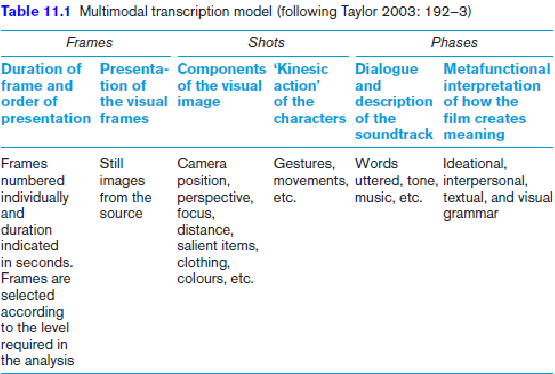
Large corpora enable researchers to identify micro-procedures and overarching strategies, as well as recurring patterns in translated texts.
Examples of corpora used in AVT research include Television in Words, the Pavia Corpus of Film Dialogue and the Corpus de Subtítulos Bilingües en inglés y español.
Significant generalisations have been made possible through the use of these corpora. However, constructing a corpus of multimodal texts presents considerable challenges:
The substantial resources required to compile and store large files.
Legal issues concerning the copyright of source texts.
The lack of specialised analytical tools for tagging and annotating corpora.
The intensive resources needed to carry out corpus annotation.
The potential impossibility of alignment in texts such as websites, which are continually updated.
The difficulty of defining representativeness with regard to non-verbal modes.
As a result, most corpora in AVT cannot be considered truly multimodal. Rather, they consist of transcriptions of spoken film dialogue, enriched with encoded paralinguistic features and information on other relevant visual and auditory mode
From Target Audience to Participatory Communities
A new conceptualisation of target audiences has emerged: communities of affinity. This frames audiences as groups formed around shared interests and expectations.
Consumers now exercise greater control over what they watch, as well as when, where and how they access content.
Within this participatory culture, audiences not only select certain texts over others, but also influence production and distribution processes by voicing opinions, sharing content and, in some cases, translating it themselves.
In this context, the notion of the target audience in translation studies can no longer be limited to issues of reception. Instead, it must be redefined in terms of consumption, self-mediation and active participation.
Such participation often includes the work of non-professional translators, who act as key agents in the translation process (e.g., fansubbing).
Localisation, Globalisation and Transcreation
In the digital age, translation has evolved into a major commercial enterprise, and, within industry (particularly the software sector), it is frequently encompassed under the acronym GILT (Globalisation, Internationalisation, Localisation, Translation) (Jiménez Crespo, 2013).

Important Definitions
Globalisation (g11n) refers to the strategic organisation of business processes (e.g., management, marketing and customer service) in ways that support both internationalisation and localisation.
Internationalisation (i18n) involves the design and development stages of a digital product to ensure that it can operate effectively across international markets.
Localisation (L10n) concerns the adaptation of a product to a specific locale, defined in industrial contexts as a combination of a sociocultural region and a language (Jiménez Crespo 2013, p. 2). This process may include the substitution of culturally inappropriate symbols and the translation of textual content, often under constraints such as limited screen or page space.
According to Dune (2006, p. 2), localisation is not limited to linguistic and cultural adjustments; it is situated at the intersection of development and authoring, sales, cost-conscious management, marketing (where promotional materials may require redesign) and legal departments, which must ensure compliance with local legislation.
What’s the Difference Between Localisation and Translation?
The boundaries between translation and localisation are often blurred.
In industry, localisation is frequently understood as a superordinate concept that encompasses translation as one of its components.
The Globalization and Localization Association (GALA) describes localisation as “the process of adapting a product or service to a specific locale (country/region and language) where it will be used and sold”, emphasising that translation is only one of several elements involved in this broader process.
CAT and MT
CAT
Computer-assisted translation (CAT) tools are employed by professional translators to aid in the translation process. These tools include those for aligning source text and target text pairs, concordancing search terms and extracting terminology.
Translation memory tools, in particular, allow the creation of databases containing previously translated material. These databases are used to identify matches with segments in the text the translator is currently working on. This not only accelerates the translation process but also ensures consistency in the translation of specific terms across different texts and by different translators.
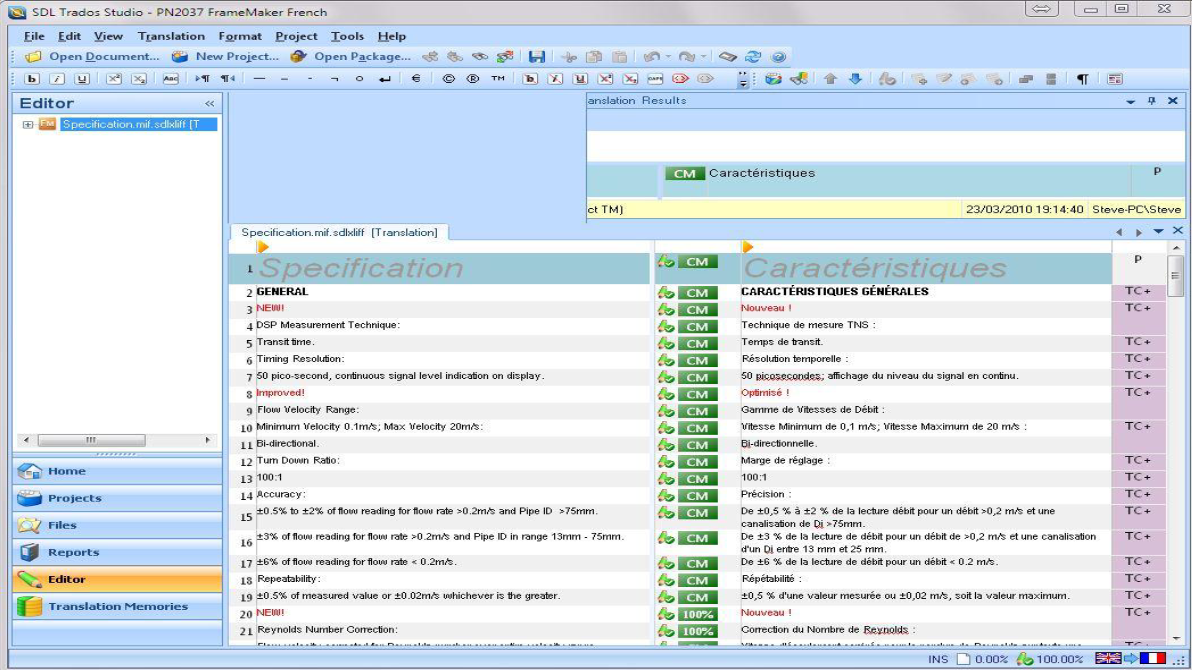
MT
Machine translation tools generate automatic translations and are primarily used for assimilation, that is, for comprehension of texts in foreign languages. However, Hartley (2009) highlights that MT is increasingly being used for dissemination purposes. For example, the European Commission utilises MT to provide a preliminary draft translation of documents, which is then post-edited by human translators or editors. [Postediting]

The Impact of New Technologies on Translation
Anthony Pym’s The Moving Text: Localization, Translation, and Distribution (2004) is a significant contribution that revisits traditional translation issues in light of emerging technologies. These advancements challenge conventional views on translation, particularly in the context of localisation and global distribution.
From a translation theory perspective, the process of internationalisation (i.e., preparing content for a global audience) necessitates adapting traditional communication models. For instance, the production of multiple target language versions alters the basic model of source text to target text transfer. An internationalised, interlingua version often serves as the basis for various TL versions, which are continuously updated. As a result, the status and role of the initial ST diminish, and, in internationalisation, equivalence is defined less by direct translation and more by the functionality of the TT.
Pym’s view of localisation, however, is somewhat critical. He portrays it as a process driven more by market concerns than by the human cultures it is supposed to represent. Projects are typically conducted by teams who, due to strict deadlines and regulations, focus on narrow tasks and often lose sight of the broader picture. In this context, collaborative translation (sometimes referred to as crowdsourcing) has become increasingly prominent. This involves large groups of non-professional translators, raising important ethical concerns about quality, fairness, and the status of the translation profession. This phenomenon leads to questions about whether competent translations can or should be produced without payment or professional involvement.
Ireland as the European Hub for Localisation
Michael Cronin’s works, Translation and Globalization (2003) and Translation in the Digital Age (2013), explore how the technologies driving globalisation have reshaped the role and status of translators. In an increasingly digital world, Cronin discusses the concept of “proximity” in translation networks. The ease of digital communication encourages translation agencies to outsource work to lower-wage economies, while those without access to such technology are excluded from global translation opportunities. In the modern digital economy, being disconnected from the “information superhighway” essentially means not existing as a translator at all.
The final chapter of the book revisits the issue of minority languages. Cronin identifies a “fragile linguistic ecosystem” under threat from dominant international languages but suggests that translation can serve both positive and negative functions in such contexts. He argues that translation theory is vital for minority languages, allowing speakers and translators to understand and potentially manipulate translation policies for their benefit (Cronin, 2013). He proposes a “translation ecology”, a practice that gives speakers and translators of minority languages more control over how and when texts are translated.
Cronin suggests that this “activist dimension” of translation is essential for raising awareness of its social responsibility and importance to comparative self understanding and future development (Cronin, 2013). He highlights the urgent need for this, as translation is often undervalued both economically (resulting in underpaid translators) and culturally (with policymakers often ignorant of translation’s historical significance).
Video Game Localisation
New genres like video games have further complicated the definition of translation and challenged the traditional separation between different types of translation. Video game localisation blends audiovisual translation with software localisation, creating a hybrid process known as game localisation (Mangiron & O’Hagan, 2006). Translators are required to exercise creativity and originality to ensure the game remains entertaining and engaging for players. This may involve renaming characters and elements, inventing new terms and choosing non-standard dialects.
From Localisation to Transcreation
Bernal Merino (2006, pp. 32-33) explores the term transcreation, which has been adopted by a new wave of companies aiming to distinguish themselves from traditional translation firms. The term was initially coined by the Indian translator and academic P. Lal (1964) to describe his domesticating English translations of Sanskrit plays. It was later adopted by the Brazilian writer Haroldo de Campos and postcolonial theorist Else Vieira (1999).
Transcreation is often contrasted with terms such as ‘domestication’, ‘localisation’, and ‘skopos’. While transcreation emphasises the creative and transformative nature of the translation process, the skopos theory of game localisation focuses on producing a target version that retains the "look and feel" of the original, while being perceived as the original (Mangiron and O’Hagan, 2006: 20). Here, the creativity inherent in transcreation is combined with the concept of "look and feel", which derives from the discourse of localisation and translation.