Overview of Lipoproteins
Lipoproteins
Lipoproteins, also known as lipid carriers, serve as crucial transport proteins for cholesterol, facilitating its storage, utilization, and excretion throughout the body.
These complexes, formed from lipids and proteins, are vital for the movement of cholesterol, triglycerides, and phospholipids within the bloodstream.
Types of Lipoproteins:
LDL (Low Density Lipoprotein)
Commonly referred to as "bad cholesterol."
It is the primary cholesterol carrier in the blood.
High levels of LDL can lead to plaque formation in arteries, increasing the risk of cardiovascular diseases such as heart attacks and strokes.
LDL transports cholesterol from the liver to the tissues, where it can be deposited in the arterial walls, contributing to atherosclerosis.
HDL (High Density Lipoprotein)
Known as "good cholesterol."
Secreted by the liver and intestines, HDL plays a protective role by transporting cholesterol away from the arteries and back to the liver for elimination.
It reduces the risk of heart disease by removing excess cholesterol from atherosclerotic plaques, effectively slowing their growth.
HDL has an antiatherogenic effect, which is important for maintaining cardiovascular health, as it increases the excretion of cholesterol in bile acid and fecal material.
VLDL (Very Low Density Lipoprotein)
Acts as a precursor to LDL.
Secreted by the liver, it exports triglycerides and cholesterol to peripheral tissues.
Elevated VLDL levels are linked to increased triglyceride levels in the blood, which can also contribute to atherosclerosis.
IDL (Intermediate Density Lipoprotein)
Serves as a transitional phase between VLDL and LDL in the metabolism of lipoproteins.
It is formed during the catabolism of VLDL, and its composition varies as it obtains cholesterol from VLDL.
IDL can be further processed into LDL.
Chylomicrons and Chylomicron Remnants
These are the largest lipoproteins, carrying triglycerides from dietary sources.
Formed in the intestine, chylomicrons transport dietary triglycerides into the lymphatic system and eventually into the bloodstream for delivery to tissues.
After triglycerides are removed, the remnant particles are ultimately taken up by the liver.
Summary of Lipoprotein Classification:
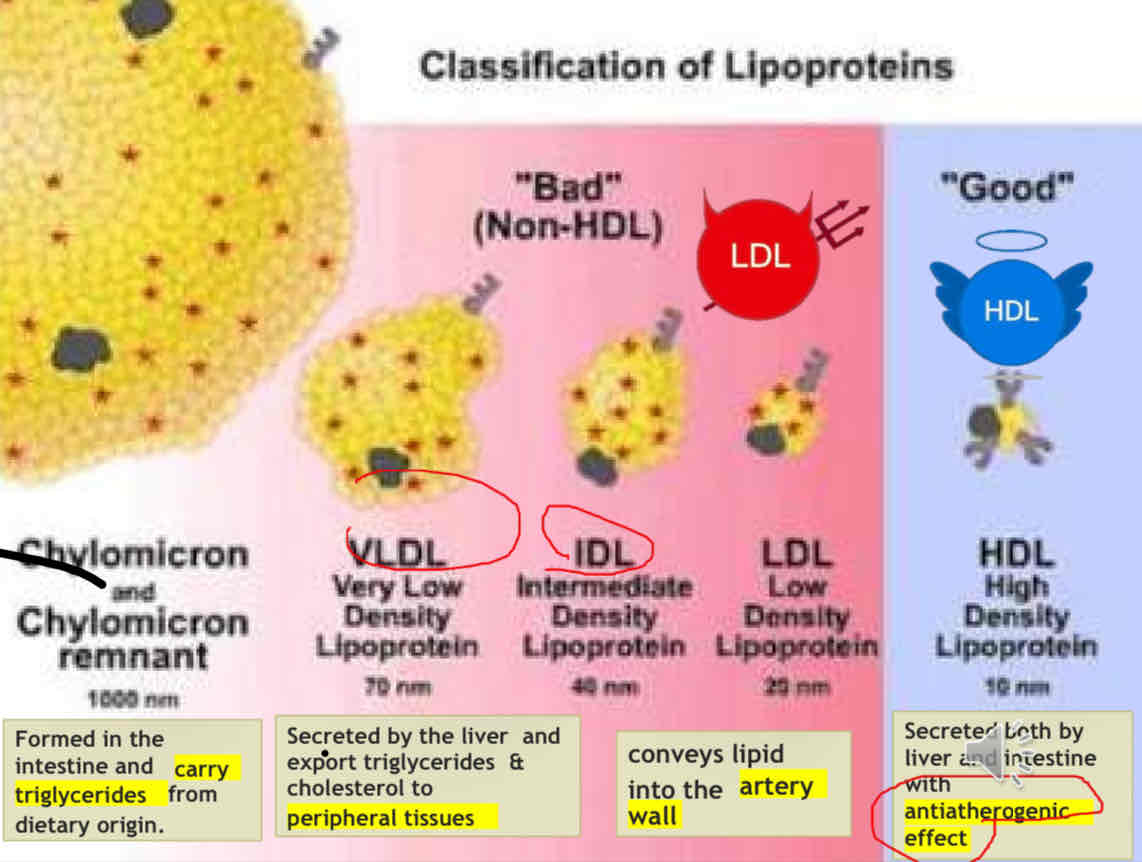
HDL: 10 nm, good cholesterol, clears cholesterol from the bloodstream.
LDL: 20 nm, bad cholesterol, deposits cholesterol into artery walls.
IDL: 40 nm, intermediate role in cholesterol transport.
VLDL: 70 nm, precursor of LDL, carries triglycerides and cholesterol to tissues.
Chylomicrons: 1000 nm, primarily carry dietary triglycerides, formed in the intestine.