Space
⭐ SECTION 1 — THE SOLAR SYSTEM
(Everything from your slides, explained properly)
🌞 1. THE SUN Yellow (kind of understands
The Sun is the most important star for Earth.
Why the Sun matters
Provides solar energy for all living things
Its gravity keeps Earth in a stable orbit
Closest star → appears brightest
Why you can’t stare at the Sun
Causes phosphenes (flashes of light)
Can cause temporary blindness
Long exposure → permanent retinal damage
What the Sun is made of
Mostly hydrogen
Some helium, carbon, oxygen, iron
Sun’s age
Has shined for 5 billion years
Will shine for 5 billion more
How the Sun produces energy
Nuclear fusion in the core:
Hydrogen atoms fuse → helium
Releases huge amounts of heat + light
Surface features (4 main ones)
Sunspots
Solar prominences
Solar flares
Coronal Mass Ejections (CME)
Caused by magnetic storms, peak every 11 years, and can interfere with telecommunications + electricity.
Solar wind
Stream of charged particles that:
damages satellites
harms astronauts
creates auroras
🪐 2. THE PLANETS
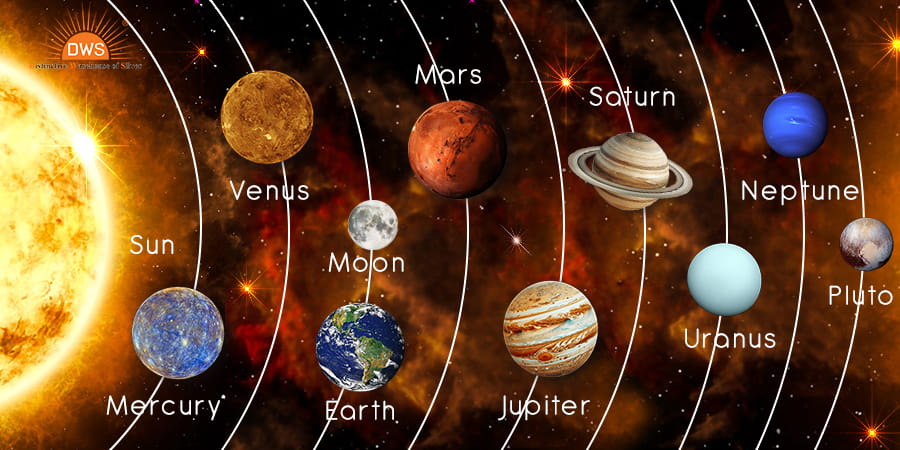
Inner (rocky) planets
Mercury
Venus
Earth
Mars
INNER planets = “small + rocky + hot-ish”
👉 close to the Sun
Mercury, Venus, Earth, Mars
Think:
🌞➡ (rocky near the sun)
🌌 OUTER planets = “big + gas/ice giants”
👉 far from the Sun
Jupiter, Saturn, Uranus, Neptune
Think:
🌞➡ 💨🪐🪐🪐🪐 (giant gas planets)
Outer (gas giants)
Jupiter
Saturn
Uranus
Neptune
How planets formed
Leftover gas + dust from the Sun clumped together due to gravity.
🌑 Inner Planets (details)
Mercury
No atmosphere
Extreme temperatures
Similar to the Moon
Venus
Thick CO₂ atmosphere
Strong greenhouse effect
Hottest planet
Rains sulfuric acid
Earth’s “twin”
Earth
Atmosphere with N₂, O₂, H₂O
Liquid water
Magnetic field + ozone
Supports life
Mars
Red (iron oxide)
Polar ice caps
Thin CO₂ atmosphere
Evidence water existed
🌌 Outer Planets (details)
Jupiter
Largest planet
Great Red Spot
Many moons
Has rings
Saturn
Most distinct rings
Least dense planet
Many moons
Uranus
Methane → blue
Rotates on its side
Very cold
Neptune
Methane → blue
Fastest winds
Very cold
☄ 3. ASTEROID BELT
Between Mars and Jupiter.
Separates inner and outer planets.
🌕 4. THE MOON
Key facts
No atmosphere
Craters from impacts
Same side always faces Earth (rotation = revolution = 27.3 days)
Gravity
Moon’s gravity = 1/6 of Earth’s.
Phases of the Moon
Caused by the Moon’s revolution around Earth.
🌊 5. TIDES
⭐ WHY tides happen (your slide explanation)
🌙 1. The Moon’s gravity pulls on Earth’s oceans
The Moon pulls the water toward it.
This creates a bulge of water on the side facing the Moon.
🌍 2. Earth rotates under these bulges
As Earth spins, different places move into the bulge → high tide
When they move out of the bulge → low tide
This is EXACTLY what your slide means by:
“Daily alternating rising and falling of ocean levels caused by the rotation of the Earth in the presence of the Moon (and Sun).”
⭐ High Tide
High tide happens where the water is bulging outward.
There are two high tides:
One on the side facing the Moon
One on the opposite side
⭐ Low Tide
Low tide happens in the areas between the bulges.
⭐ Why the pattern reverses
As Earth rotates, each location moves:
into the bulge → high tide
out of the bulge → low tide
This repeats every day.
⭐ IMAGE
Here’s the visual your slide uses:
🌑 6. ECLIPSES
Solar eclipse (S–M–E)
Moon blocks Sun.
Lunar eclipse (S–E–M)
Earth blocks sunlight from Moon.
🌌 7. AURORA BOREALIS
Caused when solar wind particles hit Earth’s atmosphere.
Produces:
red
green
yellow lights
Northern = Aurora Borealis
Southern = Aurora Australis
🌍 8. EARTH’S ROTATION
Earth spins on its axis every 24 hours → day & night.
🌞 9. EARTH’S REVOLUTION
Earth orbits the Sun every 365.25 days.
❄☀ 10. SEASONS
Caused by:
Earth’s 23.5° tilt
Revolution around Sun
NOT caused by distance.
🌗 11. EQUINOXES & SOLSTICES
Summer solstice
June 21 — longest day.
Winter solstice
Dec 21 — shortest day.
Equinoxes
Day = night
March 21
Sept 22
⭐ SECTION 2 — DISTANCES IN SPACE
⭐ 2.1 ASTRONOMICAL UNIT (AU)
Your slides say:
“Astronomical Unit (AU) = average distance between the Sun and Earth ~ 150 million km.”
🌍➡☀ What is 1 AU?
1 AU = the distance from Earth to the Sun.
That’s the baseline measurement for the solar system.
Why do astronomers use AU?
Because distances in the solar system are HUGE.
Instead of saying:
Mercury is 58,000,000 km from the Sun
Mars is 228,000,000 km from the Sun
We say:
Mercury = 0.39 AU
Mars = 1.52 AU
Much easier.
⭐ 2.2 LIGHT YEARS (ly)
Your slides say:
“Light Year = distance light travels in 1 year OR 63,000 AU.”
🌟 What is a light year?
A light year is a distance, NOT a time.
It is how far light travels in one year:
Light moves at 300,000 km/s
In one year, it travels 9.5 trillion km
Why do we use light years?
Because stars and galaxies are WAY too far for AU or km.
Examples from your slides:
Light from the Sun takes 8 minutes to reach Earth
Light from the Moon takes 1.5 seconds
When we look at stars, we are looking back in time
If a star is 500 light years away, we see it as it was 500 years ago.
⭐ 2.3 SCIENTIFIC NOTATION
Your slides show:
“Scientific notation shortens big numbers.”
Why we use it:
Space numbers are massive.
Instead of writing:
150,000,000 km
we write:
1.5 × 10⁸ km
Here’s the version your brain will remember:
✔ AU = distance from Earth to Sun
Used inside the solar system.
✔ Light Year = distance light travels in 1 year
Used outside the solar system.
✔ Scientific notation = short way to write huge numbers
Used everywhere in astronomy.
⭐ SECTION 3 — GALAXIES, BLACK HOLES, DARK MATTER
⭐ STEP 4 — THE BIG BANG THEORY
(from your “Big Bang Theory and Red Shift.pdf”)
Your slide says:
“The universe formed when an infinitely dense point suddenly and rapidly expanded.”
Let’s break that down slowly:
✔ What the Big Bang was
NOT an explosion.
It was a rapid expansion of space itself.
✔ What was created
Your slide says:
“All the matter and energy that exists today was created during the early minutes of that hot, rapid expansion.”
So everything — atoms, stars, galaxies — came from that expansion.
✔ When it happened
Your slide says:
“Occurred 13.7 billion years ago.”
That’s the beginning of:
the universe
space
time
⭐ STEP 5 — HOW EDWIN HUBBLE FIGURED THIS OUT
(from your slide: “How did Edwin Hubble come to the conclusion…?”)
Your slide says:
“He observed the light given off by far away galaxies.”
✔ What he did
He used a telescope and looked at spectra (rainbows of light) from galaxies.
✔ What he noticed
Your slide says:
“The spectral lines were shifted toward the red end of the colour band.”
This is the key.
⭐ STEP 6 — WHAT IS RED SHIFT?
(from your “Red Shift” slides)
Your slide says:
“He noticed the spectral lines were shifted toward the red end.”
✔ Red = longer wavelength
So if the lines move toward red, it means:
the light waves are stretched
the galaxy is moving away
This is why red shift = moving away.
Your slide literally shows this:
⭐ STEP 7 — WHY DOES RED SHIFT HAPPEN? (Doppler Effect)
(from your “Changing Sound Waves” slide)
Your slide says:
“It’s the same principle that makes a fire truck siren change pitch.”
✔ When something moves TOWARD you
Waves compress → shorter wavelength → blue shift
✔ When something moves AWAY
Waves stretch → longer wavelength → red shift
Your slide shows this:
⭐ STEP 8 — SPECTRAL LINES
✔ What spectral lines are
They are dark lines in a star’s spectrum.
✔ What they tell us
Your slide says:
They show whether a star is stationary, approaching, or moving away.
So:
No shift → star not moving relative to us
Blue shift → star moving toward us
Red shift → star moving away
⭐ STEP 9 — COSMIC MICROWAVE BACKGROUND RADIATION
yes
✔ What this means
After the Big Bang, the universe was extremely hot.
As it expanded, it cooled.
The leftover heat became microwave radiation.
Your slide shows the radiation map:
This radiation is found everywhere in space.
✔ Proof #1 — Red shifting of galaxies
Galaxies are moving away.
✔ Proof #2 — Microwave radiation
Leftover energy from the Big Bang
Your slides say:
“Fills up approximately 90% of the universe.”
✔ What is dark matter?
Invisible
Does NOT interact with light
Detected indirectly
Makes up 90% of all matter in the universe
Without it, the Milky Way would fly apar
⭐ FIRST: THE MEANING OF THE SHARED STAGES
⭐ 1. Nebula — meaning
A nebula is a huge cloud of gas and dust.
This is the birthplace of stars.
Gravity starts pulling the gas together.
⭐ 2. Protostar — meaning
A protostar is a forming baby star.
It is:
hot
spinning
growing
BUT no nuclear fusion yet
So it does NOT shine like a real star.
⭐ 3. Main Sequence Star — meaning
This is the real star stage.
Meaning:
nuclear fusion has started
hydrogen → helium
the star shines
this is the longest part of a star’s life
The Sun is in this stage right now.
⭐ ⭐ LOW‑MASS STAR LIFE CYCLE — MEANINGS
1. Nebula
2. Protostar
3. Main sequence star (red dwarf)
4. Red giant
5. Planetary nebula
6. White dwarf
7. Black dwarf
❌ NO.
They fade away slowly.
⭐ 4. Red Giant — meaning
The star runs out of hydrogen, so it:
expands
cools on the outside
becomes red
The core shrinks, the outside grows.
⭐ 5. Planetary Nebula — meaning
The star pushes its outer layers into space.
This forms a glowing shell of gas around the star.
It looks like a colourful bubble.
⭐ 6. White Dwarf — meaning
This is the hot leftover core of the star.
No fusion.
Just slowly cooling.
⭐ 7. Black Dwarf — meaning
A white dwarf that has cooled down completely.
It no longer gives off light.
(This takes longer than the age of the universe, so none exist yet.)
⭐ Do low‑mass stars explode?
⭐ ⭐ MEDIUM‑MASS STAR LIFE CYCLE — MEANINGS
(Same first stages as low‑mass.)
1. Nebula
2. Protostar
3. Main sequence star
4. Red giant
5. Planetary nebula
6. White dwarf
⭐ Do medium‑mass stars explode?
❌ NO.
They shrink into white dwarfs.
⭐ 4. Red Giant — meaning
Same meaning as low‑mass:
The star expands when hydrogen runs out.
⭐ 5. Planetary Nebula — meaning
Same meaning:
Outer layers drift away into space.
⭐ 6. White Dwarf — meaning
Same meaning:
Hot leftover core, slowly cooling.
⭐ ⭐ HIGH‑MASS STAR LIFE CYCLE — MEANINGS
1. Nebula
2. Protostar
3. Massive main sequence star
4. Red supergiant
5. Supernova
6. Neutron star OR Black hole
✔ YES — SUPERnova.
⭐ 4. Red Supergiant — meaning
A MUCH bigger version of a red giant.
The star expands massively because it burns fuel extremely fast.
⭐ 5. Supernova — meaning
A massive explosion.
The star collapses, then blows apart.
This explosion creates heavy elements and sends them into space.
⭐ 6A. Neutron Star — meaning
If the star wasn’t too massive, the leftover core becomes a neutron star:
extremely dense
made almost entirely of neutrons
spins very fast
⭐ 6B. Black Hole — meaning
If the star was VERY massive, the core collapses into a black hole:
gravity so strong nothing escapes
not even light
⭐ How the ending works (from your slide):
If the star is 10–40 times the Sun’s mass → becomes a neutron star
If the star is over 40 times the Sun’s mass → becomes a black hole