First Contact with the Aztecs
How and why were explorers were travelling in this period, and understand the journey of Hernán Cortés.
Why people like Columbus (paid by Spanish royalty) were exploring in this period.
Outline the initial contact between Cortés and Montezuma.
Towards the end of the 15th century, great voyages of exploration were being undertaken by the Portuguese and the Spanish, as they sought new sea routes between Europe and Asia. While the Portuguese sailed southward towards the tip of Africa, the Spanish looked to the west, across the Atlantic Ocean. Explorers such as Christopher Columbus (an Italian commissioned by the Spanish royalty) were eager to reach the fabled lands of Cathay (China) and Cipango (Japan).
On 3 August 1492, Christopher Columbus set sail from Palos in Spain with three ships – the Niña, the Pinta and the Santa Maria – hoping to find a shortcut to the ‘spice islands’ of the East Indies. In October of that year, however, he landed in the Caribbean islands that are the present-day Bahamas, Cuba and Haiti. Columbus thought that Cuba was Cipango (Japan) or perhaps part of the mainland of Asia. In further voyages between 1493 and 1504, he landed on other islands in the Caribbean, and searched the Orinoco River in South America for a fabled passage into the Pacific Ocean. Having failed to find the passage, Columbus returned home in poor health. He died in 1506, still believing that he had achieved his aim of discovering a western route to Asia.
Spanish Exploration and Conquests – Key Events
After the journeys of Columbus, more than 200 ships brought other explorers and wealth- seekers from Spain to the Caribbean between 1506 and 1518. Spain sent conquistadors (conquerors) such as Hernán Cortés and Francesco Pizarro, who took huge risks to explore new territories in the hope of enormous reward.
Source A: outline of key events in the Spanish exploration and conquests in the New World.

Spain’s government and its people were motivated to explore and conquer new territories in the Americas for several reasons, outlined in Source B.
Source B: Reasons for Spanish exploration and conquest.

The expedition landed at present-day San Juan de Ulua on the eastern coast of Mexico. Here, the conquistadors heard tales of the powerful Aztec king called Montezuma, who ruled from his capital at Tenochtitlan, high in the mountains and several days’ march from the coast. When news reached Montezuma that strangers had landed on the coast, he was unsure how to deal with them, not knowing whether the newcomers were men or gods. Montezuma sent ambassadors to meet the Spanish explorers, they sent splendid gifts including fine cloth, precious featherwork, gold trinkets in the shapes of various animals, a snake’s head made of gold with eyes inlaid with precious stones, and two huge discs as big as cartwheels, one of gold and one of silver and covered with figures and designs. Along with these gifts he sent a message that it would be impossible for the Spaniards to see him (Montezuma) and he attempted to dissuade them from attempting to come to the capital. Although Moctezuma may have intended his gifts to encourage the Spaniards to leave Mexico, the gold only increased their desire to travel to the capital of the Aztec empire, Tenochtitlàn
In Aztec culture, giving lavish gifts was a sign of power. Montezuma’s first splendid gifts were intended to show his dominance of Cortés. However, Cortés would have interpreted the gifts as signs of weakness or an attempt to bribe the Spanish. In return, he sent small gifts such as glass ornaments, bracelets and an embroidered cap. These simple gifts were designed to insult Montezuma.
The Conquistadors’ journey to Tenochtitlan
The distance to Tenochtitlan from San Juan de Ulua was around 400 kilometres. Cortés first moved up the coast to establish a settlement and entered the territory of the Totonac people, who were subjects of the Aztecs. The Totonacs promised to support Cortés in an overthrow of their Aztec masters (the support of tribes who resented the domination of the Aztecs was an important aspect of Spanish conquest). Cortés set out for Tenochtitlan in August 1519 with a force of around 300 conquistadors and 800 Totonacs.
The climate was hot and humid, and the first part of their journey was through a flat, heavily forested region, dotted with maize plantations. The land then rose sharply to 1800 metres, where the climate was milder. The next stage was over a cold, bleak plain dominated by a large salt lake. Between the plain and Tenochtitlan, was a chain of high mountains that included the volcanoes Popocatépetl and Ixtaccihuatl, both over 5000 metres high. A pass lay between them at around 4000 metres, after which the land fell away to a valley, and the great lake and the city of Tenochtitlan. Cortés passed through this valley in the summer, when rain fell every afternoon. The paths were deep in mud and rest stops were impracticable.

Source C: A satellite image of Mexico showing the conquistador’s landing point on the gulf coast of Mexico at present- day San Juan de Ulua, and their destination: the Aztec capital of Tenochtitlan, now the site of present-day Mexico City.
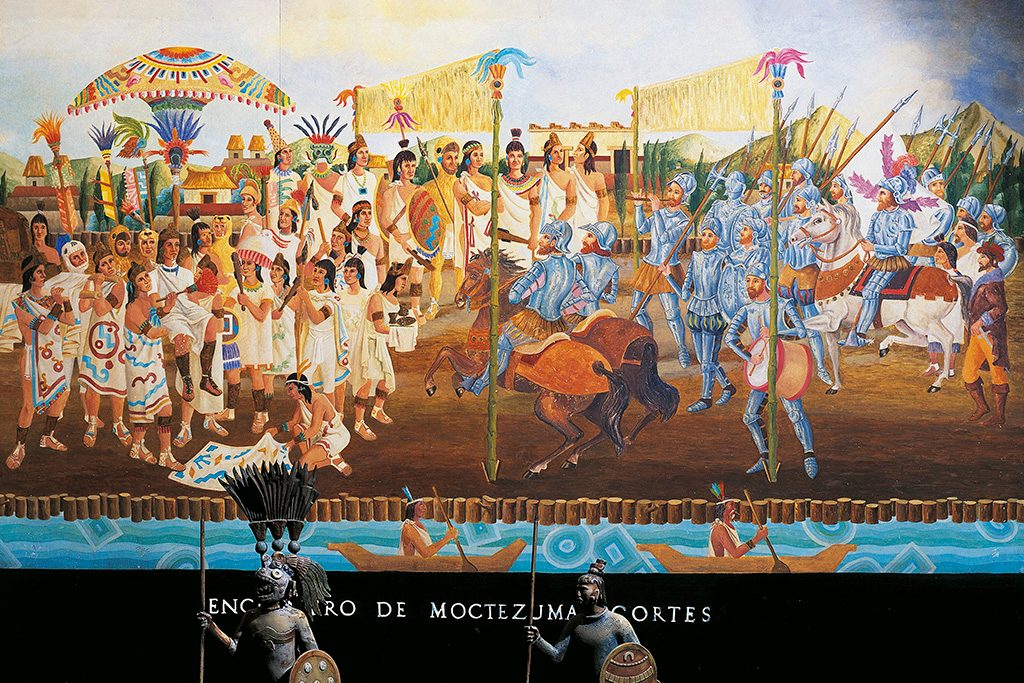
On the 8th of November 1519 Hernan Cortes and Aztec ruler (Tlatoani) Montezuma came face to face for the first time. After Cortés rode his horse onto the causeway he seems to have been kept waiting while Aztec nobles conducted a ceremonial welcome: each saluted him in courtly Nahuatl language before bowing low to touch and kiss the ground. Welcome ceremonies ensued attempting to show the dominance of the Aztecs. Montezuma came out to meet Hernan Cortes on the causeway under a canopy of green feathers, decorated with gold and Jewels. The canopy demonstrated the power and wealth of Montezuma in combination with the canopy Montezuma was surrounded by the high lords of his empire, how the tlatoani’s rank was marked out by his ornate sandals. All the other Aztecs, even the highest nobles, went barefoot to honour the man who stood so close to the gods, and only his closest advisors were permitted to look him in the face.
When Montezuma stepped down from the canopy, Cortes extended his hand however it was rebuffed as no one touched the tlatoani. Montezuma then extended his own hand taking control of the interaction. Montezma accepted a necklace from Cortes of glass beads scented with musk. In return, Montezuma offered Cortes flowers, then put over the conquistador’s head two necklaces made of valuable red snail shells, from which dangled eight shrimps made of pure gold, each the size of a man’s hand. After this rather unequal swap, the tlatoani invited Cortés into the city.
QUESTIONS
Outline the voyages of exploration that were taking place in the 15th century?
What was the earliest event shown?
How many years passed between Columbus’s first voyage and Cortés’s expedition?
What pattern do you notice about where the Spanish went and when?
What happened on the 3rd August 1492?
Outline the reasons for the Spanish Exploration and Conquest?
Who was in the force?
What weapons and animals did they bring?
What were Cortés’s aims?
Outline the expedition of Cortes to Tenochtitlan?
Identify the gifts that Montezuma sent to Cortes and why did he send gifts to the Spanish?
How might Cortés have interpreted them differently?
Why did the gold make the Spanish more eager to visit the city?