Week 2 Kinematics: From 1D to 2D Projectile Motion and Uniform Circular Motion

Acceleration

  • Definition: Acceleration is the rate at which velocity changes. Since velocity includes both speed and direction (it's a vector), acceleration can happen in a few ways:

    • Changing speed: Speeding up or slowing down.

    • Changing direction: Even if speed is constant, changing direction means velocity is changing, which implies acceleration.

  • Question: Which one of the following is not necessarily consistent with a car that is accelerating?

    • a) A car is moving with an increasing speed. (Consistent)

    • b) A car is moving with a decreasing speed. (Consistent)

    • c) A car is moving with a high speed. (Not necessarily consistent. A car moving at a high constant speed in a straight line is not accelerating.)

    • d) A car is changing direction. (Consistent)

    • Answer: c) A car is moving with a high speed.

1D Kinematics

  • Velocity Vector Direction: If an object is moving eastward and slowing down, its velocity vector points Eastward (in the direction of its motion).

  • Acceleration Vector Direction for Slowing Down: If an object is moving eastward and slowing down, its acceleration vector must be in the opposite direction to its velocity to cause the slowdown. Therefore, its acceleration vector points Westward.

Acceleration Due to Gravity (Free Fall)

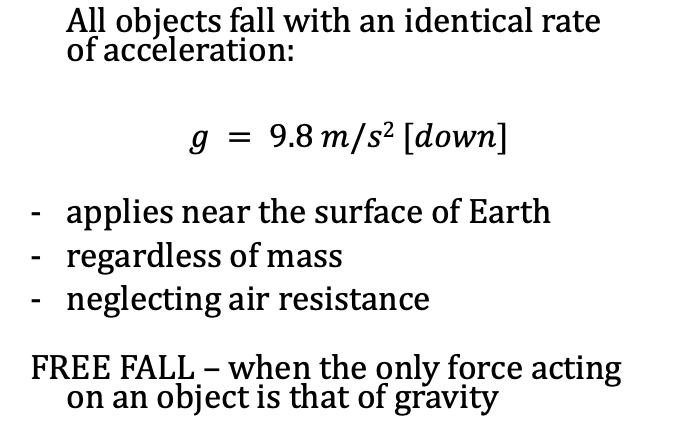
  • Concept: All objects fall with the same rate of acceleration near the Earth's surface, assuming air resistance is negligible.

    • This holds true regardless of the object's mass.

Solving Problems with Free Fall

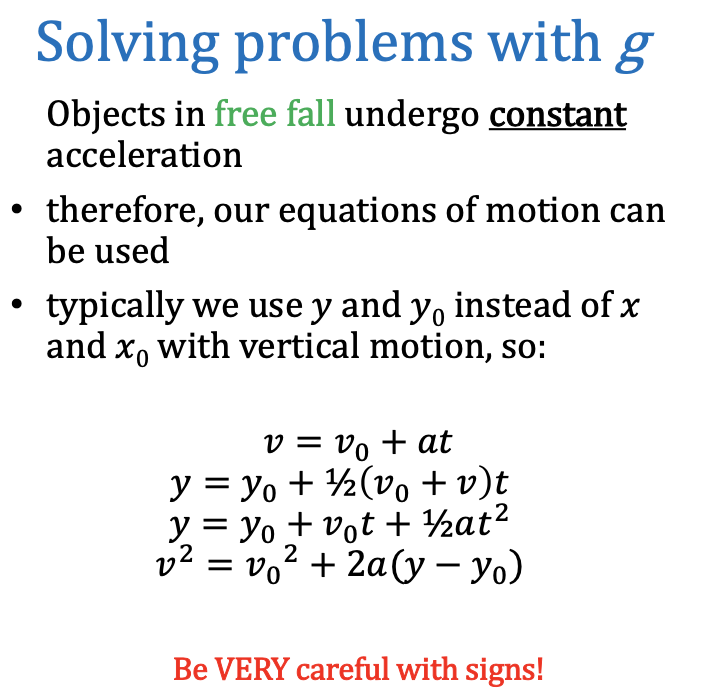
  • Objects in free fall experience constant acceleration (a=g)(a = g).

  • Therefore, the standard equations of motion (kinematic equations) can be used.

  • Crucial Note: Be extremely careful with signs when applying these equations. Define a positive direction (e.g., up = positive, down = negative) and stick to it consistently for velocity, displacement, and acceleration.

Practice is Key!
  • Sections 2.4 and 2.5 of the textbook offer great practice problems.

  • Work through the solved examples: write down the question, solve it on your own, then compare your solution to the one in the text.

Acceleration Due to Gravity - Example
  • Scenario: You throw keys straight up in the air. At the highest point in the key's path:

    • 1. velocity and acceleration are zero.

    • 2. acceleration is non-zero, but velocity is zero.

    • 3. velocity is non-zero but acceleration is zero.

    • 4. velocity and acceleration are both non-zero.

  • Explanation: At its peak, the keys momentarily stop moving upwards (vy=0v_y = 0). However, gravity is always acting on them, causing them to accelerate downwards at 9.8m/s29.8{ m/s}^2 . So, the acceleration is non-zero.

  • Answer: 2. acceleration is non-zero, but velocity is zero.

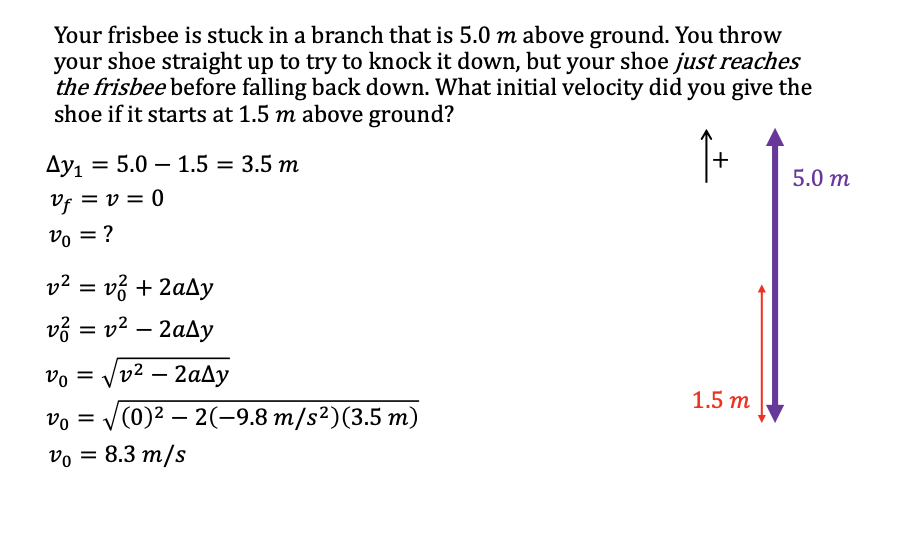
Solved Example: Frisbee in a Tree
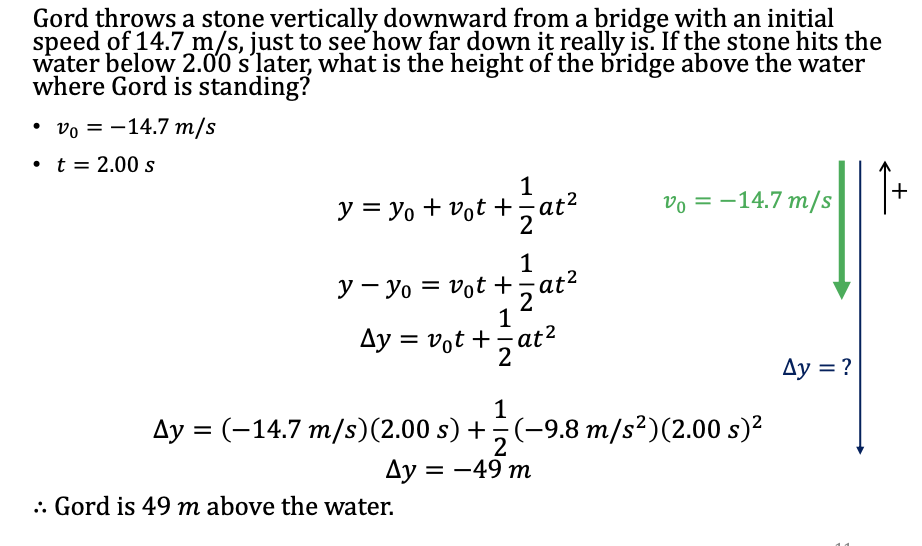
Solved Example: Stone Thrown Downward
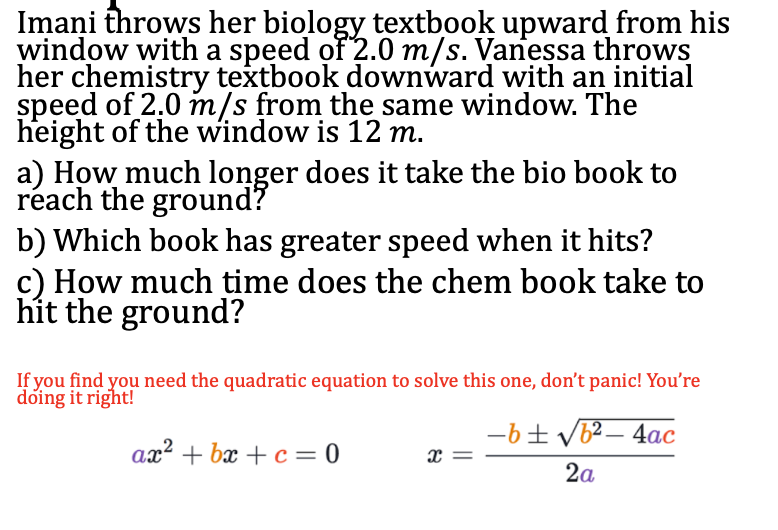
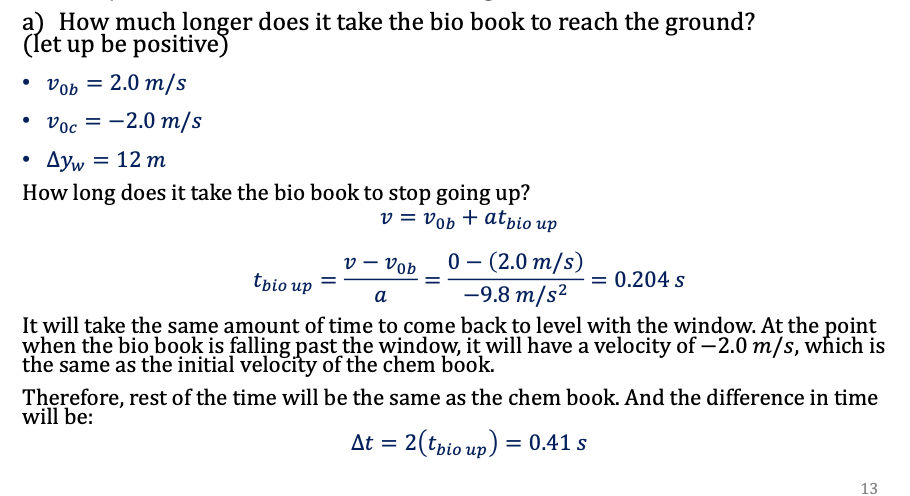
Solved Example: Biology vs. Chemistry Textbook
  • e window level on its way down with a velocity of 2.0extm/s-2.0 ext{ m/s}, identical to the chem book's initial speed. Thus, the extra time for the bio book is the time it takes to go up and come back down to the window height.

  • Time to reach peak for bio book:

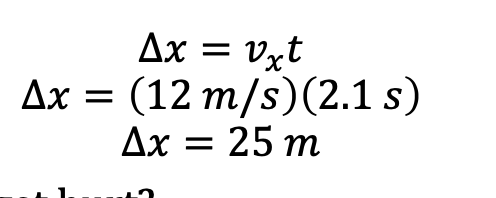
    • 2 \times 0.204 \text{ s} \approx 0.41 \text{ s}</p></li></ul></li></ul><p>Partb)Whichbookhasgreaterspeedwhenithits?</p><ul><li><p><strong>Explanation:</strong>Bothbooksstartatthesameheightandexperiencethesameacceleration.Thebiobook,uponreturningtothewindowlevel,willhaveadownwardspeedof</p></li></ul></li></ul><p>Part b) Which book has greater speed when it hits?</p><ul><li><p><strong>Explanation:</strong> Both books start at the same height and experience the same acceleration. The bio book, upon returning to the window level, will have a downward speed of2.0 ext{ m/s},identicaltothechembooksinitialspeed.Sincetheyeffectivelystartfromthesameheightwiththesameinitialspeed(magnitude),theywillhitthegroundwiththe<strong>samespeed</strong>.</p></li></ul><p>Partc)Howmuchtimedoesthechembooktaketohittheground?</p><p></p><imgsrc="https://knowtuserattachments.s3.amazonaws.com/22935f5a3291413fb905274a8a323d8f.png"datawidth="75, identical to the chem book's initial speed. Since they effectively start from the same height with the same initial speed (magnitude), they will hit the ground with the <strong>same speed</strong>.</p></li></ul><p>Part c) How much time does the chem book take to hit the ground?</p><p></p><img src="https://knowt-user-attachments.s3.amazonaws.com/22935f5a-3291-413f-b905-274a8a323d8f.png" data-width="75%" data-align="center"><p> \pm 15.46}{9.8}

      • Two solutions: Discard the negative answer

      • Result: Discard the negative time, so t1.4 st \approx 1.4 \text{ s}.

      1D and 2D Kinematics (with a Side of Vectors)

      Vector Notation
      • Vectors have both magnitude (size) and direction, while scalars only have magnitude. We use specific notation to tell them apart.

      • Scalar vs. Vector Notation:

        • Distance: rr

        • Displacement: r\vec{r}

        • Speed: vv

        • Velocity: v\vec{v}

        • Acceleration: a\vec{a}

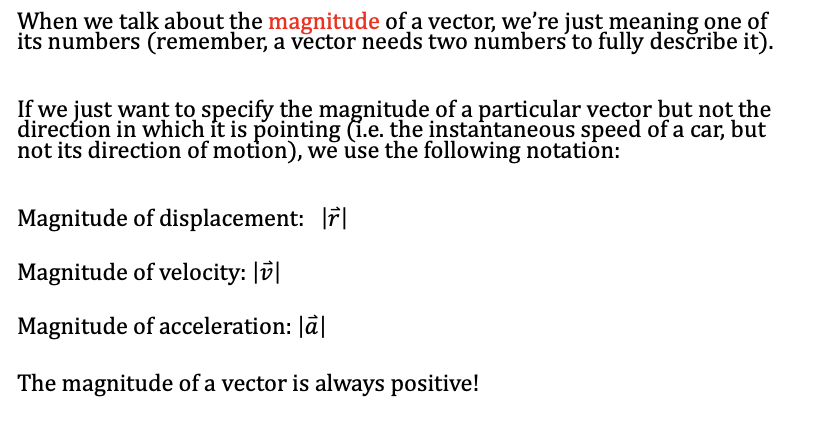
      Magnitude of a Vector/Vector Notation

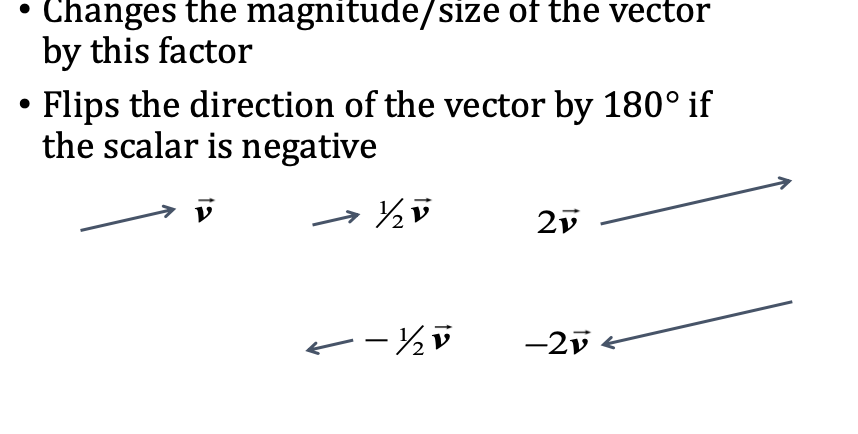
      Multiplying or Dividing by a Scalar

      • Change in Magnitude: This operation changes the size of the vector by the scalar factor.

      • Change in Direction: If the scalar is negative, it reverses the vector's direction by 180180^\circ.

        • Example: 12v\frac{1}{2} \vec{v} results in a vector pointing in the same direction, but half the length. v- \vec{v} results in a vector pointing in the opposite direction with the same length. 2v-2 \vec{v} results in a vector pointing in the opposite direction and twice the length.

      Adding/Subtracting Vectors (Graphical Method)

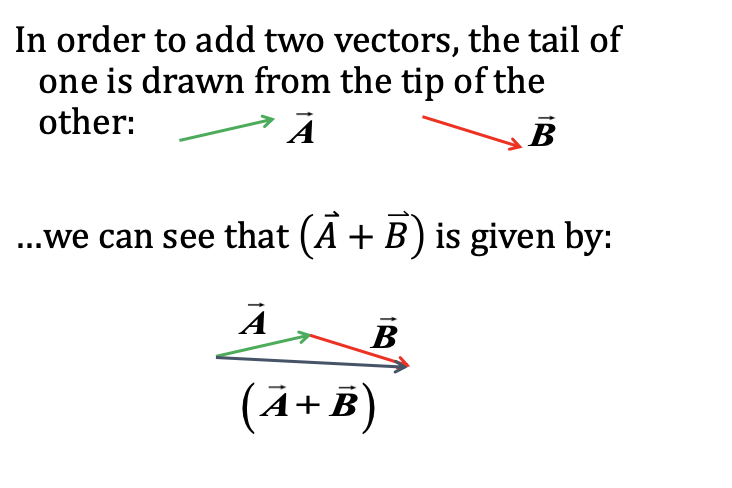
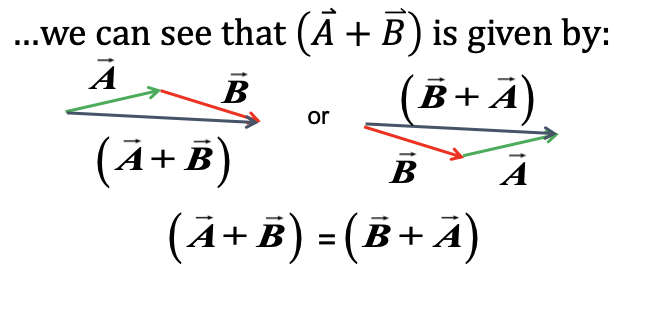
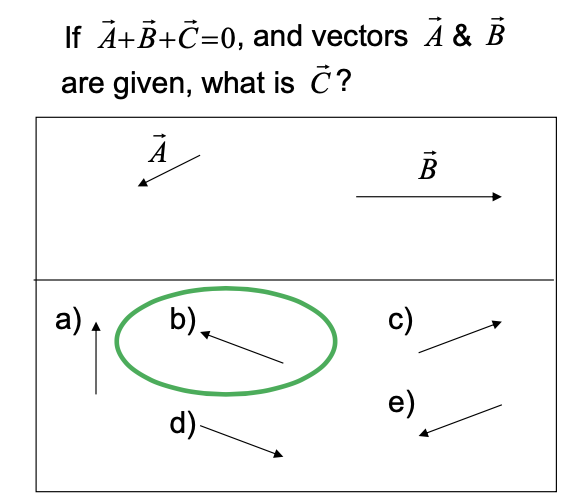
      • Vector Addition (Tip-to-Tail Method): To add two vectors (A+B\vec{A} + \vec{B}), draw the tail of the second vector (B\vec{B}) from the tip of the first vector (A\vec{A}). The resultant vector (A+B\vec{A} + \vec{B}) is drawn from the tail of the first vector to the tip of the second.

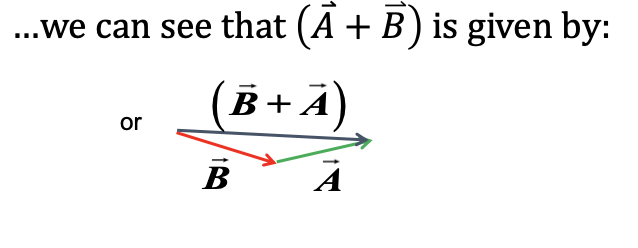
        • Vector addition is commutative: A+B=B+A\vec{A} + \vec{B} = \vec{B} + \vec{A} (the resultant vector is the same regardless of order).

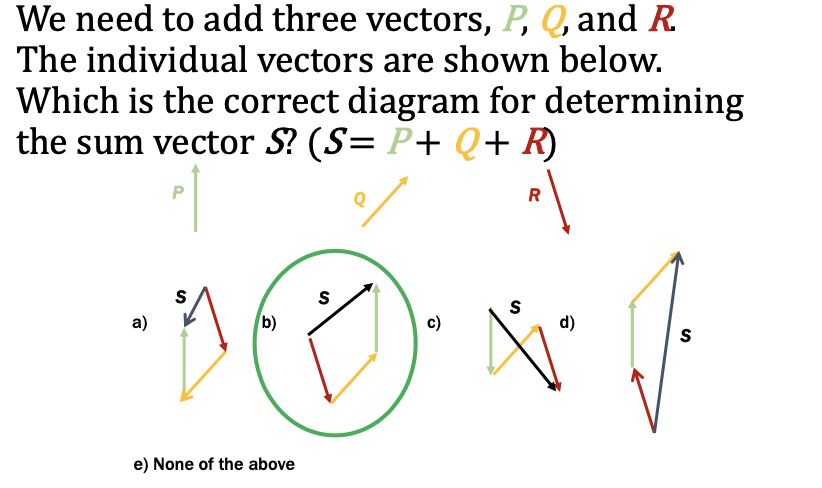
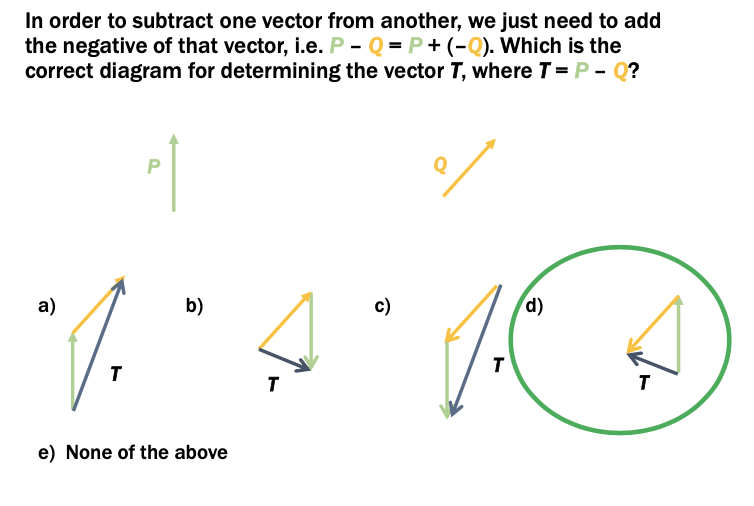
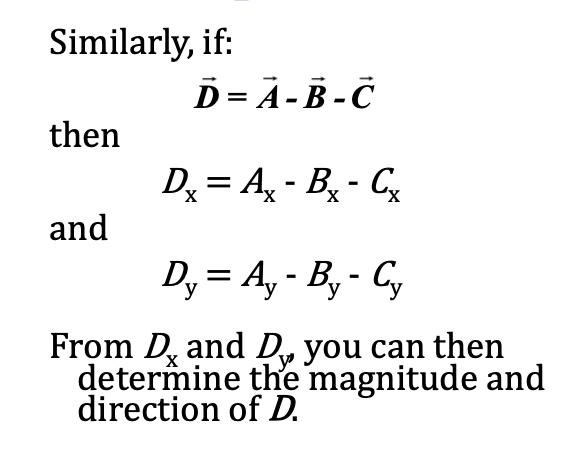
      • Vector Subtraction: To subtract one vector from another (PQ\vec{P} - \vec{Q}), you add the negative of that vector: P+(Q)\vec{P} + (-\vec{Q}). The vector (Q)(-\vec{Q}) has the same magnitude as Q\vec{Q} but points in the opposite direction (180180^\circ flipped).

      Vector Components
      • Review of Trigonometry: Basic trigonometry (sine, cosine, tangent) is essential for working with vector components.

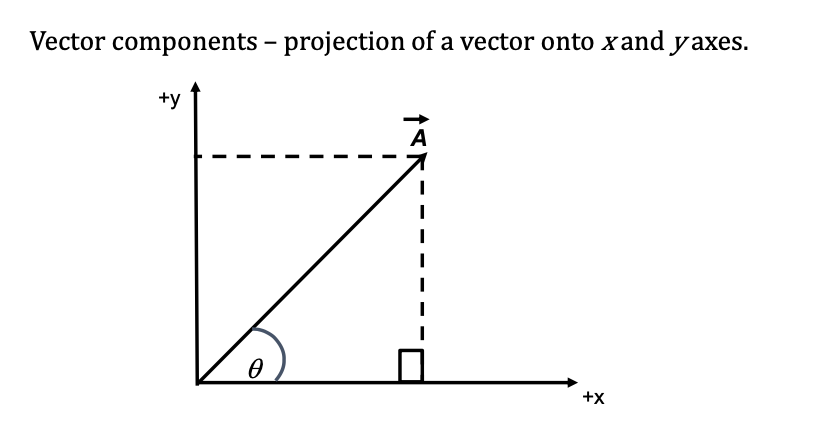
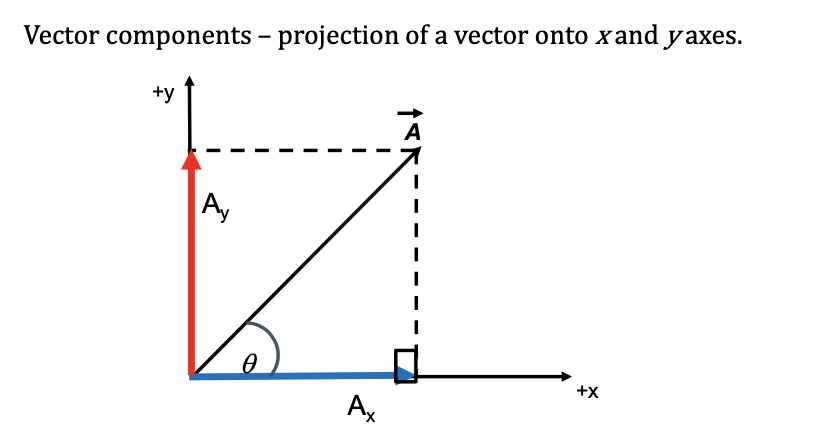
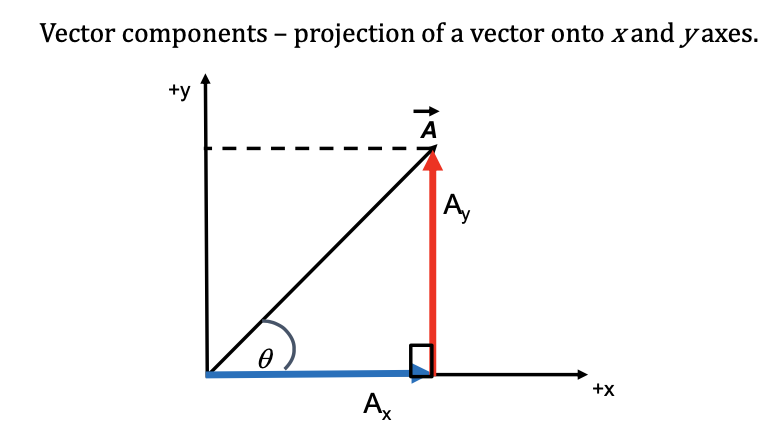
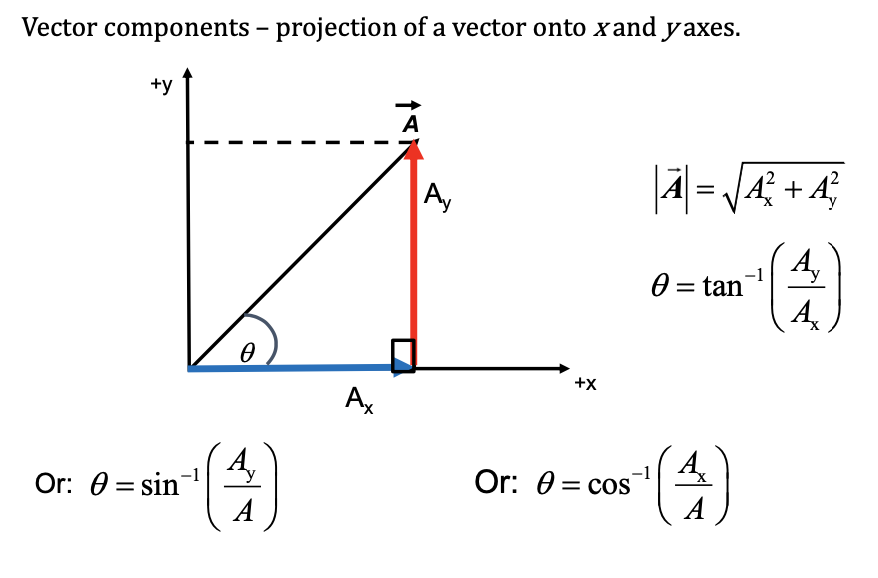
      • Definition: Vector components are the projections of a vector onto the x and y axes (or other coordinate axes).

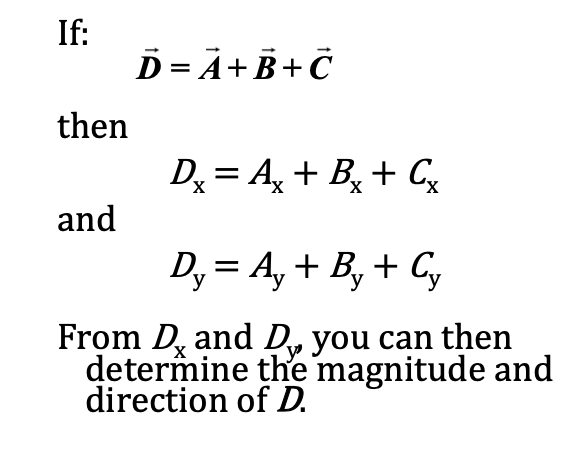
      Vector Addition/Subtraction

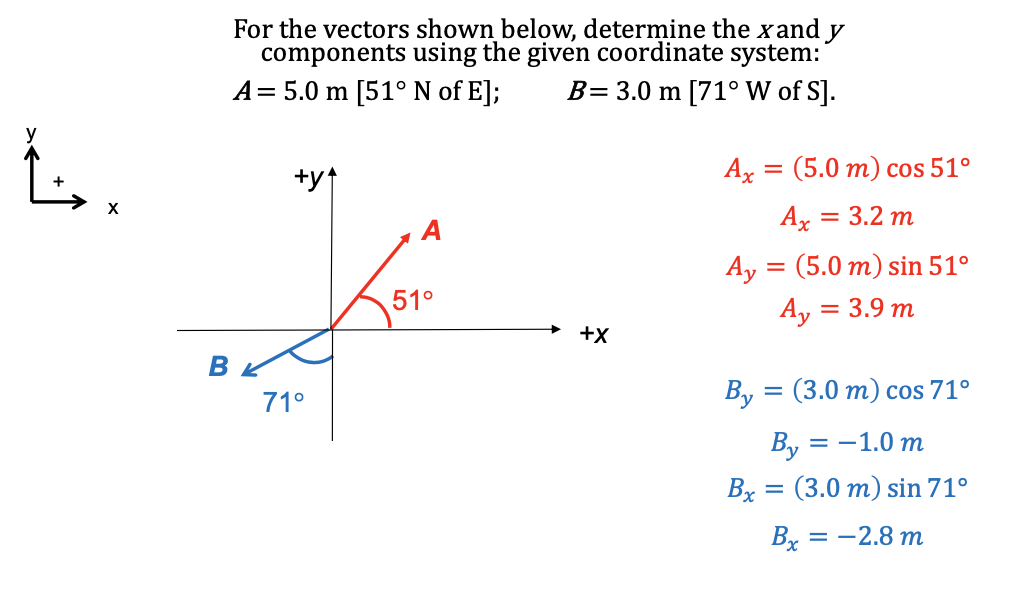
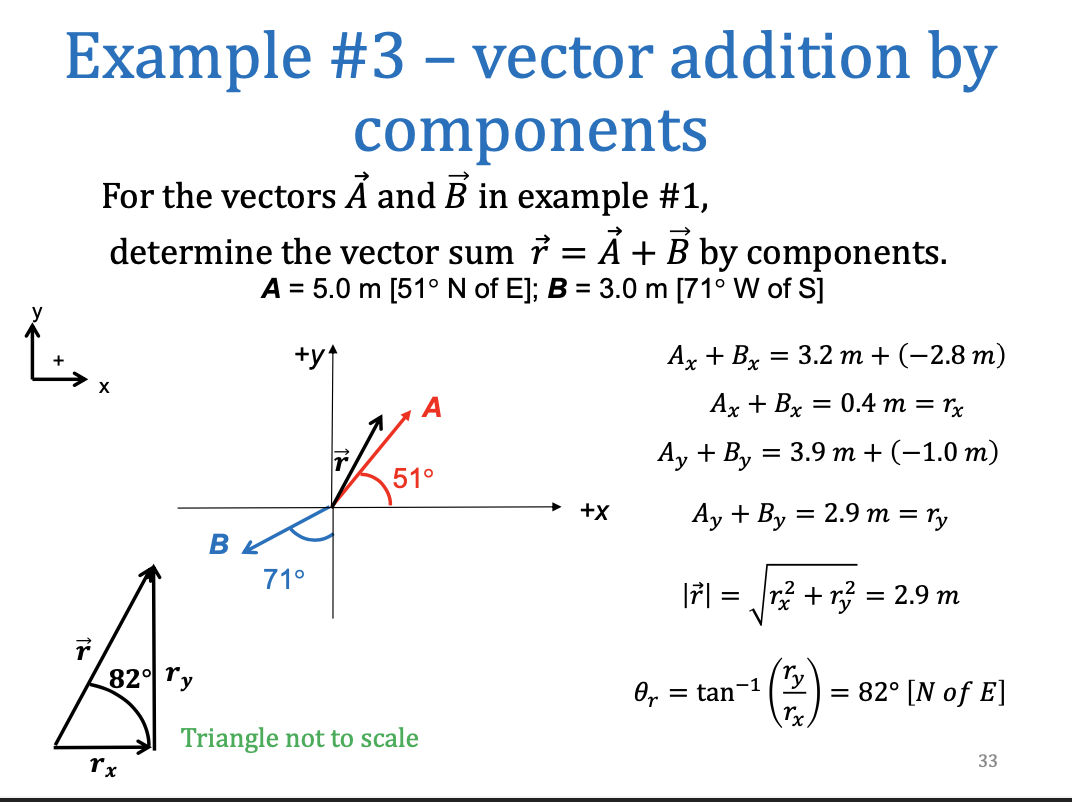
      • Problem: Determine the x and y components for:

        • A=5.0 m[51 N of E]\vec{A} = 5.0 \text{ m} [51^\circ \text{ N of E}]

        • B=3.0 m[71 W of S]\vec{B} = 3.0 \text{ m} [71^\circ \text{ W of S}]

      • For A\vec{A} (angle with positive x-axis is 5151^\circ):

        • Ax=(5.0 m)cos(51)3.1 mA_x = (5.0 \text{ m}) \cos(51^\circ) \approx 3.1 \text{ m}

        • Ay=(5.0 m)sin(51)3.9 mA_y = (5.0 \text{ m}) \sin(51^\circ) \approx 3.9 \text{ m}

      • For B\vec{B} (The angle 7171^\circ W of S means the vector is in the 3rd quadrant. The problem implies using the 7171^\circ angle relative to the negative y-axis towards the negative x-axis):

        • Bx=(3.0 m)sin(71)2.8 mB_x = -(3.0 \text{ m}) \sin(71^\circ) \approx -2.8 \text{ m} (Negative because it points left/West)

        • By=(3.0 m)cos(71)1.0 mB_y = -(3.0 \text{ m}) \cos(71^\circ) \approx -1.0 \text{ m} (Negative because it points down/South)

      \theta

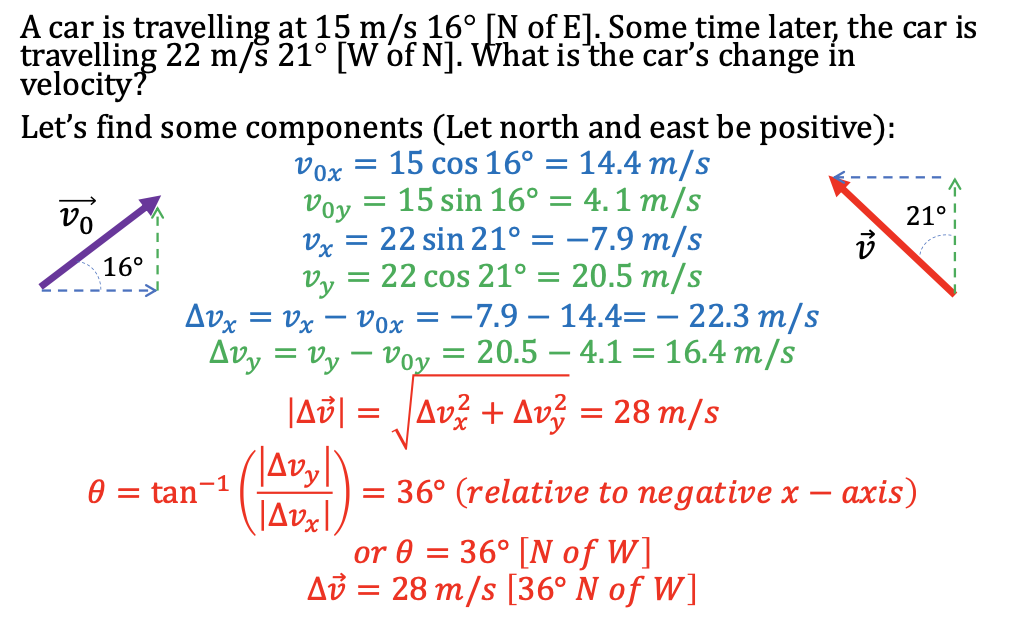
      Solved Example #4: Change in Velocity
      • Problem: A car travels at 15 \text{ m/s} [16^\circ \text{ N of E}].Later,ittravelsat. Later, it travels at22 \text{ m/s} [21^\circ \text{ W of N}].Whatisthecarschangeinvelocity(. What is the car's change in velocity (\Delta \vec{v} = \vec{v} - \vec{v}_0)?</p></li><li><p>RecapVectorComponents</p></li></ul><ul><li><p><strong>VectorComponents(Question):</strong>IfvectorAhasanangle)?</p></li><li><p>Recap - Vector Components</p></li></ul><ul><li><p><strong>Vector Components (Question):</strong> If vector A has an angle\thetarelativetotheyaxis,thelengthofthedottedlinerepresentingthexcomponent(relative to the y-axis, the length of the dotted line representing the x-component (A_x)is) isA \sin \theta.</p></li><li><p><strong>SignsofComponents(Question):</strong>Foravector.</p></li><li><p><strong>Signs of Components (Question):</strong> For a vector\vec{B}inthefourthquadrant(positivexaxis,negativeyaxis),itscomponentswillhavesigns:in the fourth quadrant (positive x-axis, negative y-axis), its components will have signs:+x; -y.</p></li></ul><imgsrc="https://knowtuserattachments.s3.amazonaws.com/28f877ecbd2f4aa5a188577c5314aa18.png"datawidth="50.</p></li></ul><img src="https://knowt-user-attachments.s3.amazonaws.com/28f877ec-bd2f-4aa5-a188-577c5314aa18.png" data-width="50%" data-align="center"><img src="https://knowt-user-attachments.s3.amazonaws.com/49f421f7-23bc-4d95-b934-59ab1f889c18.png" data-width="50%" data-align="center"><p></p><h4 id="0a90438b-0cdf-4e4f-819f-1c3b484c065f" data-toc-id="0a90438b-0cdf-4e4f-819f-1c3b484c065f" collapsed="false" seolevelmigrated="true">2D Kinematics</h4><ul><li><p><strong>Displacement (\vec{r}):</strong>Thechangeinpositionfromtheinitialtothefinallocation.</p></li><li><p><strong>Velocity():</strong> The change in position from the initial to the final location.</p></li><li><p><strong>Velocity (\vec{v}):</strong>Therateofchangeofdisplacement.):</strong> The rate of change of displacement.\vec{v} = \frac{\Delta \vec{r}}{\Delta t}</p></li><li><p><strong>Acceleration(</p></li><li><p><strong>Acceleration (\vec{a}):</strong>Therateofchangeofvelocity.):</strong> The rate of change of velocity.\vec{a} = \frac{\Delta \vec{v}}{\Delta t}</p></li><li><p><strong>KeyPoint:</strong>Allthesequantities(</p></li><li><p><strong>Key Point:</strong> All these quantities (\vec{r}, \vec{v}, \vec{a})arevectors,meaningtheyhavebothxandycomponents.</p></li></ul><h5id="7af02c8f57174dff94e4b6cdbc5af1c0"datatocid="7af02c8f57174dff94e4b6cdbc5af1c0"collapsed="false"seolevelmigrated="true">SolvedExample:SquirrelsJourney</h5><ul><li><p><strong>Problem:</strong>Asquirrelstartsat(3.0mE,5.0mN)andendsat(4.0mE,2.0mN)relativetothehouse/fence.Itcovers18min49s.</p><ul><li><p>a)Whatisthesquirrelsdisplacement?</p></li><li><p>b)Whatisitsaveragespeed?</p></li><li><p>c)Whatisitsaveragevelocity?</p></li></ul></li><li><p><strong>Given(letNorthandEastbepositive):</strong></p><ul><li><p>Initialposition:) are vectors, meaning they have both x and y components.</p></li></ul><h5 id="7af02c8f-5717-4dff-94e4-b6cdbc5af1c0" data-toc-id="7af02c8f-5717-4dff-94e4-b6cdbc5af1c0" collapsed="false" seolevelmigrated="true">Solved Example: Squirrel's Journey</h5><ul><li><p><strong>Problem:</strong> A squirrel starts at (3.0 m E, 5.0 m N) and ends at (4.0 m E, 2.0 m N) relative to the house/fence. It covers 18 m in 49 s.</p><ul><li><p>a) What is the squirrel's displacement?</p></li><li><p>b) What is its average speed?</p></li><li><p>c) What is its average velocity?</p></li></ul></li><li><p><strong>Given (let North and East be positive):</strong></p><ul><li><p>Initial position:(x0 = 3.0 \text{ m}, y0 = 5.0 \text{ m})</p></li><li><p>Finalposition:</p></li><li><p>Final position:(x = 4.0 \text{ m}, y = 2.0 \text{ m})</p></li><li><p>Distancetraveled:</p></li><li><p>Distance traveled:d = 18 \text{ m}</p></li><li><p>Timetaken:</p></li><li><p>Time taken:\Delta t = 49 \text{ s}</p></li></ul></li></ul><p>Parta)Displacement(</p></li></ul></li></ul><p>Part a) Displacement (\vec{r})</p><imgsrc="https://knowtuserattachments.s3.amazonaws.com/f7beed114d8748d5a9971cd1c7edd2e9.png"datawidth="75)</p><img src="https://knowt-user-attachments.s3.amazonaws.com/f7beed11-4d87-48d5-a997-1cd1c7edd2e9.png" data-width="75%" data-align="center"><h5 id="c06e67d2-f59c-4973-92fa-93d5aa4ad50a" data-toc-id="c06e67d2-f59c-4973-92fa-93d5aa4ad50a" collapsed="false" seolevelmigrated="true">Instantaneous Velocity in 2D</h5><ul><li><p><strong>Magnitude:</strong> Represents the instantaneous speed of the object at that moment.</p></li><li><p><strong>Direction:</strong> Shows the direction of motion of the object at that specific moment (always tangent to its path).</p></li></ul><h5 id="cd5ad6bd-2fd4-4562-bfe6-35bf3100a9bd" data-toc-id="cd5ad6bd-2fd4-4562-bfe6-35bf3100a9bd" collapsed="false" seolevelmigrated="true">2D Kinematics - Change in Velocity (Constant Speed)</h5><img src="https://knowt-user-attachments.s3.amazonaws.com/59136825-8136-4db1-a97f-620e3ed19342.png" data-width="50%" data-align="center"><h5 id="50aa8d05-bdc4-42b6-b0af-f82f85bedbce" data-toc-id="50aa8d05-bdc4-42b6-b0af-f82f85bedbce" collapsed="false" seolevelmigrated="true">Solved Example: Merry-Go-Round (Constant Speed, Non-Zero Acceleration)</h5><ul><li><p><strong>Problem:</strong> A merry-go-round horse travels at constant speed around a circle of circumference31.4 \text{ m},taking, taking20.0 \text{ s}tocompleteafullroundtrip.</p><imgsrc="https://knowtuserattachments.s3.amazonaws.com/f6e79664550a4265babb16ea74d0ead9.png"datawidth="100to complete a full round trip.</p><img src="https://knowt-user-attachments.s3.amazonaws.com/f6e79664-550a-4265-babb-16ea74d0ead9.png" data-width="100%" data-align="center"></li></ul><p></p><img src="https://knowt-user-attachments.s3.amazonaws.com/30458f9c-dd9a-4bbc-8b42-535f840f364d.png" data-width="50%" data-align="center"><p></p><p><span style="font-size: 18px;"><strong>Components make it easier</strong></span></p><ul><li><p></p><img src="https://knowt-user-attachments.s3.amazonaws.com/e3351b02-5af5-4fe8-b590-8ee97fb8bc5d.png" data-width="75%" data-align="center"><img src="https://knowt-user-attachments.s3.amazonaws.com/4499d4a9-7908-4a7f-9d8f-f08f762d6891.png" data-width="75%" data-align="center"><p></p><img src="https://knowt-user-attachments.s3.amazonaws.com/3ac52a21-1f7a-46dd-95af-cc055930f972.png" data-width="75%" data-align="center"><p></p></li><li><p><strong>Projectile Motion Simplification:</strong> For projectile motion (neglecting air resistance), the only acceleration is due to gravity, which acts purely in the y-direction. Therefore, the horizontal acceleration (a_x)isalwayszero!</p><ul><li><p></p><imgsrc="https://knowtuserattachments.s3.amazonaws.com/e04139376f4b494b91dd0f9d1e554bef.png"datawidth="75) is always zero!</p><ul><li><p></p><img src="https://knowt-user-attachments.s3.amazonaws.com/e0413937-6f4b-494b-91dd-0f9d1e554bef.png" data-width="75%" data-align="center"></li></ul></li></ul><h4 id="789390bd-4bd7-43bc-9b93-47bf66b605a3" data-toc-id="789390bd-4bd7-43bc-9b93-47bf66b605a3" collapsed="false" seolevelmigrated="true">Special Case: Projectile Motion</h4><ul><li><p><strong>Definition of a Projectile:</strong> Any object that moves through the air without its own propulsion system (e.g., a thrown ball, a kicked football, a cannonball).</p></li><li><p><strong>Path:</strong> Projectiles follow a parabolic path (assuming no air resistance).</p></li></ul><h5 id="1f8886ff-f687-41ac-815d-00f3bfec6851" data-toc-id="1f8886ff-f687-41ac-815d-00f3bfec6851" collapsed="false" seolevelmigrated="true">Projectile Motion – Key Features (No Air Resistance)</h5><ol><li><p><strong>Horizontal Velocity:</strong> Always constant (a_x = 0).</p></li><li><p><strong>VerticalAcceleration:</strong>Duetogravity,constantanddownwards().</p></li><li><p><strong>Vertical Acceleration:</strong> Due to gravity, constant and downwards (a_y = -9.8 \text{ m/s}^2ifupispositive).</p></li><li><p><strong>VerticalVelocityatPeak:</strong>Attheverytopofthepath,theverticalvelocitycomponentismomentarilyzero(if up is positive).</p></li><li><p><strong>Vertical Velocity at Peak:</strong> At the very top of the path, the vertical velocity component is momentarily zero (v_y = 0).</p></li><li><p><strong>IndependenceofMotion:</strong>Horizontalandverticalmotionsareindependentofeachother.Thismeansyoucansolvethemseparatelyusing1Dkinematicequationsforeachdirection.</p></li></ol><h5id="8480d4238780483483a63dc61898aaac"datatocid="8480d4238780483483a63dc61898aaac"collapsed="false"seolevelmigrated="true">2DKinematicsProjectilesExample(GolfBall)</h5><ul><li><p><strong>Problem(Velocity):</strong>WhatisthedirectionofthegolfballsvelocityatpointX(ontheupwardtrajectory)?</p><ul><li><p><strong>Explanation:</strong>Velocityisalwaystangenttothepathandinthedirectionofmotion.So,anarrowtangenttothecurveatpointX,pointingforwardandupward.</p></li></ul></li><li><p><strong>Problem(Acceleration):</strong>WhatisthedirectionofthegolfballsaccelerationatpointX?</p><ul><li><p><strong>Explanation:</strong>Forprojectilemotion,accelerationisalwaysduetogravity,whichactsstraightdownwards().</p></li><li><p><strong>Independence of Motion:</strong> Horizontal and vertical motions are independent of each other. This means you can solve them separately using 1D kinematic equations for each direction.</p></li></ol><h5 id="8480d423-8780-4834-83a6-3dc61898aaac" data-toc-id="8480d423-8780-4834-83a6-3dc61898aaac" collapsed="false" seolevelmigrated="true">2D Kinematics - Projectiles Example (Golf Ball)</h5><ul><li><p><strong>Problem (Velocity):</strong> What is the direction of the golf ball's velocity at point X (on the upward trajectory)?</p><ul><li><p><strong>Explanation:</strong> Velocity is always tangent to the path and in the direction of motion. So, an arrow tangent to the curve at point X, pointing forward and upward.</p></li></ul></li><li><p><strong>Problem (Acceleration):</strong> What is the direction of the golf ball's acceleration at point X?</p><ul><li><p><strong>Explanation:</strong> For projectile motion, acceleration is always due to gravity, which acts straight downwards (-9.8 \text{ m/s}^2).So,anarrowpointingstraightdown.</p></li><li><p></p><imgsrc="https://knowtuserattachments.s3.amazonaws.com/ef21c57023474b96bae88712e38d5416.png"datawidth="75). So, an arrow pointing straight down.</p></li><li><p></p><img src="https://knowt-user-attachments.s3.amazonaws.com/ef21c570-2347-4b96-bae8-8712e38d5416.png" data-width="75%" data-align="center"></li></ul></li></ul><img src="https://knowt-user-attachments.s3.amazonaws.com/f0adaf56-e1ac-4151-bdd9-f9d8f2b244ca.png" data-width="75%" data-align="center"><h5 id="ae94ef03-6e43-477f-8a3a-52a53d0987be" data-toc-id="ae94ef03-6e43-477f-8a3a-52a53d0987be" collapsed="false" seolevelmigrated="true">Projectile Motion Example (Football)</h5><ul><li><p><strong>Problem:</strong> A football is kicked with an initial upward vertical component of14 \text{ m/s}andahorizontalcomponentofand a horizontal component of12 \text{ m/s}.Whatisitsspeedatmaximumheight?</p></li><li><p><strong>Explanation:</strong>Atmaximumheight,theverticalcomponentofvelocity=0</p></li><li><p>Nohorizontalaccelerationmeansthatthehorizontalcomponentofthevelocityremainsconstantat(12 m/s),thustheoverallspeedatmaximumheightisdeterminedsolelybythishorizontalvelocity.</p></li><li><p><strong>Result:</strong>Speedatmaximumheightis. What is its speed at maximum height?</p></li><li><p><strong>Explanation:</strong> At maximum height, the vertical component of velocity=0</p></li><li><p>No horizontal acceleration means that the horizontal component of the velocity remains constant at (12 \text{ m/s}), thus the overall speed at maximum height is determined solely by this horizontal velocity. </p></li><li><p><strong>Result:</strong> Speed at maximum height is12 \text{ m/s}.</p></li></ul><p></p><imgsrc="https://knowtuserattachments.s3.amazonaws.com/25be1267cbdb44d2a4af0f89af6e5589.png"datawidth="75.</p></li></ul><p></p><img src="https://knowt-user-attachments.s3.amazonaws.com/25be1267-cbdb-44d2-a4af-0f89af6e5589.png" data-width="75%" data-align="center"><p>pprox 2.1 \text{ s}$<br> 25 \text{ m}$<strong>Solved Example: Cannonball Fired at an Angle</strong></p><img src="https://knowt-user-attachments.s3.amazonaws.com/10137258-f2f3-484b-ba92-be10e30b3487.png" data-width="50%" data-align="center"><img src="https://knowt-user-attachments.s3.amazonaws.com/5268aa60-aed4-4cad-9c55-2e8283efa261.png" data-width="75%" data-align="center"><img src="https://knowt-user-attachments.s3.amazonaws.com/83072bc1-4ef2-4dac-ba20-b61a8c979bbf.png" data-width="75%" data-align="center"><h5 id="b263c4db-b5b6-4f08-81d5-fb2e6733ee3e" data-toc-id="b263c4db-b5b6-4f08-81d5-fb2e6733ee3e" collapsed="false" seolevelmigrated="true">Solved Example: Prince's Message Rock</h5><img src="https://knowt-user-attachments.s3.amazonaws.com/0129667d-908f-4e8a-9d3d-98d57310dd17.png" data-width="50%" data-align="center"><ul><li><p><strong>Problem:</strong> A prince throws a rock withv_0 = 12 \text{ m/s}atat42^\circabovehorizontalfromacastlewall.Itlandsabove horizontal from a castle wall. It lands9.5 \text{ m}belowtheinitialheight.Whatistherocksvelocityjustbeforelanding?</p></li><li><p><strong>Given(letrightbepositivehorizontal,downbepositivevertical):</strong></p><ul><li><p>Initialspeedbelow the initial height. What is the rock's velocity just before landing?</p></li><li><p><strong>Given (let right be positive horizontal, down be positive vertical):</strong></p><ul><li><p>Initial speedv_0 = 12 \text{ m/s}</p></li><li><p>Launchangleagainsthorizontal</p></li><li><p>Launch angle against horizontal\alpha = 42^\circ</p></li><li><p>Verticaldisplacement</p></li><li><p>Vertical displacement\Delta y = 9.5 \text{ m}</p></li><li><p>Accelerationiny:</p></li><li><p>Acceleration in y:a_y = 9.8 \text{ m/s}^2</p></li><li><p>Accelerationinx:</p></li><li><p>Acceleration in x:a_x = 0</p></li></ul></li><li><p></p><imgsrc="https://knowtuserattachments.s3.amazonaws.com/2c27fc0861b64afaaf0fccdeeda3abb0.png"datawidth="75</p></li></ul></li><li><p></p><img src="https://knowt-user-attachments.s3.amazonaws.com/2c27fc08-61b6-4afa-af0f-ccdeeda3abb0.png" data-width="75%" data-align="center"></li></ul><h4 id="064c4caa-fdfc-47ec-9491-fe61fd997bd7" data-toc-id="064c4caa-fdfc-47ec-9491-fe61fd997bd7" collapsed="false" seolevelmigrated="true">Uniform Circular Motion (UCM)</h4><ul><li><p><strong>Special Case:</strong> UCM is a specific type of 2D kinematics that can be analyzed effectively without components due to its regular geometry.</p></li><li><p><strong>Key Characteristics:</strong> An object moving in a circle at a constant radius and a constant speed.</p></li><li><p><strong>Two Kinematic Rules for UCM:</strong></p><ol><li><p><strong>Velocity:</strong> The velocity (\vec{v})hasaconstantmagnitude(thespeed),butitsdirectioniscontinuouslychanging.Thedirectionisalways<em>tangential</em>tothecircleandfollowsthedirectionofmotion.</p></li><li><p><strong>CentripetalAcceleration() has a constant magnitude (the speed), but its direction is continuously changing. The direction is always <em>tangential</em> to the circle and follows the direction of motion.</p></li><li><p><strong>Centripetal Acceleration (\vec{a}_c):</strong>Eventhoughthespeedisconstant,thechangingdirectionofvelocitymeansthereisalwaysanacceleration.Thisacceleration,calledcentripetalacceleration,isalwaysdirected<em>towardthecenterofthecircle</em>.</p><ul><li><p>Theequationsforcentripetalacceleration(e.g.,):</strong> Even though the speed is constant, the changing direction of velocity means there is always an acceleration. This acceleration, called centripetal acceleration, is always directed <em>toward the center of the circle</em>.</p><ul><li><p>The equations for centripetal acceleration (e.g.,a_c = \frac{v^2}{r})andrelationshipswithfrequency() and relationships with frequency (f)andperiod() and period (T)(e.g.,) (e.g.,v = \frac{2\pi r}{T} = 2\pi r f)areimportantforsolvingUCMproblems.(Theseformulasarementionedasneedingreviewinthetext,Chapter4.5).</p></li></ul></li></ol></li></ul><p></p><h5id="51d18b258f48408a8be2d011fb35bbc6"datatocid="51d18b258f48408a8be2d011fb35bbc6"collapsed="false"seolevelmigrated="true">SolvedExample:TaylorSwiftJumpsfromaBalcony</h5><ul><li><p><strong>Problem:</strong>TaylorSwiftjumpshorizontallywith) are important for solving UCM problems. (These formulas are mentioned as needing review in the text, Chapter 4.5).</p></li></ul></li></ol></li></ul><p></p><h5 id="51d18b25-8f48-408a-8be2-d011fb35bbc6" data-toc-id="51d18b25-8f48-408a-8be2-d011fb35bbc6" collapsed="false" seolevelmigrated="true">Solved Example: Taylor Swift Jumps from a Balcony</h5><ul><li><p><strong>Problem:</strong> Taylor Swift jumps horizontally with12 \text{ m/s}fromabalconyfrom a balcony22 \text{ m}below.</p><ul><li><p>a)Howlongissheintheair?</p></li><li><p>b)Howfarhorizontallydoessheland?</p></li><li><p>c)Doesshegethurt?</p></li></ul></li><li><p><strong>Given(letupbepositive):</strong></p><ul><li><p>Initialhorizontalvelocitybelow.</p><ul><li><p>a) How long is she in the air?</p></li><li><p>b) How far horizontally does she land?</p></li><li><p>c) Does she get hurt?</p></li></ul></li><li><p><strong>Given (let up be positive):</strong></p><ul><li><p>Initial horizontal velocity(v_{0x} = 12 \text{ m/s})</p></li><li><p>Horizontalacceleration</p></li><li><p>Horizontal acceleration(a_x = 0)</p></li><li><p>Verticaldisplacement</p></li><li><p>Vertical displacement(y_0=0, y = -22 \text{ m} \implies \Delta y = -22 \text{ m})</p></li><li><p>Initialverticalvelocity</p></li><li><p>Initial vertical velocity(v_{0y} = 0 \text{ m/s})(jumpshorizontally)</p></li><li><p>Verticalacceleration(jumps horizontally)</p></li><li><p>Vertical acceleration(a_y = -9.8 \text{ m/s}^2)</p></li></ul></li></ul><p>Parta)Howlongissheintheair?(Solvefor</p></li></ul></li></ul><p>Part a) How long is she in the air? (Solve fortusingverticalmotion)</p><imgsrc="https://knowtuserattachments.s3.amazonaws.com/19f33b9edce345a39380dce370c029ee.png"datawidth="75using vertical motion)</p><img src="https://knowt-user-attachments.s3.amazonaws.com/19f33b9e-dce3-45a3-9380-dce370c029ee.png" data-width="75%" data-align="center"><p>Part b) How far from the base of the balcony does she land? (Solve forx$$ using horizontal motion)