AP World History Semester 1
Part 1 First Things First: Beginnings in History to 600 BCE
Chapter 1: First people; first farmers; most of history in a single chapter 3500 BCE
Chapter 2 First Civilizations
2.1 Landmarks for Chapter
2.2 Something New: The Emergence of Civilizations
Mohenjo Daro: major cities of the Indus Valley civilization, both flourished 2000 BCE
Harappa: sister city; major cities of the Indus Valley civilization, both flourished 2000 BCE
luxurious + sophisticated + great plumbing system
Teotihuacan
central Mexico valley
temples, pyramids, carvings, apartments and palatial homes
cities were super important to early civilizations
administrative/political, cultural, economic, and manufacturing hubs of the region
unique + more specialization + inequality
u dont rlly know ppl unless they around u
2.3 The Erosion of Equality
early urban life
so much specialization → scribes, priests, merchants, officials, artisans
farmers carried hard
Hierarchies of Class
inequality w wealth status power
wealth piled up, not spread
as jobs complexified, erosion of equality increased
normalized
upper class was very blessed
big land big money
0 labor → political, military, religion
ex: Chinese
robes banners chariots weapons
ex: Code of Hammurabi: series of laws publicized at the order of King Hammurabi of Babylon; reveals much about the social order of Mesopotamian civilization.
if ur poor and u beat up jeff bezos ur getting slimed
2.4 Comparing Mesopotamia and Egypt
common features of first civilizations:
productive agricultural technology
distinct class and gender inequalities
growing state power
differences include
political organizations
religious beliefs
women’s roles
civilizations interacted with each other
Environment and Culture
based on river valleys for productive agriculture cs land arid
Nile predictably brought soil and water annually
Tigris and Euphrates were NOT predictable
Mesopotamia more vulnerable w open space, Egypt had natural barriers of deserts and water → free security
historians try to avoid environmental determinism, but here, it’s really visible that Mesopotamians struggled → pessimistic
elite literate Egyptians grew up from a stable, predictable, beneficial environment → optimistic
pyramids reflected belief that Pharaohs and elites could make it to the Afterlife → lived morally well
environment:
Mesopotamia had deforestation and soil erosion that reduced crop productivity, and soil salinization from over irrigation (complex intrusive canals and networks)
weakened Sumerian states, conquested by foreigners, center of civilization North
Egypt had sustainable agriculture less intrusive, stable wheat prediction by river
if river pattern cooked, then egypt is cooked
Cities and States
Mesopotamia'
many separate independent city states ruler by a king each, controlled internal affairs
one of the most thoroughly urbanized areas
however, its due to frequent warfare → rural to urban migration for walled cities, rivalry over land and water
environmental + political problems tm violence
Sumerians → Akkadians → Babylonians → Assyrians
Egypt
pharaohs maintained unity and independence and longetivity
wind patterns → communication, trade, unity
cities less important but still political economic cultural hubs, so lived in agricultural villages cs super secure
pharaohs r a unity symbol, but over time, lost credit to authorities
focus on Osiris, less pharaoh
Interaction and Exchange
civilizations usually interacted and traded w each other
Egypt’s agriculture drew from Mesopotamia, South Sudan
both carried long-distance trade esp luxury goods for elite
Mesopotamia → Anatolia Egypt Iran Afganistan
Egypt → deep into Africa along Nile + East
cultural influence from interactions too
Mesopotamia
Hebrews Old Testament → Mesopotamian Eye for an Eye
Phoenicians worshipped similar Mesopotamian Gods + cuneiform (later basis for greek/latin)
syncretism of religions, brought artifacts
Egypt
Nubia sometimes military/political control from Egypt, recruited
diffusion of pyramids, religion, hieroglyphics
still distinct → unique alphabet, ironworking, political independence
Mediterranean Basin culture
clear Egyptian art influence
hot take: ancient Greeks drew from Egyptians and Mesopotamians
still, influence two-ways → ex: pastorals in southern Russia got chariots for horses, used by Hittites in Anatolia → attacked Babylon and Egypt → both incorporated it into their military → reached China → evidence of interactions bw Afro-Eurasian
Egypt got HUGE migration that threatened security a lil
adopt more technologies diffused from Asia → new weapons, sewing, instruments, plants
Egypt later became a crucial bridge bw Africa and Asia, ruling over non-egyptians too
part of international politics w Mesopotamia, practiced diplomacy, “brothers”, gifts, daughters(?)
Part 2 Continuity and Change in the Second-Wave Era 600 BCE - 600 CE
Chapter 3: State and Empire in Eurasia / North Africa 600 BCE - CE
3.1 Landmarks for Chapter 3
3.2 Empires and Civilizations in Collisions: The Persians and the Greeks
The Persian Empire
Indo-Europeans on Iranian Plateau, north of Persian gulf
inspired by Babylonian and Assyrians, esp luxury
Persian Empire: major empire of the second-wave era, expanded from the Iranian plateau to the Middle East from Egypt to India; flourished around 553 to 330 B.C.E.
LOVED king shave ur when he dies
kings were insane absolute monarchs, aka Gilgamesh
satraps → effective administration system
low lvl officials from local aurhotities
imperial spies reached outskirts of kingdom
respects outside cultures → let Jews settle back in Jerusalem
LOVEEE OTHER CULTURES AND RELIGIONS
takes luxury of others, now its theirs
noted by bureaucracy, court life, tax collectors, record keepers, translators
insane infrastructure
coinage
stable taxes
canal to link Red Sea and Nile → communication and trade
great irrigation system → rich agriculture economy despite climate
imperial centers, i.e. Persepolis, r wealth power hubs
architecture like palaces and monuments reflected imperial authority'
workers were drawn tg
The Greeks
Indo-Europeans, derived from legacy of first civilizations like Egypt
750 BCE → 400 yrs later merged to another
Hellenes = Greeks
Smaller than Persia
unique geography
small peninsula
steep mountains and valleys, but settled near waters
smelting silver copper bronze wood → deforestation and soil erosion
independent conflicting city-states → same language, religion, Olympic games
Athens, Sparta, Thebes, Corinth
expansive through settlement, not conquest → traders and farmers emigrated significantly for iron and food and brought their culture
most distinct thing is PARTICIPATION IN POLITICAL LIFE
citizenship
free people manage affairs and equality
at first, only wealthy well-born citizens could have full citizenship rights
speaking/voting assembly, public office, fighting in army
over time, smaller classes like farmers gained rights → purchased weapons and armor to help others
tyrants → strong benevolent rulers fight the wealthy w support from the poor
Sparta → political military culture, harsh
Council of Elders, wealthy and influential, had most authority
Athens → distinctive political participation
Solon pushed Athenian politics towards democracy → no debt slavery, wider public office, all citizens could take Assembly
later rulers allowed all Assembly members to be paid → Assembly became political life center
Athenian democracy: radical form of direct democracy in which most of the free males of Athens were able to vote in the Assembly and officeholders were chosen by lot
Collision: The Greco-Persian Wars
classical Greece = foundation of Western civilization, ironically that it is built off advancements from the East
Greco-Persian Wars: A half century of intermittent conflict (499–449 B.C.E.) between the Greek city-states and the Persian Empire. During two major Persian invasions of Greece, in 490 B.C.E. and 480 B.C.E., the Persians were defeated on both land and sea.
Greek settlements came under Persian control as Persia expanded west
Greeks revolted, supported by mainland
Persians launched major military expeditions cs they pissed
Greeks still won ez
embarrassing asf but it didn’t affect Persia, it affected Greece
huge Greek pride
values of freedom and courage motivated them to win
sharper divide between East and West
radicalized Athenian democracy b/c the poor supported the war
later, peak of Athenian democracy + Greek golden age
built Parthenon, Greek theater, Socratic philosophy
Athen’s Golden age = beginning of empire
Athen solidified efforts to be dominant force among its allies → civil war → Sparta defended independence of traditional Greek city states
Peloponnesian War: Greek civil war (431–404 B.C.E.) after Greco-Persian Wars, with Sparta defending city-state independence against Athenian dominance; the war left the Greeks in a state of distrust and disunity.
takeover Macedonia
Greek culture js started
Collision: Alexander and the Hellenistic Era
338 BCE: Philip II of Macedonia unified Greece under his rule at cost of prized independence of various city states
Alexander the Great: A ruler of Macedonia, unified the Greek city-states and during a ten-year military expedition (334–323 B.C.E.) conquered Egypt, the Persian Empire, and part of northwest India, huge Greek empire.
set in motion as Alexander was abt to cook the Persians for vengeance and to unify Greeks
10-year expedition was legendary
Greek empire extended egypt → anatolia → West Afghanistan → east India
Persia lost ez dubz Persepolis burned Alexander king of Asia
Alexander celebrated as liberator from Persia in Egypt → anointed pharaoh, Egyptians priests thought “son of Gods”
died 323 BCE, empire divided to 3 kingdoms, Macedonian generals lead
Hellenistic Era: 323 to 30 B.C.E. ; Greek culture spread widely in the Middle East and parts of India in the cities and kingdoms ruled by Alexander’s political successors
the cities Alexander established were CRUCIAL
Greek monuments, sculptures, theaters, markets, councils, assemblies attracted all sorts of Greek settlers
Alexandria: cosmopolitan Egyptian city established by Hellenistic rulers, 500k people; major avenue for spread of Greek culture and learning (greeks, jews, babylonians, syrians, persians)
these cities helped the culture spread
Greek language → power and elite
Indian monarch wrote Greek decrees, independent state in Afghanistan
many young Jews interested in Greek → Pharisees developed own school system bc scared theyll leave
cities v diff from og city states of greece
cultural diversity, less independence valued by Sparta and Athens
2 big conquest states: Ptolemaic of Egypt, Seleucid of Persia
social order, taxes, monarch authority
Macedonians and Greeks had superiority complex, separated from non-Greeks
ex: egyptian worker complained his boss hated him and didnt pay cs he egyptian
periodic rebellions bc of arrogant greeks
still, sm cultural interactions
Alexander had many Persian wives and encouraged intermarriages bw Asians
patronized building temples for local gods and supported they priests
Greek language, education, dressing
Greeks in caste system (warriors)
Buddha art school first depicted buddha in greek attire
as hellenistic era ended, influence vanished by 100 BCE
born: collision of 2 empires and 2 second-wave civilizations
western Hellenistic, Greek rule replaced by Romans
Roman empire, like Alexander’s served as medium to diffuse Greek influence
3.3 Comparing Empires: Roman and Chinese
similar area, population, giant empires almost half world’s population
little contact, barely knew each other
Rome: From City-State to Empire
started as small poor city-state on West central Italy → imperial state of europe, mediterranean, britain, north africa, middle east
509 BCE → roman aristocrats threw over monarchy, made republic which wealthy men participated (patricians)
executive → 2 consuls advised by patrician assembly, Senate
conflict w plebians affected political life
protect from abuse, can congregate to influence some public laws, office of tribune blocks unfavorable shi
prideful bc more freedom than others
rule of law, citizens rights, no pretension, morals, and promise when u promise keep them promises
used ts to start empire enterprise
first controlled neighbors → Italian peninsula → Punic Wars, got North Africa → Mediterranean + Spain, naval power → south, west europe
greeks, egyptians, mesopotamian under Roman rule
2nd century CE → maximum expansion
roman empire didn’t rlly build off of anything, something wholly new
piecemeal process “defensive”
new territory = new vulnerability = made up by more conquests
growth sometimes = opportunity
poor hoped for land, loot, or salaries
well-to-do wanted public office
wealth of nearby societies was basically calling their name
location was good launch pad for an empire, but its great army carried
BRUTAL
nice to former enemies when necessary tho → grant citizenship, allies
empire grew → expansion forces did whatever they needed to do
empirebuilding + army influenced roman values and society
gender roles + social hierarchy
masculinity of upper class = life as soldier + property owner, FULL control over wife and kids and slaves
ability of free men to make decisions in public and private
women make and raise warriors → ur loved!
empire wealth + imperial state authority + breakdown of old social life → elite women could have a less restricted life
not secluded → husbands cant control them fully now!
man of the house lost a little power
women could marry without giving man all legality, control their own finances, engage in commerce
property + marriage rights essentially
lots of women were brought in as slaves to do wtv with
can u still have a roman republic and values w a growing empire?
wealth only helped few to get more property and slaves, free farmers js poor
“decline” of republican values → simplicity, service, farmer = army backbone, authority of senate
authority mainly in emperor
Augustus: title that implied divine status for Octavian (r. 27 B.C.E.–14 C.E.), who emerged as sole ruler of the Roman state at the end of an extended period of civil
republic → empire and emperor
many thought rome betrayed its traditions
still maintained some public consuls but had huge personal power
conquests = for power of roman people
still used his army like crazy
provided security, grandeur, prosperity
pax Romana: The “Roman peace,” a term typically used to denote the stability and prosperity of the early Roman Empire, especially in the first and second centuries C.E.
China: From Warring States to Empire
tryna restore something old
2200 BCE Xia Shang Zhang dynasties tried to grow, but 500 BCE they were cooked
endless rivalries
unacceptable and unnatural, rulers wna fix ts
Qin Shihuangdi: “first emperor from the Qin”; Shihuangdi (r. 221–210 B.C.E.) forcibly reunited China and established a strong state that governed, often brutally, according to a Legalist philosophy
bureaucracy, subordinated aristocracy, good weapons, good agriculture and population
Legalism → clear strict rules and enforcement
little ambivalence
laid foundations for unified Chinese state
empire formation was more compressed than Rome
still military based and brutal
execute burn ppl and move “anti-centralist” aristocrats to the capital
slaves build great of wall of china to separate barbarians
uniform system of weights, measures, currency in chinese
brief superficial domestic reprecussions
speed and brutality of policies made it a pr short dynasty
Han dynasty: Chinese dynasty (206 B.C.E.–220 C.E.) that emerged after the Qin dynasty collapsed, establishing political and cultural patterns that lasted into the twentieth century
Confucianism
consolidated imperial state
Consolidating the Roman and Chinese Empires
many common features
defined in universal terms
invest in public work and infrastructure for military and commercial integration
used supernatural to support rule
dead emperors = Gods, early christians persecuted for being against ts
earth events linked to “Heaven” in china
moral force that regulated universe
rebellions, invasions, floods = bad ruler u lose mandate of heaven
absorbed foreign religion
Christianity Rome, Buddhism China
Rome → small corner, pax Romana roads slowly spread it along poor ppl → persecution → yay evb is christian cs emperors want common religion
China → came from India, little support until after Han dynasty where ppl felt misguided → Sui and Wendi dynasty supported for a lil → one of many alt. cultural traditions, unlike dominant Roman christianity
diff relationships w socieities governed
romans = always small minority cs small city state
china → grew from hearth → evb ethnically chinese → expanded south and assimilated barbaric ppl W EVERYTHINGGG
romans did diff assimilation
slowly and ehh granted citizenship to ppl for service or adoption of Roman culture
hold office, serve in military, toga, LEGAL status not CULTURAL
Roman culture like religion lang city life was super cool, esp to ppl who never heard of cities
east → greek pride in literature philosophy art
non-Roman cultural traditions spread thru empire, but not like in China
lang important, diff functions
Latin gave rise to MANY diff lang → maintain individual cultural identities
Chinese characters hard to transfer to other languages, understood by all literate ppl
elite assimilation
both made centralized control over big regions w big people, but china did better
imperial academy for Confucianism
civil service system based on MERIT
Rome → aristocratic elites and army provided state cohesion, but they made an elaborate body of law that dealt w everything
Rome = good laws, China = good men
diff effects on environment
Romans complained of noise smoke urban sprawl
mining, smelting, large scale agri = big deforestation and soil erosion
lead pollution and poisoning
big ironworking made pollution in China → intensive agriculture ppl in North China caused deforestation and soil erosion
made river YELLOW RIVER cs yellow brown color
pasturelands became farmlands
collapsed Chinese states → abandoned farms → winds → desert
The Collapse of Empires
Han dynasty collapsed 220 CE, Rome finally disintegrated 476 CE
western collapsed, eastern Byzantine another 1k years
common factors w end of imperial states
too big, extended, expensive, unsustainable
big clout families avoided taxes, free peasants became tenant farmers, less central power
elite faction rivalries = instability
Chinese court officials glazed emperor vs religious Confucius scholars
26 Romans thought they was the Emperor
disease for both decr people production reevenue
environmental factors too probably
Little Ice Age of Rome made everything cold wet = soil erosion = less productivity
soil salinization and desertification
threats from nomadic groups @ margins
walls, trade, bribing, marriage, military in China worked → dynasty weakened, barbarians were cooking
ended up becoming chinese tho
big problems from Germanic people
mercenaries, refugees
established their own kingdoms within Roman empire → controlled and displaced emperors
developed individual ethnicities
fall of West Roman empire produced new culture blend of latin and germanic shi → foundation of hybrid civilization of Western Europe
decline of urban life, cultivation, trade, ppl, security
biggest difference is what happens next
after han collapse china had 350 years of disunity war and chaos
imperial system came back under sui tang and song dynasties
emperor rule exams and confucian ideas returned and lasted to 20th century
europe diff
after rome fell europe never reestablished a large centralized empire
many tried to bring back roman unity but failed
europe became decentralized with nobles knights kings city-states and church leaders in control
comparing post-empire recovery in china and europe
china had more cultural unity while europe was ethnically and linguistically diverse
china had a strong bureaucracy and confucianism that supported stable government
europe lacked bureaucracy had church vs state conflict and fewer resources like less productive farming and weaker metallurgyF
3.4 Intermittent Empire: The Case of India
after demise of Indus → new civilization east over next thousand years along Ganges river of Indian northern plain
600 BCE → new second wave civilization of South Asia
collection of cities, small republics ruled by public assemblies, regional states by kings
HUGE everything diversity
political fragmentation and cultural diversity influenced South Asian history for many centuries, contrasting to Chinese development
recognizable identity based off common religious tradition HINDUISM and unique social organization → caste system
Persian and Greek conquering influenced development of new empire
Mauryan Empire: first and largest of India’s shortest experiments with a large scale political system; encompassed all but south tip of Indian subcontinent
impressive political structure comparable to china and rome, but not long lasting
large military, civilian bureaucracy, large amt of spies
Arthashastra gave political philosopher to rulers
all means necessary ahh
many industries: spinning, weaving, building ships, mining, armaments
tax on trade, animal, land
Ashoka: most famous ruler of India’s Mauryan Empire; converted to Buddhism and tried to rule peacefully and with tolerance
moralistic approach → diff from Shihuangdi and Alexander the Great
enlightened leader moral values and teachings of hinduism and buddhism
unfortunately, didn’t work for long
Gupta Empire: era of Indian civilization from 320 to 550 C.E.; considerable political unity, cultural flourishing, and thriving trade
free hospitals, bells to separate untouchable caste, corruption free govt
flourish of knowledge
trade w China and also reached Rome
political history resembled Western Europe (after Roman Empire) way more than Rome and China
imperial/regional states did not command huge loyalty, nor had insane fluence influence
cultural diversity + invasions from Central Asia prevented nucleus developing
social structure → caste system linked to occupational groups made intense loyal localties, no wider identity
vibrant economy made active internal commerce + focal point of sea roads
cotton textile industry carried
strong merchant artisan guilds = political leadership of cities, wealth towards temples, buildings, festivals
creativity in religion made penetrating Buddhist and Hindu traditions
indians cooked in math and science (astronomy)
Chapter 4: Culture and Religion in Eurasia / North Africa 600 BCE - CE
Landmarks for Chapter 4
China and the Search for Order
The Legalist Answer
Legalism: Chinese philosophy distinguished by an adherence to clear laws with vigorous punishments
amazing rewards, harsh punishments
pessimistic view
humans r stupid, shortnatured
state and rulers can help
farmers and soldiers > merchants and evb else
helped legalism
played a role in statecraft
few philosophers supported this as a life thing
Han and subsequent fw Confucius
The Confucian Answer
Confucius was born to an aristocratic family
thought he could solve China → went into politics
Confucianism: Chinese philosophy first enunciated by Confucius, advocating the moral example of superiors as the key element of social order
his students collected his teachings into Analects
moral example of superiors restored social harmony
society is unequal relationships
father > son, husband > wife, elder > younger, ruler > subject
if the superior acted w benevolence, then the inferior would obey
how was ts human virtue nurtured
people wanna improve → moral progress = education
esp the liberal arts
rituals, ceremonies, continuous reflection
Confucianism became synonymous w chinese culture
center to education, esp exams for govt positions
Chinese male elites were Confucianists
family = model for political life
Filial piety = honor ancestors and parents
STRONGLY patriarchal
inferior receptive earth (feminine) balanced with superior creative principle of Heaven (masculine)
Ban Zhao: major female Confucian author of China (45–116 C.E.) whose works explore the implications of Confucian thinking for women
called for education to young girls, but so she can serve her husband
education for men controlled wives
wen and wu for men
superior wen = scholarship, literacy, artistic → wu = physical, marital achievements
only superior men eligible for civil service exams → political office, prestige
military men & merchants lower in male social hierarchy
ideal good society lay on past
ideas were reformist, but to restore past golden age
“democratic” elite culture cs superior men and govt officials
usually rich can afford tutors for sons to take exams, but some poor ppl were cooking and could climb social ladder
established expectations for the superior
low taxes, justice, provide resources
otherwise forfeit mandate of heaven
husbands should b nice
secular character
Confucius didn’t discourage religion, in fact he promoted rituals w families, and universe has a character humans should follow
confucianism itself was practical tho
elite said it was good for the dumb poor ppl, but elite thought it doesn’t really help u morally
The Daoist Answer
Daoism: Chinese philosophy / popular religion that advocates a simple and unpretentious way of living and alignment with the natural world, founded by the legendary figure Laozi
different Confucius → education, moral improvement, good govt
Daoists thought that’s retarded
withdraw to nature → act spontaneous, individual, natural
Laozi wanders beyond society
dao = way of nature
governs all of nature
moves, everything comes from it, nonchalant
yearned for age of perfect virtue, interrupted by Confucius improvement
PLAY WITH Nature → Confucianism says b orderly in a hostile environment
Confucius → humans dispose and tame the wild
Daoists fled to mountains
get away from political social life and align urself w nature
simpliciy, self-sufficient, limited govt, give up education and improvement
emphasized family life, but equality of sexes
elite somehow thought it was complementing not contrasting
yin yang → Confucius by day, Daoist by night = paint, art, mountains
Daoism daily life
magic, fortune telling, immortality
inspired Yellow Turbans looking for an ideal society without oppression
Cultural Traditions of Classical India
Toward Monotheism: Search for God in the Middle East
Cultural Tradition of Classical Greece: Search for a Rational Order
tradition
religion diverse and unpredictable,gods with human-like qualities, fertility cults, oracles, and ecstatic worship, with no single, unified religious tradition of lasting world importance like those of the Jews, Persians, or Indians
intellectual shift
thinkers moved away from mythological explanations, focusing natural laws and that human rationality could understand these laws and establish ethical principles.
confucianism
separating science and philosophy from religion → secularism of Confucian thought in China, both emphasizing reason, ethics, and human agency without the divine
The Greek Way of Knowing
greek rationalism: secularizing system of science and philosophy developed in classical Greece during 600 to 300 B.C.E.; emphasized human reason to understand surroundings
flourish of city states, art, literature, theater
emphasis on HOW to ask questions, not answers
argument, logic, questioning; confidence in reason; enthusiasm for puzzling out the world
Socrates: first great Greek philosopher (469 - 399 BCE); constant questioning of conventional thinking led to his death sentence from an Athenian jury
no writing or lectures
always questioned assumptions and logics of student’s thinking
challenged conventions → don’t pursue wealth, pursue intelligence
didnt fw athenian democracy, complimented sparta
hes corrupting the youth!
early philosophers applied ts critical thinking to real world
Thales from Babylonian astronomy → predicted solar eclipse, moon reflects sunlight; first to understand universe basics, elements exist as solid, liquid, gas
Democritus → uncuttable particles
Pythagoras → chaotic world, mathematical order
influenced medicine too
Hippocrates → body has 4 fluids, humors, causing ailments when unbalanced, traced epilepsy
Herodotus
wrote abt Greco-Persian wars
reasons for war bc of HUMAN CONFLICT, not whims of Gods → HISTORIAN
ethics and govt important
Plato: Greek philosopher (429 - 348 BCE) who famously sketched out a design for a good society in The Republic
v educated guardians, led by philosophical king → not deceived by world’s illusions, grasp world of forms
goodness, beauty, justice, existed unchanged
if u cant do ts, dont rule
Aristotle: A Greek philosopher (384–322 B.C.E.); student of Plato and teacher of Alexander the Great.
complete expression of Greek knowing cs he wrote or commented abt EVERYTHING
empirical observations → cataloged city state constitutions, identified 100s animal species, wrote abt logic physics astronomy weather
reflection on ethics → virtue = learned from rational training, cultivated habit
govt → mixed monarchy, aristocracy, democracy
The Greek Legacy
still, Gods of Mount Olympus believed by many Greeks
death of Socrates → philosophy perceived maybe as a threat
even after glory Athen, literature art theater prospered
Alexander and Roman’s empire spread Greek influence
ex: lead Romans sent kids to Athens Academy
emerging Christianity explained w greek philosophy
after empire collapsed, classical texts preserved by eastern Byzantine
West → harder to access cs conditions post-roman europe, Greek scholarship < Christian writing
legacy recovered later when scholars gained access 1100s → since then, Greek legacy = central to Western concepts
christian theology, scientific revolution, point of departure for philosophy
also entered islamic world
systematic translate greek science & philosophy into Arabic + Indian Persian learning → stimulated Muslim thinkers in medicine, astronomy, math, geography, chemistry
Europe acc became reacquainted w classical greece legacy largely due to arabic translations, 1100s 1200s
tradition still remained in West “an inspiration for those who celebrate the powers of the human mind to probe the mysteries of the universe and to explore the equally challenging domain of human life”
Comparing Empires: Roman and Chinese
Rome: From City-State to Empire
small impoverished city-state → huge imperial state
roman artistocrats overthrew monarchy and made a republic of wealthy patricians
two consuls advised by Senate of patricians
conflict w plebeians → protect from abuse, shape policy, tribune
bragged abt their freedom
launched empire-building enterprise
gained control over Italy → North Africa → Mediterranean → Spain
old civilizations under Roman domination
2nd century CE → max extension
Romans created something completely new
more pieces → more vulnerabilities
opportunities for poor → loot, land, salaries; wealthy → great estates, promotions, public acclaim
army lowkey carried Rome
well trained well fed well rewarded
BRUTAL, burned everything enslaved everybody
sometimes nice to enemies → grant citizenship, allies, etc.
Part 3 Civilizations and Encounters during the Third-Wave Era
Chapter 7: Commerce and Culture 600-1450
Landmarks for Chapter 7
7.2 Silk Roads: Exchange across Eurasia
Silk Roads: Land-based trade routes that linked many regions of Eurasia; named after the most famous product traded along these routes
relay trade
unity and coherence to Eurasia
The Growth of the Silk Roads
warm, water → good for agriculture, many civilizations (outer), inner eurasia sucks so pastoralism
hides, fur, livestock, wool exchanged for agricultural and manufactured shi
diffuse languages, metalwork, horses
2nd wave civilizations furthered trade
Persia, Central Turks, Alexander the Great, Han Dynasty
Chinese want horses for military
thanks to pastoral ppl we got interconnection
prospered when large states provided security for merchants
good conditions for Roman Chinese traders long-distance west-east
flourished again during Byzantine, Abbasid, Tang dynasties
13th-14th → Mongol empire covered, new vitality for long distance trade
yokes, saddles, stirrups of oxen and camel helped transport
Goods in Transit
large caramel caravans were the goat
most goods r luxury cs they r the only ones worth traveling for
China | silk, bamboo, mirrors, gunpowder, paper, rhubarb, ginger, lacquerware, chrysanthemums |
Forest lands of Siberia and grasslands of Central Asia | furs, walrus tusks, amber, livestock, horses, falcons, hides, copper vessels, tents, saddles, slaves |
India | cotton textiles, herbal medicine, precious stones, spices, pepper, pearls, ebony |
Middle East | dates, nuts, dried fruit, dyes, lapis lazuli, swords |
Mediterranean basin | gold coins, glassware, glazes, grapevines, jewelry, artworks, perfume, wool and linen textiles, olive oil |
silk symbolized Eurasian trade
chinese monopoly on silk production until 300 BCE, then spread across Afro-Eurasian world
silk trade controlled by men, but women essential in supply/demand
Chinese rural women tended mulberry trees, unwound cocoons, made thread, wove textiles
Chinese homes were the primary site for silk production, with women as the main labor force
Tang dynasty (618–907 CE) → women contributed to household economy, technological innovation, and state via taxes in cloth
rural poverty persisted, as noted by 13th-century writer Wen-hsiang
elite Chinese women and their men demanded for these luxurious fabrics → high status
Chinese officials too so they can get horses against barbarians
Chinese comfort and fashion
HUGE demand + cotton textiles
tech and info to make silk extended beyond China 6th century CE
silk supply increases → varieties increased
Central Asia → wealth, currency
China + Byzantine → high status, only elite can wear silk
Buddhism and Christianity → sacred gifts on pilgrimages, clothing, decor
Europeans bought silk from Islamic world
Christians heavily depended on Muslims for silk
some of them were sneaky and put Arabic Quranic verses in silk
African garments
modest trade, mainly luxury for elite, but economic and social consequences
peasants gave up food production for these luxury goods of the silk road
merchants benefited
Ramhist so rich from trading he made a silk cover for Kaaba
Cultures in Transit
Buddhism culture spread
thru Central and East Asia
appeal cs universal, no Brahmin caste
west → Zoroastrianism stopped Buddhism, but some oasis villages got it
northern China
centrial Asian Sogdians helped exchange trade
translated Buddhist texts into Chinese
dominated first millenium, language became a medium of comunication
Buddhism conversion was voluntary
ppl found Buddhism is linked to prosperous areas in India
rich Buddhist merchants can built monasteries for religious merit → rest, resupply
cosmopolitan cities of learning and commerce
outside of oasis communities, buddhism progressed slowly among pastorals
too oral, cant read + nomadic'
monasteries hard to establish for nomads, limiting Buddhism’s growth
pastoralists involved in trade or ruling settled peoples found Buddhism more attractive
Jie nomads in northern China (4th century CE) converted after ruler Shi Le met Buddhist monk Fotudeng
Fotudeng’s miracle reputation and military skills helped convert thousands and build many temples
in China, Buddhism was initially a religion of foreign merchants and rulers, gaining popularity among Chinese slowly
as Buddhism traveled, it changed
original Buddhism shunned material world, but Silk Road monasteries→secular affairs
monasteries grew prosperous from gifts by merchants, artisans, rulers
monks’ begging bowls became symbolic, not daily practice
monastery art showed wealthy, worldly life: musicians, acrobats, women with makeup, drinking parties
lifestyle contrasted with traditional Buddhist asceticism
doctrines changed
Mahayana Buddhism (Buddha as deity, bodhisattvas, compassion, earning merit) flourished on Silk Roads over austere original teachings
Buddhism absorbed cultural elements along Silk Roads
in Samarkand (Sogdian city), Zoroastrian fire rituals integrated into Buddhist practice
Buddha statues in northwest India showed Greek and Roman influences in dress and features
gods from various Silk Road peoples incorporated as bodhisattvas in Buddhism
Diseases in Transit
diseases had devastating consequences
individually, developed disease patterns, mechanisms to deal w them, and immunity
contact w other communities → exposure to unfamiliar diseases → epidemics against evb
widespread diseases from Rome to China
smallpox, measles, plague
strengthened religion
534-750 BCE → bubonic plague ruined Mediterranean
maybe cs infected rats went on ships, fleas ate them, fleas ate us
recurrence of diseases made it harder for Christians to beat Muslims
Mongol Empire disseminated the disease well
Black Death: massive pandemic that swept through Eurasia in the early fourteenth century, spreading along the trade routes + Mongol Empire + Middle East +Western Europe by 1347, massive loss of ppl
permanently altered balance bw pastoral and agricultural Mongols
exchange of diseases lwk benefited Europeans
exposure over time made them immune to most Eurasian shi
New World → less animals, interaction, + isolation made them more vulnerable
perished ez
7.3 Sea Roads: Exchange across the Indian Ocean
silk road linked Eurasia thru land, sea roads linked ppl on the Eastern hemisphere
Mediterranean sea has always been valuable
Venice (1000 CE) → major commercial center w ships and merchants for the Mediterranean, Black Sea, Atlantic
profitable wealth from Asia thru Red Sea and Alexandria, picked up goods, sold thru Mediterranean and Europe
linked to large trade in Indian Ocean
Sea Roads: world’s largest sea-based system of communication and exchange before 1500 C.E. Centered on India, it stretched from southern China to eastern Africa
desire for porcelain from China, spices from Southeast, cotton/pepper from India, incense from Arabia
transportation costs < Silk Road cs ships can take more bulk goads for mass market, so Silk Road is js luxury
monsoons helped
understand monsoons + naval technology + navigation = yay evb tg
not exchanges bw entire regions
network of towns and cities that had more stuff in common w e o
all around Indian Basin, nodes
Weaving the Web of an Indian Ocean World
starts from first civilizations
Mesopotamia and Indus Valley traded via Persian Gulf
Egyptians and Phoenicians traded down Red Sea for gold, ivory, frankincense, slaves from East Egypt/Arabia
mostly coastal, short distances
Malay sailors (1st millennium BCE) voyaged across open ocean to Madagascar in double-outrigger canoes
introduced Austronesian language and crops (bananas, coconuts, taro) to Madagascar and African mainland, enriching diets
tempo picked up during Common Era as ppl understood monsoon patterns
new sails, new CHinese Arab ships, astrolabe, compass
merchants from Rome made settlements in coastal India and Africa
introduced Christianity
india had sm goods in ports from west to east
in touch w Southeast Asia, settled in Egypt
religion spread to Southeast Asia
Region | Products Contributed to Indian Ocean Commerce |
Mediterranean basin | ceramics, glassware, wine, gold, olive oil |
East Africa | ivory, gold, iron goods, slaves, tortoiseshells, quartz, leopard skins |
Arabia | frankincense, myrrh, perfumes |
India | grain, ivory, precious stones, cotton textiles, spices, timber, tortoiseshells |
Southeast Asia | tin, sandalwood, cloves, nutmeg, mace |
China | silks, porcelain, tea |
3rd-wave civillizations, 2 major events
1) economic political revival of China (Tang, Song) → effective unified state encouraged maritime trade, population shifted south towards trade → expansion of trade and products
2) sudden rise of islam 7th century CE and spread afro-eurasia
friendly to commercial life unlike Confucians
Arab Empire politically unified huge range of economies and cultural traditions for Muslim traders
more activity in Indian Basin
Arab gold and silver for Indian pepper pearl textile gemstones
Muslims + other minorities made communities along Basin
sugar and date production from badlands in Mesopotamia → slaves from East Africa
huge revolt disrupted Abbasid Empire before crushed rebellion
expansion of Islam → international maritime culture in port cities
prestige power and prosperity of Muslims = widespread conversion and trade
nonmuslims took Muslim names too
Searoads as a Catalyst for Change: Southeast Asia
Impact of Indian Ocean Trade on Southeast Asia and East Africa
trade wealth → build larger, more centralized states or cities
adoption of Confucian, Hindu, Buddhist, and Islamic ideas
conduit for political and cultural transformation, like on the Silk Roads
geography makes it an important role
3rd wave civillizations emerged on islands and mainland
similar development in Afro-Eurasia
socieities heavily based off sea trade
Srivijaya: Malay kingdom that dominated critical Straits of Malacca between 670 and 1025 C.E; absorbed various cultural influences from India
competition to pass thru straits
Srivijaya won cs gold, access to desired spices, taxes → resources for supporters, fund bureaucracy, naval military for security
inland rice states still were involved
Funan hosted Chinese Indian merchants
Roman coins
Khmer had exotic forest products in exchange for Chinese and Indian products, welcomed Chinese
Champa (south Vietnam) worked in China, Java, etc. and used piracy when trade was slow
indian culture spread
sanskrit and pallava wrote many southeast lang
Ramayana popular
art influence
southeast elites liked that leaders were god-kings → reincarnation of Buddha, shiva
Srivijaya rulers hired Indians as advisers, gave Sanskrit titles, capital Palembang was cosmopolitan
blended indigenous beliefs in chiefs’ magical powers with Indian political and Buddhist religious ideas for prestige
sponsored Buddha and bodhisattva images resembling deceased kings, inscribed with protective curses
Srivijaya became major Buddhist center, attracting monks and students globally
7th-century Chinese monk Yi Jing recommended studying in Srivijaya before India
more influence in Southeast Asia
Sailendra kingdom (Java) built Hindu temples and Buddhist monuments (8th–10th c.)
Borobudur: largest Buddhist monument, mountain-shaped, 10 levels, 3-mile walkway
carvings depict spiritual journey from ignorance to enlightenment
monument shows Javanese features and local settings, not Indian
design connects to Southeast Asian mountain worship and ancestral spirits
Borobudur exemplifies Buddhism becoming culturally rooted in Southeast Asia
hinduism in southeast asia
Angkor wat: largest religious structure in the premodern world, built by the powerful Angkor kingdom (located in modern Cambodia) in the twelfth century C.E; a Hindu understanding of the cosmos centered on a mythical Mount Meru, the home of the gods in Hindu tradition; later used by Buddhists as well
Indianization of the region
spread voluntarily, no imperial control, societies adapted ideas to their needs
mixed or coexisted with imported religions
family traced ancestry bilaterally (mother and father), unlike patrilineal india and china
southeast asian women had more rights: owned property, initiated divorce, active in commerce
women served as warriors, poets, artists, religious teachers; 1800+ female images at angkor wat
queen pwa saw of pagan held political and religious power, donated land to buddhist temple
islam entered southeast asia later through indian ocean trade, adding new cultural influence
Sea Roads as a Catalyst for Change: East Africa
Swahili civilization: East African civilization that emerged in the eighth century C.E. as a set of commercial city-states linked into the Indian Ocean trading network. Combining African Bantu and Islamic cultural patterns, these competing city-states accumulated goods from the interior and exchanged them for the products of distant civilizations
early ancestors small fish and farm, traded w romans arabs greeks, spoke bantu
rise of islam stimulated growth
opportunity for wealth and power in demand for East African products in Indian Basin
gold, ivory, leopard, slaves, animals
merchant class, larger villages, chiefs → kings
1000-1500 → civilization flourished, very diff from interior
urban city-states politically independent w own king
no imperial system ruled all
none controlled a critical choke point
commercial centers
made coastal waterways
class-stratified urban societies, huge class distinctions
cultural influence
all welcome permanently
claimed to be arab/persian for prestige
swahili spoke but grammatically in arabic
bronze lion = symbol of swahili x china
rapidly became islamic
arab trades brought islam, voluntarily spread widely adopted
linked to indian basin, many masjids built
religious leaders spoke arabic
african muslims, not colonies of arabs
islam sharply divided swahili from west civilization
economically, coastal society was intermediate bw indian basin and interior
Great Zimbabwe: powerful state in the southern African interior that apparently emerged from the growing trade in gold to the East African coast; flourished between 1250 and 1350 C.E.
7.4 Sand Roads: Exchange across the Sahara
Sand Roads: the routes of the trans-Saharan trade, which linked interior West Africa to the Mediterranean and North African world
Commercial Beginnings in West Africa
rooted in environmental variation
north africa made cloth glassware books, sahara had deposits of copper and salts + oasis dates
mostly nomadic, towards south u got agricultural societies w textiles, metal products, gold mining
either savanna grasslands for millet and sorghum, or forest areas of root and tree crops yam/kola nuts
economic incentive for good exchange
earliest long distance trade bw arabs and sudan
many independent urban clusters formed early Common Era, like Niger River Valley
Gold, Salt, and Slaves: Trade and Empire in West Africa
Arabian camel: Introduced to North Africa and the Sahara in the early centuries of the Common Era, this animal made trans-Saharan commerce possible by 300 to 400 C.E.
arabs wanted gold
transported by donkeys → points → camels
ivory, kola nuts, slaves in demand
Sudanese received horse cloth dates manufactured goods’’
sahara became an international trade route
trade provided incentives and resources for construction of of better political structures
west africans in savannahs took advantage esp
West African civilizations: series of important states that developed in the region stretching from the Atlantic coast to Lake Chad in the period 500 to 1600 C.E. Developed in response to the economic opportunities of trans-Saharan trade (especially control of gold production), it included the states of Ghana, Mali, Songhay, and Kanem, as well as numerous towns and cities
monarchies w elaborate court life, varying administrative complexity and military forces
wealth of trans-saharan trade → taxed merchants
Ghana: early and big state; reputation for great riches, flourished between 750 and 1076; later absorbed into the larger Kingdom of Mali
Mali: big state; established in 1235 C.E; flourished for several centuries; monopolized the import of horses and metals as part of the trans-Saharan trade; it was a large-scale producer of gold; most famous ruler, Mansa Musa, led a large group of Muslims on the pilgrimage to Mecca in 1324–1325
growing integration of international commerce made social complexity and hierarchy characteristics of all civilizations
west africa had emerging royals/elites, mercantile artisans, military religious, peasants
gender hierarchies, but less rigid than eurasia
most job ppl were male, matrilineal lineages died out
male bards/historians thought powerful women were dangerous, cant be trusted, seductive distraction
ordinary women for agriculture/weaving, royal women political roles, oral traditions complementary sexes
muslim ruler Ibn Battuta was surprised of casual intimacy bw unmarried men and women even tho committed to islam
west africa had slaves
mostly women, domestic servants and concubines
male slaves became state officials, porters, craftsmen, laborers
slaves from non-islamic states
trans-saharan slave trade: fairly small-scale commerce of slaves; flourished 1100 to 1400, West African slaves across the Sahara for sale in Islamic North Africa
states were important urban centers for congregation and exchange
centers of manufacturing
cosmopolitan for court officials artisans scholars students all interacted
7.5 An American Network: Commerce and Connection in the Western Hemisphere
connections were less clearly woven
llama, potato, maya writing system never diffused
civilizations had little direct contact w each other
esp cs less transportation mediums
environmental differences also hindered
panama has dense rainforests
difference bw agriculture in north/south slowed agricultural diffusion
no distinct trade routes or culture or religion diffused
loose web from Great Lakes, upper Missisippi, Andes
cultural elements
rubber ball, pottery, architecture
American web: network of trade that linked parts of the pre-Columbian Americas; less densely woven than the Afro-Eurasian trade networks; provided a means of exchange for luxury goods and ideas over large areas
active networks of exchange among densely pop agricultural areas
caribbean peoples used oceangoing canoes for inter-island trade
chincha people of coastal peru traded copper, beads, shells via seagoing rafts along pacific coast
mesoamerican trade (copper bells, macaw feathers, shell) network reached north to southwest u.s. and south to ecuador and colombia
chaco residents drank liquid chocolate in maya jars with imported cacao beans
turquoise from chaco region exported south into mesoamerica
best exchange within Mesoamerica and Andes
Yucatan and Teotihuacan maintained commercial relationships
seaborne commerce w dugout canoes
mostly for luxury goods, but critical for upholding noble prestige
cotton, jewel, feathers
pochteca: Professional merchants among the Aztecs who undertook large-scale trading expeditions in the fifteenth century C.
mostly private businessmen, sometimes noble agents
aztec → private traders handled goods, Andean/Inca → state-run operation, no special merchant group
state storehouses bulged w supplies
goods transported by caravans
distributed along borders too
7.6 REFLECTIONS: Economic Globalization—Ancient and Modern
densely connected modern world parallels to ancient world in many ways
silk/sea/sand roads, loose american web, emergence of new states, sustaining elite privileges
obv networks have been more diff recently
ancient → mostly for individual consumption, much smaller range of goods exchanged
less people had to sell their labor for wages unlike now
trade for luxury
limited versus global after 1500s
world economy increasingly had a center (industrialized western european countries) dominated world politically economically 19th century
economic relationships of earlier times were more equivalent units → no one region dominated the whole thing
no single power exercised control over major networks of world commerce
economic rls of 3rd wave civilizations were more balanced and multicentered than modern
despite massive inequalities within particular regions, globally equal
Chapter 8: China and the World: East-Asian Connections 600-1450
8.1 Landmarks for Chapter 8
8.2 Together Again: The reemergence of a Unified China
fall of the han dynasty and the rise of buddhism in china
han collapse led to 300+ yrs of disunity and rise of local aristocrats
nomadic rulers adopted chinese customs and ruled parts of china
confucianism weakened, buddhism and daoism gained elite support
A “Golden Age” Of Chinese Achievement
Sui Dynasty: Ruling dynasty of China (589–618) that effectively reunited the country after several centuries of political fragmentation
unity was solidified through the extension of canals economically linking northern and southern China
harsh leadership and futile efforts to conquer Korea eventually prompted the overthrow of the dynasty
Tang Dynasty: Ruling dynasty of China (618–907) noted for its openness to foreign cultural influences.
Together with its successor, the Song dynasty, it represented a golden age of arts and literature and established patterns of Chinese life that endured into the twentieth century
Song Dynasty: Chinese dynasty (960–1279) that rose to power after the Tang dynasty.
During the Song dynasty, an explosion of scholarship gave rise to Neo-Confucianism
revolution in agricultural and industrial production made China the richest and most populated country on the planet
incorporated buddhism and daoism
tang and song dynasty political structure and civil service exams
built a lasting bureaucracy with 6 ministries and a censorate
revived and expanded civil service exams, supported by printed books
schools and exams became key to upper-class status and government roles
limits of meritocracy in tang and song china
exams challenged aristocratic power but elites still held many positions
more people passed exams than available jobs
many scholar-officials used landownership and education to stay influential locally
china’s economic revolution: major rise in prosperity that took place in China under the Song dynasty (960–1279)
rapid population growth, urbanization, economic specialization
development of an immense network of internal waterways
great increase in industrial production and technological innovation
Hangzhou: China’s capital during the Song dynasty, with a population at its height of more than a million people
busy markets, entertainment, restaurants, and inns
wealthy culture with services for parties, music schools, and clubs
marco polo praised it as the finest city in the world
china’s early industrial revolution and technological advances
iron production boomed, powered by coal, used for weapons, tools, and coins
printing, shipbuilding, and gunpowder inventions led the world
growth slowed due to northern invasions and mongol conquest
gunpowder: Chinese invention that came about during the ninth century.
mix of saltpeter, sulfur, and charcoal
originally created by Daoist alchemists seeking to discover an elixir of immortality
revolutionized global military affairs
commercialization of song china
peasants produced for markets, not just local use, due to wide trade networks
taxes in cash pushed people to sell goods or labor
use of paper money and credit boosted economic growth and innovation
Women in the Song Dynasty
patriarchy and women’s roles in tang and song china
tang elite women had more freedom, influenced by nomadic cultures
song dynasty saw return to stricter confucian gender roles
economic growth and confucian revival reinforced female submission
confucian gender roles and ideals in song china
emphasized male dominance and female submission; strict gender separation
masculinity defined by art and scholarship, not warrior traits
widow remarriage discouraged and socially condemned
footbinding: Chinese practice of tightly wrapping girls’ feet to keep them small, prevalent in the Song dynasty and later; an emphasis on small size and delicacy was central to views of female beauty
started with dancers/courtesans, spread to elite and broader society
emphasized female beauty as small, frail, and submissive
reinforced women’s confinement to home and status distinctions
women and the changing economy in song china
men took over weaving in urban factories, reducing women’s textile income
women worked in restaurants, markets, and as domestic workers in cities
elite women often became concubines or entertainers, increasing household tensions
women’s property rights and education in song china
women gained expanded property rights, controlling dowries and inheritance
officials promoted women’s education to improve family success
era combined stricter social limits with some new opportunities for women
8.3 China and the Northern Nomads: A Chinese World Order in the Making
china and northern nomads interaction
nomads lived on steppes, focused on livestock and horse riding
formed small groups and larger confederations with strong militaries
traded with china for grain and luxury goods but also raided and pressured china for 2,000+ years
china’s complex relationship with northern nomads
china often attacked nomads, built the great wall, restricted trade
china relied on nomads for horses, furs, and control of silk road trade
interaction blended different cultures, economies, and political systems
The Tribute System in Theory
china’s self-image as the “middle kingdom”
saw itself as center of civilization, superior to “barbarian” neighbors
viewed nomads as uncivilized, mobile, and primitive compared to chinese society
allowed controlled cultural influence on barbarians, expecting them to become “civilized”
tribute system: set of practices that required a show of subordination from all non-Chinese authorities and the payment of tribute –– products of value from their countries –– to the Chinese emperor. In return, China would grant trading rights to foreigners and offer gifts even more valuable than the tribute itself
required foreigners to acknowledge chinese superiority and submit through rituals
tribute presented to emperor in exchange for permission to trade and valuable gifts
regulated relationships with nomads, neighboring states, and later europeans
success and benefits of china’s tribute system
many foreign rulers willingly participated to access chinese goods
tribute relations boosted prestige of non-chinese leaders locally
official titles and gifts from china helped rulers strengthen authority
The Tribute System in Practice
Xiongnu Empire: imperial creation of nomadic steppe peoples who inhabited lands north of China. In the third and second centuries B.C.E., this empire stretched from Manchuria to Central Asia, establishing a model for later Turkic and Mongol empires
some nomadic empires, like the xiongnu, were powerful equals to china
han negotiated peace by giving gifts, marriage alliances, and yearly supplies
agreement aimed to stop nomadic raids but showed limits of tribute system’s assumptions
nomadic relations with tang china and limits of tribute system
turkic empires in mongolia demanded large gifts from china
uighurs helped tang suppress revolt and received marriage alliance and silk trade
tribute system rhetoric didn’t always reflect real power dynamics
nomadic invasions and tribute payments in post-han and post-tang china
nomads preferred extorting goods over conquering china outright
khitan and jin established states in northern china after han and tang fall
song dynasty paid large annual tributes in silk, silver, and tea for protection
Cultural Influence across an Ecological Frontier
nomadic rulers adopting chinese culture
nomads ruling parts of china used chinese advisers and governance
elites immersed in chinese culture, language, and religion
jurchen showed deepest adoption: chinese language, clothing, marriage, buddhism/daoism
limited cultural impact of china on northern nomads
nomads north of great wall kept own culture, not absorbed like southern peoples
few nomads lived under sustained chinese rule or practiced chinese agriculture
ongoing interaction included trade, conflict, politics, and some cultural exchange
steppe and western cultural influences on tang china
sui and tang founders had mixed nomad-chinese ancestry from border regions
tang elites embraced foreign culture: music, dance, religion, fashion from central asia and beyond
southern chinese criticized northern elites for “barbarian” influences and cultural changes
8.4 Coping with China: Comparing Korea, Vietnam, and Japan
korea, vietnam, and japan’s relationship with china
agricultural, sedentary societies influenced by proximity to powerful china
borrowed major elements of chinese culture but kept distinct identities
resisted political domination while valuing chinese wealth and culture
each responded differently to china’s influence
Korea and China
korea’s early relations with china
han dynasty briefly conquered northern korea, spreading chinese culture and buddhism
early korean states used chinese title “wang” but resisted political domination
silla allied with tang china to unify korea but resisted assimilation efforts
Silla kingdom: The first ruling dynasty to bring a measure of political unity to the Korean peninsula
china withdrew troops in 688 and korea became tributary but mostly independent
korea’s cultural changes from chinese influence
korea kept political independence but copied china’s court and government
tribute missions boosted trade and brought luxury goods and culture
korean students and monks studied in china, spreading confucianism and buddhism
korean women under confucian influence
free-choice marriages and women’s gatherings declined, replaced by strict confucian family rules
married women had to live with husband’s family, limiting their independence
remarriage, female inheritance, and plural marriages were restricted, increasing family tensions
korean cultural independence
chinese culture mainly influenced aristocracy, peasants and slaves unaffected
korean exam system weaker, aristocrats kept control of government positions
hangul alphabet created in mid-1400s, spread despite elite resistance, used by commoners and women
hangul: phonetic alphabet developed in Korea in the fifteenth century in a move toward greater cultural independence from China
Vietnam and China
vietnam and chinese influence
elite culture borrowed confucianism, daoism, buddhism, exams, arts
popular culture stayed distinct from chinese
politically independent but part of tribute system
vietnam under chinese rule
chinese officials ruled for 111 b.c.e.–939 c.e., pushing assimilation
chinese agriculture, language, clothing imposed on vietnamese
many chinese settlers arrived; local resistance included female-led rebellions
vietnam after independence
rebellion ended tang rule; vietnam became independent but kept tributary ties
rulers used chinese political ideas: mandate of heaven, court rituals, emperor title
exam system weakened aristocracy, promoted social mobility, built scholar-gentry
elites saw vietnam as extension of chinese civilization, not separate nation
vietnamese culture beyond the elite
distinct language, cockfighting, betel nut chewing persisted despite chinese influence
women had greater social and economic roles; female leaders and deities honored
local gender customs resisted confucian norms; women chose husbands, men lived in wives’ homes
developed chu nom writing, supporting independent literature and educated women’s writing
chu nom: variation of Chinese writing developed in Vietnam that became the basis for an independent national literature; “southern script
Japan and China
japan’s voluntary adoption of chinese culture
separated by ocean, no direct conquest or occupation by china
borrowing was deliberate and systematic, not forced
aimed to build a centralized bureaucratic state modeled on tang china
took place mainly during 7th to 9th centuries c.e.
Shotoku Taishi: Japanese statesman (572–622) who launched the drive to make Japan into a centralized bureaucratic state modeled on China
issued the Seventeen Article Constitution in 604 C.E., which lays out the principles of this reform
led missions to china sending monks, scholars, artists, and students
issued the seventeen article constitution in 604 c.e., promoting buddhism, confucianism, and moral rulers
adopted chinese court rituals, calendar, taxation, law codes, ministries, provincial administration
built capitals nara and heian-kyo modeled after chang’an
chinese culture in japan
chinese buddhism influenced japanese art, architecture, education, medicine, views on afterlife, and attitudes toward suffering
chinese writing system inspired interest in history, calligraphy, and poetry among elites
without direct threat from china, japan was selective in cultural borrowing
by tenth century, formal tribute missions stopped but private trade and religious exchanges continued
political differences between japan and china
japan never built a strong centralized bureaucratic state like china
real political power in japan shifted to aristocratic families and local military forces (samurai)
samurai followed bushido: “way of the warrior,” referring to the martial values of the Japanese samurai, including bravery, loyalty, and an emphasis on death over surrender
china valued intellectual achievements and political office over military power
chinese saw carrying arms as disgrace, japanese embraced warrior culture
religious distinctiveness of japan
buddhism adopted but didn’t replace native beliefs called shinto
shinto centers on kami, sacred spirits linked to ancestors and nature
shinto gave legitimacy to imperial family through sun goddess descent
shinto had no complex rituals, so it blended easily with buddhism
many kami were incorporated into buddhist beliefs as local deities
japanese literary and artistic culture
unique writing system mixing chinese characters and phonetic symbols
development of tanka poetry, still popular today
refined court culture focused on aesthetics, poetry, love affairs
women writers like murasaki shikibu wrote in vernacular, producing classics like the tale of genji
japanese women and chinese influence
escaped harsh confucian restrictions like widow remarriage bans and seclusion
inherited property, marriages flexible, often lived apart or with wife’s family
women’s loss of status in 12th century tied to rise of samurai warrior culture, not chinese pressure
8.5 China and the Eurasian World Economy
china and eurasian economic interaction
tang and song dynasties saw huge economic growth affecting all eurasia
china influenced and was influenced by wider eurasian trade and contact
economic achievements partly due to connections with larger world
Spillovers: China’s Impact on Eurasia
diffusion of chinese technology
papermaking spread from china to korea, vietnam, japan, india, islamic world, europe over centuries
printing also spread, especially to korea and japan; islamic world resisted printing until 19th century
buddhism helped spread papermaking and printing by valuing sacred text reproduction
europe reinvented movable type in 15th century, unclear if influenced by asian precedents
chinese tech and innovation in europe and beyond
gunpowder and firearms in europe sparked the development of cannons by 14th century
cannons spread to islamic world and china, where cast iron was first used
competitive european state system accelerated gunpowder tech more than in china
chinese textile, metallurgy, and naval innovations, like magnetic compass, led to further developments across eurasia
china’s economic impact across eurasia
chinese demand for goods like silk, porcelain, and lacquerware transformed economies, from japan to africa
spice islands in indonesia became heavily reliant on chinese consumers
100 million chinese in a commercial network created ripple effects, influencing global markets and livelihoods
china’s prosperity boosted trade, market-based behavior, and connected distant regions economically
On the Receiving End: China as Economic Beneficiary
china’s engagement with the wider world: mutual exchange
china adopted cotton and sugar cultivation from india, expanding its agricultural base
fast-ripening rice from vietnam transformed southern china’s agriculture, fueling population growth
southern migration of han chinese farmers, along with military conquest, overwhelmed non-chinese peoples
these exchanges marked a turning point, reshaping china’s demographics and agricultural patterns
china’s technological creativity and cross-cultural influences
persian windmills inspired related innovations in china, showing the impact of global exchange
buddhist influence led to the development of woodblock printing, enhancing the reproduction of sacred texts
the diamond sutra, printed in 868 c.e., was china's first printed book, blending spiritual and technological advances
china and indian ocean trade
southern china became cosmopolitan due to foreign merchants, blending arab, persian, indian, and southeast asian cultures
trade shifted southern china from subsistence farming to a market economy, boosting merchant status and bureaucratic roles
indian ocean commerce brought cultural exchanges, including the popular monkey god stories from india to china
8.6 China and Buddhism
china's adoption of buddhism
buddhism was the most significant cultural influence china received from india, shaping chinese society for centuries
china became the hub for buddhism’s spread to korea and japan, influencing religious practices in both regions
buddhism's arrival marked the most notable large-scale cultural borrowing in china's history before marxism
Making Buddhism Chinese
buddhism's early challenges in china
buddhism arrived through the silk road but struggled to gain acceptance due to cultural differences with chinese traditions
chinese family values and confucian ideals conflicted with buddhism's monastic lifestyle and individual salvation focus
buddhism's concepts of infinite time cycles clashed with the chinese preference for finite dynastic histories, limiting its appeal initially
buddhism's growth in china (300–800 c.e.)
collapse of han dynasty discredited confucianism, opening doors for buddhism's spread
buddhism's foreign origins appealed to nomadic rulers in northern china, who supported it
buddhism provided comfort and intellectual appeal during chaotic times, especially in southern china
buddhism's role in chinese society
monasteries offered services like accommodation, charity, education, and medical help
buddhism became linked with magical powers, offering cures, miracles, and relief from guilt
many sought refuge and support during times of social and political upheaval
buddhist adaptation to chinese culture
buddhist teachings were reinterpreted using chinese concepts like dao ("the way") and filial obedience
some indian ideas were modified, like changing "husband supports wife" to "husband controls wife"
scholars worked to make buddhism more relatable to chinese values and beliefs
popular buddhist forms in china
mahayana buddhism became dominant, with deities, relics, heavens, and bodhisattvas
pure land school focused on faith, where repeating the name of amitabha ensured rebirth in a heavenly realm
less emphasis on study, making it more accessible to a wider population in china
buddhism in china under sui and tang
sui emperor wendi used buddhism to justify military campaigns
4,000 monasteries by 600 ce, became wealthy, ran businesses, had many workers
buddhism never independent, state controlled monk exams and education
Losing State Support: The Crisis of Chinese Buddhism
chinese buddhism: Buddhism was China’s only large-scale cultural borrowing before the twentieth century
entered China from India in the first and second centuries C.E. but only became popular in 300 to 800 C.E. through a series of cultural accommodations
first supported by the state, then Buddhism suffered persecution during the ninth century but continued to play a role in Chinese society alongside Confucianism and Daoism
buddhist wealth seen as challenge to imperial authority
critics accused monks of being merchants and profiteers
monasteries criticized for environmental damage, felling trees, obstructing roads
confucian and daoist thinkers opposed buddhism for undermining family system
buddhism criticism after 800 ce
resentment of foreign influence grows after an lushan rebellion
desire to return to "purity" of earlier times
han yu leads confucian counterattack on buddhism in 819
buddhism criticized for undermining traditional chinese values
state crackdown on buddhism (841–845)
260,000 monks/nuns forced to return to normal life
thousands of monasteries and shrines destroyed or repurposed
state confiscates wealth, land, and serfs from buddhist institutions
buddhist use of gold, silver, gems banned for image construction
post-persecution buddhism in china
buddhism influenced song dynasty confucian reforms
buddhism integrated into popular religion alongside ancestor worship, confucianism, and daoism
temples featured statues of confucius, laozi, and the buddha
buddhism coexisted with other traditions, unlike in europe where one faith dominated
Chapter 9: The Worlds of Islam: Afro-Eurasian Connections 600-1450
9.1 Landmarks for Chapter 9
9.2 The Birth of a New Religion
The Homeland of Islam
nomadic Bedouins inhabited central Arabian peninsula
frequent feuds
polytheistic
valued bravery, loyalty, hospitality, and oral poetry
some regions practiced settled agriculture and had small kingdoms
key trade routes led to wealthy cities with differing values
mecca held the kaaba, major religious shrine with many deities
key pilgrimage site
somewhat off main trade routes but still important
quraysh tribe controlled access to the kaaba
quraysh gained wealth by taxing pilgrimage trade
religious and cultural shifts in pre-islamic arabia
contact with byzantine, sassanid, jewish, christian, and zoroastrian influences
growing recognition of allah as supreme god
some arabs began rejecting idols, linking allah with yahweh
outsiders expected arabia to adopt judaism or christianity
The Messenger and the Message
Muhammad: Prophet and founder of Islam whose religious revelations became the Quran, bringing a radically monotheistic religion to Arabia and the world
orphan from mecca, worked as shepherd and trader
hated mecca’s corruption and inequality
received revelation, believed he was allah’s messenger after meditating
Quran: most holy text of Islam, records the words of God through revelations given to the Prophet Muhammad
quran’s message and religious impact
radically monotheistic, allah as sole creator and sustainer
muhammad seen as final prophet
aimed to restore pure faith of abraham, not create a new one
criticized jewish, christian, and arab deviations from true monotheism
social message of the quran
submission to allah = building a just society, god-conscious
condemned meccan greed, corruption, and abuse of the poor
> social justice, equality, and care for vulnerable groups
restore older tribal values eroded by wealth and commerce
umma: community of all believers in Islam, bound by common belief rather than territory, language, or tribe
rejected arab polytheism and meccan social injustice
opposed tribal feuds and violence
established the umma
promoted spiritual equality and honored role for women
Pillars of Islam: The five core requirements of the Quran: the belief in one God, regular prayer, charitable giving, fasting during Ramadan, and a pilgrimage to Mecca
jihad: struggle in islam
greater jihad: personal spiritual effort against greed and selfishness
lesser jihad: authorized armed struggle to defend and establish muslim rule
interpretations and applications of jihad have varied and remain controversial
The Transformation of Arabia
muhammad’s revelations became popular slowly
relatives, leaders, and lower-class supporters
strong opposition from mecca’s elite, especially quraysh
teachings challenged meccan everything
hijra: The “journey” of Muhammad and his original followers from Mecca to Yathrib (later Medina) in 622 C.E.; the journey marks the starting point of the Islamic calendar
umma in medina and muhammad’s leadership
faith-based community, membership by belief not birth
muhammad → political and religious power
no interest and tax-free markets
required payments to support the poor
muhammad and relations with jews in medina
initially expected support from jews and christians due to shared monotheism
prayed facing jerusalem at first, later switched to mecca
acted harshly against jewish groups allied with enemies
declared islam an arab religion with a universal message
spread of islam and consolidation of power
military victories and diplomacy gained arab tribes’ support
ended tribal warfare and formed alliances through marriage
630, muhammad entered mecca, removed idols from kaaba
632, islamic state controlled most of arabia and many converted
birth of islam vs christianity
jesus’ teachings reflected jews’ minority status under roman rule
early christians faced persecution for centuries
developed separate church hierarchy and dual religious/political authority
islam’s rise involved immediate political power under muhammad
birth of islam vs christianity
islam began as a unified religious and political state under muhammad
muhammad was religious, political, and military leader
no separate clergy or priesthood developed in islam
sharia: Islamic law, dealing with political, economic, social, and religious life. It literally translates as “a path to water,” which is considered the source of all life
arabian peninsula transformation (610–632)
islam emerged with roots in jewish, christian, and zoroastrian traditions
new islamic state unified and pacified warring arab tribes
distinctive islamic society formed as a lasting model for future communities
9.3 The Making of an Arab Empire
islamic expansion and civilization
arab empire grew across egypt, byzantine, persia, mesopotamia, india
islamic faith and arab culture spread widely through migration and conversion
created a diverse civilization united by faith but varied in culture and politics
War, Conquest, and Tolerance
arab expansion after muhammad
defeated sassanid empire by 644 and took half of byzantine territory
expanded across north africa, spain, parts of central asia, and battled china at talas
conquests included military violence, sometimes affecting civilians
motives for arab empire expansion
control of trade routes and rich agricultural lands
military success offered wealth and social advancement
expansion helped maintain unity of the umma after muhammad’s death
arab empire and religious tolerance
early empire called followers “believers,” including jews and christians
rulers tolerated and supported existing jewish and christian communities
“people of the book” (jews, christians, zoroastrians) (dhimmis) had protected status but paid special tax
jizya: Special tax paid by dhimmis (protected but second-class subjects) in Muslim-ruled territory in return for freedom to practice their own religion
arab rule and governance in conquered lands
arab armies stayed in garrison towns, separated from locals to limit disruption
local elites and bureaucracies were integrated into the empire
mass conversion to islam became a lasting change by the eighth century
Conversion
conversion to islam
often motivated by social convenience rather than deep spiritual change
occurred at different rates and in diverse ways
over centuries, millions adopted islam, reshaping cultural identity
conversion to islam: reasons and continuity
islam shared familiar beliefs with jews, christians, and zoroastrians
living under islamic rule offered social, economic, and legal benefits to converts
islam supported commerce with clear laws and a vast trade network
conversion to islam: challenges and cultural impact
resistance delayed conversion in some regions like north africa and among zoroastrians
arabic language unified the islamic world but wasn’t imposed everywhere
many persians converted to islam but preserved their language and culture
arab migration led to arabization in some areas, while others islamized without arabizing
persian influence on islamic civilization
language and culture deeply shaped islamic lands in iran, central asia, india, and the ottoman empire
administration, court customs, architecture, poetry, music, and art
essential to islamic high culture despite arab political dominance
Divisions and Controversies
leadership challenges in early islam
question of who should be caliph, successor to muhammad, created major conflicts
tensions arose between early and later converts, different arab tribes, and arabs vs non-arabs
political and social struggles often expressed through religious interpretations and disputes
early caliphs and civil wars
first four caliphs known as Rightly Guided Caliphs, chosen by Medina’s elders
immediate divisions due to tribal rebellions and challenges to authority
assassinations of Uthman and Ali led to two civil wars, intensifying Muslim internal conflicts
Sunni-Shia Split
Sunnis believed caliphs were rightful leaders chosen by the community
Shia believed leadership should come from Muhammad’s family, especially Ali and Husayn
Shia imams seen as infallible leaders with special religious authority due to their lineage
The Shia Perspective and Legacy
Shia viewed themselves as defenders of the oppressed and critics of privilege
Developed a strong martyrdom tradition and belief in a hidden, returning leader (messianic hope)
The Sunni-Shia split became a lasting division, influencing conflicts and further Shia splits to this day
9.4 Islam and Cultural Encounter: A Four-Way Comparison
Umayyad Caliphate: Growth and Controversy
Caliphs became absolute monarchs with elaborate bureaucracy and centralized control, establishing hereditary rule and moving the capital to Damascus
Ruled by an Arab military aristocracy, expanding the empire significantly
Faced criticism from Shia (who saw them as illegitimate) and non-Arab Muslims (resenting second-class status), as well as Arabs upset by rulers' luxury and corruption
The Case of India
slam in South Asia through Turkic Conquests
Turkic-speaking Muslim warriors from Central Asia brought Islam to northern India starting around 1000 CE
Their conquests led to the establishment of the Delhi Sultanate in 1206, marking formal Muslim rule in India
Early encounters were violent, including destruction of temples and plundering, but Turkic influence remained limited due to their small numbers and internal conflicts
Limits of Islam’s Spread in India
Islam never became dominant in India, reaching only 20-25% of the population, mainly in Punjab, Sind, and Bengal.
Strong cultural divides—Islam’s strict monotheism vs. Hindu polytheism, and Muslim equality vs. Hindu caste hierarchy—limited Islam’s appeal.
Differences in religious practices, like forbidding images of God and sexual modesty in Islam, contrasted sharply with Hindu traditions.
Islam and Hinduism in India: Boundaries and Blending
Islam’s exclusivity prevented full absorption into Hinduism’s inclusive religious culture, maintaining distinct boundaries.
Despite differences, interactions and mutual influences flourished—some Hindus served in Muslim political roles, and mystics like Kabir emphasized unity beyond religious divisions.
Sikhism emerged as a new tradition blending Islamic monotheism with Hindu ideas, promoting religious unity, though Muslims largely remained a distinct minority in India.
The Case of Anatolia
why did islamization in anatolia differ from india?
anatolia had fewer people but more turkic settlers, leading to stronger cultural impact
byzantine institutions collapsed under violence and disruption, weakening christian leadership
india’s decentralized society absorbed invasion better, preserving hindu culture and identity
why did islam spread more in anatolia than india?
turkic rulers encouraged conversion with rewards and opportunities
islam and christianity shared monotheism, easing religious transition
sufis rebuilt social institutions, helping replace those lost from byzantine decline
turkic influence on islam in anatolia
turkic language dominated instead of arabic
some sufis practiced rituals from turkic shamanism
turkic culture gave women more respect and freedom (e.g., no veiling)
The Case of West Africa'
islam in west africa
spread peacefully through muslim traders, not conquest
accepted mainly in urban centers like ghana, mali, songhay
offered merchants trade connections and rulers religious legitimacy
famous pilgrim mansa musa of mali showed islam’s prestige
Timbuktu: major commercial city of West African civilization and a noted center of Islamic scholarship and education by the sixteenth century
arabic was important in religion and trade, but not the everyday language
west africa had little arab migration, so arab culture didn’t dominate like in north africa
limited spread and africanization of islam in rural west africa
islam stayed mostly among urban elites and spread little to rural areas until the 1800s
many rulers adopted islam but still respected traditional african religions to keep peace
islam mixed with local customs, creating a uniquely africanized version of the faith
The Case of Spain
al-Andalus: Arabic name for Spain, most of which was conquered by Arab and Berber forces between 711 and 718 C.E. Muslim Spain represented a point of encounter between the Islamic world and Christian Europe.
cultural and religious flourishing in medieval spain
spain had europe’s richest agricultural economy and its capital, córdoba, was a major global city
muslims, christians, and jews contributed to a rich culture in science, arts, architecture, and literature
by 1000, most had converted to islam, with remaining christians adopting many muslim customs and enjoying religious freedom
decline of tolerance and increased conflict in muslim spain
golden age was brief; arabized christians still second-class
tolerance declined as Córdoba fragmented and warfare with christian kingdoms increased
stricter islamic practices led to persecution and church plundering under al-mansur
social restrictions on christians ended the era of harmony
end of muslim presence in spain and its aftermath
christian reconquest gained momentum after 1200, culminating in 1492 with fall of granada
muslims forced to convert or exile by spanish monarchy in early 1500s; many fled to north africa or ottoman empire
jews also expelled around same time for refusing conversion
cultural exchange continued briefly through translation and islamic influence in christian architecture
decline of muslim spain and its legacy
christian rule was restored, and islam was erased from the iberian peninsula
muslim spain’s main historical impact was transmitting islamic learning to christian europe
european scholars came to spain to study arabic and greek knowledge in philosophy, science, medicine, and more
this transfer helped spark the rise of new european civilization from the 13th century onward
Chapter 10: The Worlds of Christendom: Contraction, Expansion, and Division 600-1450
Landmarks for Chapter 10
Christian Contraction in Africa and Asia
Asian Christianity
many christian groups gone, very few left in arabia after muhammad
replacement of old religion → demolished cathedral pillars for new masjid
rest of middle east felt impact of islam too
638 controlled jerusalem, dome of rock built
syria and persia → rulers tolerated christians
voluntary conversion to islam
christian treatment varied per muslim ruler
some churches/villages burned, plundered, distinct clothes
syria muslims → built churches and involved in public/political life heavy + army → Church of the East
second-class though, small communities and stopped offensive paintings
635 → Nestorian Church in China, small creative
spread christianity thru buddhist+daoist concepts
Jesus Sutras: written product of Nestorian Christians living in China, these texts articulate the Christian message using Buddhist and Daoist concepts
“luminous religion” “cool wind” God “bad karma” sin
end of tang → church gone cs china stopped all foreign religions
African Christianity
churches declined, islam increased everywhere, esp north africa
egypt → majority christian
Coptic, dhimmis, jizya
less oppressive than byzantine
crusades → muslims suspected loyalty of christians, so extra destruction and persecutiuon
more conversion to islam esp rural, but urban had pockets of educated monastery christians
new african christianity in nubia
bible translated, writings of old languages, new churches
king priests, bishop office, ruling class + commoners became christian, often defeating invasions
13th century → hostile against christians, so declined
Nubian christianity: Emerging in the fifth and sixth centuries in the several kingdoms of Nubia to the south of Egypt, this Christian church thrived for six hundred years but had largely disappeared by 1500 C.E., by which time most of the region’s population practiced Islam
christianity in ethiopia is an exception
adopted by axum rulers in 4th century
survived islamic expansion due to geography
isolated from rest of christendom
ethiopian christianity: Emerging in the fourth century with the conversion of the rulers of Axum, this Christian church proved more resilient than other early churches in Africa
mountainous highlands of modern Ethiopia
largely cut off from other parts of Christendom
developed traditions that made it distinctive from other Christian churches
linked to judaism through solomon/sheba story
claimed descent from jesus for legit ruling
built underground churches as new jerusalem
Byzantine Christendom: Building on the Roman Past
byzantine empire: surviving eastern Roman Empire and one of the centers of Christendom during the medieval centuries
founded at end of third century, when Roman Empire was divided into eastern and western halves
survived until its conquest by Muslim forces in 1453
strengths of the byzantine empire, despite no clear starting point
seen as continuation of rome, lasted 1000 yrs
wealthier, more urban, better defenses than west
strong military, navy, trade, and diplomacy
Constantinople: New capital for the eastern half of the Roman Empire;
highly defensible and economically important site helped ensure the city’s cultural and strategic importance for many centuries
roman legacy in byzantine empire
preserved roman systems: roads, tax, army, laws, church, admin
constantinople founded 330 ce as “new rome”; people called themselves romans
rejected “barbarian” (germanic) customs; enforced roman dress + style
aimed to protect greco-roman culture, but empire still evolved over time
The Byzantine State
nowhere near original size
permanently lost to byzantium despite justinian’s efforts to reconquer
islam expansion = huge loss of many lands
mostly east mediterranean → greek, balkans, anatolia
naval and merchant vessels active in mediterranean and black sea
impressive creation
centralized political authority, emperor is god’s worldly representative
scholarly aristocrats → administration, elite
mainly focused on taxes, order, suppressing revolts
gave local elites autonomy to reduce tension effectively
hard to pick new rulers → civil war
invasions weakened the empire even w resilience and capacity to revive
1085 → slow, terminal decline
1453 → ottomans took over constantinople
The Byzantine Church and Christian Divergence
caesaropapism: political-religious system in which the secular ruler is also head of the religious establishment, as in the Byzantine Empire
western → Roman Catholic Church somewhat independent of authorities, Byzantium → caesar = head of state and church
picked patriarch, doctrine decisions, church councils
bishops + monasteries spread christianity, had big influence on society
eastern orthodox christianity: Branch of Christianity that developed in the eastern part of the Roman Empire and gradually separated, mostly on matters of practice, from the branch of Christianity dominant in Western Europe
subordination of the Church to political authorities, a married clergy, the use of leavened bread in the Eucharist, sharp rejection of the authority of Roman popes
emperor seen as god’s chosen, church gave him authority
identity rooted more in orthodoxy than roman-ness
churches full of relics + icons; religion shaped daily + public life
even commoners debated theology (e.g. chariot fans)
east-west christian divide
east (orthodox) + west (catholic) shared roots but grew hostile
rivalry grew from political split, islam’s rise, and legacy of rome
rome used latin, byzantium used greek; culture + doctrine shaped differently
both had jesus’ teachings, sacraments, hierarchy, but saw each other as rivals
theological + practice differences east vs west christianity
disputes on trinity, holy spirit, original sin, faith vs reason
icon controversy in byzantium; differing church practices (priest celibacy, beards)
communion bread: leavened east, unleavened west
biggest conflict: pope’s authority rejected by orthodox leaders
final schism between east + west christianity
1054 mutual excommunications deepened the split
Crusades: term used to describe the “holy wars” waged by Western Christendom, against the forces of Islam in the eastern Mediterranean from 1095 to 1291 and on the Iberian Peninsula into the fifteenth century
Further Crusades were also conducted in non-Christian regions of Eastern Europe from about 1150 on
declared only by the pope
participants swore a vow and received in return an indulgence removing the penalty for confessed sins.
crusades worsened relations; western crusaders clashed with orthodox
1204 fourth crusade sacked constantinople, western rule for 50 years
after this, christian unity was permanently broken
Byzantium and the World
byzantine relations + conflicts with neighbors
long conflict with persian empire weakened both before islamic rise
arab armies conquered persia, pushed into byzantine territory
byzantium used “greek fire” to hold off arab advances
delayed islamic expansion into europe until ottomans centuries later
byzantine economy + trade
key player in eurasian long-distance trade networks
bezant gold coin used widely, symbol of status in west europe
famous for luxury goods: jewelry, textiles, purple dye
silk industry based on chinese tech, supplied mediterranean region
byzantine cultural influence + spread
preserved greek learning, passed it to islamic world + christian west
influence sparked debates among scientists, philosophers, theologians
spread christianity + literacy among balkans + russia via military + missionaries
cyril + methodius created cyrillic alphabet to translate bible for slavs
The Conversion of Russia
most significant orthodox expansion among slavics in ukraine and russia
Kievan Rus: culturally diverse civilization that emerged around the city of Kiev in the ninth century C.E. and adopted Christianity in the tenth, thus linking this emerging Russian state to the world of Eastern Orthodoxy
stimulated by trade along river linking Scandinavia and Byzantium
princes, slaves/freemen, privileged and commoners, dominant men subordinate women
religion reflects cultural diversity
before, ancestral spirits, household deities, natural gods
prince vladimir of kiev: Grand prince of Kiev whose conversion to Orthodox Christianity in 988 C.E. led to the incorporation of an emerging Russian state into the sphere of Eastern Orthodoxy
sought to unify diverse ppl and link wider communication/exchange
christianity’s spread in rus
rulers converted first, people followed slowly
old pagan beliefs (like perun) persisted alongside christianity
churches built on pagan sites to strengthen new faith
byzantine influence + orthodox christianity in rus
rus adopted orthodox christianity, separating from islam + catholicism
borrowed byzantine architecture, cyrillic, icons, monasticism, church-state ideas
orthodoxy unified rus identity, legitimated rulers
idea of “third rome” (moscow) as protector of orthodox after fall of constantinople
Western Christendom: Rebuilding in the Wake of Collapse
Western Christendom: Western European branch of Christianity, also known as Roman Catholicism, that gradually defined itself as separate from Eastern Orthodoxy, with a major break occurring in 1054 C.E.; characterized by its relative independence from the state and its recognition of the authority of the pope
Political Life in Western Europe
roman empire gone 476, and no centralized rule large scale
disease, warfare, less urban, less people, crumbling buildings, barter
less literacy, germanic peoples r predominant group
Europe gravity moved towards north and west
classical/roman influence also stayed
Spain, France, Italy, England replace Roman authority
germanic people came into roman lands → roman culture
roman things still had high prestige
germanic rulers embraced roman laws, i.e. penalties, fines, justice
charlemagne: Ruler of the Carolingian Empire (r. 768–814) who staged an imperial revival in Western Europe
imperial bureaucracy, standardized weights and measures, imperial ruler
crowned Rokman emperor by pope 800
holy roman empire: A loose confederation of regional states, centered on what is now Germany but stretching from Denmark to Rome and the borders of France to Poland
headed by an emperor, but in practice regional states proved effective in limiting his power
established by Otto I
Society and the Church
feudalism: highly fragmented and decentralized society, power was held by the landowning warrior elite
highly competitive system
lesser lords and knights swore allegiance to greater lords or kings and thus became their vassals
frequently received lands and plunder in return for military service
even at bottom of social hierarchy, there existed dominance and subordinance
serfs not property, not discarded, live w families
peasant laborers that owed money and services to manor lord
women wove, men worked in fields → received small farm and protectio, appealing cs of violence and uncertainty without roman authority, and less stability of life
the Church filled void
similar hierarchical organization, Latin is language of church, even if vernacular languages became common
hallmark of education = literacy in latin and greek
church became wealthy, questionable spiritual mission
missionaries commissioned throughout europe mto convert
“superior natural powers” and reported miracles, victory
coercion sometimes used, but softer methods prevail
amulets → medals w jesus, wells → churches, christmas
warned against worshipping nature
Church authorities and the nobles/warriors who exercised political influence reinforced each other
rules protected papacy and faith, Church offered legitimacy and prosper of state
state and church figures also competed → esp controversial was right to appoint bishops and the pope himself
compromise to end conflict →church appoint its own officials, secular is informal and symbolic in process
Accelerating Change in the West
post-1000 european stability and growth
invaders like huns, magyars, vikings absorbed into society, some converted to christianity
increased peace after 1000 led to faster societal changes
warming climate boosted agriculture, especially in north and highlands
expansion and environmental impact in the high middle ages
europe’s population grew millions, new lands cultivated
forests, marshes cleared for villages; warmer summers enabled highland herding
heavy deforestation, overfishing, waste, and water mills harmed ecosystems
revival of trade in medieval europe
agricultural growth boosted long-distance trade, which had declined post-rome
key trade hubs: northern europe (england to baltic), northern italy (florence, genoa, venice)
trade goods included asian luxuries; fairs like champagne linked northern and southern europe
urban growth and social change in medieval europe
towns grew at old roman sites, trade hubs, and near cathedrals
major cities: london (~40k), paris (~80k), venice (~150k), smaller than non-european cities
rise of merchants, artisans, professionals; guilds formed; society shifted beyond lord-peasant structure
rise of territorial states and political centralization
post-roman loyalty shifted from family/religion to emerging states (11th–13th c)
monarchs slowly built authority; france, england, spain, etc. began forming
royal courts, bureaucracies, and professional admins emerged; italy had city-states, germany stayed fragmented
impact of economic change on women’s work
early urbanization gave women roles in trades like weaving, brewing, retail, midwifery
by 15th c, women’s opportunities declined; guild access restricted, men dominated trades
tech shifts (mills, large looms) replaced women’s labor; men trained sons, excluded women
religious life as a path for women’s autonomy
convents gave women escape from marriage/family, esp. aristocrats
nuns lived under vows but had more freedom, some became abbesses with authority
hildegard of bingen gained fame for work in theology, medicine, botany, music
decline of women’s religious independence by 1300
church tightened male control; limited roles like preaching, hearing confessions
universities replaced monastic education; only ordained men allowed
sexist beliefs (intellectual inferiority, impurity) used to justify exclusion from priesthood
shifting gender roles and male identity in late medieval europe
male control over women tightened, similar to song china
masculinity redefined from warrior to economic provider in urban settings
by 1450, “husband” meant to save/manage resources; tied to provider role
Chapter 11: Pastoral Peoples on the Global Stage: The Mongol Moment 1200-1450
11.1 The Long History of Pastoral Peoples
pastoral societies: Based on an alternative kind of food-producing economy focused on the raising of livestock
emerged where settled agriculture was difficult or impossible
led their animals to seasonal grazing grounds rather than settling permanently
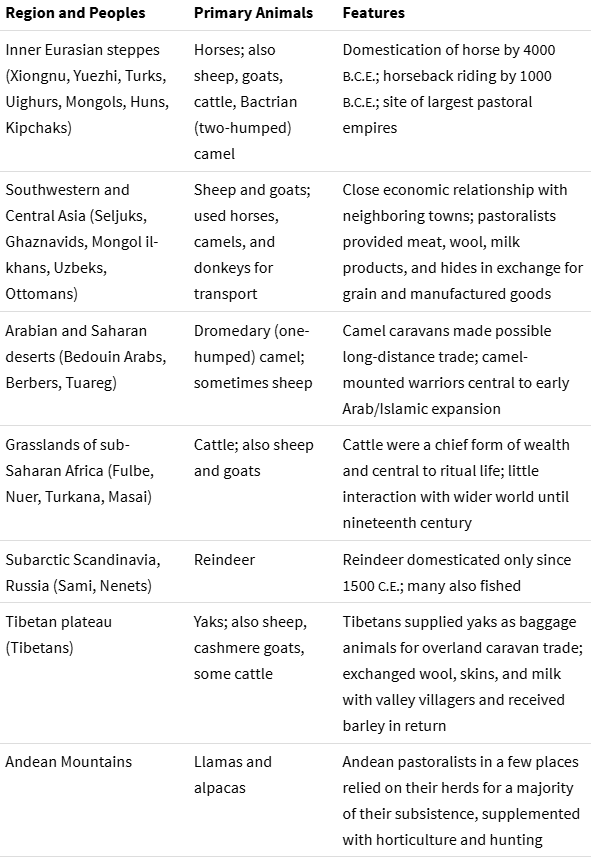
The World of Pastoral Societies
many important distinguishing factors from permanent settlers
less productive, large land for grazing, less people
small, scattered, kinship groups and clans
equality, individual achievement,
some clans → socioeconomic stratification, slavery
women had more status, less restrictions, more public life
productive labor and domestic responsibility, no control own livestock
remarriage and divorce ok
political and military advisers
nearby civilizations didnt fw their freedom, women governed
mobility due to changing of environmental conditions
depended on type of climate, would have to follow seasonal changes impacting vegetation and water supply
took felt tents w them, gave grass to animals for energy
deeply connected to and depended on farming neighbors
can’t live solely off own animals → sought manufactured and luxury from neighbors
desire for fruits → confederations and states to better deal w powerful neighbors
making a large state of pastoralists is lwk hard
lacked surplus wealth for armies and bureaucracies
independence of dispersed clans made unity hard, but Chinggis Khan weld some alliances to a state
military advantages
horseback riding, hunting skills
sustained states thru raiding, trading, extortion
cultural interactions → more religions entered, Manichaeism = Buddhist, Zoroastrian, Christian
top down conversions for political purposes
dramatic changes in society after art of horseback riding
herd larger groups of animals, move quickly over territory
new technology helped their mobility and mastery of environment → complex harnesses, armor, swords
Before the Mongols: Pastoralists in History
horseback riding (later camel) let them onto the global stage
warfare mastery → series of empires, challenged and influenced neighbors
Xiongnu is large scale empire north of china
provoked by Chinese penetration into territory → made ts military confederacy
Modum: Great ruler of the Xiongnu, exacted tribute from other Central Asian pastoral peoples and China → Han Emperor Wen acknowledged was equal
Xiongnu Empire: imperial creation of nomadic steppe peoples who inhabited lands north of China, later stretching from from Manchuria to Central Asia, establishing a model for later Turkic and Mongol empires
this era → pastoral made their historical mark
arabs, berbers, turks, mongols
islam is most expansive religious tradition from arabs, carried by Turks
great civilizations like Byzantium, Persia, India, China have been controlled by pastorals at least once
entered world history
first and dramatic incursion from Arabs
camel saddle → Bedouins fight effectively, military advantage, controlled rich trade routes w incense
shock troops of islamic expansion → first followers and forces helped to start arab empire
turks were making their path in the north
various Turkic clans migrated from Mongolia west, very short lasting empires; kaghan → supreme ruler of fragile allied tribes; kaghan supported by faithful soldier wolves (mythical ancestor)
Turkic peoples: Turkic speakers from Central Asia, originally nomads, who spread westward, creating a series of nomadic empires; Islam between the 10th/14th, carried that faith into new lands and Byzantine Empire, and became a politically powerful presence in the Islamic world
language and culture spread to agrarians, even China
major turning point for Turks is conversion to Islam
major faith expansion, new role of 3rd major carrier of Islam (Arabs, Persians)
first slave soldiers in abbasid, then took military and political power
Seljuk Turkic Empire: empire of the eleventh and twelfth centuries, centered in Persia and present-day Iraq
rulers adopted the Muslim title of sultan (ruler) as part of their conversion to Islam; exercised real power, despite formal by caliph
turkics carried islam to places
invaded north india, anatolia (prev. Byzantium) got massive infusion of culture and language and created Ottoman Empire
turkic dynasties governed well almost to modern empire too
transformed from pastoralists → sedentary farmers, steppe empire creators → rule agrarian civilizations, polythetic ancestral worship → carrying Islam
similar patterns in Africa broadly
camel introduced pastoral societies, later adopted Islam
Sanhaja Berber pastoralists reform → recently converted, superficial practice
Ibn Yasin came from Hajj and wanted orthodoxy
Almoravid Empire: Emerging out of an Islamic reform movement among the Sanhaja Berber pastoralists in the eleventh century, incorporated a large part of northwestern Africa and southern Spain
collapsed by the mid-twelfth century
strong efforts against Christian conquering in Spain
enjoyed prosperity and controlled gold trade and grain produce in Morocco
brought to Morocco sophisticated southern Islamic spanish culture, Marrakech architecture
overrun by Atlas Mountain Berbers
pastorals converted to islam, conflict w agricultural neighbors, short-lived empire, impacts of nearby civilizations
11.2 Breakout: The Mongol Empire
Mongols breakout from Mongolia helped start largest empire in history
joined inner pastorals w outer agriculturalists
brought europe, china, and the islamic world CLOSER than ever
destructive, but also neetworks of exchange and communication
modest cultural imprint on world
no new language religion or civilization, but Arabs did
Mongol religion centered on ancestral rituals
rulers got advice from shamans, religious specialists
ts boring to evb, and mongols didnt care to spread ts’
majority of conquered people were defeated, subordinate, exploited
Turks influence language and culture far away, but Mongol is just Mongolia
after mongol empire died, evb hated inner eurasian pastoralists, absorbed
From Temujin to Chinggis Khan: The Rise of the Mongol Empire
Temujin, later Chinggis Khan: Birth name of the Mongol leader better known as Chinggis Khan (1162–1227), or “universal ruler,” a name he acquired after unifying the Mongols
before he united evb, mongols are hella unstable and fractitious
early life of temujin
father killed, family abandoned by clan, lost livestock and status
lived by hunting, fishing, gathering under harsh conditions
temujin showed courage, magnetism, relied on friends not kin
Chinese fw this and patron him cs they hate pastoralists, allying with a more powerful ruler
built alliances and gained recognition as a chief with growing followers
insane clutch that surprised evb cs shifting alliances and betrayals
many military victories cs his enemies r indecisive → reputation as YAY to allies and AHH to enemies
1206 → recognized as Supreme Leader of Great Mongol Nation
what did Chinggis do w the big military he made
no task → dissolve into chaos, no resources to reward followers → can’t stay supreme
obv expand toward wealthy chinese
mongol world war: half a century of military campaigns, massive killing, and empire building pursued by Chinggis Khan and his successors in Eurasia after 1209.
china, central asia, russia, islamic middle east, eastern europe
sm setbacks for outer limits of mongol empire
withdrawal from east europe (1242)
defeat in palestine by egyptians (1260)
failed to invade japan cs typhoons
cant go thru jungles of southeast asia
Examining the Mongol Moment
grew momentum without any plan, like romans
victories → resources for more war or insecurities for more expansion
lowkey this seemed impossible for mongols
china had more people, and others had more technological prosperity
GREAT TIMING when Song Dynasty lost control to north, Abbasid shrunk
disciplined organized greatly led armies of Mongols clutched
conquered ppl became part of forcess
huge discipline and loyalty of mongol military leaders
desert = death penalty
leaders shared pain w men
encirclement, retreat, deception proved decisive
SO much wealth → poor can dress better, own slaves, climb social ladder
mongol use of conquered peoples
incorporated conquered peoples into army: pastoralists as cavalry, farmers as infantry/artillery
adopted chinese siege techniques and technology
forced labor for roads, bridges, and supply transport
skilled artisans sent across empire for specialized work, sometimes spared from massacre
growing reputation of brutality and destructiveness clutched
also psychological warfare → induced surrender
good at mobilizing human and material resources
great census-taking → aware of resources + taxation
relay system → effective communication
specialized central bureacraucy @ Karakorum
scribes translated languages of the empire
other policies appealed to some conquered groups
offered merchants more than asking price, free use of relay stations for trade
mongols had highest decision making posts, but chinese and muslims had many advisory and lower level positions in persia and china
welcomed religions as long as they weren’t politically opposing
Muslims can seek converts, Christians have other Christians
11.3 Encountering the Mongols in China, Persia, and Eurasia
China and the Mongols
main target for wealth, difficult extended conquests
began in Northern China → large destruction and plunder; Southern → Song Dynasty, less violence and more accommodating
unified divided china → persuaded that Mongols had Mandate of Heaven
behaved like a good Confucian → tax relief, leniency, less violence
Great Khan Ogodei suggested exterminating every north china for mongol pastureland
instead, extract every bit of wealth, but also accommodated to Chinese gov and culture
accommodated in many ways
administrative: practices like taxation, postal system, Yuan dynastic title started smthing new, capital to Beijing “Khanbalik” → rooted on sophisticated civilization
Khubilai Khan: Grandson of Chinggis Khan who ruled China from 1271 to 1294
Chinese tablets to honor ancestors, Chinese names
similar to good Confucian ruler → public works, less taxes, patronized art, prohibit grazing of farmland
Yuan Dynasty: Mongol dynasty initiated by Khubilai Khan that ruled China from 1271 to 1368
rituals, temples, attracted to Tibetan Buddhism, calligraphy, poetry
still harsh, exploitative, foreign, resented
bribes, executions, seized women → hostility
maintained much of Mongol culture; continued animal steppe life, traditional tent life
ignore trad exam system → foreigners r officials, themselves r top decision making posts
honored bureaucrats and artisans way more, HATE chinese
no intermarriage, Chinese can’t learn Mongol script, no foot binding, women freely mixed w Chinese husbands
relied heavily on female advisors → Chabi convinced him to maintain farmland bc advantages + tax revenue
urged for emulation of early golden China for long dynasty
relatively brief rule of china
factionalism, inflation, epidemics, peasant rebellions forced Mongols out → 1368, rebels won, returned to steppes
Ming Dynasty → new commitment to Confucianism, restrict gender roles to rid of Mongol practices
Persia and the Mongols
abrupt conquest of Islamic Persia, first led by Chinggis, 30 yrs later assault led by his grandson
Hulegu: Grandson of Chinggis Khan who became the first il-khan (subordinate khan) of Persia.
mongols viewed as infidels → huge shock to ppl accustomed to expansive islamic progress
HUGE ferocity and slaughter → Sacking of Baghdad killed 200k and ended Abbasid Caliphate
damage to agriculture and soil tilling
heavy taxes forced under whipping → peasants left, in-migration of Mongols turned agriculture into pasture and desert
fragile water channels underground, little irrigation to neglected fields, good land wasted
wine production incr, persian silk industry benefited cs china
Mongols here transformed more than the ones in China
used sophisticated Persian bureaucracy → govt operations by Persians
Ghazan reign → rebuilt damaged cities and irrigation systems; Mongols also converted to Islam 1295, unique
mongol elites learned persian, turned to farming, intermarriage
collapsed 1330 bc lack of suitable heir, but Mongols not driven out → them and turks assimilated
“barbarians” civlized, Persians resisted cultural influence, now can become patriarchal again
Russia and the Mongols
1237-40, relatively new civilization on edge of christendom, kievan rus gone, sm un-united independent princes
ferocity despite large interactions w pastoralists north of black sea → cities fell to Mongols, used catapults and battering rams from Muslims and Chinese
mass slaughter, rape; evb surrendered, laborers/skilled craftsmen sold as slaves; sm crafts loss, toll on Russia
Khanate of the Golden horde: Russian name for the incorporation of Russia into the Mongol Empire in the mid-thirteenth century; known to Mongols as the Kipchak Khanate
no garrison cities, permanent stationed officers, settlers cs little to offer → not sophisticated or productive economy, not near big trade routes
sm empty land → maintain steppe life ez, remain near Russian cities in case of military expedition
exploited russia
princes paid tribute, heavy taxes on peasants, raids = more slaves
russian orthodox church flourished cs religious toleration, no taxes
cooperated cities r good, resisted cities damaged
Moscow is primary tribute of Mongols → Ivan I rich, great for nucleus of new russian state post-mongol
no direct mongol rule → not as influenced by Russian culture compared to Persia/China, still dominated
eventually assimilated to Islamic faith of Kipchaks
Mongols impacted Russia A LOTTT despite distance
Russians adopted their weapons, diplomacy, court, tax system, military draft → facilitated new Russian state as Moscow is core
Orthodox church penetrates further
blamed Mongols for backwardness and autocracy
divisions, plague, and Moscow growth led to end of Mongol Russia end of 15th
mongol war moment now over, but still occassionally attacked
11.4 The Mongol Empire as a Eurasian Network
chinese culture and buddhism provided integration in east; christianity in europe; islam in middle
mongol empire brought all ts into 1→ circulated goods, info, disease, warfare
Toward a World Economy
mongols didn’t produce goods, didn’t trade, but promoted international commerce largely to tax it and extract wealth from rich nations
paid more than set price to attract merchants
financial banking for caravans, standardized weights/measures, merchant tax breaks
made secure environment for risky long-distance trade on Silk Road
merchants returned w tales of good lands, rich opportunities, but it’s js long-established trading networks europeans ignored
mongol trade circuit was central to linking afro-eurasian world
connected overland thru Mongol Empire, oceanic routes thru Indian/Chinese ocean
Diplomacy on a Eurasian Scale
promoted diplomatic relationships throughout
randoms invasion of Russia → mongols slimed polish german hungarian forces, set to west europe
ogodei died → mongols returned, plus europe not for pasturelands
fear of mongol return → friars dispatched to learn culture, help in crusades, proselytic, useless
useful information about eastern lands given to europe
awareness of wider world
Persian Mongols’ conversion to Islam prevented overthrowing of Jerusalem
mongols close w persian and chinese courts
exchanged ambassadors, intelligence, trade, skilled workers
Cultural Exchange in the Mongol Realm
forcibly transferred skilled educated people to distant parts, religious tolerance attracted merchants, traders, missionaries
Karakorum - cosmopolitan city for multiple religions, intermarriage, syncretism
Prophet drawn in China and in Christian scenes?? WHAT
entertainment from Byzantium, persian doctors/administrators to China, Chinese physicians and engineers in Persia
HUGE exchange of techniques and ideas
chinese tech and art - painting, printing, gunpowder, compass, high temp furnaces, medicine
flowest west cs Chinese pulse method preferable over direct contact in Islam
muslim astronomers to China reinforced their heavenly signs
lemons/carrots from middle east to China, il-khan looked for indian chinese stuff
europeans used to be cut off, but now, new tech crops knowledge WITHOUT bad mongol conquest
Chapter 12: The Worlds of the Fifteenth Century
Societies and Cultures of the Fifteenth Century
Paleolithic Persistence: Australia and North America
hunter gathering societies still existed
australia, siberia, arctic coastlands, part of america and africa
australians persisted hunting/gathering even after europeans came
overt time, assimilated practices like canoes, fishing, art, rituals
farming didn’t come to mainland australia still
still, mastered understanding of the land + firestick farming
controlled burns cleared underbush → makes hunting easier, helps grow plants and animals
exchanged goods with each other, created rituals, sculptures, and rock painting
different flourishing society w north american tribes
affluent gathering and uniting societies bc variety of animal and fish species
permanent settlements, large sturdy houses, economic specialization, ranked societies, chiefdom, excess food
numbers still plummeted as agricultural societies like russia and china took over
Agricultural Village Societies: The Igbo and the iroquois
there weren’t many fully agricultural societies who avoided larger empires/civilizations or their own city-state societies
these people lived in north america, caribbean/south america, southeast asia, and south africa with villages of kinship relations
each has their own characteristics, just like how an empire has its rise/fall, culture, etc.
igbo: People whose lands were east of the Niger River( now southern Nigeria)
built a complex society that rejected kingship and centralized statehood, while relying on other institutions to provide social coherence
title societies → wealthy men w high ranks, women’s associations, ritual experts = mediators, balance among kinship groups
igbo was not an isolated society
traded w songhay and traded cloth, fish, copper, iron goods
common artistic traditions, transition to patrilineal descent
impacted by atlantic slave trading
new york → changing agricultural societies bc of european interference
Iroquois became fully agricultural (maize and beans), larger settlements, distinct people emerged
frequent warfare
agriculture (women’s work) was main economic activity, but war gave more prestige
Iroquois: Iroquois-speaking peoples in what is now New York State
around the fifteenth century they formed a loose alliance based on the Great Law of Peace, an agreement to settle disputes peacefully through a council of clan leaders
loose confederation of five speaking people, including Mohawk
suppressed conflicts and coordinated relationships with outsiders
europeans found value in the confederacy’s limited govt, social equality, personal freedom
rights for women → matrilineal descent, live w women, women control agriculture and property → selected leaders
men were hunters, warriors, officeholders
increasingly encompassed in expanding trade networks and conquest empires
Pastoral Peoples: Central Asia and West Africa
pastoral people had more direct dramatic impacts on civilizations than agriculturalists
i.e. mongols
Timur: Turkic warrior (Tamerlane) whose efforts to restore the Mongol Empire in the late fourteenth /early fifteenth centuries fucked up some of Persia, Russia, and India
successors created a vibrant elite culture drawing on both Turkic and Persian elements, especially Samarkand city
his conquests are the last major military success of Central Asian pastoral peoples
just as aggressive as chingghis, devastated persia russia india
conflicts of successors prevented lasting empire
descendants controlled area around persia/afghanistan after
sophisticated elite culture of turkic/persian elements → patronized the arts
pastoralists of inner eurasia swallowed by outer by russia and china
africa → pastorals stayed independent longer than asian pastorals
fulbe: West Africa’s largest pastoral society
members gradually adopted Islam and took on a religious leadership role that led to the creation of a number of new states by the nineteenth century
lived in small communities among agriculturals, paid taxes for pasturing as they moved eastward; resented subordination to farmers
adopted islam → stopped pastoralism → became big religious figures → jihads made new states
Civilizations of Fifteenth Century: Comparing China and Europe
city-centered and state-based societies were larger, denser, powerful, innovative, and had socioeconomic inequalities
expanded geographically
majority of ppl lived in one of these civilizations
still, many identified w local communities
Ming Dynasty China
china disrupted by mongol rule and the plague
Ming Dynasty: Chinese dynasty (1368–1644) that succeeded the Yuan dynasty of the Mongols
noted for return to traditional Chinese ways and restoration of the land after the destructiveness of the Mongols
no mongol names/dress, yes Confucian learning + trad gender roles
Emperor Yongle did a lot of stuff
sponsored Encyclopedia w a bunch of scholars’ info
relocated capital to Beijing, built Forbidden City (palace) + Temple of Heaven
socially, past
reestablished civil service exam, created very centralized govt
emperor held concentrated power + loyal eunuchs exercised great authority
official bureaucrats pissed
restored acres to cultivation, rebuilt canals reservoirs irrigation works, planted billions of trees
better economy, more trade, good governed and prosperous
went on a huge maritime expedition
Yongle commissioned a big fleet to launch in 1408 and last 30 ish years
Zheng He: Great Chinese admiral who commanded a huge fleet of ships in a series of voyages in the Indian Ocean that began in 1405
intended to enroll distant peoples and states in the Chinese tribute system, voyages ended abruptly in 1433 and led to no lasting Chinese imperial presence in the region
still, many rulers came back w tribute and rituals of submission, offerred stuff in return
abruptly and deliberately ended
1433 → just stopped, let everything deteriorate
emperor Yongle died, main patron of this
high officials saw this as a waste bc china was already the great middle kingdom → worry abt northern barbarians
officials viewed ts as the project of eunuchs (despised)
even without support of govt, people still sailed and traded around
European Comparisons: Statebuilding and Cultural Renewal
demographic recovery and growth in eurasia
western europe recovered from plague in late 15th c.
population regrew steadily
strong infrastructure supported economic + demographic revival
europe joined china in earlier patterns of state building
Europe was a fragmented system of several separate independent very competitive states
effective taxation system → effective administrative structures, raised armies
Moscow city state ermerged
driven by needs of war → frequent
eg: Hundred Years’ War
european renaissance: A “rebirth” of classical learning that is most often associated with the cultural blossoming of Italy in the period 1350–1500
included rediscovery of Greek and Roman learning plus major developments in art, as well as growing secularism in society
use these texts alone, without religion, as the cultural standard
spread to Northern Europe after 1400
patroned artists made much more naturalistic art, also looked at islamic excellence
religious themes common in art, but also included mythology
humanists’ study of history, ethics, politics, etc. complemented religion → God made human to learn, take advantage of the ability to learn and improve
ex: The Prince by Machiavelli → practical politics, feared > loved, controversial
most artists were men, but one great exception was Christine de Pazan (daughter of Venetian official in Paris)
City of Ladies → challenged misogyny, argued for women’s education and active roles in society, ALL women of ALL cultures
renaissance focus on individuality and secularism
inspired by classical models, emphasized unique individuals + real world
reflected urban, commercial life of italian cities
secularism + individualism challenged christian otherworldliness, hinted at emerging capitalist economy
European Comparisons: Maritime Voyaging
europe, like china, also launched outward maritime expeditions
started 1415 in Portugal
2 expeditions w/ major breakthroughs
1492 → Christopher Columbus, funded by Spain, went west along Atlantic and tried to reach East, failed
1497 → Vasco da Gama went around coast of Africa to India
europeans had WAY less ships and crewmembers than chinese (columbus had 3 bro)
europeans sought the wealth of Asia and Africa, converts, and allies against Muslim powers
meanwhile, china doesn’t care → no military threats, few trade needs, no desire to convert foreigners
chinese fleets avoided conquest and colonies; Europeans monpolized commerce in Indian Ocean and built american empires
china suddenly ended their voyages, while europeans continued and escalated them
zheng he’s voyages forgotten in china, led nowhere
european expeditions, though smaller, were first steps toward global power
why did europeans continued voyages?
1) no unified political authority to end maritime outreach
2) most of elite had interest in overseas expansion
merchants sought profit, Church sought conversion, nobles sought fame and fortune
meanwhile, Zheng He’s voyages were shallow in the official circle
chinese and european worldviews
china confident in antiquity + cultural superiority, expected others to provide goods
europeans saw themselves as religiously unique (christianity)
european expansion driven by desire for eastern riches + threat from muslim powers
chinese withdrawal vs european expansion
china leaving indian ocean allowed portuguese entry, minimal resistance
both faced growing populations + land shortages
china expanded agriculture internally + inland; europe expanded overseas via oceanic exploration
Civilizations of the Fifteenth Century: The Islamic World
transformations in the islamic world
islamic civilization politically unified into four major states/empires
long-term conversion to islam continued cultural transformation
fifteenth–early sixteenth centuries saw notable political + cultural changes
In the Islamic Heartland: The Ottoman and the Safavid Empires
ottoman empire: Major Islamic state centered on Anatolia that came to include the Balkans, parts of the Middle East, and much of North Africa
lasted in one form or another from the fourteenth to the early twentieth century
ottoman empire in the fifteenth century
huge, long-lasting, diverse, economically + culturally sophisticated
rivaled ming china + incas in wealth, power, splendor
turks became dominant in islamic world, sultans claimed caliph title, sought unity + protector role
Ottoman Seizure of Constantinople: The city of Constantinople, the capital and almost the only outpost left of the Byzantine Empire, fell to the army of the Ottoman sultan Mehmed II “the Conqueror” in 1453
marked the end of Christian Byzantium
ottomans reversed roles from crusades, europeans no longer aggressive initiators
conquest of constantinople 1453 ended byzantine empire, ottomans claimed roman legacy
expansion continued to vienna 1529, europeans feared “terror of the turk”
Safavid Empire: Major Turkic empire established in Persia in the early sixteenth century and notable for its efforts to convert its people to Shia Islam
created unique identity of Persian culture
safavid empire and ottoman rivalry
shia safavid empire contrasted with mostly sunni neighbors
1534–1639: periodic ottoman-safavid military conflicts
conflicts driven by territory + religious differences
On the Frontiers of Islam: The Songhay and the Mughals
songhay empire: Major Islamic state of West Africa that formed in the second half of the fifteenth century
largest in series of west african states, controlled trans-saharan trade
islam present mainly among urban elites, monarch sonni ali blended islamic + traditional practices
became major center of islamic learning + commerce
timbuktu: major commercial city of West African civilization and a noted center of Islamic scholarship and education by the sixteenth century
mughal empire: successful state founded by Muslim Turkic-speaking peoples who invaded India and provided a rare period of relative political unity (1526–1707); their rule was noted for efforts to create partnerships between Hindus and Muslims
governed largely non-muslim population, continued islam-hindu interactions
established in early 16th century by islamized turkic group, unified most of india
early emperors used inclusive policies, blended hindu + muslim subjects, similar to ottoman religious autonomy
four muslim empires and second flowering of islam
ottoman, safavid, songhay, mughal brought political, military, economic, cultural strength
unprecedented coherence and prosperity in islamic world
fueled continuing spread of islam to new regions
oceanic southeast asia and islamic trade influence
by the 15th century, muslim traders controlled much of indian ocean commerce
hindu and buddhist rulers converted to islam to attract trade and became sultans
spread of islam occurred through merchants and sufi holy men, not conquest
Malacca: Muslim port city that came to prominence on the waterway between Sumatra and Malaya in the fifteenth century C.E.; it was the springboard for the spread of a syncretic form of Islam throughout the region
rise of malacca as a muslim trade and learning center
transformed from small fishing village to major muslim port in 15th century
commerce attracted diverse nations, helped spread islam in region
blended islam with local and hindu/buddhist traditions, became center of learning
Civilizations of the Fifteenth Century: The Americas
aztec and inca empires are newer, larger, and more politically unified
marginal people forcibly take over, absorb older cultures
killed 16th century by conquistadors and disease
The Aztec Empire
the aztec empire: Major state that developed in what is now Mexico in the fourteenth and fifteenth centuries; dominated by the semi-nomadic Mexica, who had migrated into the region from northern Mexico
more mercenaries to protect powerful people, negotiating elite marriage alliances, build capital city Tenochtitlan
1428 → Triple Alliance launched aggressive military conquest, bringing chunks of the region under a single political framework
Aztecs claim descent from elder trads
loosely structured, unstable conquest state, frequent rebellions
conquered people had to provide labor and deliver bunch of gifts, overseen by local tribute imperial collectors
public works → canals, dikes, bridges
palaces, temples, artificial floating islands made from swamplands for productive agriculture
marketplaces → big commercialization
local and long-distance trade
extent + population growth stimulated market growth and production of crafts
cities like Tlatelolco had huge marketplaces
pochtecha → commoners with huge wealth that allowed them to rise in society, land magnates
pochtecha obtained slaves for important sacrifices
sacrifice BIG part of blood rituals in aztec life
Tlacaelel developed ideology of state giving human sacrifice importance
Huitzilopochtli deity lost energy against cinstant battle of darkness → Aztecs always near catastrophe
to replenish energy and delay darkness descent, give human sacrifices (since Gods sacrificed blood for humans) → valued prisoners of war, rulers and priests dependent
huge rituals + displays of wealth served to impress everyone with the immense power of Aztec culture
poetry of beauty → fragility and brevity of human life
The Inca Empire
the Inca Empire: The Western Hemisphere’s largest imperial state in the fifteenth and early sixteenth centuries. Built by a relatively small community of Quechua-speaking people (the Incas), the empire stretched some 2,500 miles along the Andes Mountains, which run nearly the entire length of the west coast of South America, and contained perhaps 10 million subjects
incorporated traditions of older cultures
larger than Aztec
encompassed whole of Andean civlization
similar to aztec → quick military conquests brought them from rags to riches
aztec rulers left subjects alone if they received tribute
no elaborate administrative system to integrate or assimilate people into Aztec culture
incas were way more bureaucratic
divine emperor, governors for each 80 provinces
in theory, govt owned everything, but acc state lands existed alongside temples, elites, etc.
grouped into hierarchical units, inspectors checked on province officials
quipus (knotted cords) was an accounting device that recorded births, deaths, etc.
resettlement program moved populations to new locations
leaders learned Quechua for cultural integration → sons moved to the capital to learn Inca language and culture
diversity in Inca required great flexibility to deal with
some resistant, some cooperative and benefited
overlord delegated control to native authorities → always tried to bring local people in lower administrative systems
acknowledge major deities, but do ur own thing
fluid → depended on conquered people, and desires and demands of govt
dense and extended network of economic elationships
demands of conquered expressed in labor service (mita) from every household, not tribute
EVERYONE had to work for state, even if most productions stayed home
sun farms, religious institutions, military, mining, etc.
skilled → manufacture textiles, ceramics, metal goods
chosen women picked from homes, trained w incan ideology, produce corn beer and state cloth at state centers, later wives of Sun to elite men
state required to provide lots of food and wine and elaborate feasts when disaster struck
aztec and inca have similar gender systems
men and women are separate but equal → gender paralellism
Andes → men from fathers, women from mothers; Mesoamerica children from both
men love the sun, women the moon
male and female priests and political officials (Aztecs → local authority)
domestic qualities not hated on
gender complementarity, not equality
women’s unfaithfulness worse than male’s
as empires grew, slightly leaned patriarchal
Aztecs → women’s tools were riutalized as weapons and good luck for war
Inca had higher parallelism → incan ruler and his female consort, governed jointly
Webs of Connection
most people caught in some form of overlapping exchange and interaction
Incas diligently tried to integrate diverse peopl
religion linked and divided people
christianity for europe, but orthodoxy vs catholicism and then the protestant reformation made a fragmented christian region
buddhism linked a lot of east asia tg even w separate sects
islam brought tg many diverse cultures, but strong conflicts between sunni and shias
long-established patterns of trade with different goods unique to each environemnt
siberia traded fur along silk road, Nigeria received horses that flourished there from Africa, Missisippi River and Amazon River facilitated trade
voyage networks of polynesia
long-distance trading patterns were starting to change
silk road contracted when mongols fell and plague reduced demand for its products
ottoman empire blocked trade bw europe and china, but oceanic trade of east asia in indian ocean increased
larger ships carried bulk goods, sophisticated partnerships + credit mechanisms
common islamic culture helped
After 1500: Looking Ahead to the Modern Era
ties of empire, culture, commerce, disease linked people, but not on a global scale
afro-eurasia had no enduring ties w americans, and no contact with pacific oceania
ts changes as europeans sustained interaction among all regions 16th century, marking the modern age
all regions became more connected than ever
global empires, economies, cultural exchanges, migration, disease, empire, environmental changes more important
2nd distinctive feature emerged - radically new kind of human society, first in europe 19th century, then elsewhere → industrialization
more tech innovations, massive consumption of energy and raw materials, scientific outlook, human population growth, powerful and intrusive states, Europeans dominant, balance of global power different
Chapter 13: Political Transformations: Empires and Encounters 1450-1750
Comparing Colonial Societies in the Americas
spanish, portuguese, british, french made new societies when colonizing
mercantilism: economic theory that governments served their countries’ economic interests best by encouraging exports and accumulating bullion (precious metals such as silver and gold); helped fuel European colonialism
empires formed differently, so different colonies (like protestant english v. catholic spanish)
also determined settler-based agriculture, slave plantations, ranching, mining
native american character/culture changed too
men and women experienced colonial intrusion differently
women were forcibly transferred to new colonial rulers through exchange gifts as slaves
elite native american women married to spanish men
strongly encouraged to foster good relations
some of the women benefited a lot too - gained states
nonelites experienced sexual violence, sex slavery, and abuse → humiliating for native men that failed to protect them
In the Lands of the Aztecs and the Incas
spanish conquest and colonial development
spain took over rich, urbanized regions of mexico and peru
built cities, universities, churches, and missions within a century
set up complex administration and regulated global trade
economic foundations of colonial society
based on commercial agriculture and precious metal mining using mainly native labor
coercive systems like encomienda forced natives into near-slavery conditions
hacienda system kept workers as low-paid peons with heavy taxes and debts
social hierarchy in spanish colonies
colonial society mirrored spanish class and gender order while adapting to diverse racial groups
spanish men held political and economic power but were divided among conquistador descendants, creoles, and peninsulares
women had racial privilege but strict gender limits and were controlled to preserve lineage and purity of blood
mestizo: A term used to describe the mixed-race population of Spanish colonial societies in the Americas, most prominently the product of unions between Spanish men and Native American women
scarcity of spanish women led to widespread spanish–indian unions
indian women often sought security in spanish households for themselves and their children
mestizos expanded into many caste categories and eventually became a majority in mexico
mestizo status in colonial society
mestizos were culturally hispanic but viewed as illegitimate by spaniards
grew into a key social group with roles in crafts, administration, and small business
mestiza women worked in service and crafts, and rare cases like mencia perez showed upward mobility
indigenous life under spanish rule
indigenous peoples faced heavy labor demands, tribute, and cultural suppression after population collapse
many adopted spanish language, religion, work patterns, and legal systems
indian women were treated as legal minors, losing court access and property protections
indigenous persistence and resistance
local indian authorities, markets, foods, and religious blends endured under spanish rule
women often kept matrilineal property practices and folk beliefs stayed strong
revolts like tupac amaru invoked inca memories and gendered political traditions
social categories and mobility in colonies
spaniards, mestizos, and indians, with fewer africans than elsewhere
some individuals could move between categories through education, wealth, or cultural adoption
society showed fluid ethnic mixing and cultural blending compared to british colonies
Colonies of Sugar
sugar colonies in brazil and the caribbean
developed in lowland regions without major native civilizations or early mineral wealth
profitability came from sugar, heavily demanded in europe for many uses
economies focused on export sugar production and imported most necessities
sugar production origins
pioneered by arabs in the mediterranean
europeans adopted and transferred it to atlantic islands and the americas
portugal dominated brazilian sugar market 1570–1670, later challenged by british, french, dutch
impact of sugar in brazil and the caribbean
sugar was labor-intensive, large-scale, and aimed at global markets
used european capital and expertise, making it an early modern industry
relied heavily on african slave labor after native populations declined, most slaves went to brazil and caribbean
slave labor conditions on sugar estates
worked in extreme heat and dangerous conditions, high death rates 5–10% per year
constant importation of new slaves required to replace those who died
described by observers as brutal and deadly
female slaves in sugar economies
women made up about half of field gangs but rarely did skilled mill work
worked in domestic tasks in urban areas and were often hired out
faced family separations and emotional trauma when children were sold
| Portuguese America (Brazil) | |
Europeans | 18.2 percent | 23.4 percent |
Mixed-race | 28.3 percent | 17.8 percent |
Africans | 11.9 percent | 49.8 percent |
Native Americans | 41.7 percent | 9.1 percent |
mulattoes: Term commonly used for people of mixed African and European blood
cross-racial marriages were rare, about 10% of unions
concubinage and informal relationships created a large mixed-race population
mulattoes dominated, with around 40 distinct racial categories emerging
plantation society in british north america
crops included tobacco, cotton, rice, and indigo, with less racial mixing due to early arrival of european women
sharply defined racial system with black, native american, and white categories
mixed-race groups largely unrecognized, unlike in spanish and portuguese colonies
slavery and manumission differences
north american slaves reproduced locally, while latin american colonies continued importing slaves
more slaves freed in brazil, creating opportunities for free blacks and mulattoes in politics, arts, and business
some freed people even worked as slave catchers
racism and social mobility in brazil
racism existed but was based on a flexible system of mixed-race categories rather than strict black/white division
european traits were valued, but class, wealth, and education could alter racial perception
light-skinned or successful mulattoes could “pass” as white and gain high social positions
Settler Colonies in North America
northern british colonies and geography
colonies like new england, new york, pennsylvania seen as less wealthy and developed than spanish or portuguese possessions
remained minor players on global stage until at least the eighteenth century
land viewed as unpromising but available for settlement
british settlers and cultural background
came from a society with religious conflict, rising merchant class, and parliamentary influence
many sought to escape old european structures rather than replicate them
outsider status and land availability limited sharp class hierarchies and dependent labor
gender and family in puritan new england
men became independent heads of family farms, escaping old class restrictions
women remained constrained by puritan gender norms emphasizing obedience and domestic roles
few girls attended school and women could not hold ministerial positions despite church membership
demographics of northern british colonies
british settlers outnumbered spanish five to one by 1750, mostly european
native american populations largely eradicated by disease and military action
few african slaves or mixed-race people due to small-scale independent farming economy
settler colonies: Imperial territories in which Europeans settled permanently in substantial numbers. Used in reference to the European empires in the Americas generally and particularly to the British colonies of North America
religion, literacy, and governance
protestant colonies less focused on converting natives, church separate from state
high literacy among white males, unlike latin america
local self-government strong, assemblies challenged governors
long-term shift in power
spanish and portuguese colonies initially richer and more advanced
british colonies later became stable, democratic, economically strong
latin america remained divided and less prosperous
The Steppes and Siberia: The Making of a Russian Empire
russian empire: A Christian state centered on Moscow that emerged from centuries of Mongol rule in 1480; by 1800, it had expanded into northern Asia and westward into the Baltics and Eastern Europe
conquered neighboring russian cities and expanded territory
over three centuries, extended across northern asia to pacific and westward to include many european peoples
security concerns in southeast russia → pastorals raided farmers, sold to slavery
siberia → scattered people in forests had no threat to russia
hunting, gathering, herding people in small socieities
russians want siberia for fur pelts (soft gold) cs Little Ice Age
empire took shape 1500-1800
wooden forts protected frontier/trading towns and russian farmers
extensive process w variety of people - adventurers, church, criminal, merchants, peaants, etc.
offered economic and social improvements
politically “defend frontiers, enhance state power, bring christianity/civilization/enlightenment to savages”
Experiencing the Russian Empire
despite frequent resistance, russian used modern weaponry + organizational capacity of state to conquer steppes and Siberia
demanded oath of allegiance to grand tsar/monarch
yasak: Tribute that Russian rulers demanded from the native peoples of Siberia, most often in the form of furs
devastating epidemics to locals w little immunity
intermittent pressure to christian conversions → tax breaks, tribute exemption, land/wealth promise were incentives PLUS mosque destruction and resettlement
conversion was less intense if it impacted stability → catherine the great gave tolerance to muslims
most profound feature was influx of russian settlers
hundreds of thousands moved to siberia
loss of pasturelands → pastorals became dependent on farmers for sugar tea alcohol as their long-standing economies were undermined
pressured nomads to give up their ways - pay fees, get permission to cross lands
some mixed off-spring, easily absorbed into russians though
siberia and steppes incorporated into russians state
not driven into reserves or eradicated, but were Russified
final triumph of agarians over hunting pastorals
Russians and Empire
russia fundamentally changed
increasingly ,multiethnic, but russians politically dominant
rich agricultural lands, valuable furs, mineral deposits made this a great European power 18th century
russian westward expansion and european contact
acquired baltic, polish, and ukrainian territories through conflicts with regional powers
peter the great modernized administration, military, education, and industry, promoted western dress and customs
st. petersburg built as “window on the west,” continued by catherine the great’s europeanization and enlightenment influence
russia as european and asian power
empire bordered europe and asia, interacting with china, india, persia, ottoman empire
long-standing identity question: european backwardness vs unique slavic/asian character
large size fostered militarization and reinforced autocratic monarchy
comparison of russian and western european empires
russia expanded into adjacent territories while its modern state formed, unlike overseas western european empires
conquest, settlement, exploitation, conversion, and superiority similar to europeans
empire lasted much longer, with siberia and steppes still part of russia, unlike former american colonies
Asian Empires
other early modern empires in asia
chinese expanded into central eurasia, mughal empire unified much of hindu south asia, ottoman empire ruled diverse christian and arab populations
regional scope, lacked global reach and catastrophic population collapse seen in the americas
empire-building did not transform homelands as profoundly as american colonies or siberia, but shaped important cross-cultural encounters
Making China an Empire
qing china and frontier expansion
china abandoned early maritime empire ambitions after 1433, later expanded north and west
qing dynasty (1644–1912) of foreign manchu origin conquered china during general crisis
maintained ethnic distinctiveness while adopting chinese language, confucianism, and bureaucracy
qing military expansion and frontier control
centuries of trade, tribute, and warfare with nomads in mongolia, xinjiang, tibet
1680–1760 military campaigns brought these regions under qing control, motivated by security
tensions with russian expansion resolved diplomatically via treaty of nerchinsk (1689)
qing china as central asian empire
campaigns against zunghar mongols marked china’s evolution into central asian empire
chinese viewed it as unification, not empire-building
historians note similarities and differences with other early modern empires
qing expansion: The growth of Qing dynasty China during the seventeenth and eighteenth centuries into a central Asian empire that added a small but important minority of non-Chinese people to the empire’s population and essentially created the borders of contemporary China
qing administration of central eurasia
conquest used superior military technology and resources
ruled separately via court of colonial affairs, relied on local notables to govern cheaply
local officials sometimes abused power and adopted chinese/manchu customs, causing resentment
qing approach to local cultures
did not forcibly assimilate mongolian, tibetan, or muslim peoples
nobles, monks, and monasteries often exempt from taxes and labor
limited chinese settlement to preserve mongols as military recruits
long-term significance of qing empire
greatly expanded china’s territory and added important non-chinese minorities
modern chinese borders largely established during qing dynasty
tibetans and xinjiang peoples retained identities, some seeking autonomy or independence today
impact of qing and russian expansion on central asia
transformed central asia from cosmopolitan crossroads to impoverished, backward region
land-based eurasian trade declined as oceanic trade rose
mongol nomads lost land, could not herd freely, many became urban poor; nomadic pastoralism ended as major historical force
Muslims and Hindus in the Mughal Empire
mughal empire: A successful state founded by Muslim Turkic-speaking peoples who invaded India and provided a rare period of relative political unity (1526–1707); their rule was noted for efforts to create partnerships between Hindus and Muslims
founded by muslim turkic central asian warriors, descended from chinggis khan and timur
controlled a diverse subcontinent of many states, castes, sects, and ethno-linguistic groups
main division is religion cs muslims r only 20%, rest is hindu
akbar: The most famous emperor of India’s Mughal Empire (r. 1556–1605); his policies are noted for their efforts at religious tolerance and inclusion.
married rajput princesses, included hindus in elite, supported temples and mosques
promoted women’s rights among elites: remarriage of widows, discouraged child marriage and sati; nur jahan wielded political power
akbar and religious tolerance
imposed religious toleration: restrained ulama, removed jizya on non-muslims
created house of worship for interfaith dialogue, developed state cult blending islam, hinduism, zoroastrianism
promoted cosmopolitan elite culture: persian and hindu literature and art exchanged, hybrid indian-persian-turkic identity
opposition to akbar’s policies
shaykh ahmad sirhindi criticized cultural and religious blending
blamed women for introducing hindu and non-islamic practices
advocated enforcing sharia, jizya, and excluding non-muslims from high office
Aurangzeb: Mughal emperor (r. 1658–1707) who reversed his predecessors’ policies of religious tolerance and attempted to impose Islamic supremacy
strictly enforced islamic law and moral codes
banned sati, gambling, drinking, prostitution, narcotics, and court music/dance
destroyed some hindu temples and reimposed jizya
appointed “censors of public morals” to enforce laws in major cities
Aurangzeb’s legacy
harsh religious policies and heavy taxation antagonized Hindus and other groups
sparked opposition movements that fractured the Mughal Empire
weakened the empire, paving the way for British takeover in the 18th century
Mughal India: religious encounter
early policies promoted multicultural and religious accommodation
later rulers, especially Aurangzeb, imposed Islamic supremacy, increasing tension
set a pattern of Hindu-Muslim antagonism that echoed in later centuries
Muslims and Christians in the Ottoman Empire
ottoman empire: Major Islamic state centered on Anatolia that came to include the Balkans, parts of the Middle East, and much of North Africa; lasted in one form or another from the fourteenth to the early twentieth century
transformed to a powerful, prosperous, cosmopolitan empire
sultan = turkic warrior prince + caliph + conquering emperor → bore sword of islam
transformation of women’s roles
conversion to islam and imperial expansion reduced the independence of elite turkish women
increased use of slave women from caucasus and sudan
social and religious restrictions limited women’s public and religious activities
women’s agency within constraints
royal women wielded political influence during the “sultanate of women” (c. 1550–1650)
islamic law allowed property ownership, enabling women to gain wealth and endow charitable institutions
women actively used courts to protect legal rights in marriage, divorce, and inheritance
religion and cultural influence
ottomans assumed responsibility for protecting islam’s holy cities: mecca, medina, and jerusalem
conflict with safavid persia (1534–1639) highlighted the sunni–shia divide in islam
persian culture—poetry, painting, and imperial traditions—remained influential among the ottoman elite
expansion and cross-cultural encounters
conquest of constantinople in 1453 marked the fall of byzantium and establishment of istanbul as the ottoman capital
large-scale conversion of anatolia’s christian population to islam, with turkic settlement increasing
ottoman expansion represented a major interaction between the islamic world and christendom
the balkans
muslim rulers governed a large christian population with relatively few turkish settlers
ottoman authorities accommodated christian churches, reducing pressure to convert
by the early 1500s, only about 19% of the population was muslim, while 81% remained christian
christian and jewish populations
christian communities, including orthodox and armenian churches, had autonomy over social, religious, educational, and charitable affairs
many christian and jewish individuals gained legal, economic, and political opportunities, with some joining the elite or excelling in trade and banking
devshirme: term that means “collection or gathering”; it refers to the Ottoman Empire’s practice of removing young boys from their Christian subjects and training them for service in the civil administration or in the elite Janissary infantry corps
threat to europe
conquest of constantinople and the balkans expanded ottoman power in southeastern europe
naval strength in the mediterranean challenged european control of trade routes
sieges of vienna (1529, 1683) symbolized the “terror of the turk” and European anxiety
cultural encounter with europe
european artists admired the empire’s splendor, depicting it in renaissance art
thinkers like jean bodin praised ottoman religious tolerance compared with christian europe
political and commercial cooperation occurred, e.g., france allying with ottomans and merchants trading despite papal bans
cultural encounter with europe
european artists admired the empire’s splendor, depicting it in renaissance art
thinkers like jean bodin praised ottoman religious tolerance compared with christian europe
political and commercial cooperation occurred, e.g., france allying with ottomans and merchants trading despite papal bans
Chapter 14: Economic Transformations: Commerce and Consequence 1450-1750
indian ocean commercial network: The massive, interconnected web of commerce in premodern times between the lands that bordered the Indian Ocean (including East Africa, India, and Southeast Asia); the network was transformed as Europeans entered it in the centuries following 1500
trading post empire: Form of imperial dominance based on control of trade through military power rather than on control of peoples or territories
philippines (spanish): An archipelago of Pacific islands colonized by Spain in a relatively bloodless process that extended for the century or so after 1565, a process accompanied by a major effort at evangelization; the Spanish named them the Philippine Islands in honor of King Philip II of Spain
manila: The capital of the colonial Philippines, which by 1600 had become a flourishing and culturally diverse city; the site of violent clashes between the Spanish and Chinese
british east india company: Private trading company chartered by the English around 1600, mainly focused on India; it was given a monopoly on Indian Ocean trade, including the right to make war and to rule conquered peoples
dutch east india company: Private trading company chartered by the Netherlands around 1600, mainly focused on Indonesia; it was given a monopoly on Indian Ocean trade, including the right to make war and to rule conquered peoples
“silver drain”: Term often used to describe the siphoning of money from Europe to pay for the luxury products of the East, a process exacerbated by the fact that Europe had few trade goods that were desirable in Eastern markets; eventually, the bulk of the world’s silver supply made its way to China
piece of eight: The standard Spanish silver coin used by merchants in North America, Europe, India, Russia, West Africa, and China
potosi: City that developed high in the Andes (in present-day Bolivia) at the site of the world’s largest silver mine and that became the largest city in the Americas, with a population of some 160,000 in the 1570s
fur trade: A global industry in which French, British, and Dutch traders exported fur from North America to Europe, using Native American labor and with great environmental cost to the Americas. A parallel commerce in furs operated under Russian control in Siberia
“soft gold”: Nickname used in the early modern period for animal furs, highly valued for their warmth and as symbols of elite status
transatlantic slave system: Between 1500 and 1866, this trade in human beings took an estimated 12.5 million people from African societies, shipped them across the Atlantic in the Middle Passage, and deposited some 10.7 million of them in the Americas as slaves; approximately 1.8 million died during the transatlantic crossing
african diaspora: The global spread of African peoples via the slave trade
maroon societies / palmares: Free communities of former slaves in remote regions of South America and the Caribbean; the largest such settlement was Palmares in Brazil, which housed 10,000 or more people for most of the seventeenth century
signares: The small number of African women who were able to exercise power and accumulate wealth through marriage to European traders
benin: West African kingdom (in what is now Nigeria) whose strong kings for a time sharply limited engagement with the slave trade.
dahomey: West African kingdom in which the slave trade became a major state-controlled industry
Chapter 15: Cultural Transformations: Religion and Science 1450-1750
protestant reformation: Massive schism within Christianity that had its formal beginning in 1517 with the German priest Martin Luther; the movement was radically innovative in its challenge to church authority and its endorsement of salvation by faith alone, and also came to express a variety of political, economic, and social tensions
Martin Luther: German priest who issued the Ninety-Five Theses and began the Protestant Reformation with his public criticism of the Catholic Church’s theology and practice
Thirty Years’ War: Catholic-Protestant struggle (1618–1648) that was the culmination of European religious conflict, brought to an end by the Peace of Westphalia and an agreement that each state was sovereign, authorized to control religious affairs within its own territory
counter-reformation: An internal reform of the Catholic Church in the sixteenth century stimulated in part by the Protestant Reformation; at the Council of Trent (1545–1563), Catholic leaders clarified doctrine, corrected abuses and corruption, and put a new emphasis on education and accountability
taki onqoy: Literally, “dancing sickness”; a religious revival movement in central Peru in the 1560s whose members preached the imminent destruction of Christianity and of the Europeans and the restoration of an imagined Andean golden age
jesuits in china: Series of Jesuit missionaries from 1550 to 1800 who, inspired by the work of Matteo Ricci, sought to understand and become integrated into Chinese culture as part of their efforts to convert the Chinese elite, although with limited success
wahhabi islam: Major Islamic movement led by the Muslim theologian Muhammad Ibn Abd al-Wahhab (1703–1792) that advocated an austere lifestyle and strict adherence to the Islamic law; became an expansive state in central Arabia
wang yangming: Influential Ming thinker (1472–1529) who argued that anyone could achieve a virtuous life by introspection and contemplation, without the extended education and study of traditional Confucianism
kaozheng: Literally, “research based on evidence”; Chinese intellectual movement whose practitioners were critical of conventional Confucian philosophy and instead emphasized the importance of evidence and analysis, applied especially to historical documents.
the dream of the red chamber: Book written by Cao Xueqin that explores the life of an elite family with connections to the court; it was the most famous popular novel of mid-eighteenth-century China
mirabai: One of India’s most beloved bhakti poets, she transgressed the barriers of caste and tradition
sikhism: Religious tradition of northern India founded by Guru Nanak (1469–1539); combines elements of Hinduism and Islam and proclaims the brotherhood of all humans and the equality of men and women.
scientific revolution: The intellectual and cultural transformation that shaped a new conception of the material world between the mid-sixteenth and early eighteenth centuries in Europe; instead of relying on the authority of religion or tradition, its leading figures believed that knowledge was acquired through rational inquiry based on evidence, the product of human minds alone
copernicus: Polish mathematician and astronomer who was the first to argue in 1543 for the existence of a sun-centered, helping to spark the Scientific Revolution
galileo: An Italian scientist who developed an improved telescope in 1609, with which he made many observations that undermined established understandings of the cosmos
newton: English scientist whose formulation of the laws of motion and mechanics is regarded as the culmination of the Scientific Revolution
european enlightenment: European intellectual movement of the eighteenth century that applied the principles of the Scientific Revolution to human affairs and was noted for its commitment to open-mindedness and inquiry and the belief that knowledge could transform human society
voltaire: The pen name of François-Marie Arouet (1694–1778), a French writer whose work is often taken as a model of the Enlightenment’s outlook; noted for his deism and his criticism of traditional religion
condorcet: The Marquis de Condorcet (1743–1794) was a French philosopher who argued that society was moving into an era of near-infinite improvability and could be perfected by human reason