Neurons
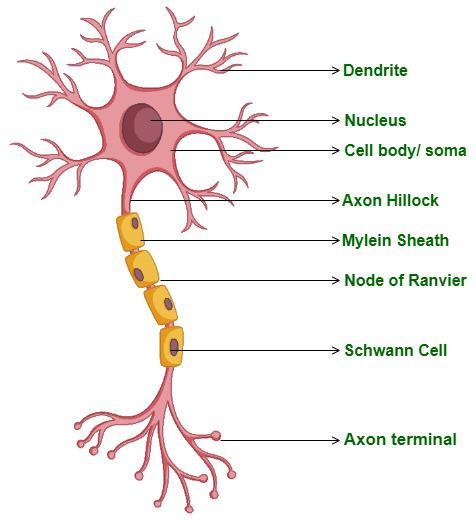
Dendrite: Branch-like extensions of a neuron that receive signals from other neurons.
Axon: A long, slender projection of a neuron that transmits electrical impulses away from the cell body.
Cell body (Soma): The main part of a neuron that contains the nucleus and other organelles.
Nucleus: The central part of a cell that contains genetic material and controls cell functions.
Axon bulb (Axon terminal): The end of an axon that releases neurotransmitters to communicate with other neurons.
‘
How is an action potential is passed from 1 neuron to the next neuron?
An action potential is passed from one neuron to the next through a process called synaptic transmission. When an action potential reaches the end of a neuron, it triggers the release of neurotransmitters into the synapse. These neurotransmitters then bind to receptors on the next neuron, causing ion channels to open and generating a new action potential. This process allows the electrical signal to be transmitted from one neuron to the next, enabling communication within the nervous system.
How are reflex and reaction time different?
Reaction time and reflex time are two different measures of the time it takes for a response to a stimulus.
Reaction time refers to the time it takes for a person to consciously process a stimulus and initiate a voluntary response. It involves the brain receiving and interpreting the sensory information, making a decision, and then initiating a motor response. Reaction time can vary depending on factors such as attention, cognitive processing, and decision-making.
Reflex time, on the other hand, is the time it takes for an involuntary reflex action to occur in response to a stimulus. Reflexes are automatic and rapid responses that bypass conscious thought and involve a direct connection between sensory and motor neurons in the spinal cord. Reflexes are designed to protect the body from harm and occur without conscious control or decision-making.
In summary, reaction time involves conscious processing and voluntary responses, while reflex time involves involuntary and automatic responses.