chemical signalling notes (from sirius revision combined with kognity)
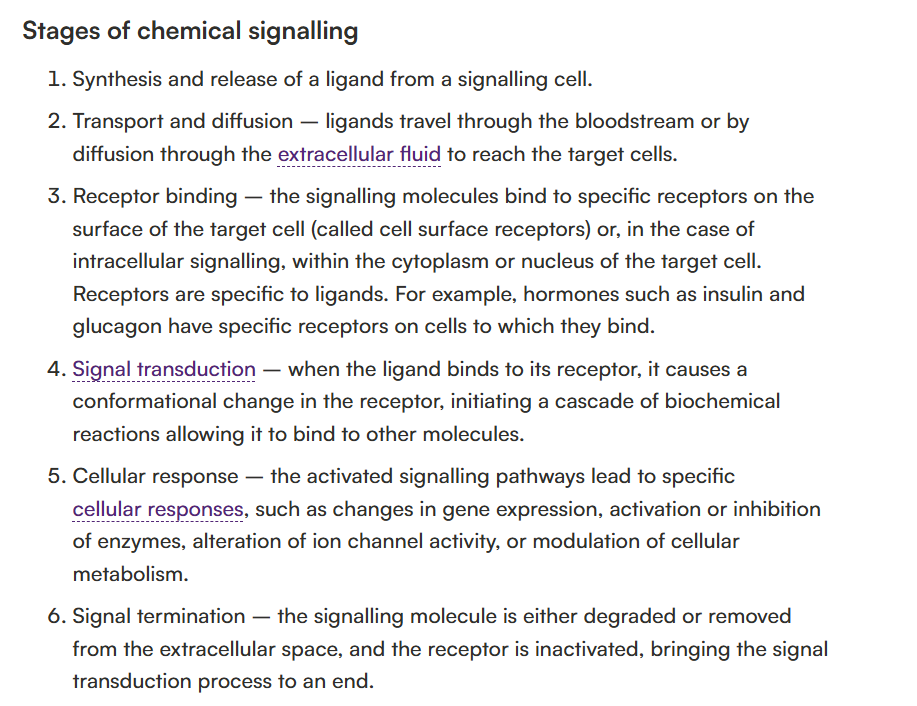
chemical signalling is the process where cells, tissues & organisms communicate with each other through signalling molecules
ligands
the signalling molecules are called ligands
so ligands are ions or molecules that bind to a protein receptor
include hormones, calcium ions, neurotransmitters
when the ligand binds to its site on the molecule, it can trigger a conformational change in the structure
this change to structure can result in a change in gene expression or a change in cellular response
ligands are specific to their receptors (similar to enzymes)
ligand remains unchanged (different from enzymes)
ligand sticks with the receptor for a longer period of time (different from enzymes)
quorum sensing
bacterial cells communicate with each other to coordinate their group behaviour in response to cell density. once population threshold is reached, the bacteria coordinate the expression of different traits
bacteria involved in quorum sensing release autoinducers (small signalling molecules) which diffuse & accumulate in their environment
the autoinducers bind to regulators & induce or repress gene expression
signalling chemicals
hormones are involved in longer processes & released by endocrine glands (effect over greater distances)
neurotransmitters are involved in quicker processes & travel through synaptic gap (localized effect)
cytokines are passed between nearby cells
can have multiple effects depending on binding site
differences & similarities between neurotransmitters & hormones
they are both:
soluble in water
are small
hv a shape compatible with a receptor
hormones can consist of:
steroids
amines
peptides
neurotransmitters can consist of:
amines
amino acids
gases
esters
differences between transmembrane & intracellular receptors
if a signalling molecule can enter the cell
receptor protein is located in cell (it’s intracellular)
so the receptor is covered in hydrophilic amino acids
if signalling molecule can’t enter the cell
then the receptor protein is located on the membrane (is transmembrane protein)
this means one section is embedded in the membrane & the other protrudes out of membrane
this means the receptor has to have hydrophilic & hydrophobic amino acids
transduction pathways
transduction pathways - series of events that occur after the ligand binds to its receptor
2 types of transduction pathways: intracellular pathway & transmembrane pathway
intracellular pathway - ligand enters cell & binds to receptor. the complex will enter the nucleus where it will regulate gene expression
transmembrane pathway - ligand binds to receptor & receptor changes shape. this produces a secondary messenger molecule which will cause changes in the cell
GPCR (G-protein coupled receptors)
it is a transmembrane protein
GDP (guanosine diphosphate) binds to GPCR & the protein doesn’t do anything
GPCR becomes active only when the ligand (GTP - guanosine triphosphate) binds to it
this means that GDP is replaced by GTP
this causes the protein complex to disassemble & causes changes within the cell
Epinephrine
is the same? or similar to adrenaline
it cannot enter the cell
so it will bind to GPCR, causing the conversion of ATP into cAMP ( a secondary messenger molecule)
this amplifies the message
Kinase
a kinase is an enzyme that phosphorylates molecules by removing a phosphate group from ATP & transferring it to the molecule
tyrosine kinase is an enzyme that transfer the phosphate to tyrosine (an amino acid) in a protein
insulin
remember insulin is important for glucose uptake
it will bind to the receptor
causes tyrosine kinase to transfer phosphate group to proteins
causes conformational change in the glucose channels
this will cause the glucose channels to be embedded in the cell membrane
this allows insulin to enter the cell