Wk2 Pre-Lecs
2a Visual Illusions
aim of visual sys
produce veridical (truthful) percept of the outside world
stages of visual processing
object
through image projection → retinal image
sensory representation (how the retinal image is encoded by brain cells)
perceived object (internal representation of the outside world)
sensory encoding
perception partly depends on how brain encodes visual info
how visual info moves through different stages in the brain
can be limiting→sensory illusions
reasons why we need to know what the visual cells are tuned to and how the info is transformed from one level in the brain to the next
two defining characteristics of how the brain processes visual info
multiple parallel pathways
different pathways optimised to extract different aspects of the visual scene
multiple processing stages
info transformed from one stage to the next
neural tuning
visual brain cells are specialised to detect specific features (e.g. motion, orientation
processing stages
each stage extracts and refines different aspects
limitations
initial encoding may miss details, requiring extra processing or population-level responses
Perceptual constraints
the way cells extract info can limit or distort perception, leading to sensory illusions
retinal image
the only direct info that the brain has to produce the percept
but retinal image is constantly changing
when we move in relation to an object, shape and size of its retinal image changes
interpretation
if percept corresponds to retinal image → worl is constantly changing
we want percept to correspond to the unchanging object
not the ever-changing retinal image
perceptual constancy
brain has to actively interpret retinal image in order to prduce a percept that corresponds to the outside world
retinal image: cup always moving, actually (and what we want to perceive): cup is still on the table
example: imaging how difficult and confusing it would be if your hands constantly changed size as the retinal image size changed
perceptual illusions: when brain incorrectly interprets the sensory representation
sensation vs perception
sensation
representation formed by our sense organs
e.g. response of our retina to light and how those retinal signals are encoded, and hence transformed, by brain cells
perception
how we 'interpret’ the sensory input/neural representation in the brain
‘software’ of the visual system
two types of visual illusions
sensory
hardware fault
limitation in how info is encoded
tells us about what brain cells are tuned to, brain area to process info
how brain cells interact
blind spots, perceptual filling in (changes over space)
perceptual
software fault
mistake in cognitive processing
tells us about how the brain interprets rep
what assumptions are made about the outside world
troxler fading illusion
looking at the same image for an extended amount of time and don’t move your eyes. percept of the image can disappear/fade (changes over time)
neon-colour spreading
brain looks for luminance (physical brightness)-defined edges and fills in the colour to those edges
simultaneous-contrast
metamers
physically different but perceived as the same
e.g. yellow vs red+green=yellow
different physically but perceived the same
hermann-hering grid
black squares, white lines separating: sees black faded areas in white intersections
due to tuning of cells early in the visual system
we don’t perceive isolated bits of info
brain tries to group things to perceive complex objects
bistable percept
for same image, it can be perceived in two ways
e.g. vase/two face illusion
people can have strong emotional responses to bistable percepts
individual differenes in emotional reactions to bistable perception
these responses are linke to other cognitive processes
2b: electrophysiology
electrical properties of cells an dhow they communicate with each other
concerns the functioning of the nervous system: electrophysiology/neurophysiology
cells/neuron
info-conducting unit of the nervous system
dendrites (communication input)
input fibres of the cell
collect info from other cells
many in numbers
increases cell surface area
dendritic spine: small protusions that cover the dendrites
axons (axon terminal = communication output)
output fibre of a cell
each cell only has one
can have multiple branches off the axon, called telodendria
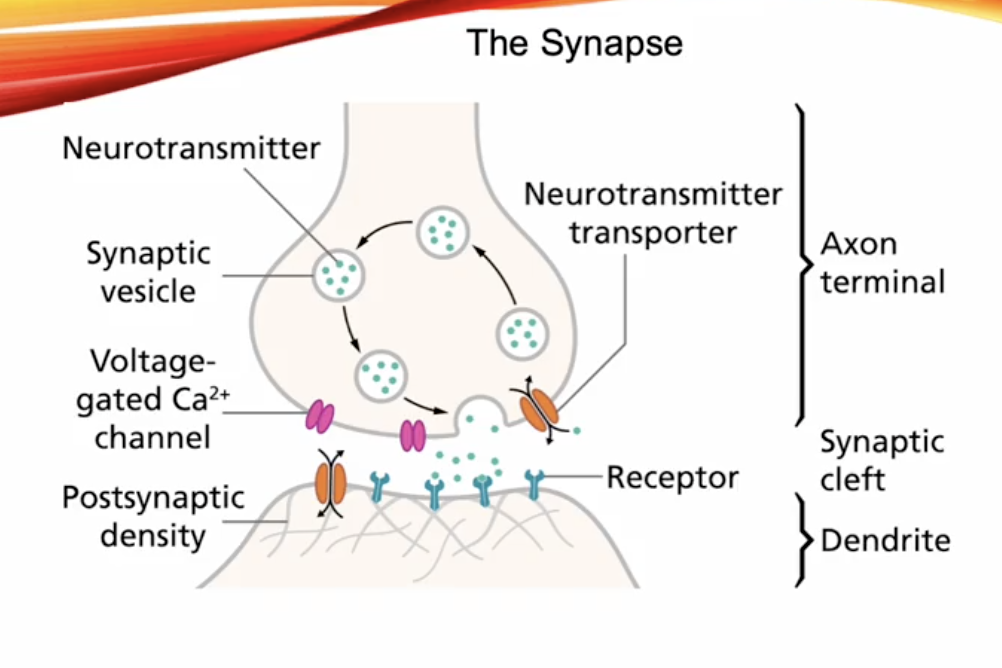
terminal button (bouton)
end foot at the end of each telodendrion (branch of the axon)
sits close to dendritic spine of another neuron
synapse
spatian junction between the terminal button and dendritic spine of the target cell
synaptic gap/cleft: actual space between them
neurotransmitter
stored in vesicles
the chemical released from the terminal buttons that carries the message across the synapse
nerve impulses
electrical signal
moves along axon
releases neuro transmitters through synaptic cleft
no actual physical connection due to synaptic cleft
electrical signal = action potention/activation spike
nerve impulse = action potential mocing along the axon
generating action potentials
generated by electrically charged chemicals (ions) passing through the cell membrane when the cell reaches a certain electrical potential
electrical potential:
voltage difference acrocc the cell membrane due to difference concetrations of ions inside and outside the cell
cell membrane
separates intracellular fluid from extracellular fluid
semi-permeable (ions cannot pass through)
this process regulates the differing concentrations of salts and other chemicals (both sides)
e.g. H2O: too much=cell burst, too little=cell shrivel
how do ions cross the membrane?
different passages on the membrane
involved in action potentials = gates
gates
proteins that change shape
creats a gated channel through the cell membrane
shape changes due to:
a chemical binding to them
in response to electrical charge (leads to an action potential)
temperature change
ions
Movement of ions create electical charges: Na+, K+ (potassium), Cl-
electrical activity of a membrane
resting potential
steady state voltage of the cell
electrical charge across the membrane in the absence of stimulation
greater negative charge in the intracellular side
a store of potential energy
-40mV to -90mV
graded potential
small fluctuations in voltage across the membrane due to stimulation
v localised
hyperpolarisation: increasing (-) charge
depolarisation: decreasing (-) charge
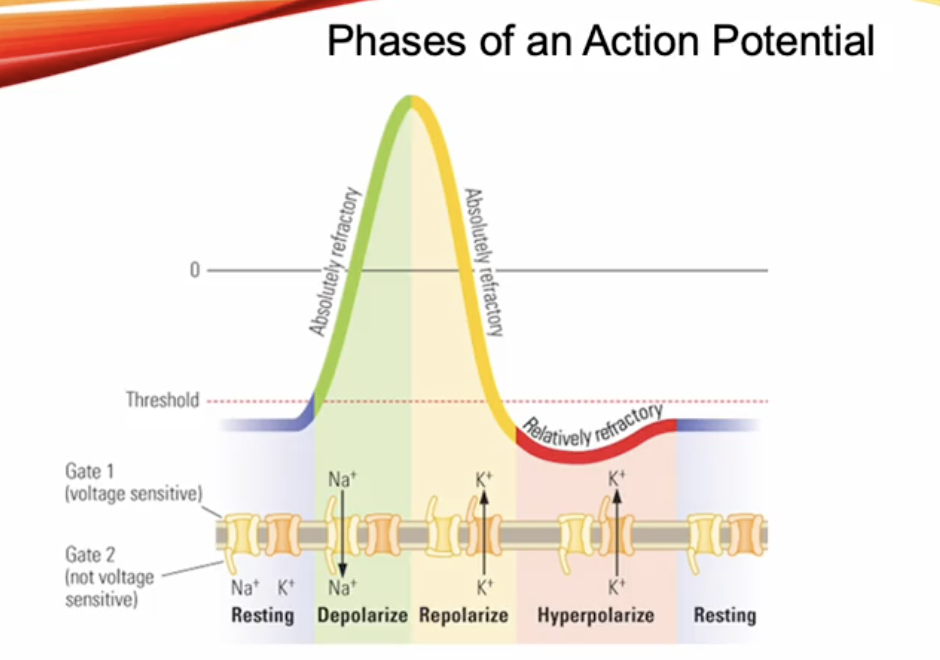
action potential
large, brief reversal in polarity of the axon membrane
occurs when large concentrations of Na and K cross the membrane (order respectively)
intracellular side become more positive
threshold potential: membrane voltage the results in this polarity reversal (~-50mV)
due to gated Na and K channels responding to the change in membrane voltage
role of voltage-sensitive ion gates
voltage sensitive ion gates
closed at rest, open when threshold potential is reached
voltage sensitive Na gates
open quickly
depolarising phase of the action potential is due to influx of Na
voltage sensitive K gates
open later
hyperpolarising phase of the action potetial is due to efflux of K
phase of the aciton potential and refractory periods
absolute refractory period
occurs during the depolarising and repolarising phases of the action potential
axon membrane cannot trigger a new action potential
around 5ms so limits maximum firing rate to 200 spikes/s
time during which no second action potential can be initiated
relative refractory period
occurs during the hyperpolarisation phase of the action potential
axon membrane only respods to stimulation that is higher that that which initiated the first action potential
time during which a second action potential can occur, but only with a stronger-than-normal stimulus
nerve impulse and axons
nerve impulse: the propagation of an action potential along the axon
voltage changes occur at one point on the membrane
brings adjacent point to threshold potential
the action potential is propagated down the axon membrane
action potential cannot travel backward due to refractory period
large axons can transmit nerve impulses quickly
vertebrate species have fast transmission anyway
due to insulation layer, that results in ‘saltatory’ transmission
saltatory conduction and myelin sheaths
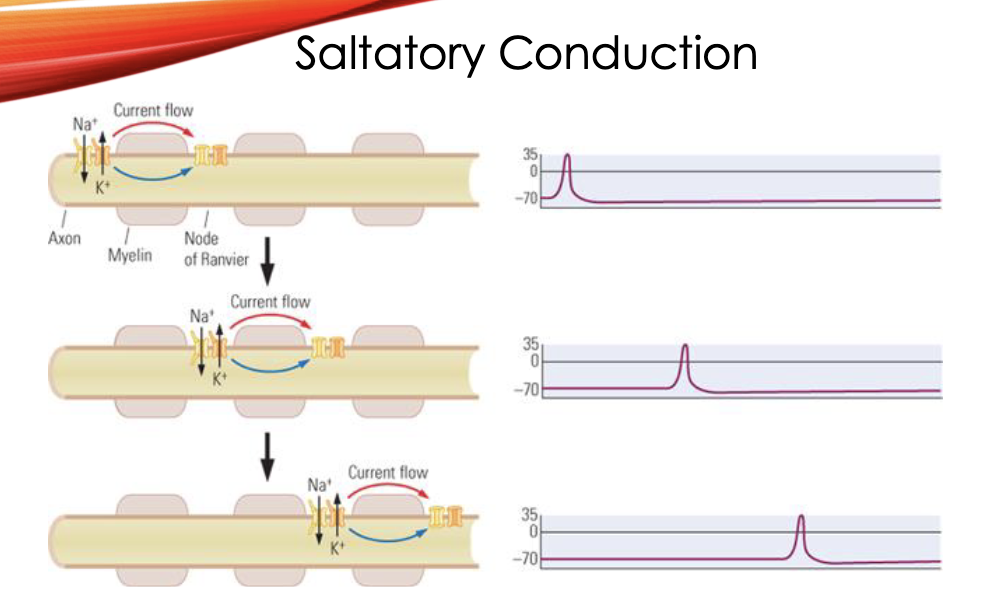
saltatory:
hop or jump
instead to moving contiuously along the axon, it jumps along certain points
myelin:
insulation around an axon
multiple sclerosis (MS)
degenerative autoimmune disease
attacks myelin
hard plaques form in affected areas and disrupt the flow of neuronal info
exposes fiber after myelin
excitatory and inhibitory inputs
excitatory post synaptic potential
brief depolarisation (lots of +) of cell’s membrane in response to stimulation
more likely to reach threshold and produce an action potential
IPSP
brief hyperpolarisation “
less likely “
Live lec
essay discussion
addressing the issue of whether there is a long-term future for psychology given advances being made in neuroscience
assumption that neuroscience approach could explain all of psychological function
need to make the case for the utility of a psychological approach
not making the case that one is always better than the other
relative strengths and weaknesses of the two and under what circumstances does the psychological approach have advantages
illusion: what we perceive differs from the outside world
perceptual illusion
literal illusions
cognitive illusions
physiological illusions
processing of visual info in the brain
multiple parallel pathways
different pathways are optimised to extract different aspects of the visual scene
different neural routes
process distinct types of visual info simultaneously
multiple processing stages
info is transformed from one stage to the next
hierarchical sequence of visual analysis
from simple to complex
brain: actively
questions
what are axons, dendrites and synapses?
what is an action potential/spike and a nerve impulse?
what role do they play in information flow between cells?