big terms unit 1 ap gov review
Articles of Confederation
Successes
Formed the framework of a government
Established some of the basic points of Congress
United all 13 states under one government
Emphasized state sovereignty to prevent monarchy
Failures
There was no president or executive leaders, all national power was held at Congress
No national courts to handle cases about disputes between states, or unconstitutional cases
Couldn’t amend articles because of the unanimous state votes
National government was not a strong, central government
There was an irregular attendance of delegates
Trade among the states was complicated and insufficient: each state cold make its own currency, exchange rates varied, and they could charge tolls and fees to export goods across state lines
An economic chaos led to a depression in the people and Shay’s rebellion
If a foreign government wanted to negotiate a trade agreement with Congress, it could be vetoed/amended by a state government. So, they might have to negotiate separate agreements with Congress and each state legislature, making this process really complicated
Structure
Members of Congress were elected by state legislatures (rather than directly by the people)
Congress was unicameral (one-house legislature) in which states had one vote each
Bigger states were angry that every state had one vote, smaller states had equal power to bigger states
Congress could negotiate treaties, borrow money from other countries, request money from states, fund an army and navy, and deal with Indian affairs
Congress could not regulate trade, collect taxes, establish a draft, or force states to comply with laws
9/13 states had to approve laws (big majority, not good) and to amend articles you need an unanimous consent
Power was decentralized in states rather than centralized in the national government (Ex: both national government and states could make treaties and coin money)
Federalist
Those at Constitutional Convention who favored strong national government and a system of separated powers
Anti-federalist
Those at Constitutional Convention who favored strong state governments and feared that a strong national government would be a threat to their rights
Brutus I main ideas:
Brutus’s warning was that a large central government can take away individual rights. He also warns that if they give their powers to the Constitution now, then they must acknowledge the rights they are giving up and not receiving back.
Would 1 central, republic form of government be best for the United States rather than 13 republic States with powers and control over the federal government?
Brutus refers to the necessary and proper clauses, and the supremacy clauses. Refers to them because he is afraid that Congress will have too much power, that they’ll overpower and control the States with this power. Also, that the central government will have too much power, that no State may override the Constitution. This is not what they want as they want a republic government that’s balanced and not tyrannic.
He likes the enumerated powers. However, he’s still concerned that the proposed government will endanger liberty because the States have very little power in the proposed government, the supremacy clause and necessary and proper clause give the central government too much power. He’s afraid that the State's power will diminish over time and in turn endanger their citizen’s liberties.
Fears that the Supreme Court will become too powerful and that the state courts will lose their power.
The elastic clause is a potential threat to state government because the Congress could deny laws that states put in place and Congress could pass many laws at the national level, preventing States from passing laws at the state laws.
Congress can make laws that will negatively affect the States, and the States have little recourse against it.
Concerned about the size of the new republic because he fears that the new republic is becoming too large, that a smaller country would be more successful for a republic government
Small republic is preferable because they are closer to the people and are more likely to know what the people want, the people will understand the government better
Concerned about the diversity of the new, large republic because if there are too many opinions in a republic, there will be conflict. You’ll get groups of representatives teaming up and fighting against each other (worried about the formation of political parties).
Concerned about men who would serve in the federal government were that an enlarged republic would abuse their power, become tyrannical, and make it difficult to hold them accountable for their actions as the central government would be more powerful than the State government.
Federalist 10 main ideas:
Factions are a group of citizens with common interests, they are dangerous to the people as they take away the rights of others
A pure democracy cannot handle factions, but a republic is good at dealing with factions because a republic is a bigger country hence it can house more factions
The more factions there are, the less likely 1 faction will have a lot of power
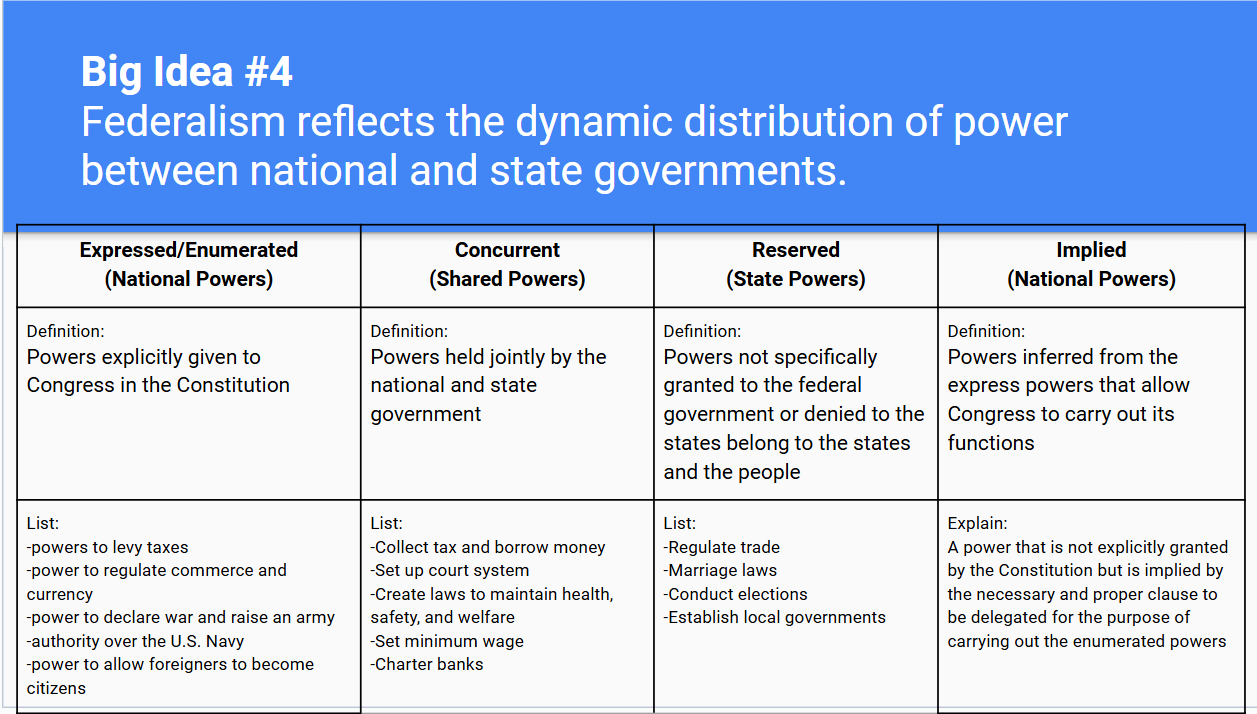
Enumerated powers
Powers explicitly granted to the Congress, the president, or SCOTUS in the first 3 articles of the Constitution
Implied powers
Powers supported by the Constitution that aren’t expressly stated in it. SCOTUS often defines boundaries of it, but Congress, the president, and public can play key roles in this power.
Concurrent powers
Responsibilities for particular policy areas (like transportation) that are shared by federal, state, and local governments
Reserved powers
Powers not given to the national government by the Constitution or not prohibited to the states, are reserved by the states or the people
McCulloch v Maryland
Facts
In 1816, Congress chartered the Second Bank of the U.S.
In 1818, Maryland attempted to pass legislation to impose taxes on banks
A cashier in the bank refused to pay the taxes
Maryland sued the national bank and said that the national bank was unconstitutional
Decision
SCOTUS deemed that the Second Bank was constitutional, and that states cannot tax the national government
National governments had more power because SCOTUS ruled that national governments may create banks and state governments couldn’t tax these banks as they are buildings from the national government
United States v Lopez
Facts
12th grade high school student, Lopez, was carrying a weapon into San Antonio, Texas High School
Charged under Texas law with a state crime of firearm possession on school grounds
State charges were dismissed when federal agents charged Lopez with violating federal criminal statute which was Gun-Free School Zone Act of 1990
Lopez was found guilty of violating the federal criminal statute and was sentenced to 6 months in prison with 2 years of supervision after release
His lawyers appeals the conviction on the basis that the Gun-Free School Zone Act was unconstitutional
Decision
SCOTUS said the Gun-Free School Zone Act is unconstitutional because it doesn’t relate closely enough to economic activity to use the commerce clause and the necessary and proper clause to pass such a law
The state government gained more power because the federal government or Congress was restricted to pass that legislation under the commerce clause. It limited the power of Congress and ensured state’s rights.
Factions
A group of citizens with common interests who influence others to join their group
Tyranny of the majority
A faction’s interests influences a majority of citizens, prevailing over the government and the rights of the minorities
Popular sovereignty
The idea that the government is authorized by citizens and influenced by what they want
Limited government
A government that is limited in its powers by laws such as the constitution and individual rights to prevent tyranny
Federalism
The division of power across local, state, and national levels government
Separation of powers
The division of power across 3 branches of government with their own main power
Checks and balances
Giving a branch power over the other 2 branches of government
Participatory democracy
A democracy in which citizens are directly involved in proposing laws and voting for laws through some form of referenda
Pluralist democracy
A democracy in which each citizen has an equal amount of influence over government politics in factions (that are constrained by the Constitution)
Elitist democracy
A democracy in which citizens are elected as representatives to make decisions in their role as trustees with the skills, education, and ability to protect against unwise decisions. They have a disproportionate influence over government politics.
Shay’s Rebellion
An economic chaos led to a depression and many farmers lost land because they couldn’t pay their debts or state taxes
Frustration from the depression cause the former captain, Daniel Shays, to lead a force of 1,000 farmers to attempt to take over the Massachusetts state government arsenal
Rebels were repelled by State militia, yet many other protests took place in Pennsylvania and Virginia
Exposed fundamental discontent with the new government, and that the future of the fledgling nation was at risk
Federalist 51 main ideas:
To create a better government, this new government must have separation of powers and members of each branch should be as little involved as possible when appointing new members
Checks and balances are important in it because each great, powerful branch must be as powerful as the Constitution lets them so that the other branches are controlled by them
Madison viewed human nature as abusive and chaotic without a controlled leader, that if all men were perfect then no government would be needed
Viewed the Legislative branch as the most powerful, hence it must be divided into 2 houses to make it harder to pass a law through both houses
Compares single republic to compound republic and mentions the national government and the state government working together, along with federalism
Discusses the dangers of factions and tyranny of the majority, and how in a large republic these interests are broken up into many different factions in which a majority cannot rise to the top
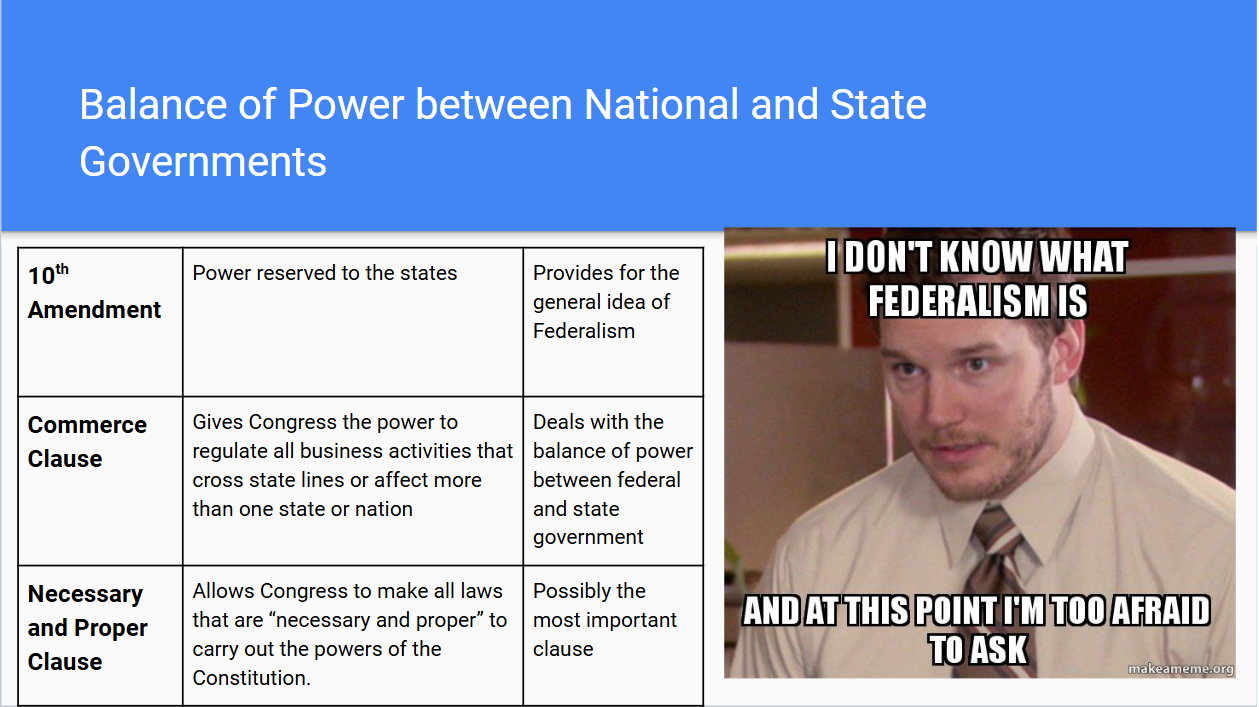
Commerce clause
Giving Congress the power to regulate commerce among several states and foreign lands. This clause serves as a basis for much of Congress’s legislation
Supremacy clause
States that any national law is the supreme law of land and takes precedence over any state law that conflicts with it
Judges are bounded by these laws such as the Constitution and treaties
Necessary and proper clause
Giving Congress the power to pass all laws related to its expressed powers
Full faith and credit clause
Each state’s laws must be honored by the other states (Ex: legal marriage in one state must be recognized across state lines)
Judicial review
Ability of SCOTUS to strike down a law or executive branch action as unconstitutional
Block grants
Federal aid provided to the state government to be spent within a certain policy area, but the state can decide how to spend money within that area
Best way for levels of government to cooperate to solve problems
Categorical grants
Federal aid to state or local governments that is provided for a specific purpose, such as school lunch programs within the education budget
Dual federalism
National and state governments are seen as distinct entities providing separate services.
This usually, not always, limits the power of the national government. Mainly seen in decisions of court cases
Cooperative federalism
National and state government work together to provide services efficiently
A profound shift toward less concrete boundaries of responsibility in national-state relations
National government played enhance role of initiator of key policies
Picket fence federalism
A more refined and realistic form of cooperative federalism in which policy makers within a particular policy area work together across levels of government. Activity occurs within policy areas
Ideology
A cohesive set of ideas and beliefs used to organize and evaluate the political world
Conservative
One side of the ideological spectrum defined by support for lower taxes, free market, and more limited government
Usually associated with Republicans
Liberal
One side of the ideological spectrum defined by support for stronger government programs and more market regulations
Usually associated with Democrats
Natural rights
“Unalienable rights” known as “Life, Liberty and the pursuit of Happiness”
Believed that these rights should be the government’s central purpose
Social contract
Developed by political philosophers of 18th century that defined legitimacy of the state
People allow the authority of state to govern over them if the government protects their rights and freedoms
Power of the purse
Control over taxation and spending
10th amendment
SCOTUS interpreted this amendment as it being to protect the state power and to limit the reach of national government in areas of environmental policy such as gun control
Privileges and immunities clause
States must treat visitors within their borders as they would treat their own residents
Meant to promote commerce and travel between states
Unfunded mandates
Federal laws that require states to do certain things but do not provide state government with the funding to implement these policies
Consent of the governed
Idea that the government gains its legitimacy through regular elections in which people participate to elect their leaders
Libertarian
Those who prefer a very limited government and thus tend to be conservative on issues like welfare policy, environment policy, and public support for education, but liberal on issues of personal liberties like freedom of speech, abortion rights, and legalization of drugs
Culture wars
Political conflict in U.S. between “red-state” Americans (republicans usually) with strong religious beliefs and “blue-state” American (democrats usually) that are more nonreligious
Federal preemption
Allows federal law to override state or local laws that conflict with it. It's based on the Supremacy Clause of the United States Constitution, which states that federal law is the "supreme Law of the Land"
So basically the supremacy clause