18_1 Actions taken by Hitler
Actions Taken by Hitler on Rearmament
Hitler came to power in 1933, focusing on rearming Germany as one of his first actions.
He increased military forces and drafted unemployed workers into the army to reduce unemployment.
Rearmament aimed at restoring Germany's military strength and defying the Treaty of Versailles.
1) Sources of Support for Rearmament
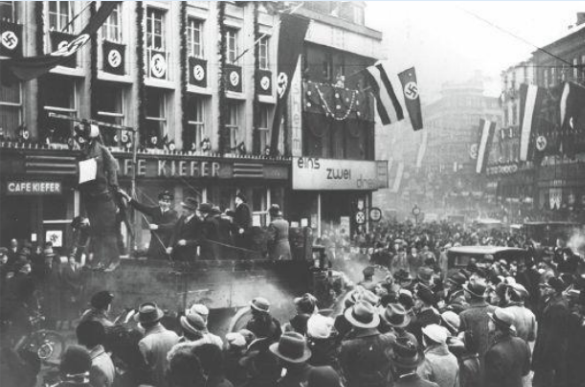
Visual Evidence of Saar → SOURCE 2: ‘A photograph showing German forces moving back into the Saar after the plebiscite in 1935’
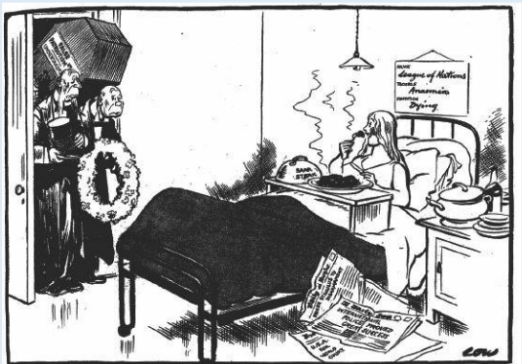
Perception of the League of Nations → SOURCE 3: British cartoon from January 1935 depicting the League of Nations as weak and ineffective post-Saar plebiscite.
→ Insinuation of the League's decline in influence and efficacy.
→ ‘A British cartoon published in January 1935, soon after the Saar plebiscite. The figure in bed is the League of Nations. The caption ‘Sitting up in bed and taking nourishment’. The writing on the wall reads, ‘Name: League of Nations; Trouble: Anaemia; Condition: Dying.’
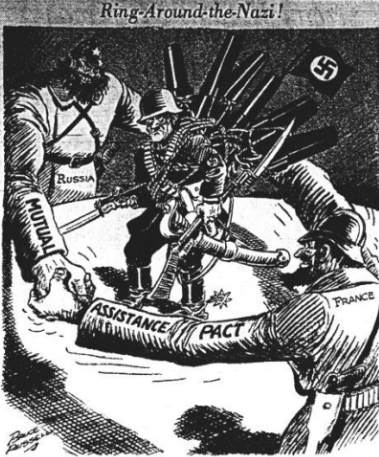
Foreign Perception of Hitler → SOURCE 4: ‘An American cartoon entitled ‘Ring-Around-the- Nazi!’ published in March 1936 showing the encirclement of Germany by France and the USSR.’
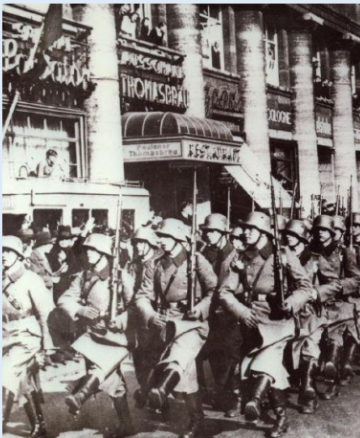
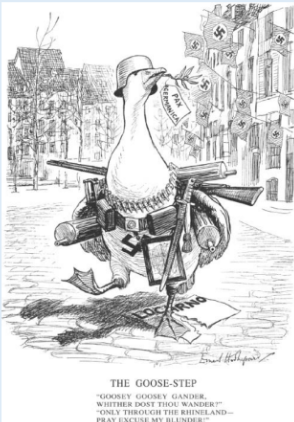
Military Presence → SOURCE 5: ‘German troops marching through the city of Cologne in March 1936. This style of marching with high steps was known as goose-stepping.’
Commentary on Rhineland Occupation → SOURCE 6: A British cartoon about the reoccupation of the Rhineland, 1936. Pax Germanica is Latin and means ‘Peace, German style’.
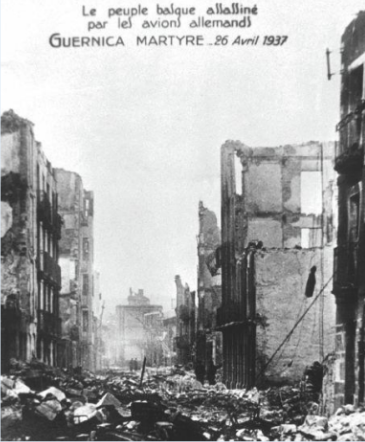
Guernica Bombing → SOURCE 7: Postcard from France commemorating the bombing of Guernica, highlighting the civilian casualties and evoking sympathy and outrage.
→ Discussion prompts focused on perceptions and media portrayal.
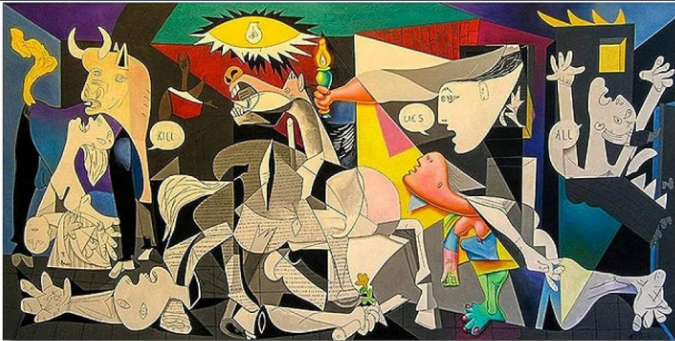
Art of War → SOURCE 8: A painting by Pablo Picasso, depicting the horrors of Guernica.
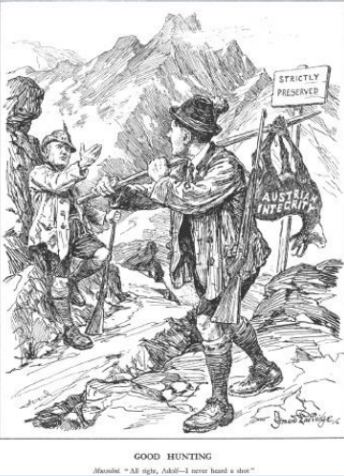
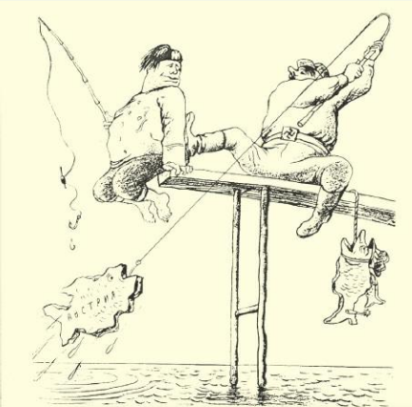
British Commentary on Anschluss → SOURCE 9: British cartoon analyzing the Anschluss, depicting a mocking portrayal of Hitler’s triumph.
Soviet Response → SOURCE 10: Soviet cartoon reflecting on the Anschluss, portraying Hitler's aggressive tactics in annexation.
2) Hitler's Rearmament Strategy
1933: Hitler began secret rearmament, citing other nations’ refusal to disarm as justification.
1935:
March: Hitler staged a military rally and reintroduced conscription, violating the Treaty of Versailles.
The Anglo-German Naval Agreement allowed Germany to expand its navy to 35% of Britain’s naval strength, further undermining the Treaty.
Impact: Rearmament boosted Nazi regime popularity in Germany.
British Perspective: Many in Britain sympathized, viewing Versailles’ military restrictions as overly harsh.
1930s Continuation: Hitler escalated military spending and production, preparing for future aggression.
3) The Saar Plebiscite
In January 1935, the Saar region held a plebiscite to determine whether it would return to Germany.
The result was 90% in favor of reunification with Germany, boosting Hitler’s popularity.
Hitler claimed no further territorial demands against France, presenting a façade of peace.
4) Remilitarisation of the Rhineland (1936)
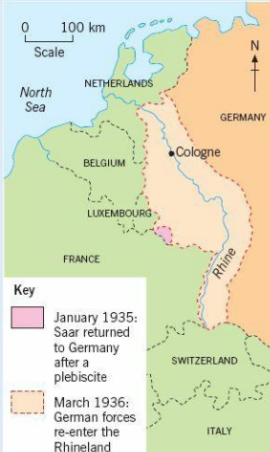
In March 1936, Hitler sent troops into the Rhineland, violating the Treaty of Versailles and the Locarno Treaties.
He justified it by claiming Germany was under threat after France signed a treaty with the USSR.
Hitler gambled that Britain wouldn’t intervene and France wouldn’t act.
France, distracted by domestic issues, did not respond, allowing Hitler to succeed.
5) Hitler's Gamble in Rhineland and it’s consequences
The remilitarisation strengthened the Hitler-Mussolini alliance and convinced Hitler that Britain and France would not act if he violated the Treaty of Versailles further.
Britain responded by significantly increasing military spending, particularly on the Royal Air Force.
The USSR grew suspicious of Britain and France due to their reluctance to confront fascism.
League of Nations Response
In 1936, the League of Nations was preoccupied with the Abyssinian crisis, and although it condemned Hitler’s actions, it lacked the power to intervene effectively.
Divisions within French leadership led to hesitation, as they waited for British support that never came, allowing Hitler’s remilitarisation of the Rhineland to succeed.
6) The Spanish Civil War
1936-1939: The Spanish Civil War provided Hitler with an opportunity to test military strategies and tactics.
German Support:
The Luftwaffe played a critical role in supporting Franco's Nationalists.
Political Impact:
Strengthened the alliance between Hitler and Mussolini.
Exposed the reluctance of Britain and France to intervene, emboldening Hitler’s expansionist ambitions.
7) Militarism and the Axis Powers
In the east, nationalist leaders like General Tojo, backed by business elites, aimed to expand Japan's empire to rival the USA.
In 1937, Japan invaded China, which some historians consider the first campaign of World War II.
Hitler and Mussolini saw similarities with Japan’s military dictatorship, leading to the Anti-Comintern Pact in 1936, aimed at opposing communism, with Italy joining in 1937.
This led to the formation of the Rome-Berlin Axis alliance.
Britain and France had limited options to counter the Axis, especially since Britain lacked the resources to fight both Japan in the Far East and Germany in Europe.
8) Anschluss with Austria 1938
March 1938: Hitler pursued the Anschluss (annexation of Austria).
Tactics: Encouraged Austrian Nazism and pressured the Austrian government to hold a plebiscite.
German Intervention: German troops entered Austria to secure control, resulting in 99.75% approval for annexation.
Impact:
Further defied the Treaty of Versailles.
Highlighted the inability of Britain and France to challenge German aggression.