Chapter22"physics"
Electric Flux
The concept of flux describes how much of something goes through a given area. More formally, it is the dot product of a vector field within an area. For a better understanding, consider an open rectangular surface with a small area that is placed in a uniform electric field. The larger the area, the more field lines go through it and, hence, the greater the flux; similarly, the stronger the electric field (represented by a greater density of lines), the greater the flux. On the other hand, if the area is rotated so that the plane is aligned with the field lines, none will pass through, and there will be no flux. If the area is perpendicular to the electric field then the angle between their vectors becomes zero, resulting in maximum flux. Suppose the surface is rotated in such a way that it forms a 60° angle with the electric field; in this case, the electric flux results in half of the product of the electric field multiplied by the area.
For discussing the flux of a vector field, it is helpful to introduce an area vector. This vector has the same magnitude as the area and is directed normal to that surface. Since the normal to a flat surface can point in either direction from the surface, the direction of the area vector of an open surface needs to be chosen. However, if a surface is closed, then the surface encloses a volume. In that case, the direction of the normal vector at any point on the surface is from the inside to the outside.
The electric flux through an surface is then defined as the surface integral of the scalar product of the electric field, and the area vector and is represented by the symbol Φ. It is a scalar quantity and has an SI unit of newton-meters squared per coulomb (N·m2/C). In general, a rectangular surface is considered an open surface as it does not contain a volume, and a closed surface can be a sphere as it contains a volume.
Procedure
Electric flux is defined as the number of electric field lines penetrating a surface of a given area that can be either open or closed.
Consider an open surface with many tiny elements with area dA placed in an electric field.
The area is made as a vector with the same magnitude as the area of the element and the direction perpendicular to the element.
The flux through each element is given by the dot product of the electric field and the area vector. The net flux is obtained by integrating this product over the entire surface.
If the surface is closed with electric charges inside it, the electric field lines penetrate through the surface.
The area vectors point in different directions, always from inside to outside. The net electric flux can then be obtained similarly as before.
The flux can be either positive or negative based on whether it enters or leaves the surface and is determined by the type of charge that creates the electric field.
Gauss’s Law
If a closed surface does not have any charge inside where an electric field line can terminate, then the electric field line entering the surface at one point must necessarily exit at some other point of the surface. Therefore, if a closed surface does not have any charges inside the enclosed volume, then the electric flux through the surface is zero. What happens to the electric flux if there are some charges inside the enclosed volume? Gauss's law gives a quantitative answer to this question.
To get an understanding of what to expect, let's calculate the electric flux through a spherical surface around a positive point charge, q, since we already know the electric field in such a situation. Recall that when we place the point charge at the origin of a coordinate system, the electric field at a point that is at a distance r from the charge at the origin is given by

Using this electric field, the flux through the spherical surface of radius r can be found.
Then, substituting the known values into the electric flux expression for the closed system and integrating the expression, the flux through the closed spherical surface at radius r is obtained as
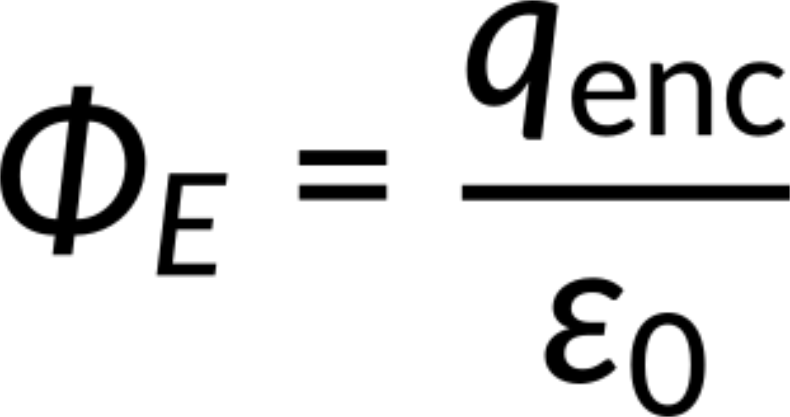
A remarkable fact about this equation is that the flux is independent of the size of the spherical surface. This can be directly attributed to the fact that the electric field of a point charge decreases at 1/r2 with distance, which just cancels out the r2 rate of increase of the surface area.
Gauss's law generalizes this result to cases with any number of charges and any location of the charges in the space inside the closed surface. According to Gauss's law, the flux of the electric field, through any closed surface, also called a Gaussian surface, is equal to the net charge enclosed, qenc, divided by the permittivity of free space, ε0:

To use Gauss's law effectively, you must have a clear understanding of what each term in the equation represents. The field is the total electric field at every point on the Gaussian surface. This total field includes contributions from charges inside and outside the Gaussian surface. However, qenc is just the charge inside the Gaussian surface. Finally, the Gaussian surface is any closed surface in space. That surface can coincide with the actual surface of a conductor, or it can be an imaginary geometric surface. The only requirement imposed on a Gaussian surface is that it be closed.
Procedure
Gauss's law states that the net electric flux through any closed surface is equal to the net charge enclosed by the surface divided by the permittivity of free space.
The closed surface which is a three-dimensional mathematical construct that can be any imaginary shape is called the Gaussian surface.
However, irrespective of the shape or size of the Gaussian surface, the total flux through it always depends only on the charge enclosed by it.
When there is a charge distribution, the total electric field can be determined using the principle of superposition. The net flux through the Gaussian surface by applying Gauss's law for individual charges equals the sum of only the charges enclosed by it.
Consider a point charge in a sphere. From Gauss's law, the electric field due to the enclosed charge can be obtained.
Using the expression for the force on a point charge due to an electric field, Gauss's law can be shown to be equivalent to Coulomb's law.
Gauss's Law: Spherical Symmetry
A charge distribution has spherical symmetry if the density of charge depends only on the distance from a point in space and not on the direction. In other words, if the system is rotated, it doesn't look different. For instance, if a sphere of radius R is uniformly charged with charge density ρ0, then the distribution has spherical symmetry. On the other hand, if a sphere of radius R is charged so that the top half of the sphere has a uniform charge density ρ1 and the bottom half has a uniform charge density ρ2, then the sphere does not have spherical symmetry as the charge density depends on the direction. Thus, it is not the shape of the object but rather the shape of the charge distribution that determines whether or not a system has spherical symmetry. Suppose a sphere has four different shells, each with uniform charge density. Although the charge density in the entire sphere is not uniform, the function depends only on the distance from the center and not on the direction. Therefore, this charge distribution does have spherical symmetry.
In all spherically symmetrical cases, the electric field at any point must be radially directed because the charge and, hence, the field must be invariant under rotation. Therefore, using spherical coordinates with their origins at the center of the spherical charge distribution, the electric field only becomes the function of distance. To find the electric field, a Gaussian surface, which is a closed spherical surface with the same center as the center of the charge distribution, is constructed to find the electric field. Thus, the direction of the area vector of an area element on the Gaussian surface at any point is parallel to the direction of the electric field at that point. Further, the electric field magnitude over this surface is the same at all points. So, the electric flux over the surface is the product of the electric field magnitude and the surface area. The electric field magnitude can be obtained using this in Gauss's law.
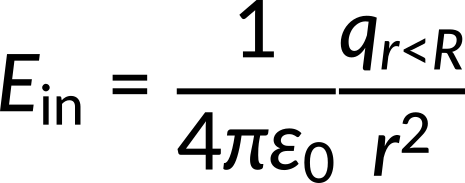
When a spherical charge distribution occupies a volume, two concentric Gaussian spheres are constructed inside and outside the sphere to find the electric field inside and outside the sphere. The charge enclosed depends on the distance r of the field point relative to the radius of the charge distribution R. If point P is located outside the charge distribution, then the Gaussian surface containing P encloses all charges in the sphere. In this case, the enclosed charge equals the sphere's total charge. On the other hand, if point P is within the spherical charge distribution, then the Gaussian surface encloses a smaller sphere than the sphere of charge distribution. In this case, the charge enclosed is less than the total charge present in the sphere. Using the Gauss's law expression, the magnitude of the electric field at a point outside and inside the sphere can be obtained.

Procedure
Consider a sphere with uniform charge density.
Suppose the sphere is rotated in any radial direction; the charge density remains unchanged. Since the charge density is only a function of distance, the system possesses spherical symmetry.
If a sphere has a different charge distribution in each quarter, the charge density depends on the direction. So, this system is not spherically symmetric.
Spherical symmetry is thus determined only by the shape of charge distribution and not by the system's shape.
When there is a spherically symmetric charge distribution, the electric field magnitude over a suitable Gaussian surface is constant.
The electric field is parallel to the area vector, making the flux a product of electric field magnitude and surface area.
Applying Gauss's law, the expression for electric field magnitude simplifies to an algebraic relation.
Suppose the spherically symmetric charge density is distributed over a volume. The electric field magnitude outside the sphere is equivalent to that of a point charge with a magnitude equal to the total charge of the spherical charge distribution.
Gauss's Law: Cylindrical Symmetry
A charge distribution has cylindrical symmetry if the charge density depends only upon the distance from the axis of the cylinder and does not vary along the axis or with the direction of the axis. In other words, if a system varies if it is rotated around the axis or shifted along the axis, it does not have cylindrical symmetry. In real systems, we do not have infinite cylinders; however, if the cylindrical object is considerably longer than the radius from it that we are interested in, then the approximation of an infinite cylinder becomes useful.
In all cylindrically symmetrical cases, the electric field at any point P must also display cylindrical symmetry. To make use of the direction and functional dependence of the electric field, a closed Gaussian surface in the shape of a cylinder with the same axis as the axis of the charge distribution is chosen. The flux through this surface of radius r and height L is easy to compute if we divide our task into two parts: (a) the flux through the flat ends and (b) the flux through the curved surface. The electric field is perpendicular to the cylindrical side and parallel to the planar end caps of the surface. The flux is only due to the cylindrical part whereas the flux through the end caps is zero because the area vector is perpendicular to the electric field. Thus, the flux is

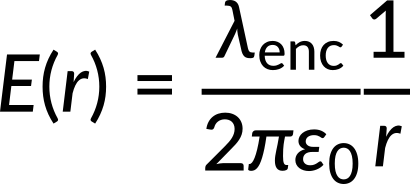
According to Gauss's law, the flux must equal the amount of charge within the volume enclosed by this surface divided by the permittivity of free space. For a cylinder of length L, the charge enclosed by the cylinder is the product of the charge per unit length and the cylinder length. Hence, Gauss’s law for any cylindrically symmetrical charge distribution yields the following magnitude of the electric field at a distance r away from the axis:
Procedure
Consider different infinitely long straight cylinders, each having distinct charge distributions.
Among these, only the systems with a charge density that does not vary when you rotate it and do not vary along the axis length possess cylindrical symmetry. In comparison, the others do not have cylindrical symmetry.
When there is a cylindrically symmetric charge distribution, a cylindrical Gaussian surface is constructed to obtain the electric flux.
The electric field through the curved part of this surface is parallel to the area vector and has the same magnitude over the circumference and length. From this, the flux over the curved portion is obtained.
The electric field through the flat ends is perpendicular to the area vector, making the flux zero. By combining both, the total flux through the Gaussian surface is obtained.
Since the charge density is constant over the Gaussian cylinder length, the charge enclosed is the product of line charge density and cylinder length.
According to Gauss' law, the electric field magnitude is obtained, which varies inversely with distance from the line charge.
Gauss's Law: Planar Symmetry
A planar symmetry of charge density is obtained when charges are uniformly spread over a large flat surface. In planar symmetry, all points in a plane parallel to the plane of charge are identical with respect to the charges. Suppose the plane of the charge distribution is the xy-plane, and the electric field at a space point P with coordinates (x, y, z) is to be determined. Since the charge density is the same at all (x, y) - coordinates in the z = 0 plane, by symmetry, the electric field at P cannot depend on the x- or y-coordinates of point P. Therefore, the electric field at P can only depend on the distance from the plane and has a direction either toward the plane or away from the plane. That is, the electric field at P has only a nonzero z-component.
The electric field due to a planar charge distribution with surface charge density σ can be calculated using Gauss’s Law. For this, consider a cylindrical Gaussian surface that is equidistant from the plane on both sides. The cylinder's axis is perpendicular to the plane, and the area of its flat ends is A, as shown in the figure.

The electric flux through the curved surface of the cylinder is zero as the electric field is perpendicular to the area vector. The electric flux through the flat surface is EA, as the electric field in this plane is parallel to the area vector. Hence the total flux through the Gaussian surface is -2EA.
Now, the charge enclosed by the Gaussian surface is -σA. From Gauss’s law, the electric flux through the Gaussian surface is proportional to the charge enclosed by the surface.
Using the equations for the flux and Gauss's law, the electric field at a point P from the uniformly charged plane is given by
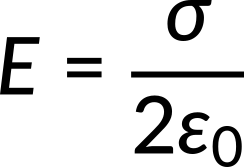
The direction of the electric field depends on the sign of the charge on the plane and the side of the plane where the field point P is located. From the above expression, the electric field is observed to be independent of the distance from the plane; this is an effect of the assumption that the plane is infinite. In practical terms, the result given above is still a useful approximation for finite planes near the center.
Procedure
A flying airplane gains a negative charge on its surface due to friction with the air.
Assuming these charges are uniformly spread on its wings, what is the electric field generated?
Consider a small portion of the wing. The charge distribution remains unchanged under rotation about an axis perpendicular to it. Hence, the charge distribution has planar symmetry.
Due to planar symmetry, the electric field is uniform and perpendicular to the surface on either side.
A cylindrical Gaussian surface with its axis perpendicular to the plane and the flat ends equidistant from it is constructed.
The electric flux over the curved surface is zero. The flux through the flat ends equals the electric field magnitude multiplied by the surface area.
The total flux is, thus, twice the flux obtained from each flat surface.
From Gauss's law, the charge enclosed is the product of the area of the flat surface and the surface charge density.
Combining these, the electric field magnitude can be obtained.
Electric Field Inside a Conductor
When a conductor is placed in an external electric field, the free charges in the conductor redistribute and very quickly reach electrostatic equilibrium. The resulting charge distribution and its electric field have many interesting properties, which can be investigated with the help of Gauss's law.
Suppose a piece of metal is placed near a positive charge. The free electrons in the metal are attracted to the external positive charge and migrate freely toward that region. This region then has an excess of electrons over protons in the atoms while the region from where the electrons have migrated has more protons than electrons. Consequently, the metal develops a negative region near the charge and a positive region at the far end. This separation of equal magnitude and opposite type of electric charge is called polarization. The electrons migrate back and neutralize the positive region if the external charge is removed. The polarization of the metal happens only in the presence of external charges.
When a conductor is polarized, an induced electric field is created inside the conductor opposite to the external field. This means that the net field inside the conductor differs from the field outside, and is a vector sum of the fields due to external charge and induced surface charge densities. The free electrons continuously migrate under the external electric field until the induced electric field becomes equal in magnitude to the external field and electrostatic equilibrium is established. Thus, the net electric field inside the conductor at electrostatic equilibrium is zero. From Gauss's law, if the net electric field inside a conductor is zero, then there is no net charge enclosed by a Gaussian surface that is solely within the volume of the conductor. Thus, the net charge inside the conductor is also zero.
Procedure
Consider a conductor placed in an external electric field. In a conductor, only the electrons are free to move.
The free electrons migrate opposite to the external electric field, accumulating at one end of the surface.
Consequently, the other end of the surface has a lesser number of electrons and so gains a net opposite surface charge, thus polarizing the conductor.
Due to the accumulation of surface charges, an internal electric field is developed opposite the external field.
As the charges continue to move, the internal field magnitude increases until it equals the external field.
The conductor now reaches a steady state known as electrostatic equilibrium, and the charges do not move anymore.
In this condition, the net field at all the points inside the conductor, which is the sum of the external and the internal fields, vanishes.
From Gauss' law, zero electric fields imply no net charge enclosed inside a conductor.
Charge on a Conductor
An interesting property of a conductor in static equilibrium is that extra charges on the conductor end up on its outer surface, regardless of where they originate. Consider a hollow metallic conductor with a uniform surface charge density. Since the conductor itself is in electrostatic equilibrium, there should not be any electric field inside the conductor. Now, assume a Gaussian surface enclosing the hollow portion. Applying Gauss's law, the inner surface of the hollow conductor will not have any charge.
Now, suppose a charge is enclosed inside the hollow conductor. Due to electrostatic equilibrium and Gauss's law, the conductor's inner surface acquires a negative charge. As the net charge inside the conductor is zero, the conductor's surface also acquires a net charge opposite to the cavity. Thus, the charges always reside on the surface of a conductor.
Consider another conductor with two cavities, 1 and 2. Cavity 1 encloses a positive charge, while cavity 2 encloses a negative charge. The polarization of the conductor results in induced negative and positive surface charges, respectively, on the inside surface of cavities 1 and 2, respectively. Similarly, the outside surface of the conductor shows an induced charge equal to the difference between the positive and negative induced charges inside the cavities.
The distribution of charges on the surfaces depends upon the geometry. At electrostatic equilibrium, the charge distribution in a conductor is such that the electric field by the charge distribution in the conductor cancels the electric field of the external charges at all points inside the conductor's body.
In summary, the net charge inside a closed conducting container is always zero. If the closed conducting container encloses a charge and the charge finds a conducting path, it flows to the container's surface. Otherwise, the enclosed charge induces an equal and opposite charge on the inner surface, so the net charge inside is still zero. Any net charge on a conducting object resides on its surface.
Procedure
Suppose a lightning bolt strikes a car. The car's body is induced with electric charges on its surface.
Will there be any charges on the car's inner surface?
Here, the car's metallic body can be approximated as a conductor with a cavity.
Since the conductor itself is in electrostatic equilibrium, there should not be any electric field inside the conductor.
Hence, according to Gauss' law, the car's inner surface will not have any charge.
Consider another case where a deep, hollow, metal container is connected to an electroscope.
If a positively charged object is lowered into this container, the electroscope deflects, suggesting the presence of electric charges on the container's surface.
This condition can be approximated as a charge enclosed inside a hollow conductor. Due to electrostatic equilibrium and Gauss' Law, the conductor's inner surface acquires negative charges.
As the net charge inside the conductor is zero, the conductor's surface also acquires a net charge opposite to that of the cavity.
Thus, the charges always reside on the surface of a conductor.
Electric Field at the Surface of a Conductor
Consider a conductor in electrostatic equilibrium. The net electric field inside a conductor vanishes, and extra charges on the conductor reside on its outer surface, regardless of where they originate.
In the 19th century, Michael Faraday conducted the famous ice pail experiment to prove that the charges always reside on the surface of a conductor. The experimental set-up consists of a conducting uncharged container mounted on an insulating stand. The outer surface of the container is connected to an electroscope. The electroscope deflects when a positively charged metal ball with an insulating thread is lowered into the container without touching its walls. The electroscope's deflection suggests that negative and positive charges are induced on the container's inner and outer surfaces. The negative charges in the metal container are attracted to the positive charges of the metal ball, and they move to the inner surface of the container. In contrast, the positive charges are repelled by the positive charges of the metal ball and move to the outer surface. The electric field due to the induced charges cancels the electric field due to the metal ball inside the container, causing zero electric field.
When the metal ball touches the container's inner wall, the electroscope remains in a deflected position. All the charges on the metal ball flow out and neutralize the induced negative charges. Thus, the inner walls of the container and the metal ball remain uncharged, while positive charges reside on the container's outer surface.
The electric field at the surface of a conductor in electrostatic equilibrium does not have a component parallel to the surface. If the electric field had a component parallel to the surface of a conductor, free charges on the surface would move, a situation contrary to the assumption of electrostatic equilibrium. Therefore, the electric field is always perpendicular to the surface of a conductor. At any point just above a conductor's surface, the electric field's magnitude is directly proportional to the surface charge density.
Procedure
Consider a metallic earth wire placed on the top of an electric transmission tower. When an electrostatically charged cloud looms over this transmission tower, the metallic wires develop an induced surface charge.
The electrostatic equilibrium of the conductor ensures that the electric field outside the conductor is perpendicular to its surface; while it vanishes within the conductor.
The electric field on the surface of this conductor can be calculated, assuming an infinitesimal cylindrical Gaussian surface through the conductor.
Along the curved surface, the flux is zero, whereas, at the flat end, the flux equals electric field times area.
Under the assumption that surface charge density is constant, the total charge enclosed by the flat Gaussian surface equals the surface charge density times the surface area.
Applying Gauss' Law, the total flux equals the charge enclosed divided by the permittivity of the vacuum.
Rearranging the terms, the magnitude of electric field at the conductor's surface is obtained.
Hence, the electric field at the surface of the conductor is dependent only on its surface charge density.
Key Takeaways on Electric Flux and Gauss's Law:
Electric Flux Definition: Electric flux measures how much electric field passes through a given area (surface integral of electric field and area vector).
Surface Types: Surfaces can be open (like rectangles) or closed (like spheres). Electric flux depends on the orientation and area size relative to the electric field.
Gauss's Law: States that the net electric flux through any closed surface equals the net charge enclosed divided by the permittivity of free space (Φ = q_enc / ε₀). This law applies in cases of spherical and cylindrical symmetry.
Spherical Symmetry: For uniformly charged spheres, the electric field behaves as if all charges were concentrated at the center regardless of the surface size.
Cylindrical Symmetry: In cylindrical charge distributions, the electric field at distance r from the axis varies inversely with distance.
Planar Symmetry: Uniform charge distributions on large flat surfaces lead to constant electric fields independent of distance.
Conductors in Electric Fields: Electric fields within conductors at equilibrium are zero; excess charge resides on the surface.
Surface Charge Dynamics: When charged, conductors redistribute charges such that electric fields are always perpendicular at the surface, and any internal electric fields cancel out.