3. Atomic Stability and Molecular interactions
Atomic Stability and Molecular Interactions
Atomic Stability
Atomic stability dictates how strongly an atom holds onto or releases electrons.
Electrons orbit the nucleus in specific electron shells.
The first shell can hold a maximum of two electrons.
Subsequent shells can hold a maximum of eight electrons (biologically relevant).
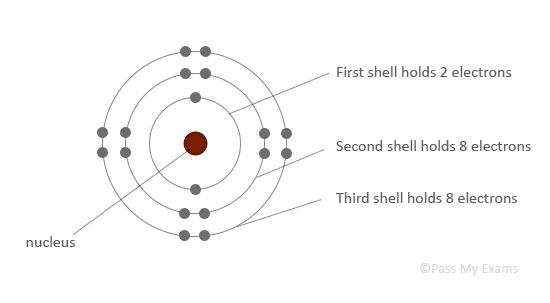
Atoms with a complete outer shell are stable and unreactive because they don't need to gain or lose electrons.
Examples:
Helium (2 electrons): Unreactive.
Neon (10 electrons): Unreactive.
Hydrogen (1 electron): Reactive.
Carbon (6 electrons): Reactive.
Sodium (11 electrons): Reactive.
Oxygen (8 electrons): Reactive.
Achieving Atomic Stability
Atoms aim to complete their outermost electron shell.
This can be achieved by:
Gaining electrons.
Losing electrons.
Sharing electrons.
Gaining or losing electrons results in the formation of ions.
Ions : Cations and Anions
Ions are atoms with an electrical charge.
Atoms are electrically neutral because they have an equal number of protons and electrons.
Cations:
Positively charged ions.
Formed when an atom loses electrons.
Mnemonic: "Cats are positive" or the "t" in cation looks like a plus sign.
Example: Sodium (Na) loses an electron to become .
Anions:
Negatively charged ions.
Formed when an atom gains electrons.
Example: Chlorine (Cl) gains an electron to become
Ions interact based on their electrical charge (opposites attract).
Example: Sodium Chloride (NaCl) Formation
Sodium (Na) has 11 electrons and readily loses one to achieve stability, forming .
Chlorine (Cl) has 17 electrons and readily gains one to achieve stability, forming
and attract each other due to their opposite charges, forming an ionic bond.
Ionic bonds are relatively weak and can be disrupted by water.
General Ionic Compound Formation
Ions combine in ratios that achieve electrical neutrality.
Example: Magnesium (Mg) loses two electrons to become , requiring two chloride ions () to balance the charge and form .
Covalent Bonds: Sharing Electrons
Covalent bonds involve sharing electrons between atoms to achieve atomic stability.
Atoms must stay close together for the electron(s) to orbit both nuclei.
Sharing does not change the overall charge of the atom.
Covalent bonds create a tighter interaction than ionic bonds.
A single covalent bond involves sharing a pair of electrons (one from each atom).
Multiple pairs of electrons can be shared, forming double or triple bonds.
Example: Two oxygen atoms sharing two pairs of electrons.
Chemical Notation: O=O
Example: 1 Oxygen atom sharing 1 pair of electrons with two hydrogen atoms (1 pair per hydrogen)
Chemical Notation: H-O-H
Polarity of Covalent Bonds
Electrons in covalent bonds can be shared equally or unequally.
Nonpolar Covalent Bonds:
Electrons are shared equally.
No charge difference across the molecule.
Polar Covalent Bonds:
Electrons are shared unequally.
One atom is more electronegative and attracts the electrons more strongly.
Results in a slight negative charge ($\delta^-$) on the more electronegative atom and a slight positive charge ($\delta^+$) on the other atom.
Creates a dipole moment.
Polarity and Molecular Interactions
Polarity influences how molecules interact with each other.
Water () is a polar molecule due to oxygen's higher electronegativity.
Oxygen has a slight negative charge ($\delta^-$).
Hydrogens have slight positive charges ($\delta^+$).
Polar molecules (hydrophilic) interact favorably with water.
Nonpolar molecules (hydrophobic) do not interact favorably with water.
Larger molecules can have both polar and nonpolar regions.
Identifying Polar vs. Nonpolar Bonds
Electronegativity determines bond polarity.
Bonds between carbon and oxygen tend to be polar (except O-O). Other atoms bonded covalently with oxygen, apart from oxygen, tend to make polar covalent bonds.
Bonds between carbon and hydrogen tend to be nonpolar. Things that bond with carbon tend to make nonpolar covalent bonds.
Carbon, hydrogen, oxygen, and nitrogen are key elements in the body.
The presence of sufficient oxygen usually indicates polarity. Absence indicates nonpolarity.