Chap 7: Cognition
Models of Memory
Three-Box / Information-Processing Model
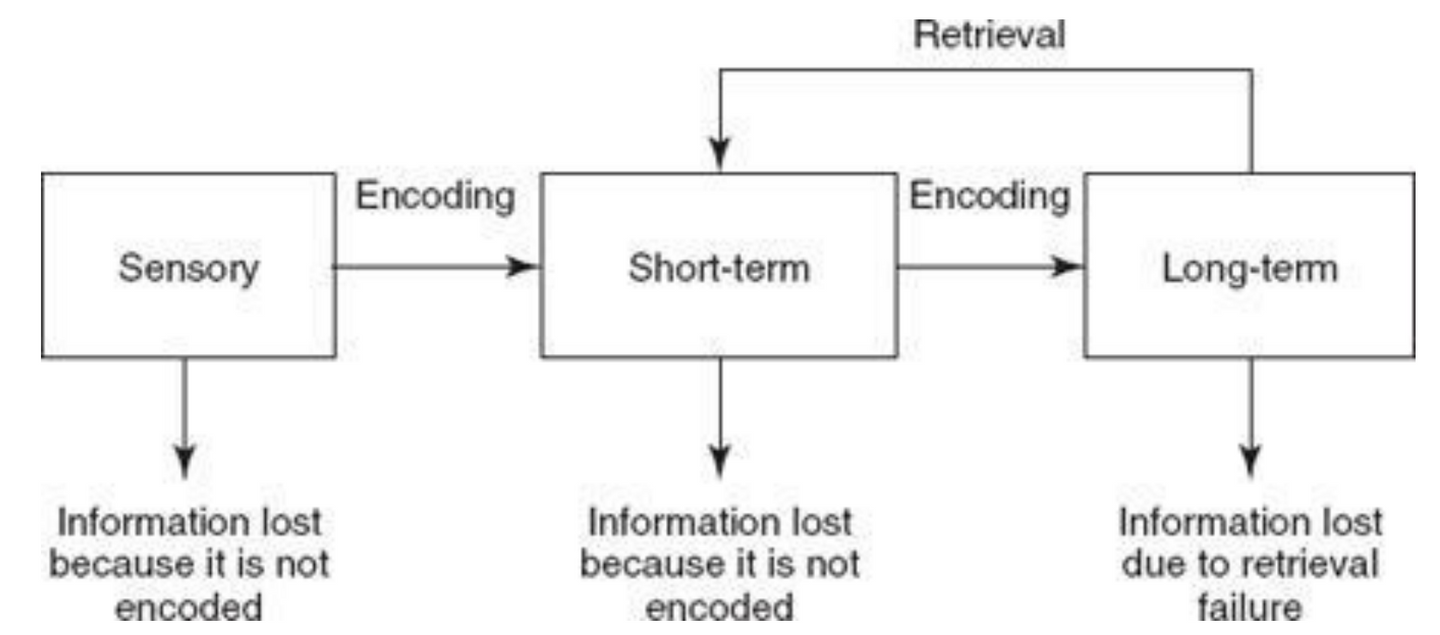
Sensory Memory
- First stop for external events. It is a split-second holding tank for incoming sensory information.
- George Sperling
- Flashed a grid of letters to participants for 1/20th of a second. Participants were asked to recall either the top, middle, or bottom row immediately after the grid was flashed at them.
- The participants could recall any of the rows perfectly. This experiment demonstrated that the entire grid must be held in sensory memory for a split second.
- Iconic memory → a split-second perfect photograph of a scene
- Other experiments demonstrate echoic memory → an equally perfect brief (3-4 second) memory for sounds
Most of the information in sensory memory is not encoded. Only some of it is encoded, or stored, in the short-term memory
- Events are encoded as visual codes (a visual image), acoustic codes (a series of sounds), or semantic codes (a sense of the meaning of the event)
Selective attention
- We encode what is important to us (determines which sensory messages get encoded)
Short-Term / Working Memory
These are memories we are currently working with and are aware of in our consciousness.
- Short-term memories are temporary. If we do nothing with them, they usually fade in 10-30 seconds.
- Our capacity in short-term memory is limited on average to around 7 items
- This average was established in a series of famous experiments by George Miller called “The Magical Number Seven, Plus or Minus Two”
- Chunking can expand this limit
- The process by which the mind divides large pieces of information into smaller units (chunks) that are easier to retain in short-term memory
- Mnemonic devices
- Any device or technique used to assist memory, usually by forging a link or association between the new information to be remembered and information previously encoded.
- Rehearsal
- The repetition of information in an attempt to maintain it longer in memory (not as effective)
Long-Term Memory
Our permanent storage of memory
- Capacity of long-term memory is unlimited, but memories can decay or fade from long-term memory (forgetting)
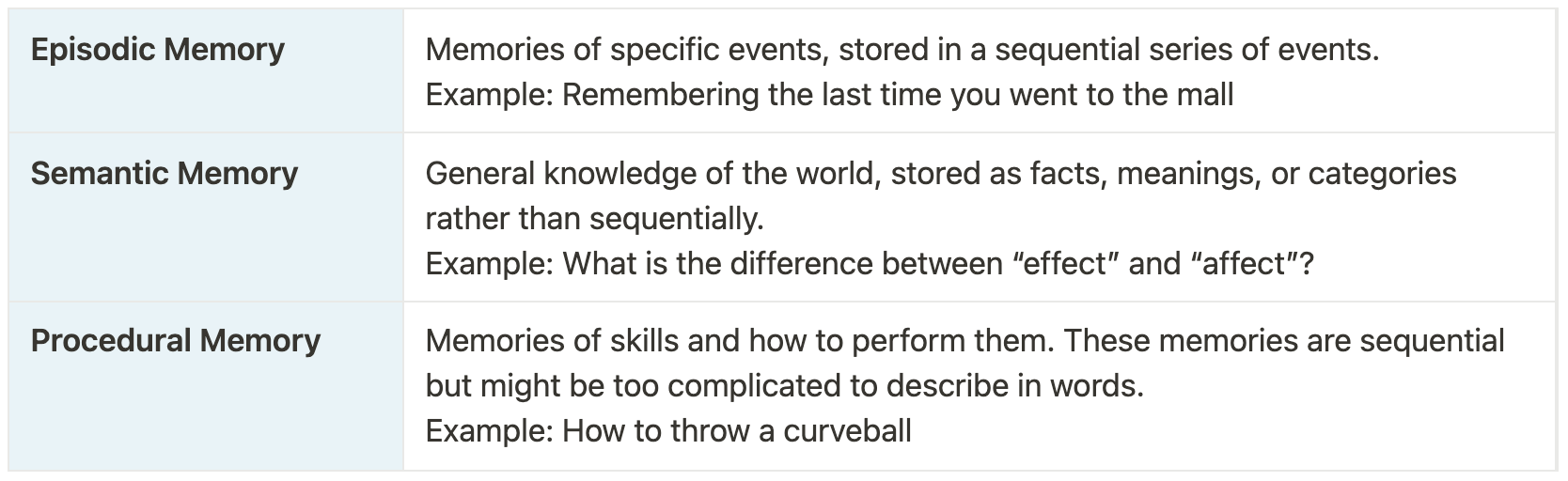
Explicit memories (declarative memories)
- What we usually think of first
- Conscious memories of facts or events we actively tried to remember
Implicit memories (non-declarative memories)
- Unintentional memories that we might not even realise we have
Eidetic (photographic) Memory
- A clear, specific, high-quality mental image of a visual scene that is retained for a period (seconds to minutes) after the event.
Alexander Luria
- Studied eidetic (photographic) memory
Levels of Processing Model
The theory that encoding into memory and therefore subsequent retention depend on the depth of cognitive elaboration that the information receives and that deeper encoding improves memory.
- Memories are either deeply (or elaborately) processed or shallowly (or maintenance) processed.
Retrieval
Recognition
- The process of matching a current event or fact with one already in memory
Recall
- Retrieving a memory with an external cue
Hermann Ebbinghaus
- Established that the order of items in a list is related to whether or not we will recall them
- Primacy effect
- More likely to recall items presented at the beginning of a list
- Recency effect
- Ability to recall items at the end of a list
- Items in middle are most likely forgotten
- Serial Position Effect - Primacy effect + Recency effect
Context is also an important factor in retrieval
- Tip-of-the-Tongue Phenomenon
- Temporary inability to remember information
- Semantic Network Theory (may explain TOT phenomenon)
- This theory states that our brain might form new memories by connecting their meaning and context with meanings already in memory
- Flashbulb Memories
- A vivid, enduring memory associated with a personally significant and emotional event, often including such details as where the individual was or what he or she was doing at the time of the event.
- Some studies show the flashbulb memories can be inaccurate → we tend to construct parts of the memory to fill in gaps in our stories
Mood-congruency memory
- Greater likelihood of recalling an item when our mood matched the mood we were in when the event happened
State-dependent memory
- Memory for a past event is improved when the person is in the same biological or psychological state as when the memory was initially formed
Constructive Memory
Recovered memory
- Claim to suddenly remember events they have repressed for years, often during the process of therapy
Elizabeth Loftus
- Showed that many of these memories may be constructed or false recollections of events
Constructed memory
- Can report false details of a real event or might even be a recollection of an event that never occured
Leading questions can easily influence us to recall false details, and questioners can create an entirely new memory by repeatedly asking insistent questions.
Forgetting
One cause of forgetting is decay: forgetting because we do not use a memory or connections to a memory for a long period of time
Relearning effect
- A way of measuring retention by measuring how much faster one relearns material that has been previously learned and then forgotten
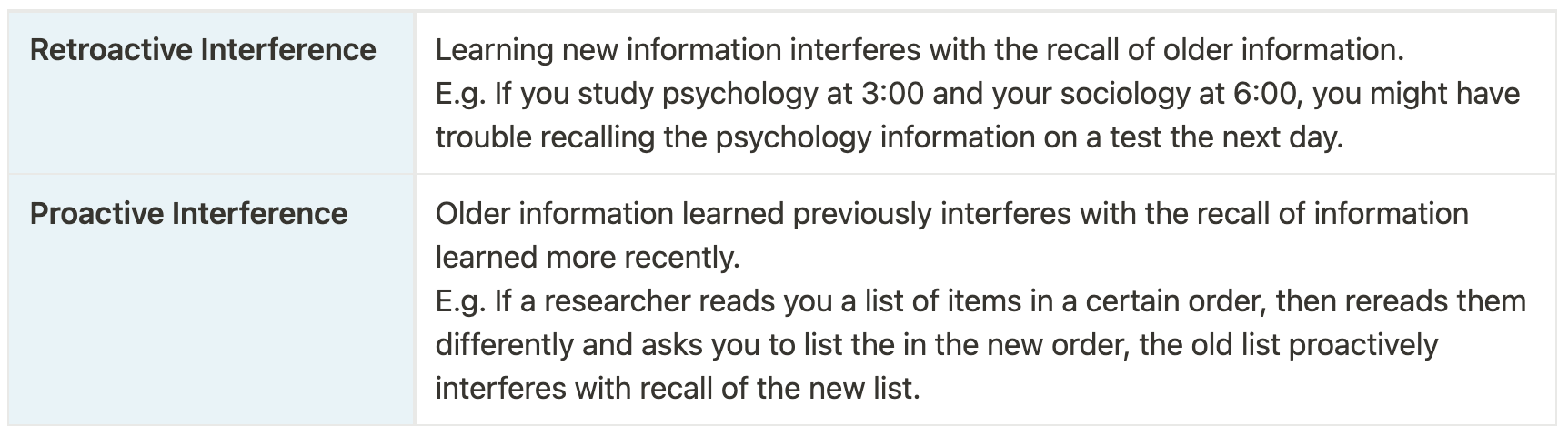
Interference
- Some other information in your memory competes with what you are trying to recall
How Memories Are Stored in the Brain
By studying patients with specific brain damage, we know that the hippocampus is important in encoding new memories. However, other brain structures are involved.
Anterograde amnesia
- Individuals with damage to the hippocampus who cannot encode new memories, but they can recall events already in memory
- They can learn new skills, although they will not remember learning them
- Indicates that the memory for these skills, or procedural memory, is stored elsewhere in the brain
Long-Term Potentiation
- Studies show that neurons can strengthen connections between each other.
- Through repeated firings, the connection is strengthened and the receiving neuron becomes more sensitive to the messages from the sending neuron
- This strengthened connection might be related to the connections we make in our long-term memory
Language
Phonemes
- Smallest units of sound used in language
Morpheme
- Smallest unit of meaningful sound
- Can be words or parts of words
Phonemes put together become morphemes, which make up words.
- These words are then spoken or written in a particular order, called syntax
Language Acquisition
Stage 1 happens when the baby starts to babble → appears to be innate (even babies born completely deaf go through this stage)
- Babies in this stage are capable of producing any phoneme from any language in the world
Babbling progresses into utterances of words as babies imitate the words they hear others speaking.
Holophrastic stage (One-word stage)
- During this time, babies speak in single words (holophrases)
Telegraphic speech (Two-word stage)
- Toddlers will combine the words they can say into simple commands. Meaning is usually clear at this stage, but syntax is absent.
- E.g. “No book, movie!”
- Children begin to learn grammar and syntax rules during this stage, sometimes misapplying the rules
- E.g. “Marky hitted my head so I throwed the truck at him.”
- Overgeneralization (Overregulation)
- Misapplication of grammar rules
Behaviourists theorized that language is learned like other learned behaviours: through operant conditioning and shaping.
- They thought that when children used language correctly, they got rewarded by their parents, and therefore they would be more likely to use language correctly in the future.
Noam Chomsky
- Theorized that humans are born with a language acquisition device → the ability to learn a language rapidly as children (Navist theory of language acquisition)
- Pointed to retarded development of language in cases of children deprived of exposure to languge during childhood
- Critical period → A window of opportunity during which we must learn a skill, or our development will permanently suffer
Language and Cognition
Benjamin Whorf
- Linguistic Relativity Hypothesis
- Theorized that the language we use might control, and in some ways limit, our thinking
Thinking and Creativity
Concepts
- We each have cognitive rules we apply to stimuli from our environment that allow us to categorize and think about the objects, people, and ideas we encounter. These rules are concepts.
We may base our concepts on prototypes
- What we think is the most typically example of a particular concept
Images
- Mental pictures we create in our minds of the outside world
Algorithm
- A rule that guarantees the right solution by using a formula or other foolproof method
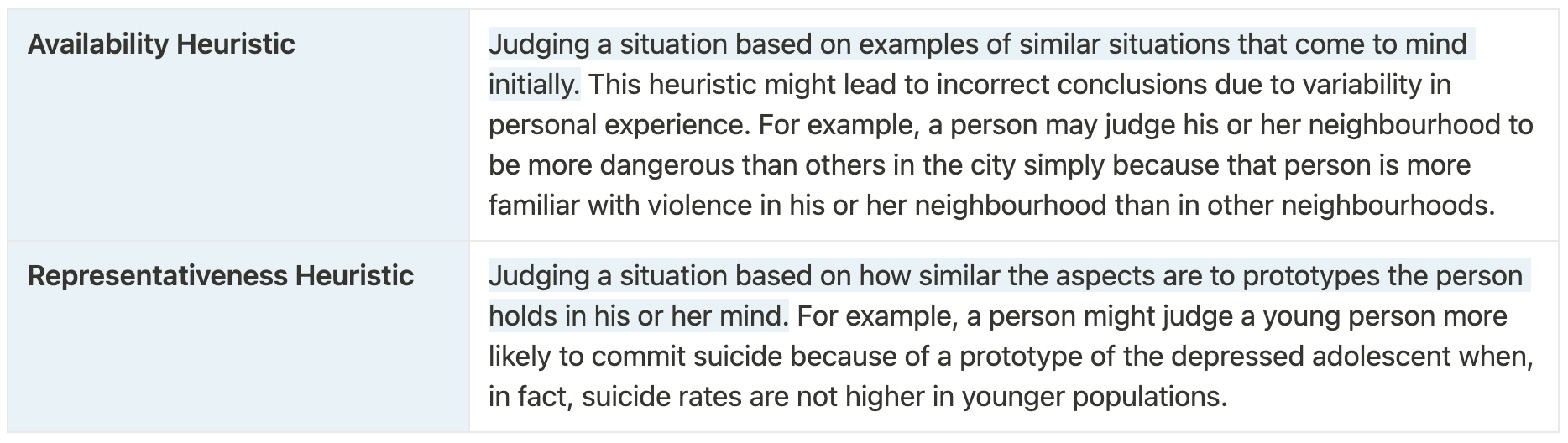
Heuristic
- Rule of thumb → a rule that is generally, but not always, true that we can use to make a judgement in a situation
Overconfidence
- Our tendency to overestimate how accurate our judgements are
- How confident we are in a judgement is not a good indicator of whether or not we are right
Belief Bias
- Occurs when we make illogical conclusions in order to confirm our preexisting beliefs
Belief Perseverance
- Our tendency to maintain a belief even after the evidence we used to form the belief is contradicted
Rigidity (Mental Set)
- The tendency to fall into established thought patterns
- Most people will use solutions or past experience to try to solve novel problems
Functional Fixedness
- The inability to see a new use for an object
Confirmation Bias
- We tend to look for evidence that confirms our beliefs and ignore evidence that contradicts what we think is true
Framing
- Refers to the way a problem is presented
- Presentation can drastically change the way we view a problem or an issue
Researchers investigating creative thinking find little correlation between intelligence and creativity.
Most people’s criteria for creative thinking involve both originality and appropriateness.
Convergent Thinking
- Thinking pointed towards one solution
Divergent Thinking
- Thinking that searches for multiple possible answers to a question
- More closely associated with creativity