Unit 8 Grammar
The Dative Case
Dative case of nouns
Masc & neut: Hard- Add y. Soft- Add ю
фem: Hard & soft - add e. Fem soft sign - add и. Ия/Ии add и.
Plural: Hard - Add am. Soft, fem, , Ия/ии - add ям
Some masc nouns have stress endings whenever an ending is added.
Some masc nouns of o or e in semifinal position lose this vowel when an ending is added.
Words мать and дочь have longer stem in every case except the nom and accusative singular. Their dative forms are матери, матерям and дочери, дочерям.
The possessive modifiers его and её and их never change. (but also note that его means his and the dative form, ему, means him)
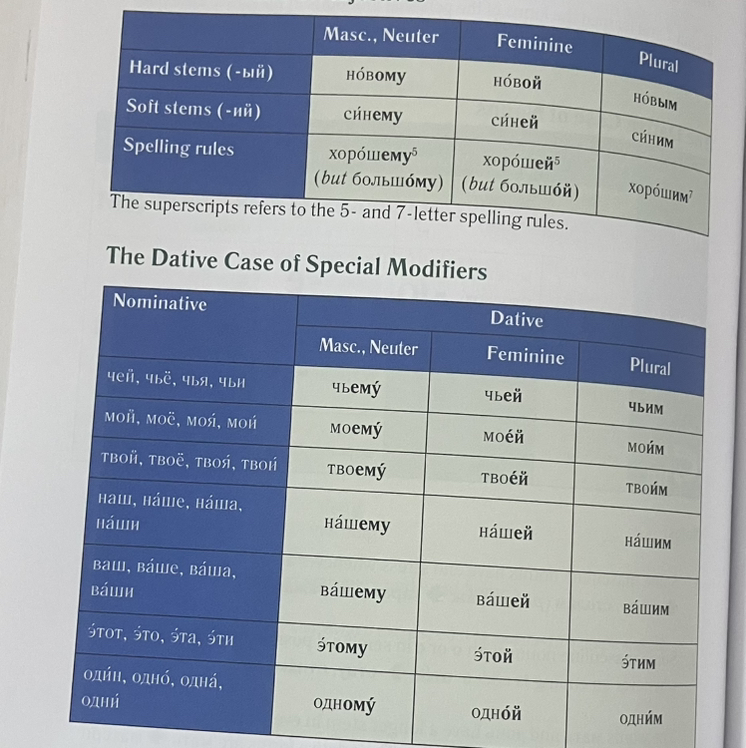
Dative case of adjectives:
Uses of Dative Case
A. expressing age
B. Indirect objects; the person to whom or for whom an action is done, eg. jim wants to give masha a gift; masha is the indirect object.
C. After the preposition по; (meaning most often on the topic of)
D. Expressing necessity
E. Expressions of possibility and impossibility: можно means it is possible and невозможно it is permissible. Можно takes dative, never nominative. But even so, dative is used only when context not clear. To negate можно, don’t use не. use невозможно for impossible and нельзя for not permitted. Невезможно is never used w nom and occasionally used with dative.
F. other dative subjectless construction; Russian uses dative constructions to convey how people feel. Dative + o adverb + rest of sentence. Almost any qualitative adverb ending in o can be combined w dative with or without additional phrasing.
Liking: Нравится, нравятса + Dative
To be pleasing to
Dative + нравятса + nominative
conjugates in они form: Мне, тебе нравится, ему нравятся
Past tense: Был
Past tense of to be
Он/Кто был
Она: была
Оно/что: было
Они/вы/мы были
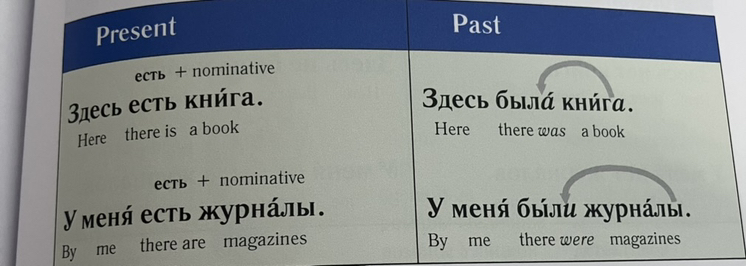
Had and did not have, past tense of ecт and нет
Existence
Past tense of is . The verb agrees w the thing that exists. This also applies to y constructions.