geog notes
Chapter 3 — Water and Its Spatial Distribution
1. States of Water
Water exists in three physical states:
Solid – Ice, snow, hail (molecules are tightly packed, fixed shape).
Liquid – Rivers, lakes, oceans (molecules move freely, takes shape of container).
Gas – Water vapour in the atmosphere (molecules far apart, no fixed shape).
Changes in state happen through:
Melting: Solid → Liquid
Freezing: Liquid → Solid
Evaporation: Liquid → Gas
Condensation: Gas → Liquid
2. Distribution of Water on Earth
Water is stored in different places called water stores:
Oceans and Seas — ~97% of Earth's water (salty, not drinkable).
Ice Caps and Glaciers — ~2% (solid state, freshwater, locked in polar regions).
Groundwater — Stored in underground layers (aquifers).
Lakes and Rivers — Small fraction but important for human use.
Atmosphere — Water vapour and clouds.
Soil Moisture — Water stored in the soil.
Freshwater availability: Only about 3% of all water is freshwater, and most is frozen in ice caps or underground.
3. The Hydrological (Water) Cycle
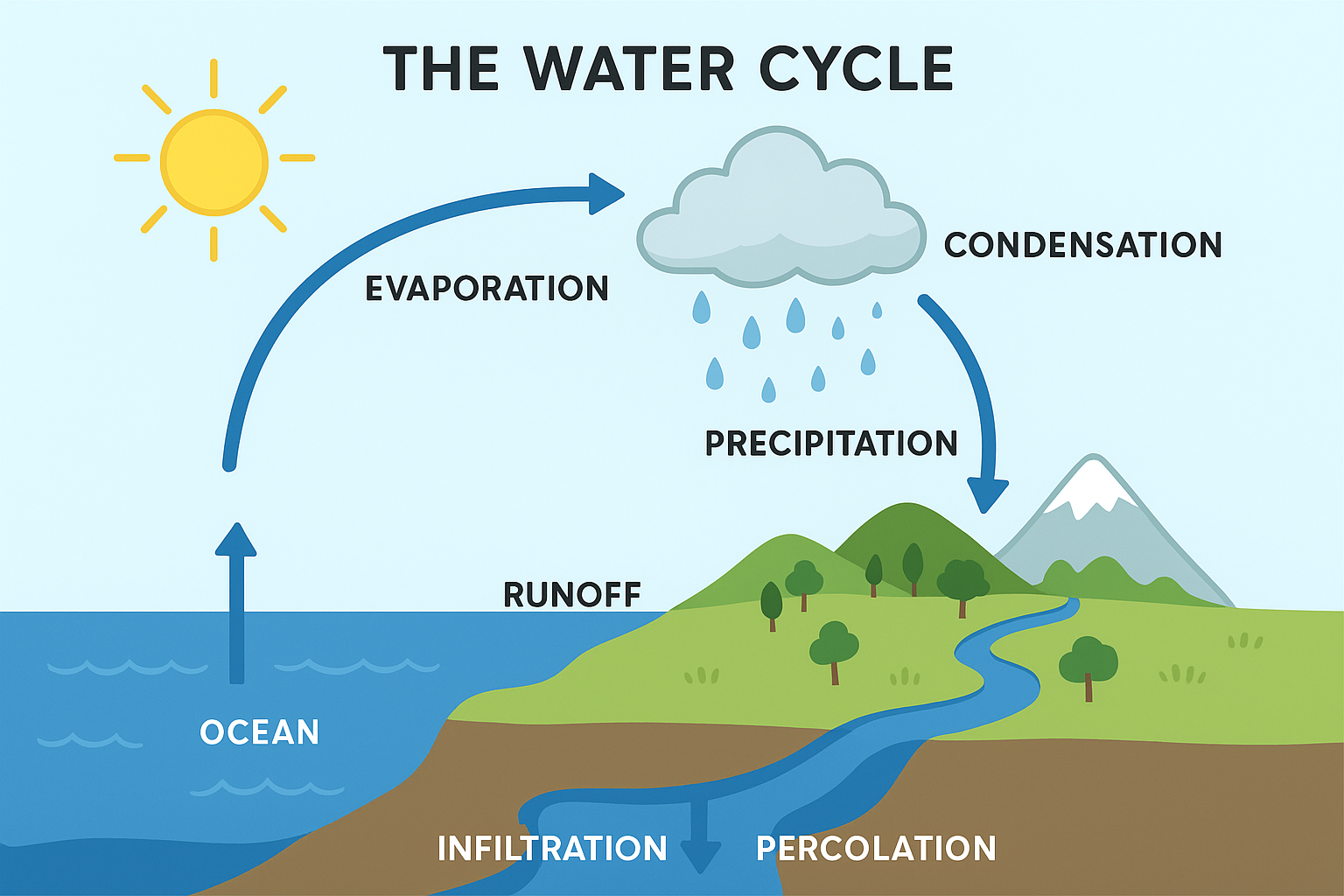
The movement of water between the atmosphere, land, and oceans through continuous processes:
Evaporation – Sun heats water from oceans, lakes, rivers → turns to vapour.
Transpiration – Plants release water vapour from leaves.
Condensation – Water vapour cools and turns into tiny droplets (forms clouds).
Precipitation – Droplets combine and fall as rain, snow, hail.
Infiltration – Water soaks into the ground.
Surface Runoff – Water flows over land back into rivers, lakes, oceans.
Percolation – Water seeps deeper underground to replenish aquifers.
Importance:
Recycles water.
Distributes heat around the globe.
Maintains ecosystems and the human water supply.
4. Key Diagram
Chapter 4 — Sustainable Management of Water
1. Importance of Water
Human survival — Drinking, cooking, sanitation.
Economic activities — Agriculture, industry, energy production.
Ecosystem health — Supports plants, animals, biodiversity.
2. Water-Related Hazards
A. Floods
Flash Floods:
Cause: Sudden heavy rain + poor drainage/impermeable surfaces.
Effect: Water levels rise quickly, dangerous in urban areas.
Example: Singapore flash floods in Orchard Road (2010).
River Floods:
Cause: Prolonged heavy rainfall → river overflows banks.
Often affects rural and low-lying areas.
Impacts of Floods:
Damage to property, loss of crops.
Disruption of transport.
Water contamination and disease spread.
B. Drought
Definition: Extended period of below-average rainfall.
Causes: Climate change, El Niño (unusual warming of surface waters in the eastern tropical Pacific Ocean) , overuse of water resources.
Effects:
Water shortages.
Crop failure and famine.
Economic losses in farming and industries.
C. Water Pollution
Sources:
Industrial waste (chemicals, heavy metals).
Domestic sewage.
Agricultural runoff (fertilisers, pesticides).
Effects:
Harm to aquatic life.
Unsafe drinking water.
Spread of waterborne diseases (e.g., cholera).
3. Sustainable Water Management
Goals:
Ensure adequate supply for present and future generations.
Protect water quality.
Reduce wastage.
Strategies:
Increase Water Supply:
Build reservoirs (e.g., Marina Barrage in Singapore).
Desalination plants.
Import water from other countries.
Rainwater harvesting.
Reduce Water Demand:
Water pricing to discourage wastage.
Public education campaigns (e.g., “Water Wally” in Singapore).
Use water-efficient appliances.
Protect Water Resources:
Treat industrial and domestic wastewater.
Protect catchment areas from pollution.
Legislation to control pollution.
4. Case Study — Singapore’s 4 National Taps
Local catchment water.
Imported water.
NEWater (recycled water).
Desalinated water.
This ensures water security despite small land size and limited natural resources.
5. Quick Mind Map (Text)
WATER MANAGEMENT
  ├─ Increase Supply
  │    ├─ Reservoirs
  │    ├─ Desalination
  │    ├─ NEWater
  │    └─ Rainwater Harvesting
  ├─ Reduce Demand
  │    ├─ Pricing
  │    ├─ Education
  │    └─ Water-saving devices
  └─ Protect Resources
       ├─ Wastewater treatment
       ├─ Catchment protection
       └─ Anti-pollution laws