BASIC ELECTRONICS
What are semi-conducting substances ?
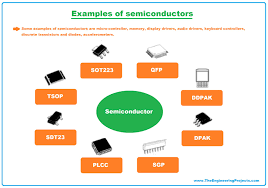
A ==semiconductor== is a substance that has an electrical conductivity between that of a conductor ==(like copper)== and an insulator ==(like rubber)==. Semiconductors are important materials used in electronic devices because their properties can be manipulated to control the flow of ==electrical current.==
In a semiconductor material, the atoms are arranged in a ==crystal structure,== and each atom shares its electrons with neighboring atoms to form a ==covalent bond.== In this way, the electrons are held tightly and are not free to move through the material. However, if energy is added to the material, either through heat or an applied electrical field, some of the electrons can be excited and break free from their covalent bonds, becoming mobile and able to conduct electrical current.
Semiconductors are commonly used in electronic devices such as ==transistors,== diodes, and solar cells. They are also used in computer chips, where their unique properties allow for the creation of ==complex circuits== and the storage and processing of information.
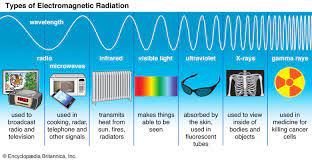
Define and give the function of electromagnetic waves in radio ?
waves are a type of wave that that travel through space at the speed of light. These waves are used in to transmit information over long distances.
Radio waves are a type of electromagnetic wave that have a frequency range of around Radio waves are used in radio communication because they can travel long distances without the need for They can also penetrate walls and other obstacles, which makes them useful for
The function of electromagnetic waves in radio is to transmit information from one location to another. The information is carried by the electromagnetic wave as a series of variations in the amplitude, frequency, or phase of the wave. These variations represent the signal that is being transmitted,
In radio communication, the transmitter converts the information signal into a modulated radio wave, which is then transmitted through the air. The radio wave is picked up by the receiver, which demodulates the signal to recover the original information. The electromagnetic waves used in radio communication are an of modern communication systems, enabling us to communicate over long distances and
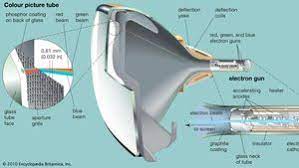
Define picture tube of television ?
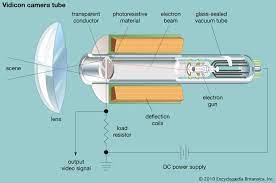
A @@picture tube,@@ also known as a cathode ray @@tube (CRT),@@ is a type of electronic display device used in older televisions and @@computer monitors.@@ The picture tube consists of a @@vacuum-sealed glass tube@@ with a fluorescent screen at one end and an electron gun at the other.
The electron gun fires a beam of electrons at the @@fluorescent screen,@@ which causes it to light up and produce a @@visible image.@@ The electron beam is directed by a magnetic field, which scans across the surface of the screen in a pattern to create a complete image. The pattern of the electron beam is controlled by an electrical signal that represents the image to be displayed.
The picture tube technology was widely used in older televisions and computer monitors, but it has largely been replaced by other display technologies such as @@liquid crystal displays (LCDs) and light-emitting diodes (LEDs).@@ These newer display technologies are more @@energy-efficient,@@ have a slimmer form factor, and can produce higher resolution images. However, picture tubes are still used in some specialized applications, such as in @@certain medical imaging equipment.@@
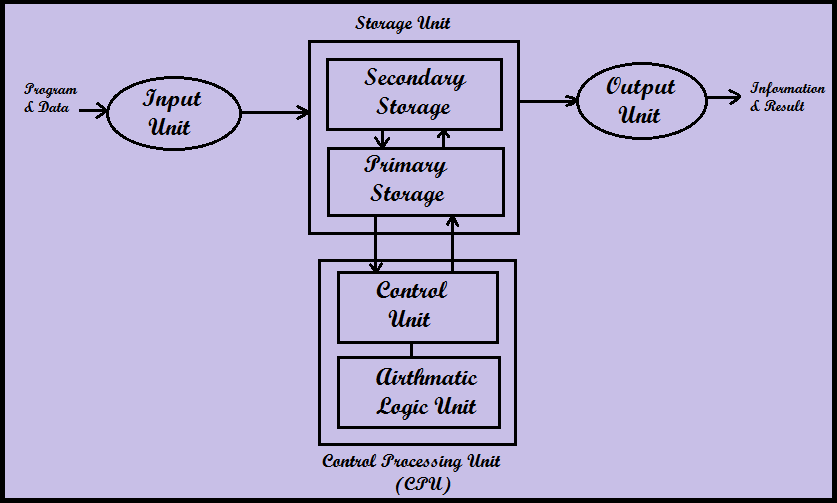
What are the basic units of computer ?
The basic units of a computer are:
- %%Input Unit:%% The input unit is responsible for accepting data and instructions from external sources, such as the keyboard, mouse, or microphone, and transferring them into the computer's memory.
- %%Output Unit:%% The output unit is responsible for presenting data and information to the user, such as through a monitor, printer, or speakers.
- %%Central Processing Unit (CPU):%% The CPU is the brain of the computer and performs all the processing of data and instructions. It consists of the arithmetic and logic unit ^^(ALU)^^ and the ^^control unit (CU).^^
- %%Memory Unit:%% The memory unit is responsible for storing data and instructions that are currently being used by the CPU. It consists of primary memory ^^(also known as RAM)^^ and secondary memory ^^(such as a hard disk drive or solid-state drive).^^
- %%Secondary Storage Unit:%% This unit is used for long-term storage of data and information, and it includes devices like hard disk drives, solid-state drives, and optical storage media (like DVDs and CDs).
- %%Input/Output (I/O) Control Unit:%% This unit is responsible for controlling the transfer of data between the ^^CPU^^ and the input/output devices.
Together, these basic units work together to perform the various functions of a computer, from processing data and running software applications to storing and retrieving information.
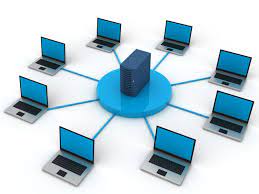
Name few computer networks ?
Here are a few common types of computer networks:
- %%Local Area Network (LAN):%% A LAN is a network that connects computers and devices in a small geographic area, such as an office or a home. A LAN can be used to share resources such as printers and files, and to enable communication among the connected devices.
- %%Wide Area Network (WAN):%% A WAN is a network that spans a larger geographic area, such as a city, country, or even the world. WANs can be used to connect multiple LANs and to provide access to remote resources.
- %%Metropolitan Area Network (MAN):%% A MAN is a network that spans a metropolitan area, such as a city. MANs are typically used by large organizations or government agencies to connect their offices and facilities in a specific region.
- %%Wireless Local Area Network (WLAN):%% A WLAN is a type of LAN that uses wireless technology, such as Wi-Fi, to connect devices. WLANs are commonly used in homes, offices, and public places like cafes and airports.
- %%Storage Area Network (SAN):%% A SAN is a dedicated network that is used for storage and data management. SANs are typically used in large organizations and data centers to provide high-speed access to storage devices.
- %%Virtual Private Network (VPN):%% A VPN is a network that is created over the Internet to provide secure and private communication between remote devices. VPNs are commonly used by businesses and organizations to enable remote work and to connect geographically dispersed offices.
What are semi conducting materials ? Describe p-type and n-type materials ?
A semiconductor material is a material that has electrical conductivity between that of a conductor and an insulator. These materials are widely used in the electronics industry to make components like transistors, diodes, and ==integrated circuits.==
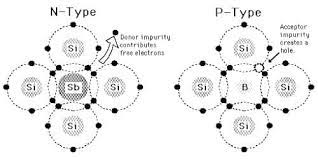
There are two types of semiconductor materials: ==p-type and n-type.==
P-type semiconductor materials have a deficiency of electrons, which creates =="holes"== in the valence band of the material. When a voltage is applied to a p-type material, electrons from nearby atoms can move into the holes, creating a flow of electrical current. ==P-type== materials are typically made by adding impurities, such as boron or aluminum, to a pure semiconductor material like silicon.
==N-type== semiconductor materials have an excess of electrons, which are free to move through the material. ==N-type== materials are typically made by adding impurities like phosphorus or arsenic to a pure semiconductor material. These impurities have extra electrons that become part of the crystal lattice structure of the material, creating an excess of free electrons.
When a ==p-type== and ==n-type== material are brought together, they form a p-n junction, which is the basic building block of many electronic devices. The ==p-n junction== can be used to control the flow of electrical current, allowing it to act as a switch or amplifier.
In summary==, p-type== semiconductor materials have a deficiency of electrons, while ==n-type== semiconductor materials have an excess of electrons. These materials are used to create electronic devices, and when brought together, they form a ==p-n junction== that can be used to control the flow of electrical current.
Highly pure silicon and germanium crystals are almost insulators, especially at low tempreatures. Explain why ?
Highly pure %%silicon and germanium crystals%% are almost insulators at low temperatures because they have a very low concentration of impurities that would normally act as charge carriers and allow the material to conduct electricity.
In their pure %%crystalline%% form, %%silicon%% and %%germanium%% have a perfect, regular arrangement of atoms that creates a complete valence band %%(the outermost electron energy band)%% and a completely empty conduction band %%(the next energy band above the valence band).%% This means that there are no free electrons available to move through the material and conduct electricity.
However, at higher temperatures, some electrons in the valence band can acquire enough energy to jump to the conduction band, creating a small number of charge carriers that can conduct electricity through the material. In pure silicon and germanium, this effect is very small and the materials still act as %%insulators%% at room temperature.
At very low temperatures, even this small amount of thermal energy is not enough to excite electrons into the conduction band, so the materials remain insulators. This is why highly pure silicon and germanium crystals are used as the base materials for semiconductors in electronic devices - by carefully introducing controlled impurities %%(doping),%% it is possible to create p-type and n-type semiconductors that have the desired electrical properties for use in %%electronic circuits.%%
p-n junction diode always allows electric current to pass through it in one direction. Why ?
A diode is a two-terminal semiconductor device that allows electric current to pass through it in one direction, but not in the opposite direction. This property is called rectification, and it is due to the way that the p-n junction is
The p-n junction is formed by bringing together a as I explained in my previous answer. When these two types of semiconductor material are brought into contact, they form a depletion region near the interface between them. This depletion region is essentially a barrier to the flow of electric current, as it contains few free charge carriers that can move through the material.
When a voltage is applied to the diode in the forward-bias direction , the depletion region is made thinner and the barrier to the flow of current is reduced. As a result, current can flow easily through the diode.
In the reverse-bias direction the depletion region is made wider and the barrier to the flow of current is increased. This makes it very difficult for current to flow through the diode in the reverse direction.
So, the p-n junction diode allows electric current to pass through it in one direction because the depletion region is reduced and the barrier to the flow of current is lowered in this direction. In the opposite direction the depletion region is widened and the barrier to the flow of current is increased, so current cannot flow through the diode.
How does a television camera work to produce a picture ?
A ^^television camera,^^ also called a video camera, works by converting the light from the scene being filmed into an electronic signal that can be transmitted and displayed on a ^^television screen.^^ The basic components of a television camera include a lens, an image sensor, and electronic circuitry.
The lens of the camera focuses the light from the scene being filmed onto the ^^image sensor.^^ The image sensor is a device made up of a ^^large number of tiny light-sensitive elements^^ called ^^photosites or pixels^^. When light hits a ^^photosite,^^ it ^^generates^^ an electrical charge, which is proportional to the amount of light that hit it.
The electronic circuitry of the camera reads the charges from all of the pixels in the image sensor and converts them into a ^^voltage signal.^^ This signal is then processed by the camera's circuitry to produce a composite video signal, which can be transmitted to a television receiver.
The video signal is made up of three components: the luminance ^^(brightness)^^ signal and two color difference signals ^^(chrominance).^^ The luminance signal represents the intensity of the light in the image, while the color difference signals represent the difference between the ^^red and blue components of the light.^^
The ^^camera scans the image sensor in a series of horizontal lines to create the video signal.^^ This process is called scanning, and there are two main scanning methods: interlaced and progressive. In the interlaced scanning method, the camera scans every other line of the image sensor in one pass, and then goes back and scans the remaining lines in a ^^second pass.^^ This creates a video signal that consists of two fields of alternating lines. In the progressive scanning method, the ^^camera scans all of the lines in a single pass, creating a video signal that contains a complete image.^^
The composite video signal is then transmitted to a ^^television receiver,^^ which uses an ^^electron gun^^ to scan a similar set of lines across a ^^phosphor-coated screen.^^ The brightness and color information in the video signal is used to modulate the intensity of the electron beam as it scans across the screen, ^^creating a picture^^ that corresponds to the original scene captured by the camera.
In summary, a television camera works by using a lens to ^^focus light^^ from a scene onto an image sensor, which ^^converts^^ the light into an electronic signal that can be processed and transmitted as a video signal. The video signal is then used to modulate an electron beam in a television receiver, creating a picture that corresponds to the original scene ^^captured by the camera.^^
What is the importance of information technology in pakistan ?
%%Information technology (IT)%% has become increasingly important in Pakistan over the years, with the government and private sector making efforts to promote and develop the IT industry. Here are a few ways in which IT is important in Pakistan:
- %%Economic Growth:%% The IT industry in Pakistan has the potential to contribute significantly to the country's economic growth. The industry has been growing rapidly, with several IT companies and startups emerging in recent years. This has created job opportunities and contributed to the country's GDP.
- %%Education:%% IT has played a significant role in improving education in Pakistan. E-learning platforms, online courses, and digital libraries have made education more accessible and affordable for people living in remote areas. IT has also been used in schools and universities to enhance the learning experience.
- %%Healthcare:%% IT has the potential to revolutionize healthcare in Pakistan. Telemedicine, electronic health records, and digital imaging have made it easier to diagnose and treat patients. This has improved the quality of healthcare services, particularly in rural areas where medical facilities are limited.
- %%E-commerce:%% The growth of e-commerce in Pakistan has been facilitated by IT. Online shopping platforms and digital payment systems have made it easier for people to buy and sell goods and services, even in remote areas. This has created new business opportunities and made it easier for entrepreneurs to start their own businesses.
- %%Communication:%% IT has improved communication in Pakistan by providing access to mobile and internet services. This has made it easier for people to stay connected with each other, even across long distances. IT has also facilitated the growth of social media, which has become an important tool for political and social activism.
In summary, %%IT%% is important in Pakistan for its potential to drive economic growth, improve education and healthcare, facilitate e-commerce, and improve communication. The government and private sector have recognized the importance of %%IT%% and are making efforts to promote and develop the industry. \n