Unit 2
Crime scene processing
barricading of crime scene
Integrity
Contamination
Location indicator
Investigation efficiency
Legal admissibility
To maintain chain of custody
Methods of barricading
Physical barriers
crime scene tape
barricades
cones (traffic cones)
temporary fencing
police vehicles (van)
Personal barriers
police personnel
forensic investigator
Natural barriers
building, wall
large vehicle
tree
Perimeters of barricading
Inner (hotspot)
the actual crime scene where evidence is collected
only forensic expert and investigator are permitted
Middle
staging area for investigator and equipment
police and driver are allowed
Outer
media and public should stay away from the boundary
best practice for barricading
larger area
assigned for duty to protect the barricading
challenges
larger area (forest area)
media and public interference
weather conditions
documenting crime scene
crime scene photography
Photography refers to preserving any object in the form of images.
Forensic photography refers to preserving evidence found at a crime scene in form of an image.
format → .raw, .tiff, .png, .jpeg (best to lowest)
Overview
Image of each corner to see overall view of crime scene.
for an overview of evidences
Midrange
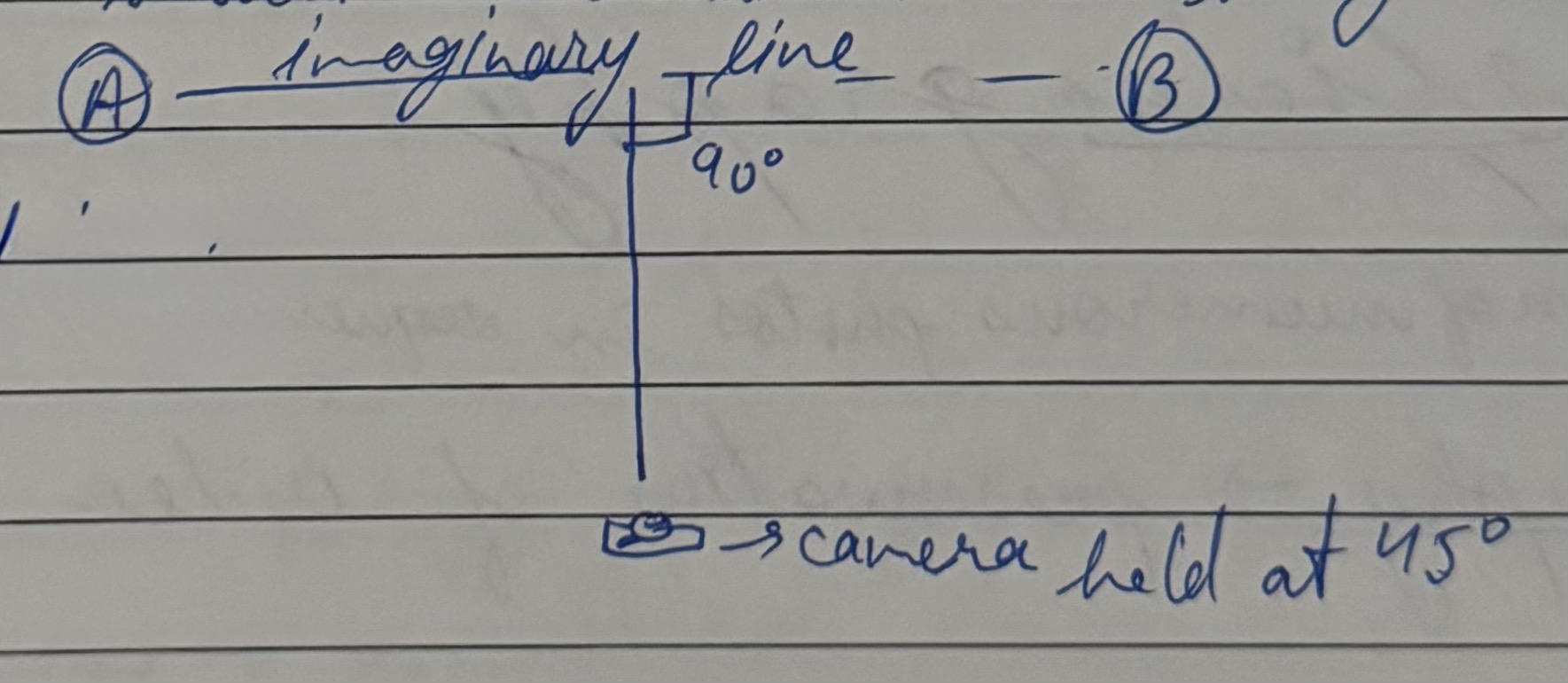
to show distance between 2 marked evidences
photographed at 90° angle.
evidences should be visible in the image
for location and distancing
Close-up/short range
captured by placing an L-scale near the evidence and the camera at a 90° above evidence.
for length, breadth and detailing
Photogrammetry → 3 dimensional rendering of images captured at the crime scene.
→ distancing and location
Challenges
light conditions
Surface of evidence
weather conditions
underwater photography
arial photography
videography
video refers to a collection of numerous photos in a sequence.
videography → preservation of video
overview
mid range
short range/ close up
crime scene notes
Journal observation →
Case number
Date and time of arrival
Location
Weather condition
Lighting condition
Crime scene type
Indoor, outdoor or vehicular
Reporting officer or investigator name
Other officer
Initial observation →
Entry and exit point
Position and condition of body (if available)
Presence of odour
Environmental conditions
temperature and humidity
Visible evidence
Documentation and scene processing →
Sketching, Photography, Videography
Witness statement collection
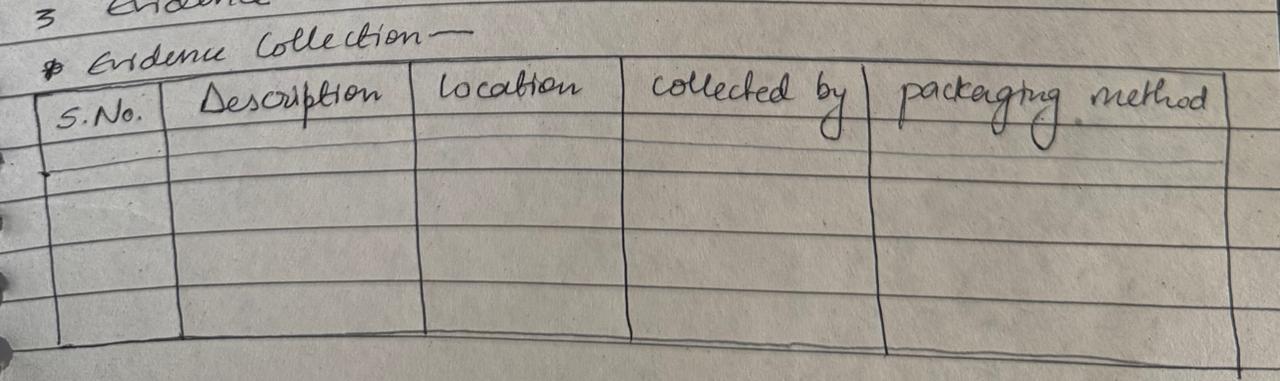
Evidence collection
Action taken →
Search method used
Processing techniques
lifting of fingerprints
swapping of blood
Safety precautions
gloves
ppt, etc
Specialist involvement
Final notes and scene release
Crime tapes removal
crime scene sketching
Triangulation method
measure the evidence distance from a fixed object or an object that cannot be moved.
must form a triangle
Baseline method
draw an imaginary line across the room, ideally near the most amount of evidences.
then take the perpendicular distance from the evidence to the baseline.
also measure the distance between all evidences on the baseline.
Polar method
In cases where only one reference point or fixed point is present.
using distance from fixed point and then measuring the direcction using a compass.
search patterns
strip method
grid method
zonal method
time consuming
crime scene is thoroughly searched
spiral method
spiral inward
out to centre
spiral outward
centre to out
wheel method
For outdoor crime scenes
it is time consuming, so it is not used generally.