PHYS2011 - Thermodynamics
5 lectures to watch

Lecture 1 - Revision
statistical approach to entrophy & equilibriu
Thermodynaic Identites
Functions for energy, heat & extractable work
Ability to predict events
An introduction to thermal physics - Chp 1-5
1st Law of Thermodynamics: Energy is conserved
1st law tells us what energy restricting is.
2nd Law of Thermodynamics: Entropy always increases \Delta Stot>0
Work is energy that goes into a system
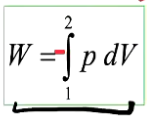
Ideal system , Ideal gas and Einstein sold
Ideal gas: Elastic collisions always
PV=nRT - Ideal gas Constant
PV=NkT - Boltzman’s Constant
n moles, R = 8.314 j/k
N molecules, k=1.381 × 10^-23
Internal energy U

U is an intristic property of the system - indepent of path taken to get a give state
Average V gets distributed. KE = ½ mv² where v is average
PE ~ no external forces for ideal gas therefore, PE=0
Equipartition = all quadratic degrees of freedom have an average energy of 1/2kT

monoatomic gas is not distinguishable as it rotates and not a real degree of freedom
When we give the system energy is randomly distributes that energy equally over all its degrees of freedom
Degrees of freedom depend on quantum effects


Heat Engine
Convert heat to work - Carnot cycle ~ ideal motor
Isothermal process= no temp change delta T =0
Adiabatic process = no heat flow Delta Q ~ insulated or Fast
isobaric - Delta P = 0
isochoric = Delta V = 0
Lecture 2 - Probabilistic approach to Entropy
Chapter 2 Section 2.1 - 2.4
2nd law of thermodynamics - entropy, it can only increase
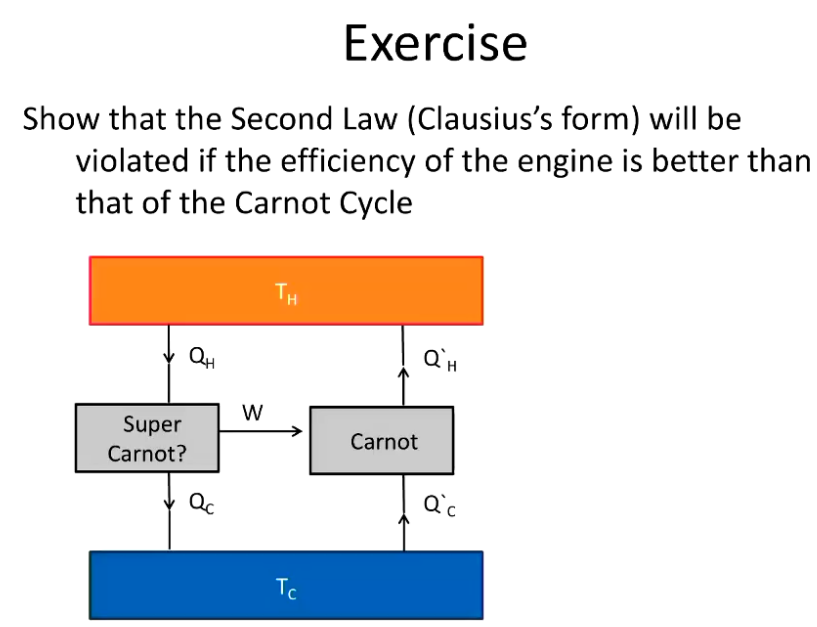
Any heat engine
Any refrigerator requires work. in order to get cold
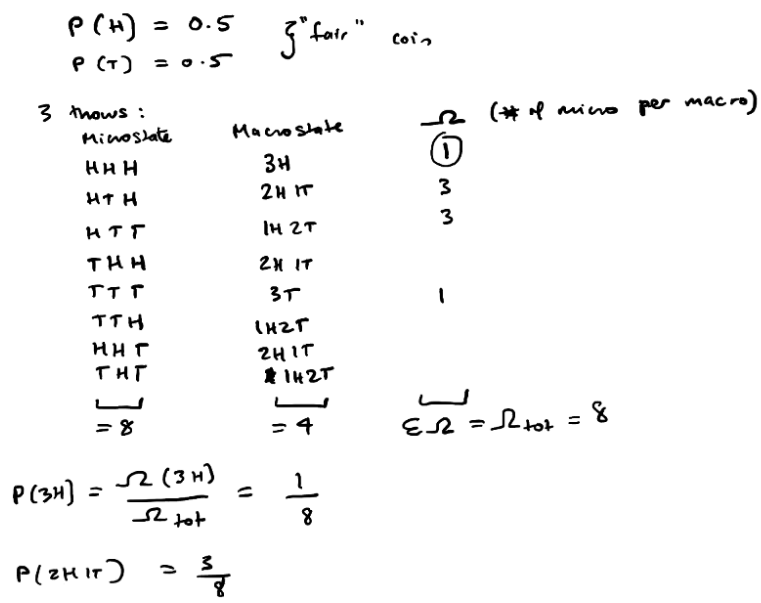
concepts of microstates and microstates
Definition and understanding of entropy in terms of probability and multiplicity ( )
calculate a likelihood that a molecule will be in a certain state and a certain point in time
Microstate
precise state of individual particles in the system

N can be Avogadro’s system large
Macrostate
defined by the bulk macroscopic detail of the system and the number of particles in particular energy states and positions
Multiplicity
number of microstates that produce a particular macrostate.
a list of all the velocities of all the particles of a gas is a microstate. The temperature is its equivalent macrostate.
Using calcs you can give the number of particles in a particular energy stat and position, you can find the macrostate.
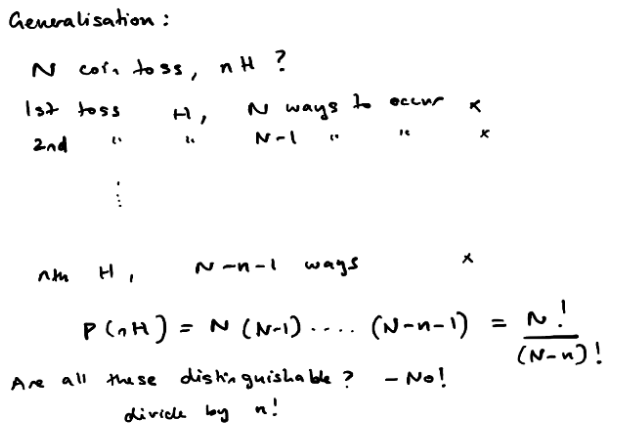
Therefore, total distinct ways = N!/ n!(N-n)!
Einstein Sold
Each atom is an identical isolated quantu harmonic oscilator, with diferent energy wells
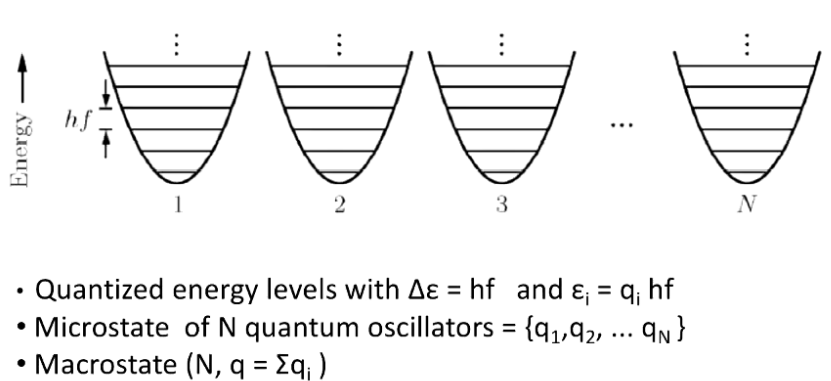
more energy added the more it can be distributed.
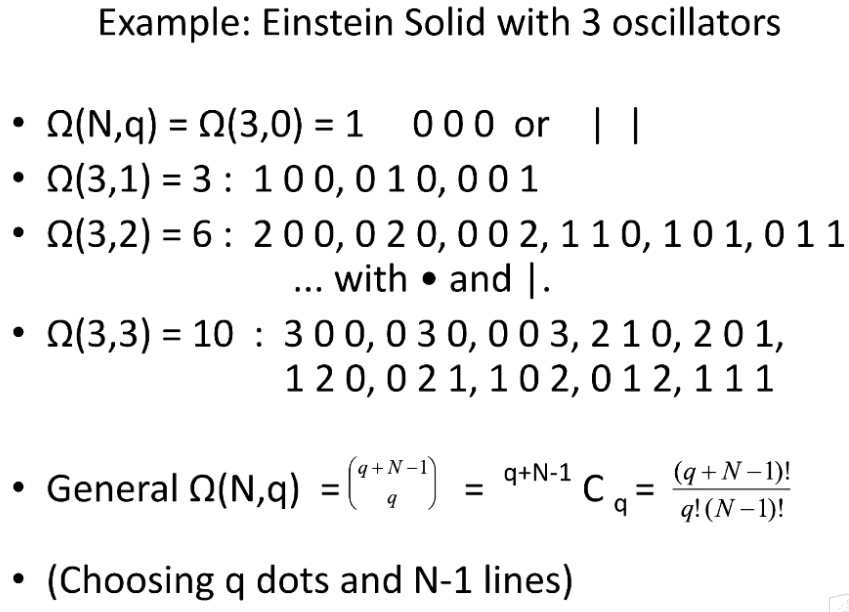
2 einstein solids
q=qA+qB
N=NA+NB
Fundamental assumption of statistical Mechanics all microstates are equally probable at thermal equilibrium
Detailed balance, no preference, no intrinsic bias by the gases
Time reversibility event all together can lead to an irreversible event

If you assume it is irresverable and you get reverability you must go back and rethink assumptions about detailed balance

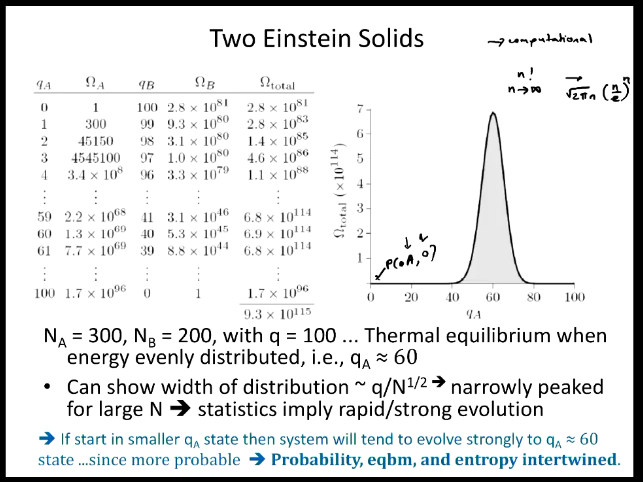
for large N it is almost impossible to see it out of equilibrium
at some point there would be a vacuum in the room
Random moment can happen just very unlikely
Probability
all microstates are equally probable at thermal equilibrium
Probability of particular macrostate = Multiplicity of particular macrostate / total number of microstates
2nd law: System will tend to be found in the macrostate the is most probable, that with the larges multiplicity
all other macrostates will be increasingly unlikely to occur (as N, q increase)
Multiplicity will tend to increase as a system evolves (finding its way into more microstates
this suggests that entropy is related to multiplicity
Entropy S= k Ln
Boltzmann hypothesis

Lecture 3 - Sackur - Tetrode Equation for Entropy
Extend understanding of entropy and apply to an ideal gas
k = Boltzmann’s constant
multiplicity: how many macrostate given each microstate also depends on the system. gases can be rearranged
n! = 1 × 2 × 3 …. n
Striling approximation, assumes a large n. n! approaches inffinity
Entropy for a monoatomic ideal gas
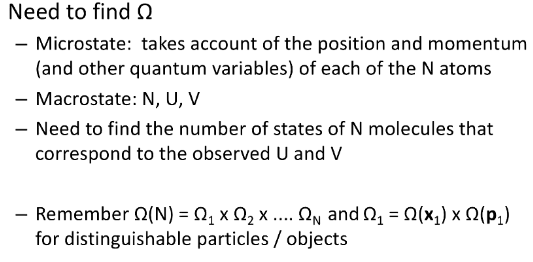

conseptuatl limit of what can possibly be measured
volume P, which we call the momentum volume
factor of one own Planck's constant H.
So this is why suddenly quantum physics is appearing thermodynamics. - Through the uncertainty principle.
planks constant tells us what the smallest box we can put our particle in is.
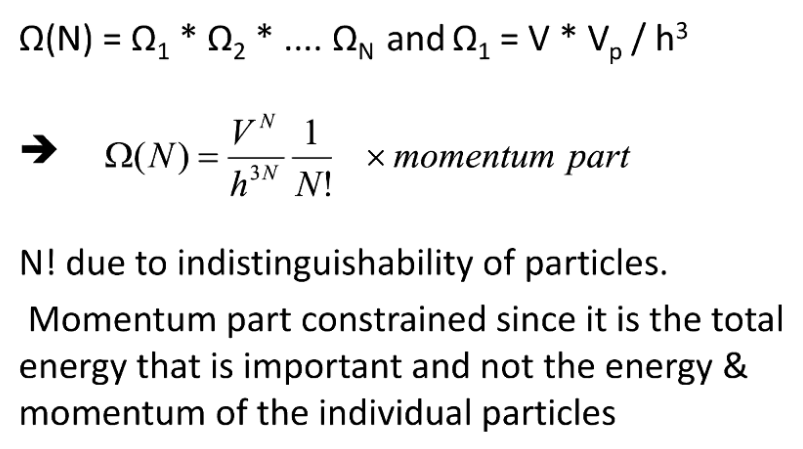
Volume in momentum space relates to maximum or average momentum, which then relates to the kinetic energy of the particles of gas
Kinetic energy of a gas is related to its temperature
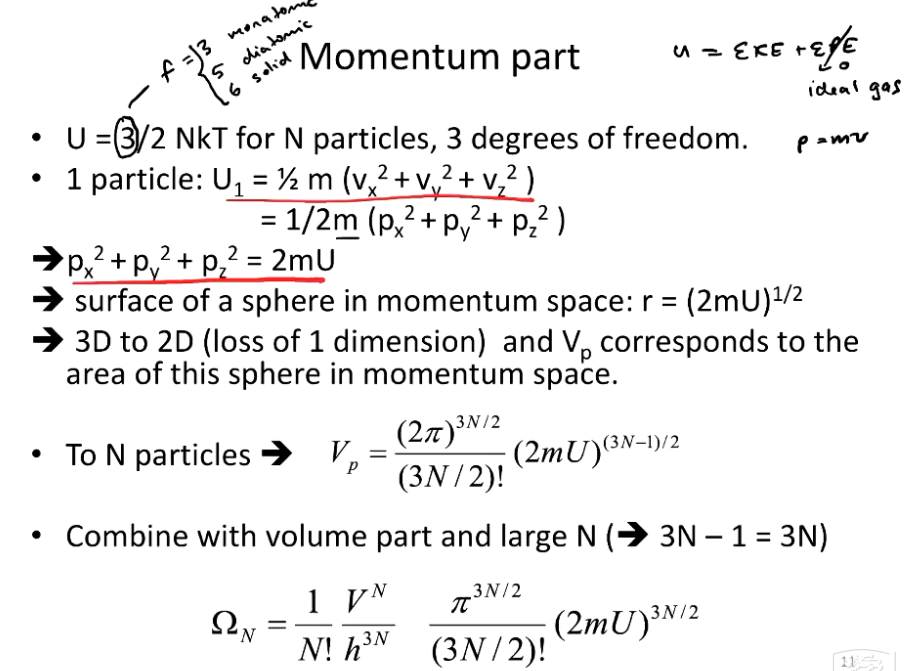
3/2 comes from degrees of freedom
Sackur - Tetride Equation

h² is in the equation → quantum precision of location, from the uncertainty principle.
3/2 comes from degrees of freedom
V/N is the density, gas has density
U/N relates to the sum of kinetic energy plus potential energy per particle
for a diatomic gas the 3/2 goes to a 5/2
for 1 mole of helium, monatomic gas.
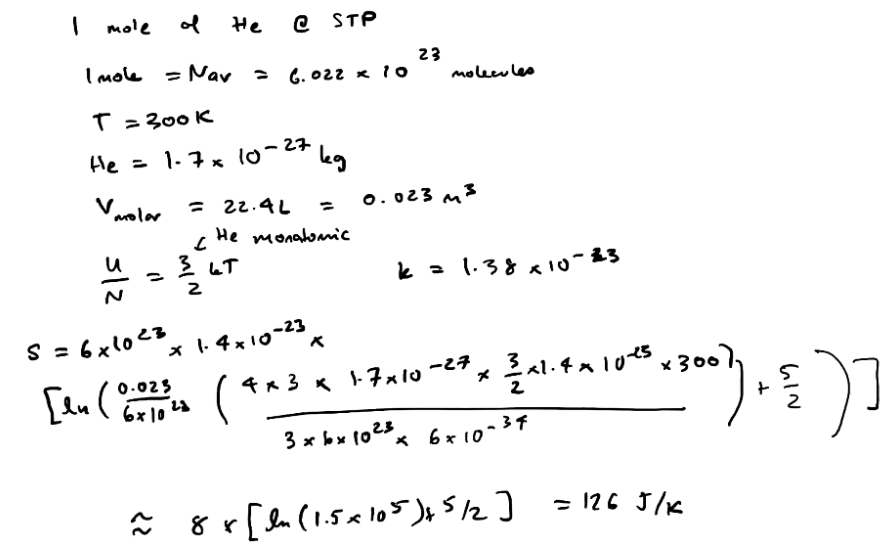
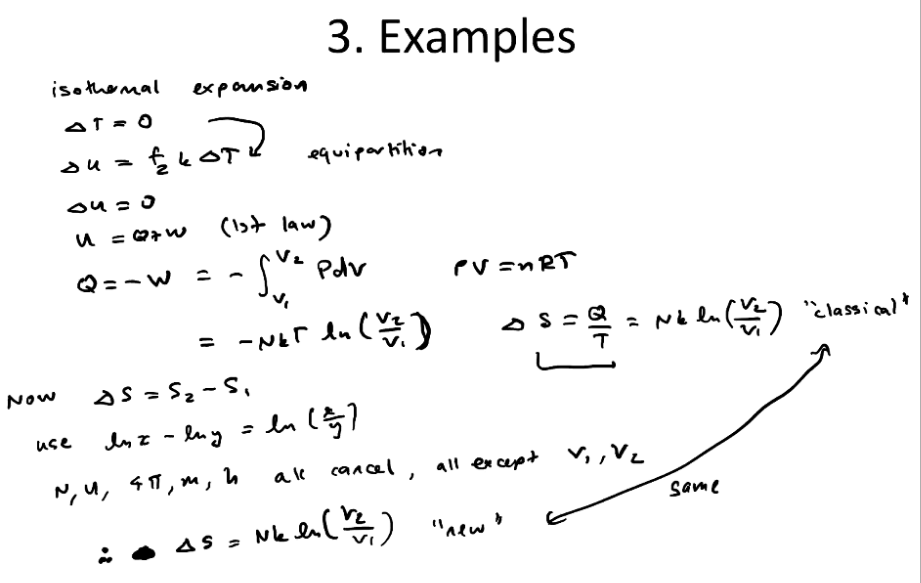
Examples
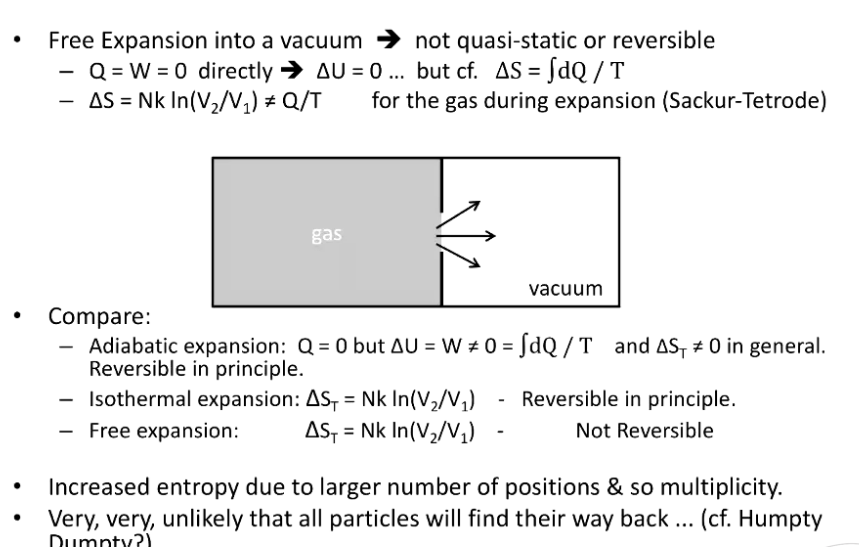
isothermal expansion
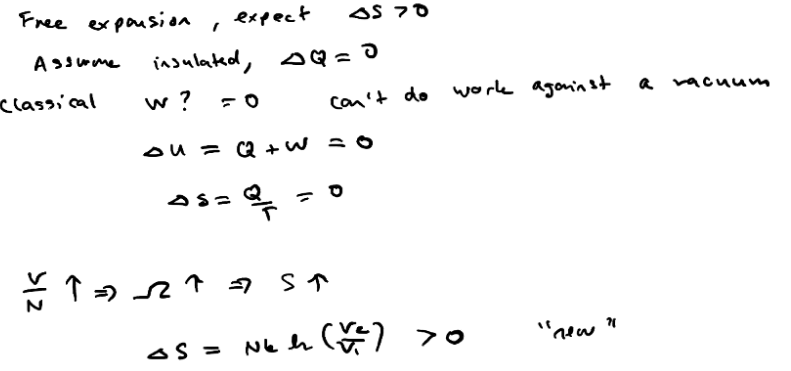
Free expansion into a vacuum
Mixing of 2 gases

2 free expansions as red is expanding into blue and visa versa
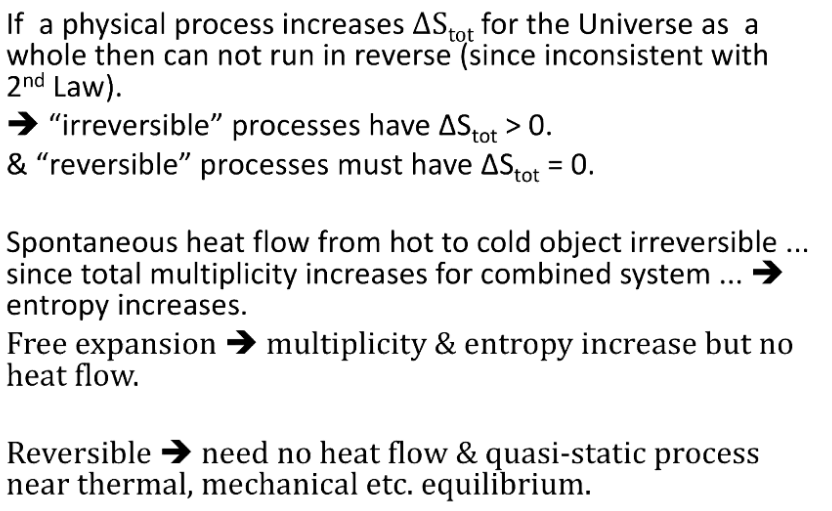
Reversible and Irreversible
irreversible are much more common and probabile
Lecture 4 - Equilibrium & 1st Thermodynamic Identity
consider equilibrium situations and define temperature and entropy in terms of equilibrium
derive the thermodynamic identity
Textbook: Chp 3: 3.1, 3.2, 3.4
a system is in equilibrium when the system isn’t changing anymore
equilibrium is something the system tends towards

Heat cannot be converted competely into work in a heat engine.
Heat cannpt flow from cold to hot by itself (spontaneously and irreversibly)
Efficiency of heat engines is limited tp 1-Tc/Th
Entropy tends to increase. (System tends to evolve to the macrostate with the largest multiplicity.)
Multiplicity is the: number of microstates that contributes to a different macrostate

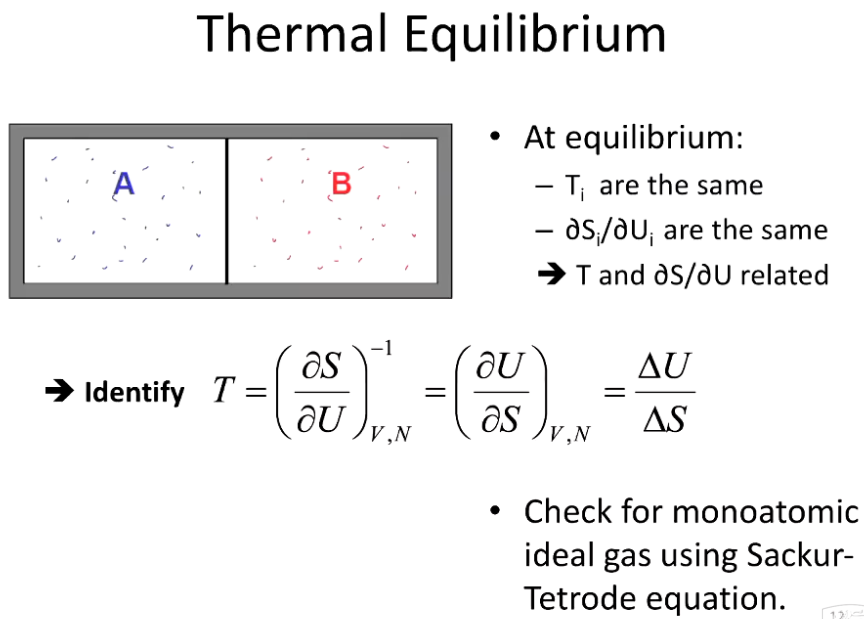
Exchange heat Q, until we get to thermal equilibrium → Ta =Tb
Exchanging Volume, state change → mechanical equilibrium → Pa=Pb
Exchange particles, gas exchange or chemical reaction → chemical equilibrium →Mua = Mub. chemical reactions are equally likely
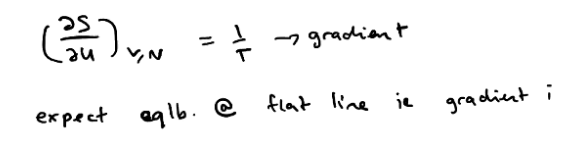
They will change until they reach equilibrium and find when the derivative is equal to 0. turning point when the derivative is 0 (maximum)
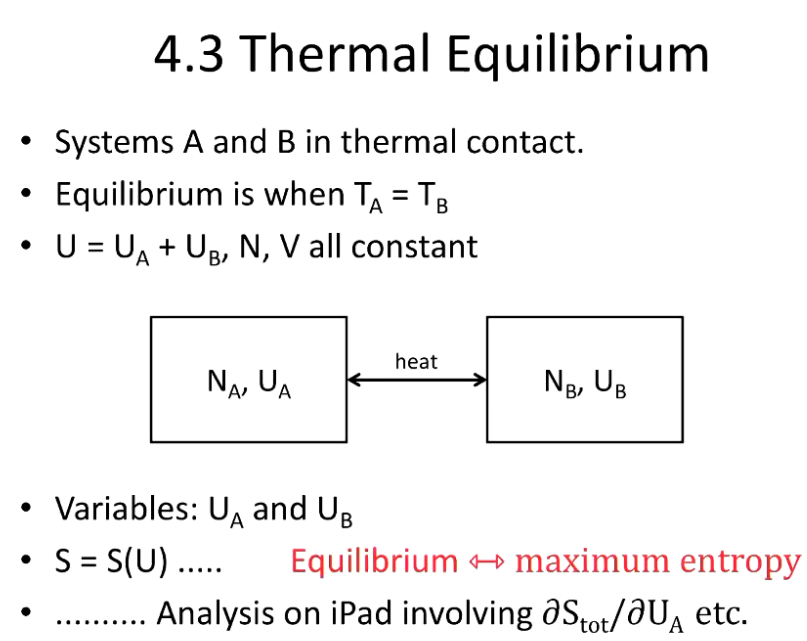
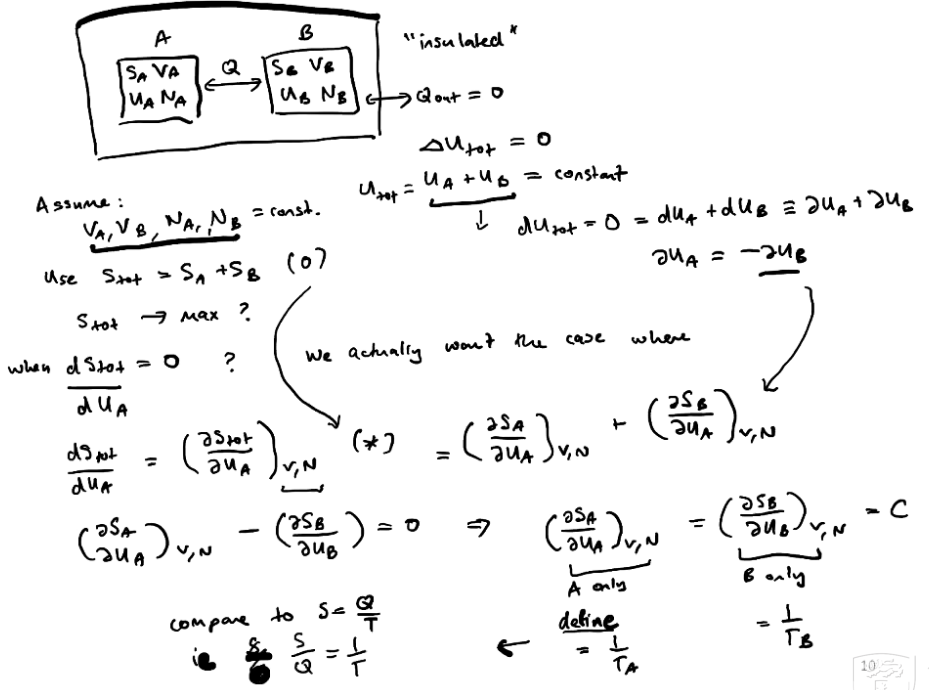
In an insulated box Qout= 0.
Utot=Ua+Ub
Assume Va, Vb, Na,Nb is constant
Stot= Sa+Sb
S as a function of qa(~Ua) eq. Einstein solid
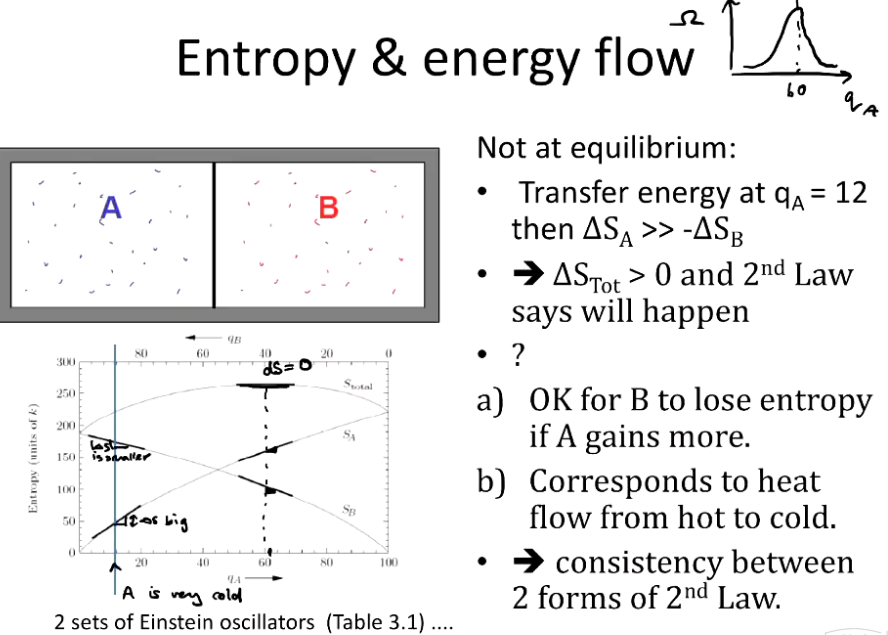
Einstein oscillators → Plotted the equilibrium by looking at the multiplicity. (normally distributed, with sharp peak at 60)
multiplicity told us the entropy was maximum because
we're at equilibrium.
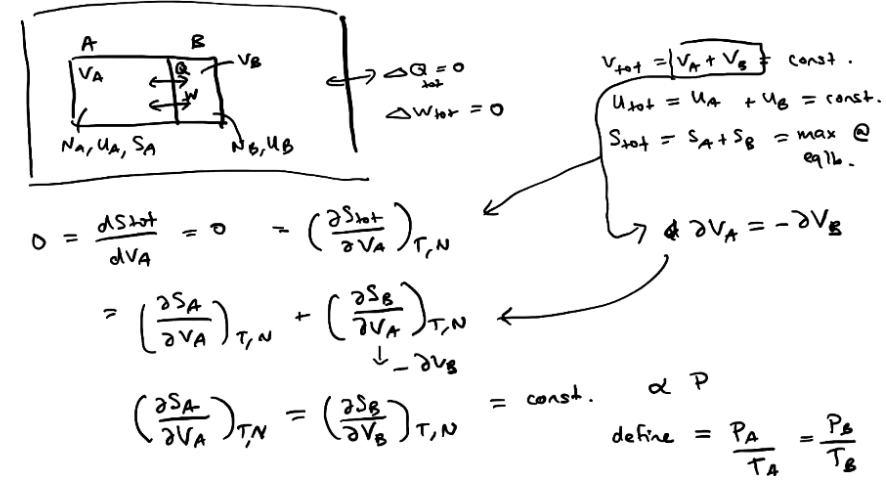

very small changes we have an infinitesimal change

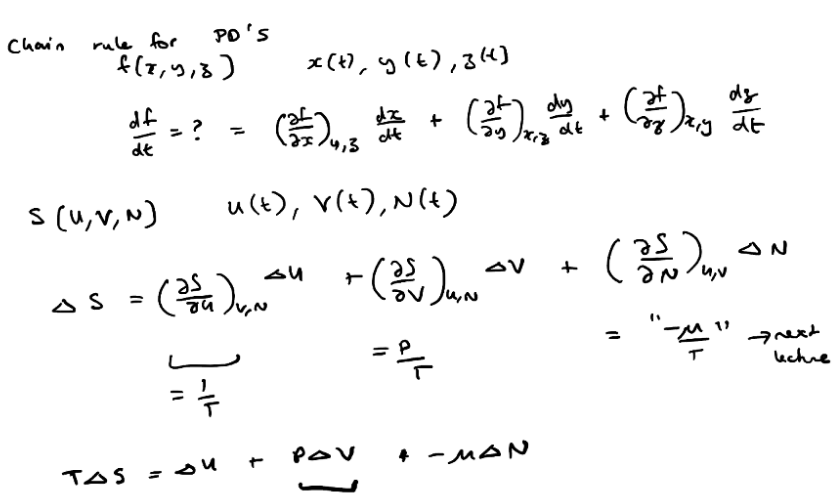
Q = T delts S
Work = P delta V
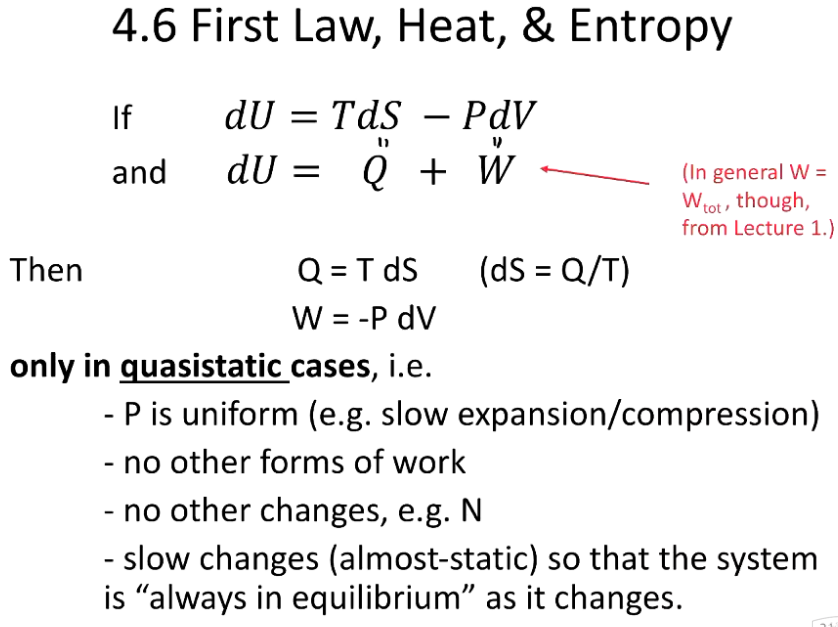

use the more complex equation and then make assumptions until you get the simple equation or you have to use the old one.
Lecture 5 - Chemical Potential & Applications of 1st Thermodynamic Identity *
Lecture 6 - Enthalpy & Helmholotz & Gibbs Free Energies *
Lecture 7 - Thermodynamic Potential & 2nd Law *
Lecture 8 - Phase Diagrams & Phase Transitions *
Lecture 9 - Thermodynamics of Black Holes
Every past exam there is a battery question
What can we say about the thermodynamic properties of black holes?
So massive, big gravitational field, nothing can escape, phtons’s can’t escape
We can’t get information out and cant measure anything inside them, light cant escape
Only 3 observable traits, m, q, angular momentum j
Non- rotating charge neutral only var
mass is microstate
no information about microstate
Ecreasion disk matter folds in
Will CERN generate a black hole, massive particle accelerator,
Very unlikely - predict how unlikely
Event horizon
escape velocity
max escape velocity anything can have is the speed of light c
First law
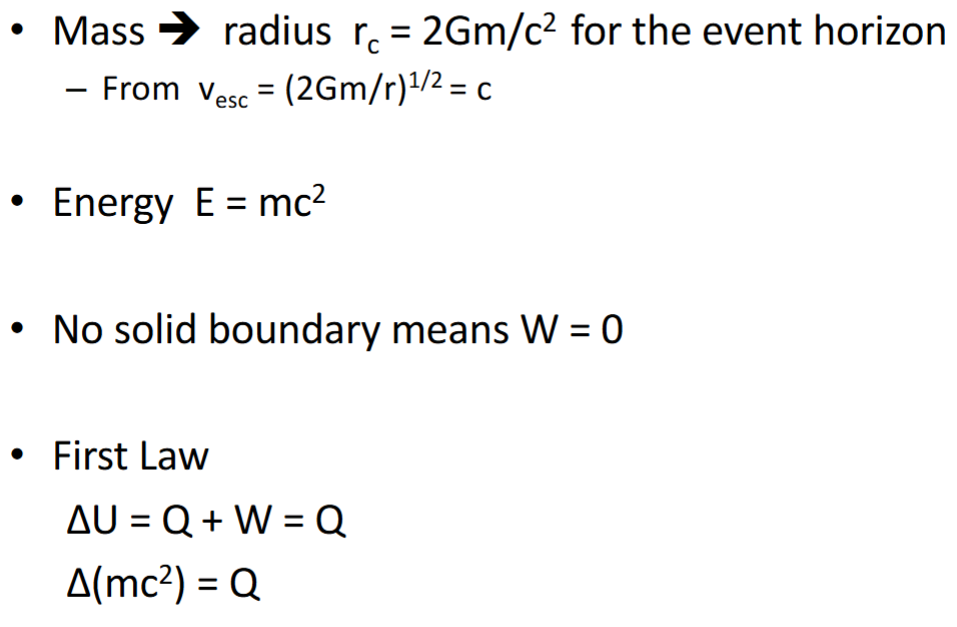
=1/21/
u>0 escape, u<0 trapped and u=0 solve
how close can something get before getting trapped
Assumption: cant violate 2nd law. → no proof otherwise
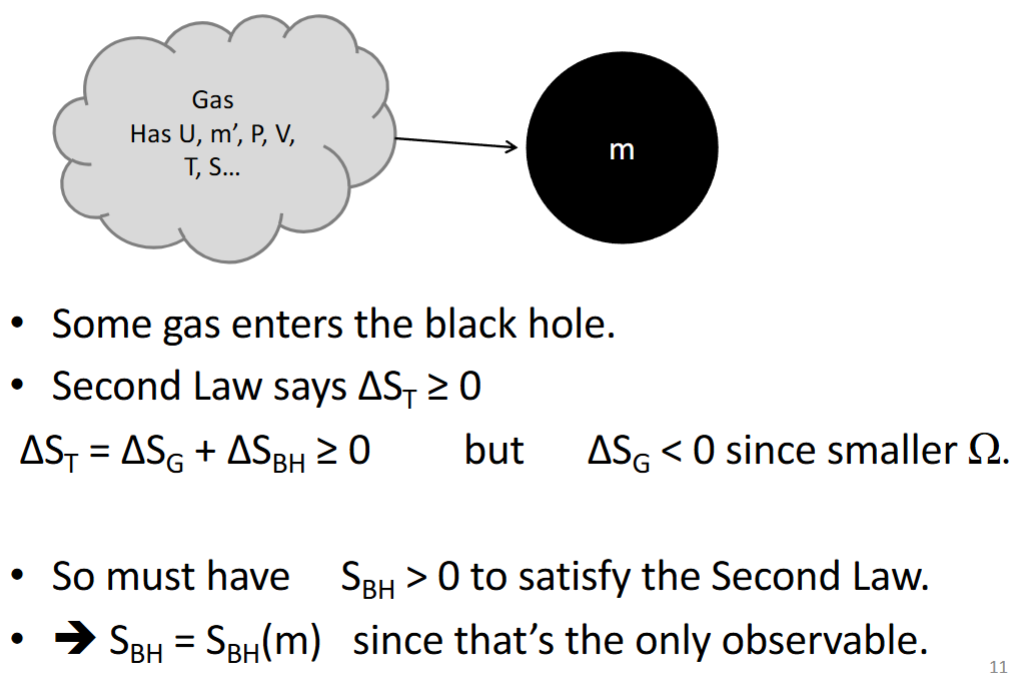
multiplicity of gas goes down so entropy decrease therefore entropy of black hole must goes up
Universe ends in giant black hole
Entropy of black hole depend on some function of mass
smallest amount of mass we can add to a black hole → smallest photon
longer wavelength photon
minimum size photon that can interact with a black hole
bigger than event horizon will not interact with black hole
chance of interacting
very low frequency EM rad that doesnt interact
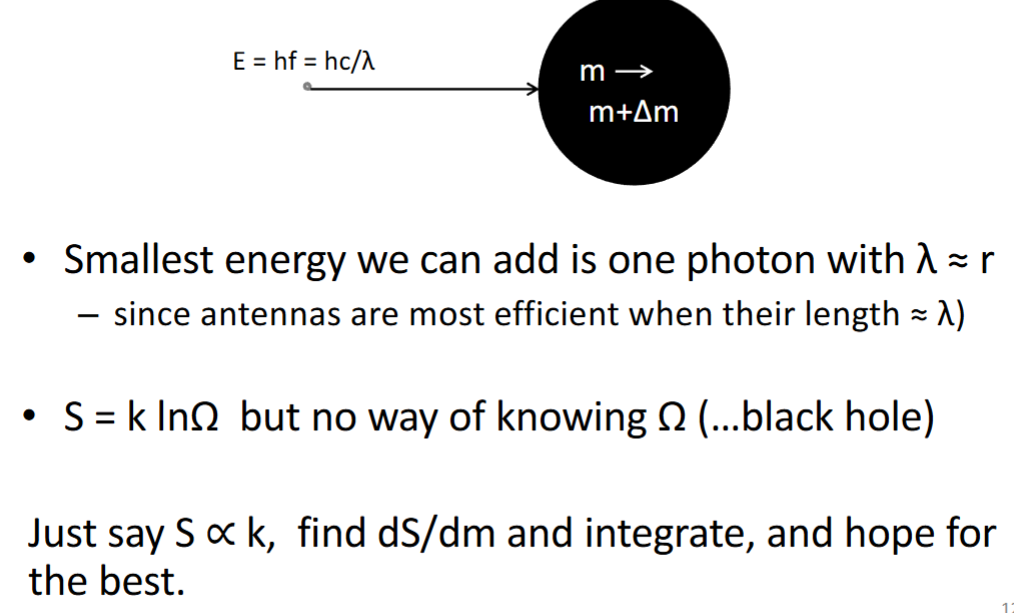
a larger black hole has a larger entropy
r is event horizon
a black hole with our suns mass with have
smaller black holes has smaller entropy
Can we predict the temperature - black holes radiate things
the hotter something is
gains entropy and has a temperature and
evaporation in black holes
Small black holes are hot and large black holes are cold
predicted lifetime of the universe: 33 billion years
CERN could make a small black hole and would evaporate instantaneously.
PROBABLY NOT IN EXAM - CERN question