Geol 1420 Chapter 2.3
Astronomy Today - Chapter 2 Study Notes
Tycho Brahe
Time Frame: Late 1500s
Contributions:
- Known for accurate and comprehensive astronomical observations.
- Made precise systematic measurements of the movements of planets and stars.
- Observed a “new star” in 1572 in the constellation Cassiopeia, now known as a supernova.
- Visual reference:
- Another visual reference: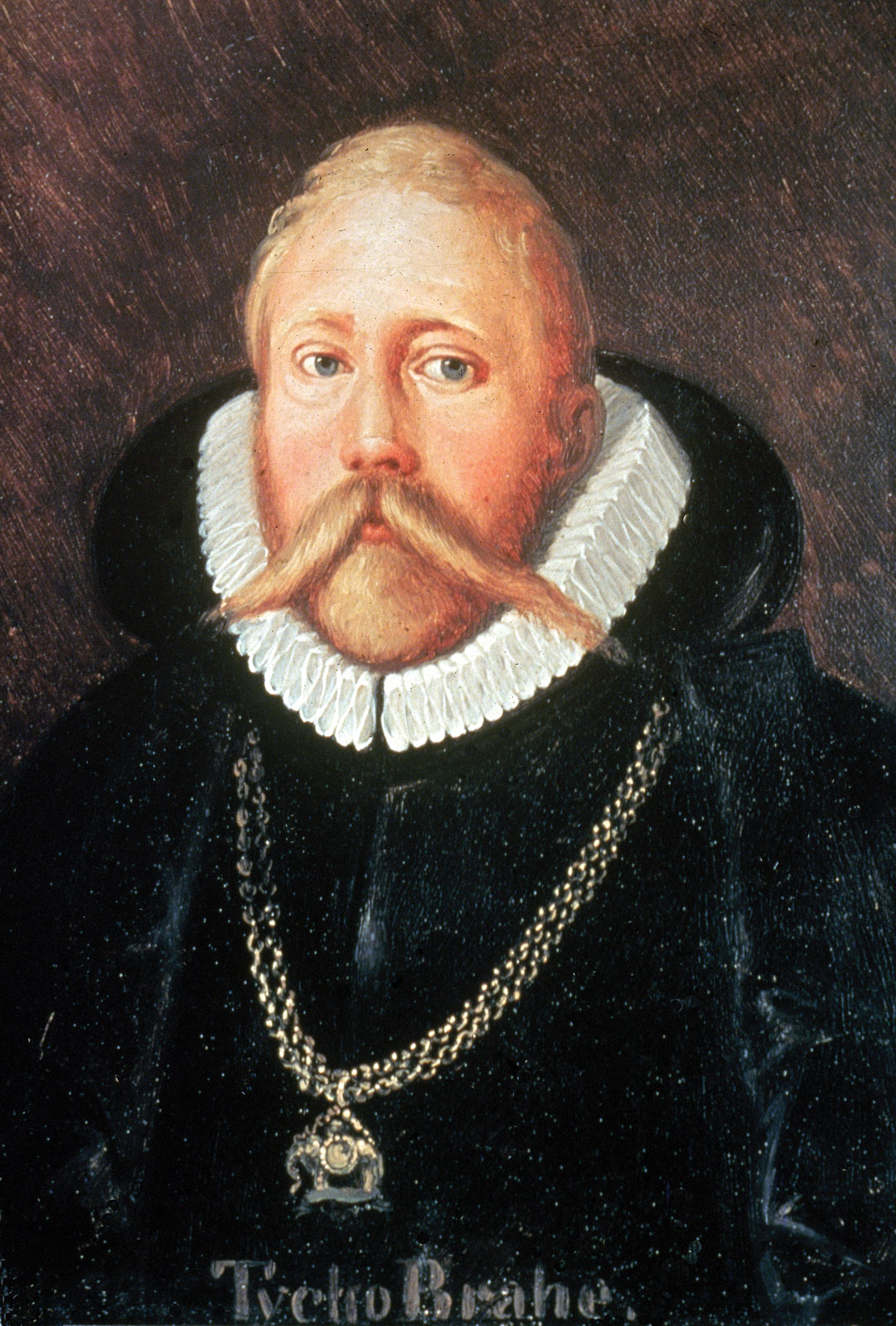
Brahe's Study of Parallax
Definition of Parallax:
- The apparent shift in an object’s position due to a change in the observer’s viewpoint.
- Example:
- Holding a finger in front of your face and closing each eye alternately causes your finger to appear to jump side to side against the background. This observed shift is parallax.
- Observation Principle:
- The closer an object to the observer, the larger the parallax effect observed.
Measurement of Parallax in Astronomy
Importance:
- Crucial for measuring distances to nearby stars.Method:
- Astronomers observe a star from different points in Earth’s orbit (e.g., 6 months apart) and measure the tiny shift in its position against distant stars.
- Use trigonometry to calculate its distance.Key Formula:
- Relationship between a star's distance (d) and its parallax angle (p):
-
- where distance d is measured in parsecs (pc) and parallax angle p is measured in arcseconds (”).Conversions:
- 1 arcsecond (1”) = 1/3600 degrees.
- 1 parsec = 3.3 light years = (9.461 trillion km).
Brahe’s Views on Parallax and its Implications
Investigations:
- Brahe attempted to use parallax to measure distances to comets and the 1572 supernova.Conclusions:
- The absence of parallax for these objects led him to correctly conclude that they are far beyond the Moon.
- Determined that stars are so distant that their stellar parallax is too small to detect with the naked eye.
- Brahe’s inability to detect stellar parallax prompted him to reject Copernican heliocentrism, eventually proposing his own hybrid model.
Brahe’s Modified Copernican System
Description of System:
- Earth is stationary and at the center of the universe.
- Planets revolve around the Sun, which in turn orbits the Earth.
- The Moon and Sun revolve around the stationary Earth.Complexity:
- This model is considered complex and goes against Ockham’s Razor principle, which states that the simplest explanation is preferred.
Johannes Kepler
Lifetime: ~1600
Role:
- Mathematician and assistant to Brahe.
- A key figure in the 17th century scientific revolution.
- Best known for his laws of planetary motion.
Kepler’s Laws of Planetary Motion
First Law:
- Each planet's orbit around the Sun is elliptical, with the Sun at one of the two foci.Second Law: Law of Equal Areas
- Each planet orbits the Sun such that a line connecting the planet to the Sun sweeps over equal areas in equal time intervals.Third Law:
- The orbital period of a planet (in years) is proportional to its distance from the Sun in astronomical units (AU).
- Formula:
-
- where p = orbital period in years and d = distance in AU.
Galileo Galilei
Lifetime: (1564 to 1642)
Significance:
- Known as the father of observational astronomy, modern physics, and the scientific method.Discoveries Using a Telescope:
- Phases of Venus: Demonstrated that Venus has phases similar to the Moon, supporting heliocentrism.
- Moons of Jupiter:
- Observed moons orbiting Jupiter, establishing a miniature Copernican system.
- Over 8 weeks from January 7 to March 2, 1610, Galileo sketched 64 observations of the positions of four moons relative to Jupiter.
- These are now known as the Galilean moons: Io, Europa, Ganymede, and Callisto.
- Observation of Planets:
- Determined that planets appeared as circular discs rather than merely points of light.
- Moon's Surface:
- Discovered that the Moon's surface is not smooth and features mountains and craters.
- Produced topographical charts estimating the height of the Moon’s mountains.
- Sunspots:
- Observed sunspots, revealing the Sun’s rotational motion.
Galileo's Model of Motion
Principle of Inertia:
- An object in motion has inertia that keeps it in motion unless acted upon by a net external force.
- This principle laid the groundwork for the Law of Inertia (Newton’s First Law of Motion).
Isaac Newton
Lifetime: Late 1600s
Role:
- English physicist and mathematician; a pivotal figure in the scientific revolution of the 17th century.
Newton's Laws of Motion
First Law of Motion:
- A body will remain at rest or in uniform motion in a straight line unless acted upon by a net external force.Second Law of Motion:
- The acceleration of a body is proportional to the net force acting on it and inversely proportional to the mass of the body.
- Formula:
-Third Law of Motion:
- For every action, there is an equal and opposite reaction.
Newton’s Hypotheses on Solar System Dynamics
Key Ideas:
- The force exerted by the Sun on the Earth is the same as the force exerted by the Earth on the Sun (3rd Law).
- Given that the Sun has greater mass than Earth, Earth must have greater acceleration (2nd Law).
- Therefore, planets likely orbit the Sun.
Newton’s Law of Mutual Gravitation
Fundamental Principle:
- Two bodies attract each other with a force directly proportional to the product of their masses and inversely proportional to the square of the distance between the bodies.Example:
- If the mass of one of the objects doubles, the gravitational force between them also doubles.
- If both masses are doubled, the gravitational force increases by a factor of four.
- If the distance between two objects triples, the gravitational force decreases by a factor of 9 (since ).
Consequences of Mutual Gravitation and Inertia
Observation:
- Planets tend to fall towards each other, but the inertial movement balances this tendency.
- The Moon is in a state of free fall around Earth instead of falling directly towards it.Newton’s Principles:
- Assert that there is no distinction between motion on Earth and motion observed in the celestial sphere.
Summary of Chapter 2
Historical Models:
- Early models of the solar system were geocentric but failed to easily explain retrograde motion.
- The heliocentric model accounts for retrograde motion and brightness variations.Galileo’s Contributions:
- His observations supported the heliocentric model and disproved the notion of perfect celestial spheres.Kepler’s Findings:
- Identified three empirical laws of planetary motion based on observational data.Newtonian Mechanics:
- Provided a theoretical foundation for Kepler’s observations, where gravitational force between two masses is proportional to the product of their masses divided by the square of the distance between them.