theories
ALSO LOOK AT GOOGLE DOC: UNIT ONE: REVIEW
what exactly is a theory?
first, understand that different people have differing opinions on a state’s decision
one person may view a state’s decision as sensible, while another views it as reckless
the reason: our perception on the world is influence by our thoughts, prejudice, personal experience & assumptions
a theory can be somewhat defined as: a lens - it is a way of perceiving the world. and this view is shaped on our assumptions
or can define theory as: a set of connected ideas & assumptions that tries to explain the reasons behind something occurring the way it did
& to predict what may occur in a given situation or set of circumstances
remember: most of the theories don’t provide insights on whether the behaviour of a state is moral or ethical
theories tend to talk about events in terms of whether they make strategic sense or not
REALISM
“In an ideal world, where there are only good states, power would be irrelevant” - John Mearsheimer
instead of describing the desired world we want, realism tries to explain the world as it is
thus, realism can sometimes be seen as ignoring the moral or ethical implications of a certain event (like a territorial conflict)
explain power politics largely in terms of states’ hard power capabilities. They see states as locked in competition with each other. Each state wants to protect its national security (both military and economic) against threats from other states in the anarchic world order (GOT FROM SLIDESHOW SHE POSTED ON OCT 24)
key focus for realist theorists: power
2 main assumptions upon which realism is developed
1) By their nature, humans are selfish & competitive
2) there’s no higher authority than the state. we can describe this by saying states operate in an anarchic system
i think this means that there is no governing body above the state - in the global system, there isn’t a central authority that enforces rules or order on states
realists are focused on the behaviours of states in a structure where there is no higher entity than the state itself
thus, realists typically aren’t too concerned with the actions at the sub - state level (any level of analysis below the state)
Classical Realism - a strand of realism
classical realists are more focused on human nature
believe that the actions/behaviour of a state is primarily caused by natural human selfishness & competitiveness
maybe an example could be a country taking land to grow its economy & power of its country, but doesn’t consider the negative consequences (war or conflict, displacement, etc)
Nicolo Machiavelli writes in early 1500’s in Florence - political life is characterized by strife/suffering. this forces leaders to rule through cruelty, cunningness & manipulation
Thomas Hobbes supports this view & argues: the desire for power is the most strongest of human desires
the problem: there is no individual nor group of individuals who have a high enough position of authority to dominate society & create a system of orderly rule over society
the result: a ‘state of nature’ - ongoing conflicts between various members of society
Hobbes argues the only solution to this ‘state of nature’ is the creation of a sovereign power - one that could not be challenged
basically, only solution = creation of the state
if we accept the claim made by classical realists that, because we are human, we are ego driven & self seeking, it is reasonable to view conflict between ourselves as inevitable in all aspects of social life
theorists like Morganthau claim: state egoism may be caused by the inherent egoism that’s part of human nature
this innate sense of egoism, which can lead to state egoism, may lead to an international system that’s characterised by rivalry & the desire of each state to prioritize its own national interest over other things
/
Structural realism - another strand of realism
focuses more on what they view as the anarchic nature of the international system
structural realists like John Mearsheimer, argue that states behave the way they do because of the nature of the international system/the global political structure
have a set of key assumptions
States operate in an anarchic global system - (similar to assumptions for classical realism)
all states possess at least some form of offensive military capability (makes sense because each state is responsible for their own safety, so they would have military to protect their country)
states can never know other states intentions (the intentions of other states)
primary goal of all states = survival
states are rational actors
the assumptions in more detail
1) nature of global system
hierarchy is the ordering principle in almost all domestic policies (politics inside a state)
political structure - organised in top - down manner
= ppl at the bottom call on those above them for help (ex: citizens of a state need help or protection, we call upon the authorities who are above us, to help)
international system - anarchic
there’s no higher authority to call on if a state needs help or protection
2) military capability
since all states posses offensive military capacity, they are all capable of harming their neighboring countries in some way
of course, the degree to this harm differs greatly from each state
main factor is their military capability (countries with large military capacity [USA] can inflict more harm compared to a smaller & non - nuclear state with a smaller military capacity
countries may not have military organisation (like the Army) but they may have military capability/capacity - like national law enforcement agencies (like La Fuerza Publica in Costa Rica)
States can’t know other states intentions
it is possible to know the military capability of the opposing countries, but essentially impossible to know their intentions
the intentions remain in the minds of the state’s leaders & decision makers
result: states must always be prepared for the possibility of a state utilizing force
4) primary goal = survival
simple reason that Mearsheimer argues is that survival of a state is the foundation for other goals the state may have
without the state’s existence or sovereignty, how can it solve other problems facing the state?
5) rational actors
states can produce strategies that maximise their chances of survival
however, states can - and do - miscalculate, as they are functioning with minimal knowledge of the intentions of the other country
key point: states carry out decisions because they believe it is the smartest decision to benefit them
We can further separate structural realists into 2 categories: offensive structural realists & defensive structural realists
offensive structural realists (like Mearsheimer) argue states should aim to maximise their power whenever possible - or should achieve an appropriate amount of power
defensive structural realists (like Kenneth Waltz) argue that once a state accumulates a certain amount of power, gaining too much power can result in consequences
believe it is illogical for states to pursue hegemony
3 main reasons why defensive realists believe states should show restraint
other states will “balance” against the state with excessive power - if a state accumulates too much power, other states will try to balance out that power through various strategies (like forming alliances).
this balancing helps to equalize the odds against more powerful states
these strategies result in the original states have less power than before
ex: after the Austro - Prussian war & the Franco Prussian war, Otto von Bismarck ( a leader in Germany) realized that if Germany became more powerful, its neighbors would try to balance this power. so, he called for a halt to German expansion (to stop Germany from acquiring even more power)
offense/defense balance favours defending rather than attacking state
offense/defense balance shows how easy or difficult it is to dominate a territory or defeat a defender in battle
this balance is typically heavily weighted in the defenders favour (any state that tries to accumulate large amounts of power, is likely to end up fighting a series of losing wars)
for defensive realists, this means that states will realise that offense is a futile strategy & will instead redirect their concentration on maintaining their current position in the balance of power
costs of conquest - even when conquest is possible, the costs of conquering another state will likely outweigh any benefits
one of the reasons for this is nationalism - it will often be impossible for the conqueror to fully subdue the conquered
ig the conquered would have uprisings against the conqueror
ex: the roles played by the Verzet in Holland & Maquis in France during World War 2 & the challenges that occupying power in Iraq & Afghanistan have faced
the ideology of nationalism is all about self - determination, which virtually guarantees that occupied populations will rise up against the occupier
counterarguments made by Structural realists
balance is often an inefficient process - especially when forming coalitions
a clever opposing state would be able to take advantage of its enemies as they attempt to balance against the aggressor
there is issue with the claim that the defender always has a significant advantage over the attacking state
if structural realists are correct, then it follow that aggression can sometimes pay dividends
structural realists acknowledge the defensive realist claim that conquest doesn’t always pay, but point out the other side - sometimes it does pay to pursue conquest of an opposing side (adversary) as a strategic goal
Something that both offensive & defensive realists agree about is nuclear weapons.
both agree that besides the exception of only one side in a conflict having nuclear weapons, these weapons don’t have much utility for offensive purposes
reason: if both sides have a survivable retaliatory capability, neither gains an advantage from striking first
both sides also agree that conventional war between 2 nuclear - armed states is possible but isn’t likely, because of the danger of escalation to the nuclear level
hegemony: a state having dominance over another state or states
regional hegemon: a state has power or influence over other states in a certain area or region (ex: China)
LIBERALISM
“Seduction (search what seduction is) is always more effective than coercion, and many values like democracy, human rights, & individual opportunities are deeply seductive.” - Joseph Nye
i think seduction in a political sense refers to the strategies &
liberalism focuses on the way in which we live in a world characterised by interdependence between states (states & their fortunes are connected to each other)
view us as living in an era that has great change occurring at a fast pace
the interactions between states had changed because they grew to be interdependent, by the second half of twentieth century
domino effect - what happens in one state can affect another state
the relations between two states can impact the relations between other states
believe soft power, cooperation, and a rules based international order are the most
effective and safest way of using power in global politics (GOT FROM SLIDESHOW POSTED ON OCTOBER 24)
WHAT EXACTLY IS COMPLEX INTERDEPENDENCE?
Complex interdependence is built of off 3 main elements
multiple channels
multiple issues
decline in effectiveness of military power
1) Multiple channels
non - state actors play a largely important role in global politics (are in a sense underappreciated), but don’t dispute the importance of states as political actors
ex of non - state actors - multinational corporations (MNCs), Nongovernmental organizations (NGOs) & International Organisations or Intergovernmental Organizations (IGOs)
substate actors are important in cultivating & maintaining multiple channels
ex: non - multinational business import goods from other countries, provincial governments set up trade missions abroad, and we have friendships with others in other countries & we frequently travel abroad
conclusion of sorts: by focusing on only the state -to-state relations, we are disregarding an important aspect of global politics as states aren’t the only actors that have their actions driven by interests. non - state actors have their own goals & interests that may differ than the state’s goals & interests
2) Multiple issues
economic, ideological, religious & cultural issues are all components of the contemporary global agenda
issues that may appear to be solely domestic, actually have an international dimension
ex: if a state adopts certain environmental policies, there would be effects on trading partners - cuz imports would have to meet the new standards
domestic policy can be foreign policy due to the direct result of these connections between different states in the international system (PARAPHRASE)
3) Decline in the effectiveness of military power
decline in using military power to fulfil foreign policy objectives is due to the increase in interdependence
one reason: many issues don’t require military power
ex: climate change - it cannot be solved using military power
another reason: complex interdependence - states have to consider the implications their actions will have on other states & non - state actors
from the textbook it says “states are constrained in their use of military power as this will damage the multiple interests of multiple states & non-state actors
WHY DO STATES COOPERATE?
if the international system is as anarchic & dangerous as realists claim, then why do states cooperate with each other in the way liberals suggest?
According to Liberalism, its cuz states cooperate because its in their own interest to do so
hostile actions can cause the same damage to the state’s intentions as any potential rivalry
different channels that connect non - state actors constrain states. even if leaders identify security threats & want to employ conflictual means, they often face resistance from public or powerful interest groups (COPIED FROM DIGITAL TEXTBOOK)
leaders are more likely to be cautious about engaging in conflict because the citizens & multiple channels (media, public opinion, political parties) can hold the leaders accountable
development of nuclear weapons & force - states risk causing significant damage to humanity if used
increased technological developments (associated with globalisation) = a more connected world
ex of developments: phones, internet, reducing cost of air travel
NEOLIBERALISM
“Neoliberal democracy. Instead of citizens, it produces consumers, it produces shopping malls. The net result is an atomized society of disengaged individuals who feel demoralized & socially powerless. In sum, neoliberalism is the immediate & foremost enemy of genuine participatory democracy, not just in the United States but across the planet, and will be for the foreseeable future.” - Noam Chomsky
Capitalism: an economic system in which private individuals or businesses own & control the means of production, distribution & the exchange of goods and services. Under capitalism, the pursuit of profit & individual self - interests are the driving force of the economy. - profits are determined by supply & demand. essential motive of capitalism in the motive to make a profit
best way for a country to develop = minimal state intervention
thus neoliberalists advocate for the least amount of state involvement
instead market should be free to set wages & prices on its own
promote privatisation as one factor in an effective pathway to development
its counterproductive for a state to construct barriers to imports ( it think it means that instead of these barriers being beneficial, they’ll actually have negative impacts for the state)
removal of tariffs & trade barriers = promoting an increase in exports = increased income for the country = development
also includes removing the social net - so of course puts ppl at a disadvantage, at an even greater disadvantage
the theory of comparative advantage can help promote development
Ricardo ( i dont really know who he is) says instead of importing goods from another state, it makes sense for states to specialize in producing the goods they are able to, at a lower cost
this gives the state an advantage in trade
THE WASHINGTON CONSENSUS
refers to a set of policies that, in the late 80’s, were promoted by the US & international institutions (like IMF & World Bank)
aim of the policies - to promote economic development in Latin American countries, so that a debt crisis would be relieved
these policies included tax reform, deregulation, privatisation & promoting foreign direct investment
STRUCTURAL ADJUSTMENT PROGRAMME
a set of policies that countries had to enact (make law) in order to gain access to funding from the World Bank
policies included: reduction in government spending, a reduction in wages in real terms & elimination of trade barriers & subsidies
SAD has been criticized - ineffective in eliminating poverty & has created more dependency
MODERNIZATION THEORY
“It takes more than industry to industrialise” - Walt Whitman Rostow
main idea underpinning Rostow (the original theorizer of the theory?), is that societies will go through the same 5 stages of development, in the same order
but of course, the speed at which this development occurs may differ from each society
important to remember that Rostow’s theory relates to economic development, but development can also be measured in a number of different ways
the five stages: Traditional Society, Preconditions for Take - Off, Take - Off, Drive to maturity & Age of mass consumption
1) Traditional Society
the dependence on agriculture as the main form of economic activity & production in a society
due to the low level of development = productivity is relatively low compared to the work that needs to be done to produce food
this stage is also characterised by a lack of central political authority
2) Preconditions for take - off
the stage at which societies transition from a subsistence economic model to one where there’s demand from other societies for things like raw materials
there is a condition for trading & development of more commercial forms of agriculture
Subsistence refers to the idea of being to meet your own immediate needs but no more. for example, subsistence farming is farming on a small scale that allows the farmer to feed and meet the needs of his family. This is opposed to commercial farming where the farmer's aim to sell his crops in order to make a profit.
is also characterised by the development of national identity
3) Take - off
increase in urbanization (ppl moving to more urban areas, which also involves the issues that come along with this shift to urban areas)
expansion of secondary sectors (manufacturing goods) which increases in relation to the primary sector (primarily resource extraction & raw materials)
4) The drive to maturity
industries begin to diversify - new industries develop while existing industries expand
investment in the social infrastructure (governments help expand the amount of schools, universities, & hospitals)
5) the age of mass consumption
this final stage is made up of states where the majority of the population have disposable income beyond what is needed to meet basic needs ( i think this basically means that the majority of the population is able to earn more than they need)
this means there’s a widespread consumption of high values goods & society is largely urban in nature
modernisation theory is one way to explain the development of states
is based off of the assumption that the things that happen in order for the development of a state, are internal
for a state to develop, it has to make changes within the state
criticisms of the theory
its based on European & North American history & assumes all countries develop in the same way
it also may not be applicable to African states (amongst others) since its based on Western model of development
the theory is largely an economic model of development & assumes mass consumption & wealth is a desirable outcome
DEPENDENCY THEORY
“To fulfil their function as hostages of foreign prosperity, Latin American workers must be held prisoner, either inside or outside of the jails.” - Eduardo Galeano
we accept Modernisation Theory, it would mean that ‘developing’ or ‘less developed’ states are simply earlier (or primitive) versions of developed states
these ‘primitive’ states have not yet went through the 5 stages of development
the theory fails to take into account the unique circumstances in which less developed states operate & the complex/interrelated factors that hinder a state’s development
main point is the belief in a core/periphery model
resources flow more the developing or poorer nations to an economic core of richer, more developed nations (like the West)
a key assumption: the relatively superior development of western economies was due to a capitalist model of development
understood by Dependency theorists like Andre Frnak & Celso Furtado, capitalism as practised by the West, is a way for western states to exploit the less developed states & prevent them from developing
the process of dependency
according to Dependency Theory, developed countries like USA, UK & France have exploited less developed countries (specifically in Africa & Latin America) through processes like colonisation & unfair trading practices
as a result, these less developed countries (those on the periphery of the global economic system) have provided resources like low cost labour & raw materials to more developed countries
thus, enriching those in the global economic core while leaving themselves poorer
the solution, as seen by dependency theorists, is for nations on the economic periphery ( the poorer countries) to break the strong and unequal ties they maintain with developed nations & to pursue policies promoting internal growth
to do so, the state should promote nationalisation of important industries & promote import substitution policies
import substitution is the process of a state replacing foreign imports with domestically produced food
UNIVERALISM
“We declare that human rights are for all of us. all the time: whoever we are & wherever we are from; no matter our class, our opinions, our sexual orientation” - Ban - Ki Moon
adopts the view that some ideas or beliefs apply universally
if smthg is true in one nature or culture, then it’s true for all societies & cultures
the Universal Declaration of Human Rights (UDHR) 1948 was one of the first documents to attempt, at least, to promote a moral universalism in expressing (articulating) international human rights
if we accept, as Universalism assumes, that rights are universal, then it follows that those rights are still held by all even when their rights contradict local beliefs, practices & traditions
also can cause a conflict between the aspirational nature of the UDHR & the reality of cultural diversity and difference in the world
ex: even though female genitial mutilation being condemned as a violation human rights by numerous treaties, it still occurs in many countries around the world
According to some critics the UDHR - and the Universalist perspective that underpins it - fails to adequately recognize the cultural relativity amongst states, countries and cultures in the contemporary world. Given this diversity is a fact of life it can be argued that universalism cannot ever be a useful framework for considering the world. (idk what this means)
RELATIVISM
"The idea of cultural relativism is nothing but an excuse to violate human rights.” - Shirin Ebadi
(FROM BIG UNIT 1 GUIDE THAT POSTED) it is the ideology that all points of view are of equal value & importance
indicates that all moralities are good & all belief systems are valid to an equal degree
relativism can be seen as a response/critique of Universalism
cultural relativism as 'the idea that a person's beliefs, values, and practices should be understood based on that person's own culture, rather than be judged against the criteria of another”, then it raises interesting questions when it comes to making moral judgements
ex: are the universal values promoted in documents like the UDHR really universal?
using the example of female genital mutilation, it is seen through the UDHR as a violation of human rights, but who has the authority to make this value judgement?
Certain supplementary declarations to the UDHR, such as the Cairo Declaration on Human Rights in Islam (1990) & the Bangkok Declaration (1993) provide evidence of the difficulty of defining universal standards, in this case related to human rights
a relativist theoretical perspective forces us to consider the possibility that these are not - and could never be - universal agreement on what constitutes good or bad, right or wrong
JUST WAR THEORY
(FROM UNIT 1 REVIEW DOC) outlines that there are legitimate uses of war, but also maintains reasonable boundaries & principles for the use of war to resolve conflicts
basically, it outlines the circumstances where war is justified
tries to provide a framework of explanation on how states should act in a certain instance - in this case, when deciding whether or not to wage war
scholars, like St.Thomas Aquinas tries to find a way in which these three different beliefs are true
1) taking a human life is wrong
2) States have a duty to defend their citizens & defend justice
3) Sometimes, force & violence have to be utilized to defend innocent human lives & defend important moral values
the theory provides conditions for judging if it is appropriate to wage a war & the conditions for how the war should be fought
theory provides a set of criteria - all of this criteria has to be met in order for a war to be considered just
the criteria are split into 2 categories
1) Jus ad bellum - the right to go to war
2) Jus in bello - the right conduct/manner in war
Jus ad bellum
1) Just Cause - reason for war has to be just (cannot be solely for recapturing taken things or punishing wrongdoers
for instance? innocent life must be in danger & intervention is required to protect life
2) Comparative justice - the injustice suffered by one party must significantly outweigh the suffering by the other party
3) Competent Authority - only public authorities who have lawfully been established, can wage war
dictatorships (like Hitler’s Regime) or a deceptive military actions (like the 1968 US bombing of Cambodia) are viewed as violating this criterion
4) Right Intention - force may be used only in a truly just cause & solely for the purpose of the just cause
correcting a suffered wrong - a right intention, but pursuing material gain or maintaining economies is not
5) Last Resort - if all peaceful & viable alternatives have been exhausted, or are clearly not practical, then force may be used
6) Proportionality - the expected benefits of waging a war must be proportionate (equal/in balance) to its expected evils or harms
Jus in bello
1) Distinction - the acts of war should be directed to the enemy combatants & not to non - combatants who are caught in the crossfire
2) Proportionality - the harm caused to civilians or civilian property should not be excessive in relation to the concrete & direct military advantage anticipated by an attack on a legitimate military objective
3) Military necessity - an attack or action must be intended to assist in defeating the enemy
4) Fair treatment of POWs - enemy combatants who were captured or surrendered, no longer pose a threat. therefore, it’s inhumane & wrong to torture or mistreat them
5) No means malum in se - this means wrong or evil in itself. combatants may not use weapons or other evil warfare methods, such as mass rape, forcing enemy combatants to fight against their own side or utilizing weapons whose effects cannot be controlled (like nuclear/biological weapons)
Difficulties
theory involves, to a certain extent, making moral or value judgements
ex: who gets do decide whether or not an intention is right or wrong?
should be aware of the difficulties in answering these complex questions & the issues surrounding them
GALTUNG’S CONFLICT TRIANGLE
“By peace we mean the capacity to transform conflicts with empathy , without violence & creatively - a never ending process” - Johan Galtung
based on definition of theory given at the beginning of this doc, Galtung’s conflict triangle is a more a model than a theory - but this doesn’t reduce its importance
the conflict triangle provides a method on helping us understand & unpick the motivations, actions & impacts of various actors that are involved in a conflict
Galtung argues that in societies with conflict, it’s possible to identify specific causes & general conditions, which will increase the likelihood of a violent conflict
also highlights that the two (or more) parties involved in the conflict are likely to agree on the causes of the conflict
Triangle enables us to view behaviour & attitude as separate from each other, allowing us to explain how this influences not only each party but the conflict itself
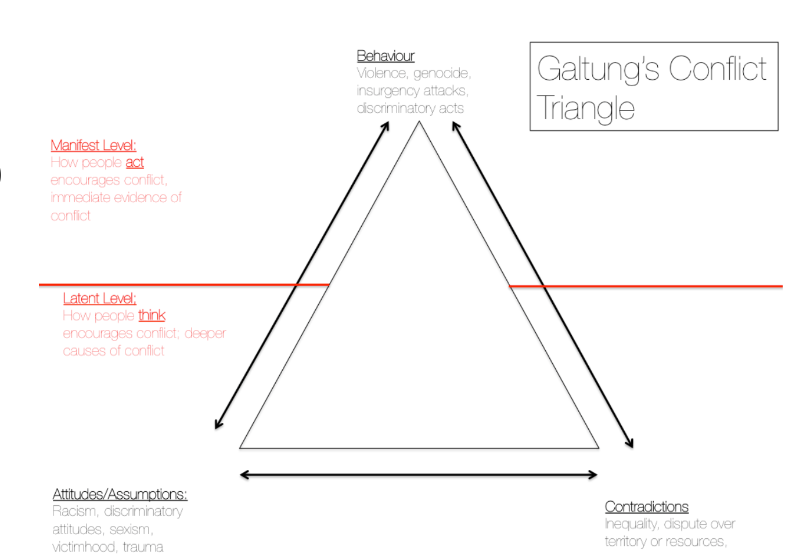
conditions that make violent conflict more likely
little to zero democratic means of dispute resolution
minorities are excluded from political representation
wealth, territory or resources are distributed unequally & controlled by powerful elites
poverty
government is above the law & makes arbitrary & illegitimate choices
judicial system is absent or interfered with - isn’t independent or just/fair
human rights are abused
conditions that make violent conflict less likely
the establishment of democratic institutions (democratic institutions exist) with full political equality & participation
equal distribution of wealth & resources
everyone has equal opportunities
government respects the rule of law
disputes can be fairly resolved through a just & independent judicial system
respect of human rights (especially of minorities)
IDEALISM
“According to idealism, humans are basically good, and it is social institutions that drive them to immoral acts”
the idealist critique is focused on the absence of morality in realism (and to a lesser extent) in liberalism
according to idealist theorists - morals & values should (and do) mold the behaviour of states & individuals
one key difference between idealism & almost all other theories - the use of the word ‘should’
this word shows that idealists focus more on what states should do, instead of what they’re already doing
Idealism & Realism
idealists are concerned by what they view as an unnecessary emphasis on power politics by realism
they argue that this ignores the underlying values that states are trying to promote
basically, they argue that states are not simply driven by power but they also act in ways that are basically value driven
are also concerned on how realism portrays military force as an acceptable way to achieve goals
for idealists, war is the last resort because it takes away human life
Idealism & Liberalism
idealists argue that its essential to perfect social institutions in order to achieve individuals experiencing external pressure by social institutions???
greater cooperation = better global peace
idealists claim that states don’t participate in IGO’s & pursue cooperation because its in their best interest to do so, or they do this for self interest (like stated in realism & liberalism) but instead that cooperation is desired because it promotes a desirable value - in this case peace - & avoids any undesirable consequences in the form of war
Values & global politics
there is disagreement within idealism as to the importance of certain values
this raises certain questions such as whether values are truly universal or are they culturally relative?
idealists also disagree on which situations call for military force to be used in defense of values
CONSTRUCTIVISM
“The physical world is much less important than the social world & that important parts of the physical world are actually build of, or ‘constructed’ by, the social world”
constructivists claim that not only do humans build - or construct - the physical world, but that the physical world is itself built - constructed by the social world.
realism is based on what realist theorists view as ‘real’ while constructivists question ‘reality’ itself
using example of a ‘state’ - states are important for realists because they view them as the sole significant actors in global politics & the pursuit of power is the main driver of the international system (state actors pursue power for their own self - interest)
however, using constructivism we are faced with the question of what a ‘state’ is - in the realist story, its a government that exercises sovereign authority over a defined territory
but then constructivism may bring up the question of what is a government & a sovereign authority?
we can see the concept of government varies from society to society
if we go deeper, we may ask “what are the objective interests that states pursue, according to realists?”
this is important because it supports the argue by constructivists that we need to understand how a certain state “conceives of itself & its interests”
also is important to what the shared understanding of ‘state’ & ‘sovereignty’ is in the global system as this is what provides the foundation behind a states’ actions
basically arguing that concepts like sovereignty are not something external to the global political system but hold meaning depending on the actors in the international system (but hold subjective meaning which is constructed by actors in the international system)
international norms & global politics
key strand of this theory is the claim that international system is more influence by states’ construction of that international system than by any objective conditions external to states
simple way: states co - construct the international system rather than the system being something that’s imposed on them from outside
an international norm is a shared understanding of expectations and standards related to acceptable forms of behaviour of state and non state actors in the international system
whats considered right, wrong or appropriate is a result of the ‘collective social context’ of global politics
if something is in a state’s self interest, that’s also a product of this collective social context
ex: the increase of acceptance of the right & responsibility to intervene in internal affairs of another state, in order to protect human rights
this is an international norm that’s socially constructed by state actors & now acts a constraint on & driver of states’ behaviour
POSTCOLONIALISM
“The use of ‘post’ by postcolonial scholars by no means suggests that the effects or impacts of colonial rule are now long gone. Rather, it highlights the impact that colonial and imperial histories still have in shaping a colonial way of thinking about the world and how Western forms of knowledge and power marginalise the non-Western world” - Sheila Nair
TAKEN FROM UNIT 1 DOC - refers to the study of a nation’s cultural, economic & political status, after being colonized by another nation
this helps create connections between the colonized nation (colonizer??) & the nation that got colonized
discourse - for the purposes of the IB Global Politics, this term means identifying & describing written or spoken communication
the concepts the West had about the Non - Western states & ppl being viewed as ‘other’ or different to the West & generally in a way that made the non - West appear to be inferior
these Western discourses make certain power relationships appear natural & in some cases, inevitable
the use of Western discourses on power allowed Western powers to justify their domination of other cultures & countries
a justification could have been that the West was delivering civilisation or progress to these people & places
post colonialists argue that using discourse allows a way of thinking about global politics that’s not restricted, as opposed to using an empirical approach ( i think using liberalism & realism), which is seen as restrictive
postcolonialism makes the claim that ‘in order to better understand how global class relations emerge & are maintained we must address ideas about why these ideas appear normal.’
Nair suggests that by utilizing this approach & focusing on Wester discourses of power, we can better see how characterisations of global poverty are often ‘accompanied by images & narratives of non - Western governments & societies as simultaneously primitive, hyper - masculine, aggressive, childlike & effeminate’
Characterisations of global poverty are often 'accompanied by images and narratives of non- Western governments and societies as simultaneously primitive, hyper-masculine, aggressive, childlike and effeminate'
this important because. according to postcolonialists, Western policymakers are unable to move past their biases because, as they go through the process of trying to find solutions to global inequality, poverty & other issues, their biases will be reinforced through various situations
as presented by postcolonialism, policymakers in the West are unable to address the structural issues that affect issues, like the accumulation of wealth & the ways in which the global flow of wealth & capital can generate more inequality, instead of reducing it
result (according to postcolonialists) = the ‘solutions’ will focus more on supporting the less developed state, instead of addressing the root & structural causes of inequality that led to the states’ current situation
some key features of postcolonialism
provides a more complex view of the key concepts of global politics (like sovereignty)
there’s a general acceptance in realism & liberalism, that sovereignty is understood in the Westphalian sense. but postcolonialists would point out that the concept of sovereignty, & along with it the shifts of the modern state, were imposed by Western powers onto the colonial world
the development of the concept of ‘othering’
can also be viewed in terms of racialized othering
some writers have highlighted how race impacts the way that a coloniser related to a colonised & vice versa
this can explain why some colonised ppl begin to accept (or internalise) the concept of racial inferiority through the imposition of colonisation systems, like language, education & religion
another interesting application of postcolonialism can be seen in the debate over nuclear weapons
in the US foreign policy discourse, Iran & North Korea are labelled as ‘rogue states’, who are viewed as untrustworthy regarding nuclear weapons & unpredictable & dangerous
but the USA has been the only state to utilize nuclear weapons in anger
this raises the question on who decides on who should be trusted with weapons, and why?
Marxism
An economic, social, and political theory that examines the flaws inherent in capitalism and seeks to identify an alternative. Marxist theories were influential in the development of socialism and communism. Marxism includes viewpoints such as “To each according to their needs, from each according to their abilities” and that capitalism creates inequality, poverty, and eventually revolution.