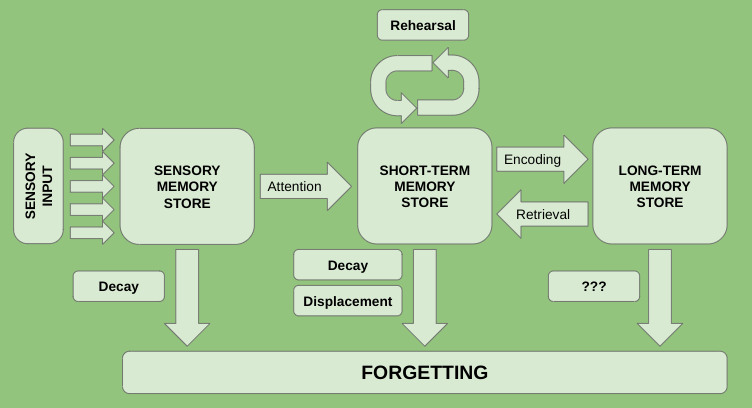
MULTI-STORE MODEL OF MEMORY: Atkinson & Shiffrin (1968)
EVALUATION:
+ Murdock’s study
shows that rehearsal can lead to encoding into LTM (primacy effect) and also points out the limited space and duration of the STM
+ one strength is there is evidence for different memory stores
Clive Wearing - his hippocampus was destroyed, meaning he could not access past memories or form new ones. LTM & STM are different as he had no STM but some LTM
- Clive Wearing had different elements of LTM
(no episodic but did have semantic and procedural) - suggests LTM is more complex than the MSM suggests#
- artificial memory tasks
nonsense syllables/word lists do not show the other ways we use our memory. we cannot know if the MSM is supported by real life examples
COMPONENTS OF THE MULTI-STORE MODEL OF MEMORY:
memory | coding | capacity | duration |
sensory | encoded through the same format it is received | limited | less than a second |
STM | encoded acoustically (generally) | 7 ± 2 items | between 20 and 30 seconds (unless rehearsed) |
LTM | encoded semantically | unlimited (as far as we know) | a lifetime (as far as we know) |