203 CH3 Job-Order Costing: Cost Flows and External Reporting
POHR = est MOH / est allocated base
est MOH = est fixed variable / est allocated base * unit variable MOH
AMOH = POHR x actual use of allo base
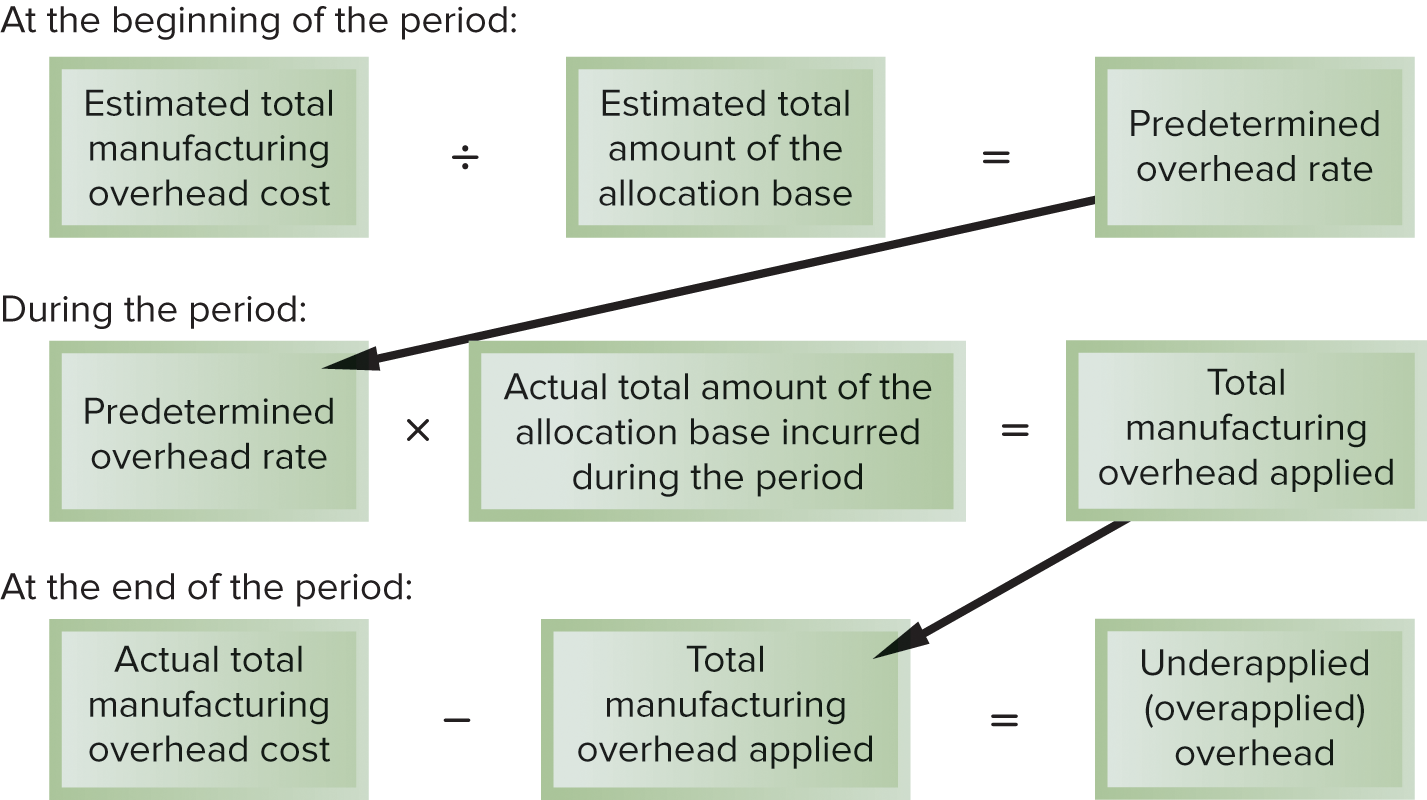
beg bal + purchase - end bal = amount used
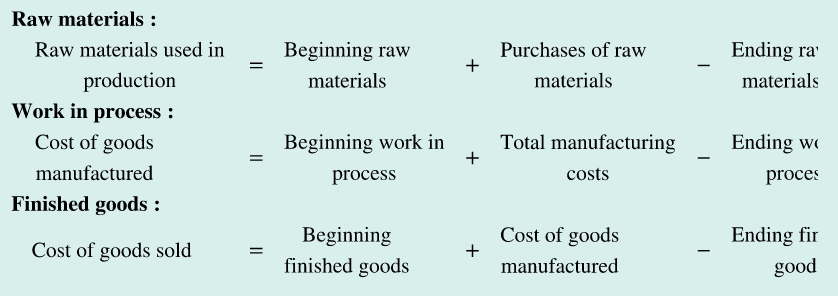
RM used → RM ; asset, dr inc
COGM → WIP
COGS → FGI
WIP
Inventories
Exercise 3-2
a. Dr RM 94k; Cr Cash 94k
b. Dr WIP 78k, Dr MOH 11k; Cr RM 89k
c. Dr WIP (DL) 112k, Dr MOH (IDL) 20k; Cr S&WP 132k
d. Dr MOH 143k; Cr Cash 143k
e. Dr WIP 152k; Cr MOH 152k
f. Dr FGI 342k; Cr WIP 342k
g. Dr COGS 342k; Cr FGI 342k
h. Dr COGS 22k; Cr MOH 22k
MOH: Dr. 174k ; Cr. 152k — Dr Bal 22k
LO
Understand the flow of costs in a JOC system and prepare appropriate journal entries to record costs
Use T-accounts to show the flow of costs in a JOC system
Prepare schedules of cost of goods manufactured and cost of goods sold and an income statement
Compute underapplied or overapplied overhead cost and prepare the journal entry to close the balance in MOH to the appropriate accounts
Vocabulary
Job-order costing : a costing system used in situations where many different products, jobs, or services are produced each period
Absorption costing : a costing method that includes all manufacturing costs—direct materials, direct labor, and both variable and fixed manufacturing overhead—in the cost of a product
Allocation base : a measure of activity such as direct labor-hours or machine-hours that is used to assign costs to cost objects
Predetermined overhead rate : a rate used to charge manufacturing overhead cost to jobs that is established in advance for each period.
Based entirely on estimate of what the level of activity and overhead costs are expected to be at beginning of year
Overhead application : the process of assigning overhead costs to specific jobs
Normal costing : a costing system in which overhead costs are applied to a job by multiplying a predetermined overhead rate by the actual amount of the allocation base incurred by the job
Job cost sheet : a form that records the direct materials, direct labor, and manufacturing overhead cost charged to a job
JOC - The Flow of Costs
Cost Flows and Classifications in a Manufacturing Company That Uses JOC
Shows that a company’s product costs flow through three inventory accounts
From 3 inventory accounts on balance sheet to COGS on income statement
Raw materials : any materials that go into the final product
WIP : when raw materials are used in production as direct materials ; consists of units of product that are only partially complete and requires further work before completed
When a job is complete, the job costs are transferred OUT of WIP
Finished goods : completed units of products that have not yet been sold to customers
Cost of Goods Manufactured (COGM) : the manufacturing costs associated with units of product that were finished during the period
COGM = beg WIP inv + total manufacturing cost - ending WIP inv
COGS = beg inv + purchases - end inv
DM used = beg raw mats + purchases - end RM
After selling something
Dr COGS, Cr Finished Goods Inventory
Dr Cash, Cr Sales
The Purchase and Issue of Materials
Purchasing Materials
Raw Materials is an asset account; when purchased, initially recorded as asset, not expense
Dr RM, Cr Cash or AP
Issue of Direct and Indirect Materials
Moving raw materials from storeroom/inventory for use in production
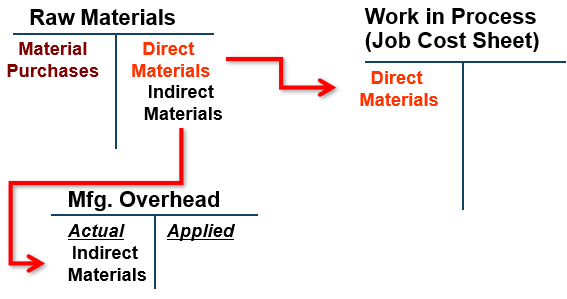
If direct materials, goes into WIP account, indirect goes into MOH account
Dr WIP and MOH, Cr RM
Raw Materials Cost Flows
Labor Cost
In flashcards
When labor costs are incurred, only direct labor costs are added directly to the WIP account
Labor costs charged to MOH represent indirect labor costs
Manufacturing Overhead Costs
Manufacturing overhead costs : manufacturing costs other than direct materials and direct labor
Costs are entered directly into the MOH account
All actual manufacturing overhead costs are debited to the MOH account as they are incurred
Examples in section
If indirect material, gets Dr’d; direct materials gets Dr’d in WIP; Raw materials gets Cr’d

Applying Manufacturing Overhead
How are MOH costs assigned to WIP?
Uses POHR (est total MOH/est total amt of allo base)
Ex : Ruger Corp. POHR = $6 per machine-hour. Assume during April, 10k machine-hours were worked on Job A and 5k machine-hours were worked on Job B (total 15k). AMOH = POHR * allo base : $6 * 15k machine hours = $90k overhead cost
The difference between overhead applied to WIP and actual overhead is the overapplied or underapplied overhead
The Concept of a Clearing Account
WIP is debited, MOH is credited
POHR is based entirely on estimates of what the level of activity and overhead costs are expected to be
Established before the year begins
As a result, overhead costs applied during a year will almost certainly turn out to be more or less than the actual overhead costs incurred.
Non-manufacturing Costs
Selling and administrative costs
should be treated as period expenses and charged directly to the income statement
Non-manufacturing costs should not go into the MOH account
Expense accounts have no effect on product costs
COGM
Transfer of costs from one inventory account to the next parallels the physical transfer of goods from one inventory to the next
Costs of completed job are transferred out of Work in Process account and into Finished Goods account
Costs of goods manufactured: sum of all amounts transferred between WIP and FG for the period
COGS
When completed jobs are shipped to customers, their accumulated costs are transferred from FG to COGS
Schedules of Cost of Goods Manufactured and COGS
Schedule of COGM
The schedule of COGM summarizes costs that remain in WIP inventory and that have been transferred from the WIP to FGI
Schedule of COGS
The schedule of COGS summarizes the portions of those costs that remain in ending FGI and that are transferred out of FGI into COGS
Income Statement
Underapplied and Overapplied Overhead - A Closer Look
Computing Underapplied and Overapplied Overhead
Underapplied : when applied cost is less than actual cost
Overapplied : when applied cost is more than actual cost
What is the cause of underapplied or overapplied overhead?
The method of applying overhead to jobs using a POHR assumes that the actual overhead costs will be proportional to the actual amount of the allocation base
Example
Allocation base is given, the POHR numbers are also given, so we can see where each number comes from
When the allocation base is dollars (due to direct materials cost), POHR is expressed as a percentage of the allocation base
When dollars are divided by dollars, the result is a percentage
Assume that because of unexpected changes in overhead spending and unit sales, the actual overhead cost incurred and the actual amount of the allocation base used during the year is lower for Turbo Crafters and higher for Black and Howell
Now we have the POHR and the actual amount of the allocation base, so we can calculate the Applied MOH
If Actual > Applied, then it is underapplied
If Actual < Applied, then it is overapplied
For Turbo Crafters, the actual overhead cost for the year ($290k) is higher than the applied overhead cost to WIP ($272k), therefore, overhead is underapplied by $18k
For Black and Howell, the actual overhead cost for the year ($130k) is less than the applied overhead cost to WIP ($135k), therefore, overhead is overapplied by $5k
Underapplied or overapplied overhead is the difference between overhead applied to WIP and actual overhead
Disposition of Underapplied and Overapplied Overhead Balance
Closing the balance in MOH to COGS
if MOH has a debit account (meaning more on debit side in T account), needs to be credited to close out the account
Closed Proportionally to WIP, FG, and COGS
Because everything was not finished all the way and so had to split costs when closing to MOH
Comparing the Two Methods for Disposing of Underapplied or Overapplied Overhead
Closing underapplied or overapplied overhead to WIP, FG, and COGS is more accurate than simple approach of closing it out to COGS
A General Model of Product Cost Flows