japan and the atomic bomb
Japan and the Atomic Bomb
On 6 August 1945, the USA dropped an atomic bomb on the Japanese city of Hiroshima. The blast devastated an area of five square miles, destroying more than 60 per cent of the city’s buildings and killing around 140,000 people. Three days later the USA dropped a second atomic bomb on the Japanese city of Nagasaki, killing around 74,000 people.
Why were the bombs dropped?
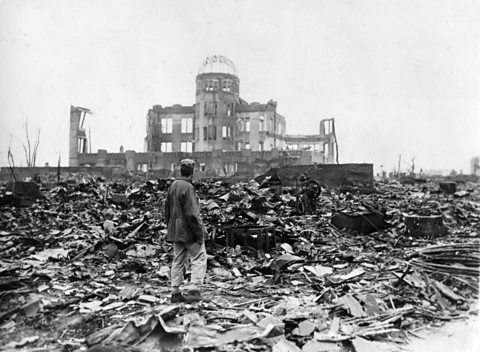
The damage caused by the atom bomb attack on Hiroshima on 6th August 1945
The official US justification for the dropping of the two atomic bombs was to force the Japanese government to surrender, which it did on 14 August 1945. Some historians have speculated that the bombs might also have had another purpose - to send a warning to the Soviet Union about the strength of the American arsenal.
Whatever the intention, the USA had changed the nature of warfare, and for the remainder of the Cold War the threat of atomic weapons and nuclear war would be a constant theme. Stalin himself remarked that future wars were inevitable and the Soviet Union now stepped up its own programme of atomic research. American 'nuclear hegemony' would not last long.
The Manhattan Project, the USA’s secret project to develop the atomic bomb, had begun in 1939 based on the fear that the Germans were developing something similar – Albert Einstein had warned them of this. The USA’s top scientists worked on the Manhattan Project alongside some European and Jewish scientists.
The Manhattan Project was top-secret even within the US government: Truman didn’t know about it when he was Vice President, and only found out about it when he became President after Roosevelt’s death. When he was briefed on the project in April 1945, Truman was told that the US was the only nation which could produce a weapon so destructive it could destroy the whole world. However, the USSR was expected to catch up within four years.
The Secretary of War, Henry Stimson, advised that after VE Day the nuclear bomb could act as a deterrent against expanding Soviet influence in Eastern Europe. Truman reportedly agreed and said I’ll certainly have a hammer on those [Russians].
After the bomb was tested at the desert in Alamogordo, New Mexico on 16 July 1945 this advantage over the rest of the world was proved. Truman did not fully explain the test and its success to his allies, and it was only after the bombs had dropped on Hiroshima (6th) and Nagasaki (8th) in August 1945 that Stalin was informed on the weapon’s existence by Truman. However, as early as 1943, two spies for the USSR, Klaus Fuchs and Rudolf Peierls, had started working for the Manhattan Project and sending information back to the USSR. Though how helpful the information they passed on is debated by many, it certainly did not help in terms of the strength and honesty of the East – West relationship.